

High Pressure Homogenizer Cost: Pricing and Buying Tips
A homogenizer quotation can look competitive and still be the expensive choice once production starts. The risk is greatest when buyers compare a machine name and purchase price without fixing the required flow, pressure, number of passes, product properties, temperature limit, cleaning method, and acceptance criteria. Two offers may therefore describe materially different duties: one may include a complete feed, cooling, control, and commissioning scope, while the other covers only the pressure-generating unit. The gap later appears as integration work, repeated trials, excessive wear, slow cleaning, or unplanned downtime. This guide shows how to define the buying boundary, normalize supplier quotations, and compare capital cost with utilities, wear parts, validation, service, and lost production—without pretending that one public price can represent every process.
The short answer is that high-pressure homogenizer pricing should be compared only after every bidder confirms the same verified duty point and supply boundary. Pressure alone is not enough; the decision must also cover net throughput at the target result, feed conditions, pass count, allowable product temperature, utilities, materials, controls, cleaning, documentation, and acceptance testing. For pharmaceutical work, the intended use may also bring equipment design, cleaning, recordkeeping, and control expectations into scope. A buyer should first freeze an RFQ data sheet, then compare compliant base scope, lifecycle consumption, and risk allowances. Any savings shown before those conditions are aligned are provisional rather than bankable.
Define pressure, flow, and pass count before comparing prices
The duty point is the combination of feed and output conditions the equipment must achieve. It should state the formulation or representative test fluid, solids or droplet characteristics, viscosity range, inlet temperature, required outlet limit, target pressure range, minimum net throughput, number of passes, and the measurement used to judge the result. A quote based on water flow or a single nominal pressure can be useful for preliminary screening, but it does not establish performance on a shear-sensitive, abrasive, viscous, or temperature-limited product.
The acceptance method matters just as much as the target. ISO 13320:2020 describes laser diffraction methods for particle-size analysis, including matters that influence measurement quality.[1] It is a test-method standard, not a certification that a homogenizer will meet a specific formulation target. The RFQ should identify sample preparation, instrument settings, reporting basis, replicate handling, and the point in the process where samples are taken; otherwise, supplier and buyer may report different results from the same batch.
Throughput should mean saleable or acceptable output, not merely pump displacement. Pass count, recirculation, cleaning, warm-up, product recovery, sampling, and changeovers reduce net capacity. For an illustrative calculation, a plant requiring 400,000 liters per year over 400 scheduled operating hours needs 1,000 L/h of net acceptable output. If the planning allowance for availability and routine losses is 80%, the screening capacity becomes 1,250 L/h. These figures are illustrative only; the buyer must replace them with actual production calendars, yield, availability, and validated pass requirements.
Separate equipment scope from operating and ownership costs
Read the capital scope line by line
High pressure homogenizer cost may include only the core unit, or it may extend to feed equipment, heat exchange, recirculation, electrical cabinets, instrumentation, guarding, piping, installation supervision, training, and qualification documents. Shipping terms, taxes, local electrical adaptation, site utilities, and lifting requirements can also sit outside the quoted number. A useful high pressure homogenizer diagram is therefore not decorative: a process-flow or piping-and-instrumentation drawing can show battery limits, flow paths, instruments, drains, cooling connections, and which party owns each interface. Every unmarked interface is a potential change order.
Match wear, cooling, and output to the product
Operating pressure, abrasive solids, feed consistency, valve geometry, seals, and the number of passes affect wear-part consumption. Temperature-sensitive products may require pre-cooling, interstage cooling, or a lower-energy process route. A higher nominal flow is not necessarily more economical if the target result requires repeated passes or if heat generation forces long pauses. Bidders should report the conditions behind any claimed capacity and separate demonstrated results from estimates.
Utilities should be requested at the proposed duty point: electrical load and expected consumption, cooling-water flow and temperature, compressed air where applicable, and cleaning-media requirements. A lifecycle model can then use the plant’s real tariffs rather than generic assumptions. The same principle applies to labor. Automated recipes, data capture, and cleaning sequences may reduce intervention, but their value depends on the site’s batch pattern, quality system, and staffing—not on the presence of an automation label alone.
Treat cleaning and changeover as production time
The buyer should define whether cleaning is manual, clean-in-place, or a hybrid; which fluids are used; what disassembly is expected; where product can remain trapped; and how cleanliness will be verified. A fast production cycle can be undermined by a long changeover or difficult product recovery. In an illustrative scenario, three additional one-hour changeovers per week across 50 weeks remove 150 production hours annually. Multiplying those hours by the site’s actual contribution margin and labor burden reveals a hidden cost that should be compared with the purchase-price difference.
Normalize supplier quotations before comparing total cost
A normalized comparison separates included scope, exclusions, assumptions, recurring consumption, and evidence. It prevents a low base price from winning simply because another bidder included cooling, commissioning, spares, or documentation. The following table is a decision worksheet, not a supplier ranking or a price claim.
| Comparison line | What to normalize | Evidence to request | TCO consequence |
|---|---|---|---|
| Core equipment | Pressure range, net flow at duty, pass arrangement, wetted materials | Data sheet, test conditions, scope drawing | Determines whether output and quality targets are comparable |
| Integration | Feed, cooling, piping, controls, guarding, electrical adaptation | Interface list and responsibility matrix | Exposes site work and change-order risk |
| Consumables and spares | Wear parts, seals, recommended stock, service intervals | Priced bill of materials and lead times | Shows recurring spend and inventory exposure |
| Cleaning and changeover | Time, labor, cleaning media, product loss, verification | Proposed procedure and hold-up information | Affects capacity, yield, and labor |
| FAT, SAT, and commissioning | Protocols, test materials, travel, training, retest rules | Draft protocols and acceptance responsibilities | Controls validation delay and start-up risk |
| Service and downtime | Response path, remote support, technician access, critical-part lead time | Service terms and escalation contacts | Converts repair uncertainty into a business-risk allowance |
A practical TCO model adds acquisition, integration, utilities, consumables, preventive maintenance, service labor, cleaning, validation, inventory carrying cost, and expected downtime over the chosen evaluation period. Any resale value or remaining asset value should use the buyer’s accounting policy. Keep the inputs visible, use ranges for uncertain variables, and run sensitivity checks for wear rate, production demand, and downtime; a single total without assumptions creates false precision.
Make every supplier answer the same RFQ questions
Before contacting high pressure homogenizer companies, procurement and engineering should agree on which requirements are mandatory, which are preferred, and which remain to be established by trials. This prevents suppliers from optimizing toward different interpretations. It also makes a non-compliant offer visible before commercial negotiation begins.
| RFQ field | Buyer input | Supplier response required |
|---|---|---|
| Product and feed | Composition, concentration, viscosity range, solids, inlet temperature, hazards | Compatibility assumptions and preconditioning needs |
| Required result | Particle or droplet metric, stability or cell-disruption objective, sampling point, method | Expected result, pass count, evidence status, test proposal |
| Production duty | Batch size, annual volume, shifts, required net throughput, campaign length | Capacity at stated conditions and operational assumptions |
| Temperature and utilities | Outlet limit, available cooling, power, water, air, room conditions | Heat-removal concept and utility demand at duty |
| Cleaning and materials | Cleaning method, chemistry, allergen or cross-contamination controls, surface requirements | Wetted-material list, cleaning sequence, disassembly and verification needs |
| Acceptance and documents | FAT/SAT tests, records, drawings, manuals, training, destination requirements | Included deliverables, exclusions, schedule, retest process |
The commercial comparison should record when information was checked, which documents were used, and where a claim remains unverified. There is no commercial relationship implied between the buyer and any supplier mentioned in the worksheet. For a broader pricing comparison in a specific food application, the dairy homogenizer buyer and selection guide provides a related decision framework.
Select the supplier against the required process result
The strongest supplier is not automatically the company with the largest model, lowest quote, or longest feature list. It is the one that identifies the process boundary, documents assumptions, explains what has and has not been tested, and offers an acceptance route that the buyer can audit. Procurement should evaluate five questions:
- Can the supplier map the proposed configuration to the stated feed, result, net throughput, temperature, and pass requirements?
- Are wetted materials, cleanability, controls, utilities, and site interfaces documented rather than implied?
- Does the offer distinguish standard scope, options, buyer-supplied items, and post-order engineering?
- Are wear parts, service intervals, lead times, and escalation paths explicit enough to build a lifecycle spare-parts plan?
- Do FAT, SAT, commissioning, training, and any application trial have named protocols, responsibilities, and acceptance limits?
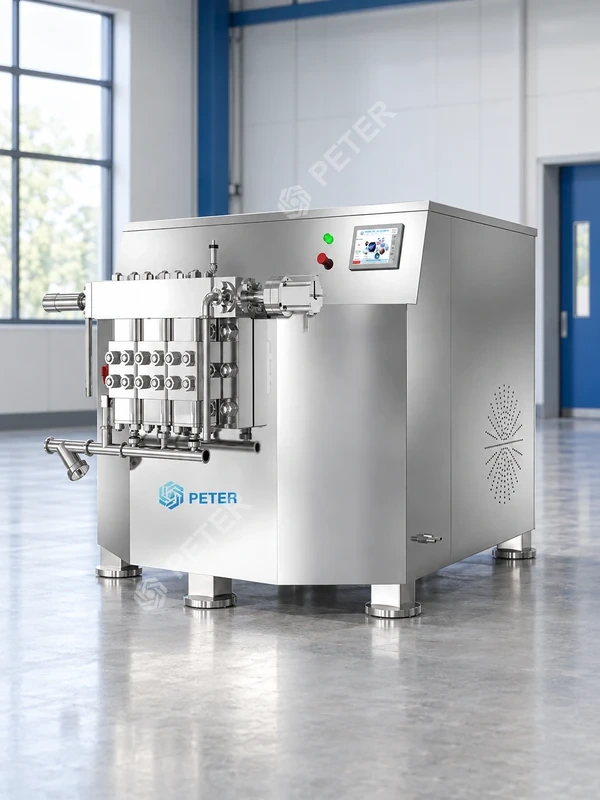
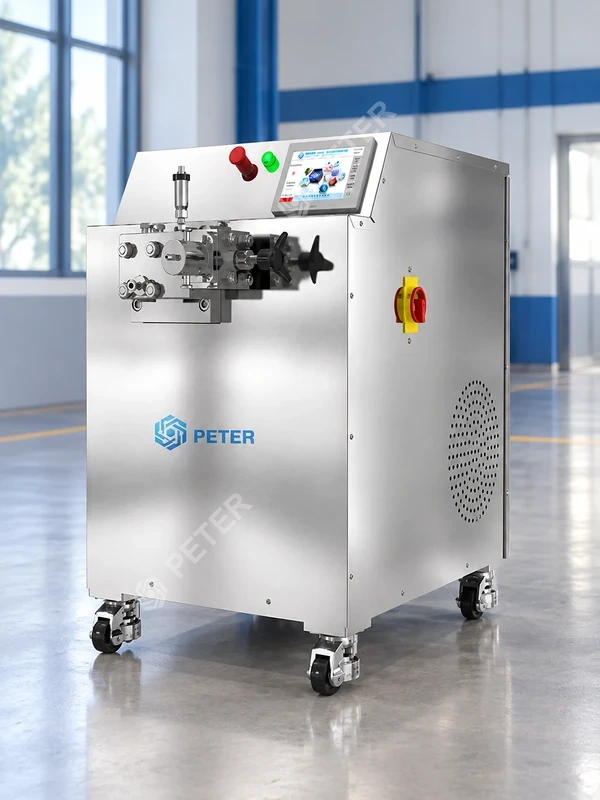
CAS PETER offers experimental and production-type high-pressure homogenizer and microfluidizer options. Buyers can use the PT-500 production high-pressure homogenizer and high pressure homogenizer for sale configuration represented by the PT-1000 as starting points for a documented inquiry, but the appropriate model and configuration still require application review and confirmation. A product page is not a substitute for an approved duty-point data sheet.
Include validation, controls, and downtime in the budget
For pharmaceutical manufacturing in the United States, 21 CFR 211.63 requires equipment used in manufacturing, processing, packing, or holding a drug product to be appropriately designed, adequately sized, and suitably located for its intended use and for cleaning and maintenance.[3] Section 211.67 addresses equipment cleaning and maintenance, including written procedures and records.[4] Section 211.68 covers automatic, mechanical, and electronic equipment, including routine checks and controls appropriate to the system.[5] These provisions do not certify a homogenizer, and their applicability depends on the product, process, destination market, and regulated role.
ICH Q8(R2) frames pharmaceutical development around product and process understanding, including critical quality attributes, critical process parameters, risk assessment, and the possible use of a design space.[2] For a homogenization step, that logic supports linking pressure, passes, flow, temperature, and feed variation to the quality result rather than accepting an isolated nameplate value. It also explains why documentation, change control, and reproducible measurement can add legitimate cost.
Hidden validation cost appears when protocols, calibrated instruments, material records, control descriptions, audit trails, or test samples were not included in the original scope. Hidden downtime cost appears when a critical seal or valve component has an uncertain lead time, or when only one trained person can perform service. The lifecycle spare-parts plan should classify parts by failure consequence and lead time, define minimum stock, specify storage and shelf-life controls where relevant, and assign a review interval based on actual wear history after start-up.
Buying questions to resolve before requesting a final quote
How much does a high-pressure homogenizer cost?
There is no reliable universal price because a quotation depends on the verified duty point and supply boundary. Buyers should ask for a project-specific offer that fixes the feed, pressure, net throughput, pass count, temperature limit, wetted materials, controls, cleaning method, utilities, documentation, commissioning, and acceptance test.
What affects the price of a high-pressure homogenizer?
Major cost drivers include pressure and net capacity at the real process conditions, valve and wetted-part configuration, materials, cooling, automation, hygienic or validation requirements, feed and recirculation equipment, factory and site testing, training, spares, and local installation work. A lower base price may simply exclude items that another bidder includes.
How do new and used high-pressure homogenizers compare?
New equipment is usually easier to specify around the intended process, documentation, controls, service, and acceptance plan. Used equipment may reduce the initial purchase cost, but the buyer must verify wear condition, parts availability, control-system support, material records, cleanability, pressure-boundary integrity, prior service, and whether the unit can demonstrate the required duty point.
How should buyers assess high pressure homogenizer cost before choosing a high-pressure homogenizer?
Normalize every offer against the same requirement sheet, separate included scope from exclusions, and compare total ownership cost rather than the invoice alone. The review should include utilities, wear parts, cleaning time, validation effort, product loss, maintenance labor, critical-spares lead time, and the financial consequence of downtime, with uncertain assumptions shown as ranges.
Sources for particle-size testing and equipment compliance
- ISO 13320:2020, Particle size analysis — Laser diffraction methods. ISO catalogue entry.
- ICH Q8(R2), Pharmaceutical Development. International Council for Harmonisation guideline, Step 4 version, August 2009.
- 21 CFR 211.63, Equipment design, size, and location. Electronic Code of Federal Regulations.
- 21 CFR 211.67, Equipment cleaning and maintenance. Electronic Code of Federal Regulations.
- 21 CFR 211.68, Automatic, mechanical, and electronic equipment. Electronic Code of Federal Regulations.
Compare the verified duty point, not just the purchase price
A sound buying decision begins by separating nominal equipment price from the cost of delivering a repeatable, measurable process result. First define the feed, target, method, throughput, passes, temperature, cleaning, and regulatory boundary; then normalize included scope, utilities, wear parts, FAT/SAT, commissioning, service, and downtime. Finally, test the variables that could overturn the business case. The step that must not be skipped is written acceptance at the real duty point—especially when a test method, validation package, or destination-market requirement controls release. CAS PETER’s high-pressure homogenizer product range can support the initial configuration discussion; buyers should share a completed RFQ checklist and request documented assumptions before asking for a final quotation.