

High Pressure Homogenizer Working Principle: Practical Guide
A process team can reach the specified gauge pressure and still miss its particle-size, emulsion-stability or cell-disruption target. The usual mistake is to treat the pressure reading as the process rather than one boundary condition. Feed temperature and viscosity affect pump filling; gas can destabilize delivery; interaction-zone geometry controls the local pressure drop; repeated exposures add heat and wear; and the analytical method can make two apparently similar samples look different. That distinction matters before a scale-up decision, because buying more pressure cannot correct an undefined pass, an unstable inlet or a non-reproducible measurement. This guide explains where pressure is generated and dissipated, how shear, turbulence, impact and cavitation can overlap, and which trial records convert the working principle into a defensible equipment specification.
The short answer is that a positive-displacement pump raises the feed pressure, then a restrictive valve or interaction zone converts much of that pressure into rapid acceleration, velocity gradients and energy dissipation before the stream returns toward downstream pressure. The result is not attributable to one universal mechanism: geometry, feed properties, flow, pressure differential, temperature and exposure history determine the balance. One megapascal equals 10 bar, but equal gauge readings do not guarantee equal product results. Buyers should therefore define the inlet condition, a physical pass, the allowable temperature window and an endpoint measured by a named method before comparing machines.
What the pressure reading tells you and what it does not
The pump and the interaction zone perform different jobs. A reciprocating or intensifier-type pumping system displaces liquid and develops pressure against downstream resistance. Check valves, seals, pressure-control components and the feed supply must support stable filling. The interaction zone then imposes a narrow, geometry-specific restriction. Local velocity rises as the liquid enters that restriction, static pressure changes, and energy is dissipated through the downstream expansion and flow field. A gauge records pressure at one location; it does not describe every local stress or guarantee that every fluid element receives the same history.
This separation is central to the high pressure homogenizer working principle. If the inlet starves, contains compressible gas or varies in viscosity, pump delivery can pulse even when the setpoint appears correct. If a valve or interaction component wears, the relationship among valve position, flow and pressure can drift. If the downstream restriction differs between designs, the same nominal pressure can create a different velocity field. Pressure is therefore a controlled input to a defined configuration, not a portable performance claim.
The comparison below reflects the mechanisms described in a peer-reviewed review of high- and ultra-high-pressure homogenization, which identifies sudden pressure drop, torsion and shear, turbulence, impingement, cavitation phenomena, shock waves and temperature rise as interacting effects. It should not be read as a claim that every mechanism is equally important in every machine or formulation (Frontiers in Microbiology, 2016).
| Mechanism or variable | What changes it | What the trial should observe | Interpretation boundary |
|---|---|---|---|
| Shear and velocity gradients | Restriction geometry, flow, viscosity and wall proximity | Endpoint change at controlled feed and temperature | A gauge reading alone cannot quantify local shear |
| Turbulence | Geometry, velocity, density and viscosity | Distribution change, pressure stability and flow | Its contribution is formulation- and scale-dependent |
| Impact or impingement | Jet path and interaction-zone architecture | Result under the supplied geometry | Do not assume an impact path not documented by the supplier |
| Cavitation-related effects | Local pressure, vapor pressure, temperature and downstream condition | Noise, stability, temperature and endpoint trends | Presence or dominance cannot be inferred from set pressure alone |
| Decompression and heat | Pressure drop, flow, efficiency, cooling and pass count | Inlet, immediate outlet and cooled temperatures | A final cooled value can hide a damaging peak |
Check inlet conditions before changing the pressure setting
A reproducible run begins with a feed specification, not the start button. Record formulation, concentration, viscosity at the relevant temperature, largest credible particle or agglomerate, gas-control method, premixing history and hold time. Confirm chemical compatibility and allowable feed limits against the actual wetted configuration. A screening step may protect a narrow passage, but the acceptable opening and any effect on the formulation must be established rather than assumed.
Gas is especially disruptive because it is compressible. Vortexing, foaming, suction leaks or inadequate inlet head can reduce volumetric filling and create pressure ripple. The corrective action is to inspect the feed route and stabilize the inlet—not automatically to increase the setpoint. A quiet feed vessel, suitable deaeration, controlled agitation and a documented level can improve comparability, although the chosen method must not alter a sensitive formulation.
Temperature belongs in the inlet specification because it affects viscosity, vapor pressure and material sensitivity. Record feed-vessel temperature, machine-inlet temperature, immediate post-interaction temperature and cooler-outlet temperature. Also record the time between passes. A single temperature after cooling cannot reveal the maximum exposure or explain why later passes behaved differently from the first.
Separate physical passes from batch-volume equivalents
One physical pass means a defined quantity crosses the interaction zone once. In discrete multi-pass work, the once-processed material is collected separately before it becomes the feed for the next pass. That definition is easy to audit. In a recirculating vessel, however, some fluid elements can return repeatedly while others have not yet returned. Dividing cumulative processed volume by vessel volume gives batch-volume equivalents (BVE), an average turnover measure—not proof that every element received that exact number of exposures.
The distinction affects both scale-up and heat history. A laboratory result reported as “three passes” cannot be transferred to a plant as three vessel turnovers unless the flow path and residence-time distribution justify the equivalence. Record whether the route is single-pass, discrete multi-pass or recirculating; include batch volume, measured flow, return location, vessel mixing and sampling time. The related benchtop-to-pilot scale guide provides additional context for separating formulation screening from sustained-duty evidence.
More exposure is not automatically better. If the measured endpoint plateaus within analytical variability, another pass may add only temperature rise, energy consumption and wear cycles. Conversely, an apparent plateau can be caused by inconsistent sampling or a measurement limit. A sensible study therefore changes one planned factor at a time where practical, includes replicates appropriate to the decision, and stops on a pre-defined endpoint rather than the most impressive pressure number.
Use the same particle-size method when comparing results
Particle-size measurement must match the system being measured. ISO 13320:2020 covers laser diffraction methods, while ISO 22412:2017 covers dynamic light scattering. These standards are test-method references, not product certifications and not evidence that a homogenizer will achieve a particular size. The report should name the method, instrument and optical assumptions where relevant, sample preparation and dilution, replicate approach, elapsed time after processing, and the reported statistic or distribution.
Laser diffraction can be appropriate for broad particle or droplet distributions within its method scope; dynamic light scattering is highly sensitive to scattering intensity and requires careful interpretation for polydisperse material. A D90 value and a Z-average are not interchangeable descriptions. Teams should also retain the unprocessed baseline and a process blank where relevant, because sampling, dilution or handling can change the apparent distribution independently of the interaction zone.
For pharmaceutical development, ICH Q8(R2) frames pharmaceutical development around understanding how material attributes and process parameters relate to critical quality attributes. It does not prescribe a homogenizer setting or certify equipment. Its practical lesson is broader: define the quality target, identify plausible variables, study their relationships, and justify a working range with evidence.
Record trials so you can diagnose drift and confirm acceptance
The high pressure homogenizer principle becomes commercially useful only when the trial links input conditions to an accepted output. The following checklist is designed for R&D, procurement and maintenance to share. It prevents a technically promising sample from becoming an unrepeatable purchase specification.
| Record or test | Minimum evidence | Diagnostic or buying use |
|---|---|---|
| Feed and inlet | Composition, concentration, viscosity basis, temperature, gas control, premix and hold time | Separates inlet instability from interaction-zone performance |
| Pressure and flow | Measurement locations, calibrated instruments, trend stability and actual flow | Reveals pulsation, restriction change and throughput reality |
| Exposure | Physical passes or BVE, route, vessel mixing and sample time | Prevents false pass-to-turnover equivalence |
| Temperature history | Inlet, immediate outlet, cooled outlet, coolant and inter-pass hold | Sizes cooling and protects a heat-sensitive endpoint |
| Quality measurement | Named method, preparation, replicate rule, sample age and acceptance limit | Makes results comparable and auditable |
| Energy and TCO | Measured power where available, cooling, labor, cleaning, yield loss and downtime assumptions | Converts purchase price into cost per accepted batch |
| Wear and repair | Inspection criteria, baseline parts, service intervals, critical spares and lead times | Distinguishes planned maintenance from unexplained performance drift |
| Acceptance test | Agreed feed, duty point, run duration, sampling plan and pass/fail rules | Connects factory or site testing to the intended process |
Installed cost includes more than the machine. Hydraulic power is approximately pressure differential multiplied by volumetric flow before efficiency losses; it is useful for utility planning, but it does not predict particle size. Add cooling demand, operator time, cleaning, consumables, planned wear parts, critical spares, rejected batches and downtime. A realistic high pressure homogenizer price comparison therefore uses the same accepted throughput and product endpoint, not maximum pressure and maximum flow quoted separately.
Turn the working principle into measurable purchase requirements
Start with an application brief that states the feed envelope, required throughput, batch route, target attribute, analytical method, temperature ceiling and cleaning expectation. Then request a trial matrix with agreed sample handling. Compare the result at the intended duty point, and require the proposal to identify utilities, wetted materials, wear parts, service access, documentation and the conditions under which the performance evidence was generated.
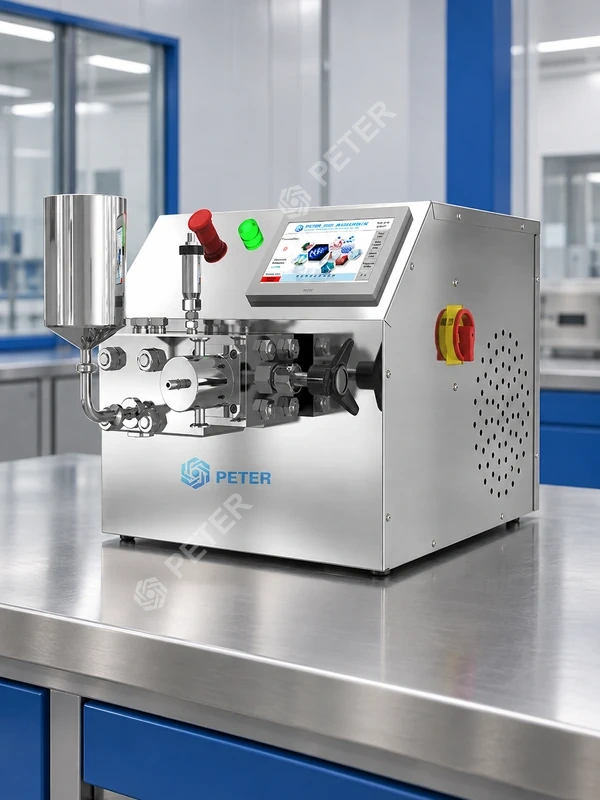
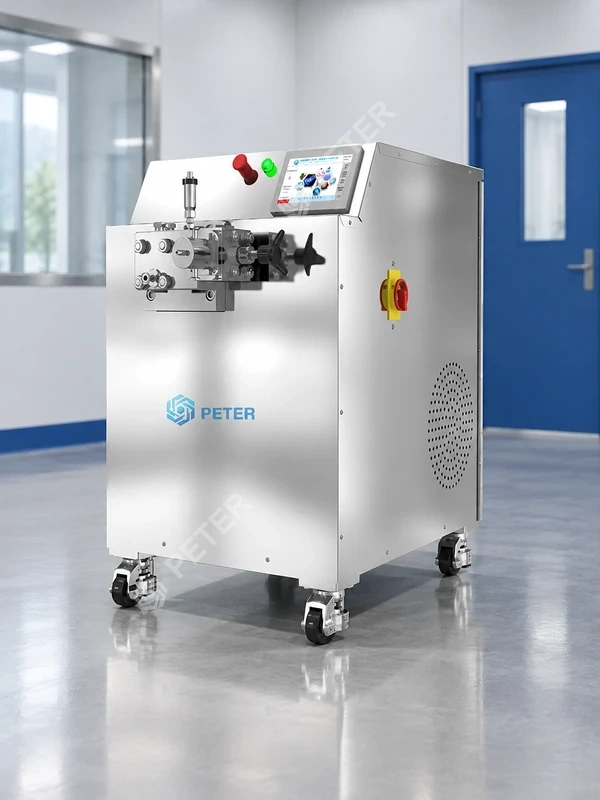
For early formulation work, CAS PETER’s experimental high-pressure homogenizer page can be used to frame supplier questions; buyers should verify every rating and configuration for the quotation they receive. For a larger development step, the pilot-scale high-pressure homogenizer page provides a separate starting point. Neither page substitutes for a representative trial or an agreed acceptance protocol.
Maintenance evidence should include the wear surfaces relevant to the supplied geometry, inspection criteria, safe disassembly requirements, expected service skills, spares availability and lead times. A list of high pressure homogenizer repair companies is not enough unless each provider is authorized or demonstrably competent for the exact pressure-containing assembly, controls and parts. Ask how baseline pressure, flow, leakage and product results will be restored and documented after service.
Where U.S. drug current good manufacturing practice applies, 21 CFR 211.110 requires written procedures for in-process controls and tests designed to monitor output and validate performance of manufacturing processes that may cause variability in drug-product characteristics. Applicability depends on the product and market. The regulation does not certify a homogenizer; it strengthens the case for pre-defined controls, traceable records and scientifically justified acceptance criteria.
Frequently asked buying questions
How much does a homogenizer machine cost?
There is no defensible universal figure without pressure, flow, materials, controls, cooling, cleaning and documentation requirements. Compare quotations at the same accepted duty point, then add installation, utilities, wear parts, labor and downtime to estimate total cost.
What affects the price of a homogenizer machine?
Major drivers include pressure-containing design, interaction-zone configuration, throughput, wetted materials, automation, cooling, hygienic requirements, documentation, testing and service scope. The lowest capital quote can be more expensive if it needs extra passes, creates longer cleaning stops or lacks critical spare support.
How do new and used homogenizer machines compare?
A new machine usually offers clearer configuration control, documentation and supplier acceptance options, while a used machine may reduce initial capital. Used-equipment buyers should verify pressure-boundary history, wear, control obsolescence, parts availability, cleaning status and performance with a representative feed before valuing the saving.
How should buyers assess high pressure homogenizer principle before choosing a homogenizer machine?
Buyers should map pressure generation, inlet stability, interaction geometry, decompression, cooling and exposure count to a measurable product endpoint. The high pressure homogenizer principle is credible for selection only when a controlled trial records those variables and repeats the result with the intended analytical method.
References
- Frontiers in Microbiology (2016), “Applications of High and Ultra High Pressure Homogenization for Food Safety.”
- ISO 13320:2020, Particle size analysis—Laser diffraction methods.
- ISO 22412:2017, Particle size analysis—Dynamic light scattering.
- ICH Q8(R2), Pharmaceutical Development.
- U.S. eCFR, 21 CFR 211.110, Sampling and testing of in-process materials and drug products.
Conclusion
The sound decision rule is to treat pressure as one controlled input, not as a substitute for process understanding. First define the feed and inlet window; next specify geometry, flow, physical passes or BVE, cooling and sampling; then judge the result with a suitable, documented analytical method. Do not skip representative acceptance testing or assume that an ISO particle-size method certifies the equipment. Energy, wear, service evidence and downtime should be evaluated at the same accepted throughput to expose the true ownership cost. CAS PETER supplies experimental and production-type high-pressure homogenizers and high-pressure microfluidizers; buyers can review CAS PETER’s full product range and submit their feed description, target quality attribute and duty point for a configuration discussion.