

Benchtop High Pressure Homogenizer: Pilot-Scale Guide
When Maya—an illustrative R&D engineer in Boston—encountered rapid creaming in a pilot emulsion, she increased pressure and ran another pass. The fresh sample looked smoother, yet its outlet temperature climbed and the next-day particle-size result drifted again. The reversal came when her team stopped blaming the machine: their bench and pilot trials used different inlet temperatures, pass definitions, and sampling points. The failure was a process-design problem, not simply a bad homogenizer.
Summary: Treat pressure, number of passes, inlet and outlet temperature, feed condition, flow, and sampling time as one controlled process window. A three-pass trial means three full batch-volume equivalents through the valve, not merely three readings. ICH Q8(R2) distinguishes critical process parameters from critical quality attributes; establish that relationship with a small, documented design-of-experiments plan before choosing capacity. The practical recommendation is to select equipment only after the acceptable quality window and total processed volume are known.
A benchtop high-pressure homogenizer forces a pumpable feed through a restricted homogenizing zone. The resulting velocity change, shear, turbulence, impact, and pressure drop can reduce droplets, disperse agglomerates, or disrupt cells, depending on formulation and valve design. It is not interchangeable with a rotor-stator mixer: the latter is often useful for premixing, while high-pressure processing is typically the controlled finishing step. For pilot transfer, the useful question is not “What is the maximum pressure?” but “Which operating history produces an acceptable, repeatable product?”
A transferable scale-up plan begins with measurable product targets
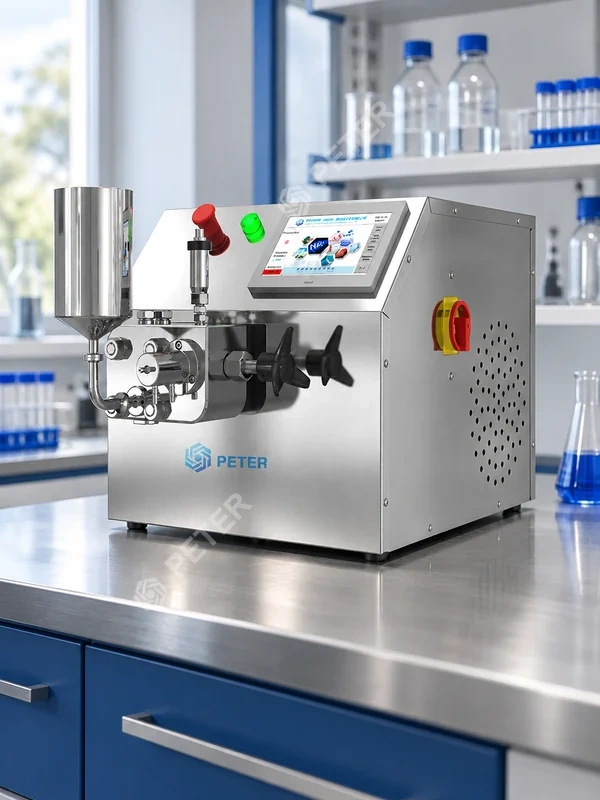
Define the output before specifying benchtop high pressure homogenizing machines. A defensible development brief names the material attribute to control—such as D10/D50/D90 by laser diffraction, z-average and polydispersity index by dynamic light scattering, viscosity at a stated temperature and spindle condition, cell-disruption yield, or short-term physical stability. ISO 13320:2020 describes laser-diffraction particle-size analysis, while ISO 22412:2017 covers dynamic light scattering; neither method is a certification of the homogenizer, and the two results are not automatically interchangeable.
Build the process map from feed to sample. Record premix method, solids or oil fraction, pH, viscosity, maximum incoming particle or agglomerate size, inlet temperature, set and observed pressure, interaction-zone or valve class, observed flow, pass definition, cooling condition and duty, outlet temperature, startup and hold-up loss, hold time, and sampling location. ICH Q8(R2) frames development around linking material attributes and process parameters to product quality. That logic matters because two runs at the same pressure can differ when the feed, valve geometry, flow, temperature, or sample history changes.
Temperature deserves its own limit. An idealized 100 MPa pressure-energy term is 100 kJ per kilogram; if all of that energy appeared as sensible heat in water, the calculated rise would be about 24°C using a heat capacity of 4.18 kJ/kg·K. A real system loses and removes heat, so this is a conservative calculation rather than a predicted outlet temperature. Specify an outlet ceiling based on product stability, then size the heat exchanger and feed temperature around measured data.
A transferable process package must record what created the result
The handoff package should contain the formulation or feed identifier and lot, premix procedure, feed solids or oil fraction, pH, viscosity with measurement conditions, incoming size or morphology, interaction-zone or valve class, pressure setpoint and observed range, working flow, pass definition, batch-volume equivalents, inlet and outlet temperature ranges, cooling-medium inlet and outlet conditions or measured cooling duty, sampling point and time, startup volume, system hold-up, recoverable yield, cleaning state, deviations, and the matched analytical method with instrument settings and sample preparation. Add the acceptance criteria for each critical quality attribute and the raw run record. This is the minimum context needed to determine whether a pilot result reproduces the bench process rather than merely its pressure setting.
A controlled run recipe makes pressure, passes, temperature, and sampling reproducible
Pressure alone is an incomplete recipe. Start every run with a defined priming volume and steady-state criterion; then collect the sample only after pressure, flow, and outlet temperature are stable. State whether flow is measured, calculated, or taken from a nominal rating, and use the same sampling point at each scale. A pressure trace without the associated flow and thermal history is not enough to reproduce the run.
Batch-volume equivalents reveal whether a multi-pass batch was treated evenly
Calculate batch-volume equivalents (BVE) as cumulative volume through the interaction zone divided by the usable batch volume. If 15 L passes through the valve from a 5 L usable batch, the operation has delivered 3 BVE; the calculation must state whether line hold-up is included in the usable volume. BVE measures total exposure, not the exposure of every fluid element. In a well-segregated three-pass method, collect all first-pass material in a dedicated receiver before starting pass two, account for drainable hold-up in the mass balance, and repeat with clearly labelled vessels and switching endpoints. This prevents untreated feed from entering the next-pass receiver and prevents already processed material from returning early.
A recirculating vessel behaves differently: untreated and repeatedly treated material mix in the loop, so 1 BVE does not prove that every fluid element received exactly one pass. For recirculation, report cumulative throughput, elapsed time, vessel mixing method, loop hold-up, starting and final mass, and the location and timing of samples. Do not convert those data into an exact discrete-pass claim unless the hydraulic distribution has been demonstrated. Keep startup flush or priming material separate unless the approved run plan explicitly returns it to the batch, because doing so changes both concentration and exposure history.
Use a small designed study instead of changing one setting indefinitely. For example, a 2×2×2 screening design for pressure level, pass count, and inlet-temperature level creates eight combinations before replicates. Measure the same quality attributes with the same sample preparation and instrument settings. ICH Q8(R2) supports systematic understanding of parameter effects; the study still needs product-specific acceptance criteria and enough replication to distinguish process variation from measurement noise.
Check the measurement system before interpreting small differences. ISO 13320 requires control of factors such as dispersion conditions and optical inputs for laser diffraction, while ISO 22412 requires appropriate handling of concentration, multiple scattering, and sample quality for DLS. Report the method, instrument settings, temperature, dilution medium, and elapsed time after processing. A tighter process cannot compensate for an unstable analytical method.
Finally, trend wear-sensitive signals. At a fixed recipe, a gradual change in flow, pressure stability, temperature rise, noise, or particle-size result can indicate fouling, valve wear, seal deterioration, or feed variation. Set an investigation threshold from baseline data rather than an arbitrary universal percentage. For regulated drug manufacturing, 21 CFR 211.110 requires written in-process controls and tests where appropriate; a research laboratory can adopt the same discipline without implying that its equipment or study is GMP certified.
High-pressure processing fits only pumpable feeds and suitable quality objectives
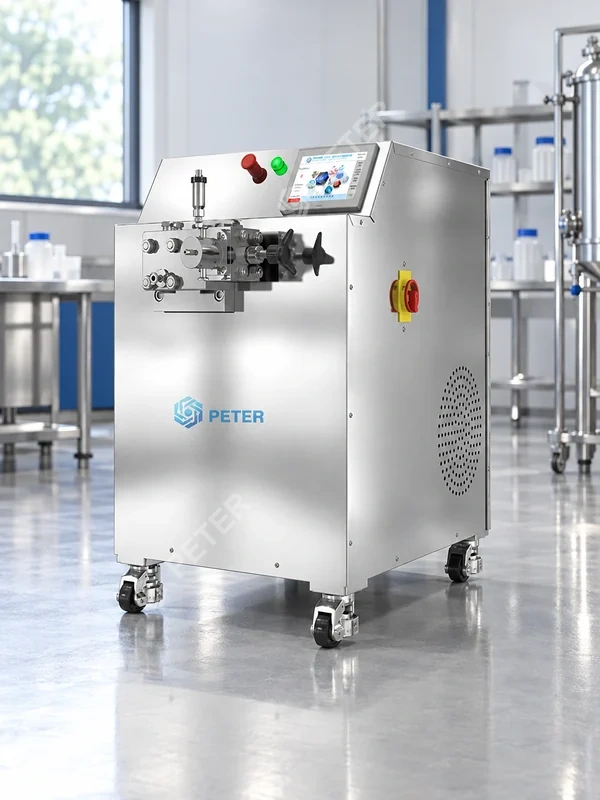
Use high-pressure processing when the target depends on repeatable droplet reduction, deagglomeration, fine dispersion, or pressure-assisted cell disruption, and when the feed can be pumped safely through the selected valve. It is especially useful when the team must translate a defined pressure-pass-temperature history into pilot work. A rotor-stator premixer may still be necessary to remove large, dry agglomerates before the high-pressure step.
Do not select it automatically for every sample. Very small batches may be consumed by line hold-up; highly viscous, abrasive, fibrous, or large-particle feeds may exceed the supplier’s inlet limits; volatile, hazardous, oxygen-sensitive, or biologically active materials may require containment and material-compatibility controls beyond a standard laboratory configuration. The decision for high-pressure benchtop homogenizers should therefore include a feed-acceptance test, cleaning review, and hazard assessment—not just a target particle size.
Scale-up is more credible when the mechanism remains comparable. Hold constant the attributes that matter to the product, such as pressure, number of discrete passes, inlet-temperature window, valve geometry class, and sampling point, then confirm quality at the larger flow. The related guide on pharmaceutical homogenizer equipment from lab to production explains why matching nominal pressure without matching residence and thermal history can fail.
Total processed volume determines capacity, schedule, and ownership cost
Rated flow is not batch completion time. Use the illustrative equation: processing hours = batch volume × full passes ÷ verified working flow. A 5 L batch at 5 L/h for three discrete passes requires 3 hours of valve processing before allowing for priming, cooling, sampling, cleaning, and changeover. If development routinely needs six conditions and duplicates, the weekly load is 36 processing hours—not a five-liter task.
Total cost of ownership includes the equipment, cooling utility, installation, electrical service, operator time, cleaning time, product loss in hold-up, seals and valve wear parts, analytical testing, preventive maintenance, and downtime. Ask suppliers to separate maximum pressure from continuous working pressure and to quote flow using a defined fluid and pressure. A water-based headline flow is not a guaranteed rate for a viscous formulation.
Capacity also affects experimental quality. An oversized machine can create unacceptable hold-up or force a large minimum batch, while an undersized unit can extend the run until the feed changes with time or temperature. The best capacity is the smallest platform that processes the planned matrix within the allowed hold time and still offers a credible path to pilot throughput.
This comparison shows where each laboratory processing method fits
| Option | Best fit | Main scale-up variable | Maintenance and TCO tendency |
|---|---|---|---|
| Rotor-stator | Premixing and coarse emulsification | Tip speed, head geometry, batch circulation, and time | Lower pressure-system burden; scale-up can be mixing-geometry sensitive |
| Ultrasonic processor | Small-volume screening and localized energy input | Amplitude, probe geometry, immersion, duty cycle, and volume | Probe wear and local heating require attention |
| Benchtop high-pressure homogenizer | Fine emulsions, dispersions, and pumpable cell suspensions | Pressure, discrete passes, valve design, flow, and temperature | Higher wear-part and cooling burden; clearer continuous-process transfer logic |
| Bead mill | Abrasive solids, pigments, and robust cell disruption | Bead size/loading, agitator speed, residence time, and cooling | Media handling, wear, and separation add operating tasks |
No row is universally superior. Compare options using the product’s acceptance criteria, representative feed, required containment, cleaning method, and intended production mechanism.
Application workload determines the specification that procurement should write
| Planning dimension | What to quantify | Procurement consequence |
|---|---|---|
| Exploratory formulation | Smallest recoverable sample, hold-up, rapid cleaning | Prioritize low loss and flexible setup over headline flow |
| Method optimization | Pressure stability, temperature window, pass definition, sampling | Require data capture and repeatable controls |
| Pilot supply | Weekly processed volume, passes, changeovers, hold time | Size from duty cycle and cleaning time, not batch volume alone |
| Regulated development | Traceability, calibrated instruments, material documents, written procedures | Evaluate documentation and validation support separately from performance |
Standards and qualification evidence support decisions without certifying the process
- ICH Q8(R2): a pharmaceutical-development guideline for understanding product attributes, process parameters, design space, and control strategy. It does not certify a homogenizer.
- 21 CFR 211.110: a US finished-pharmaceutical GMP requirement for appropriate written in-process controls and tests. Its legal applicability depends on the product and activity; early non-GMP research should not be presented as compliant manufacturing.
- ISO 13320:2020 and ISO 22412:2017: particle-characterization methods for laser diffraction and dynamic light scattering. They govern how measurements are made, not machine safety or product efficacy.
- EU Pressure Equipment Directive 2014/68/EU: applies to qualifying stationary pressure equipment and assemblies with maximum allowable pressure above 0.5 bar when placed on the EU market. Classification and conformity obligations depend on the assembly, fluid group, pressure, volume or nominal size, and supplier role.
Unsupported claims can delay qualification, misdirect a purchasing decision, or create a regulatory and contractual gap. Request the declaration, test record, material certificate, calibration scope, and manual that support each relevant claim for the destination market and intended use.
IQ, OQ, and acceptance records are site-specific evidence rather than product certification
For a regulated or tightly controlled project, define the evidence expected before the purchase order: an approved user requirement specification and traceability matrix; equipment drawings and product-contact material records where applicable; calibration certificates; factory or site acceptance protocols and results; installation qualification (IQ) and operational qualification (OQ) protocols, executed records, deviations, and approvals; and operating, cleaning, maintenance, spare-parts, and training documents. IQ can show that the delivered system was installed against the approved design and documentation, while OQ can challenge specified functions and operating ranges under an approved protocol. A supplier statement that “IQ/OQ is available” describes support or a document package—it does not certify the homogenizer, qualify the owner’s installation, or validate the product process. Acceptance criteria, execution responsibility, test instruments, deviation handling, and final approval must be agreed for the actual site and intended use.
A representative feed trial and acceptance plan should drive platform selection
- Write a one-page user requirement specification. Include feed envelope, target attributes, batch range, allowable product loss, pressure window, throughput duty, temperature ceiling, utilities, cleaning approach, and documentation needs.
- Run a representative trial. Use the actual solids level, viscosity, pH, and starting particle distribution; record steady-state flow and temperature rather than relying only on a nominal rating.
- Challenge the edges. Test the lowest and highest planned pressure, inlet temperature, and pass count, then confirm the measurement method can resolve meaningful differences.
- Review ownership costs. Obtain wear-part intervals, service access, cleaning time, hold-up, training, and spare-part details in writing.
- Resolve scale-up and documentation gaps before the purchase order. Agree on acceptance tests, deliverables, and the larger model that preserves the intended process mechanism.
CAS PETER positions its laboratory and pilot equipment across different throughput classes. For low-volume screening, review the PT-10 page for high-pressure lab and benchtop homogenizers; for a higher-throughput laboratory discussion, compare the lab scale high pressure homogenizer page. The public PT-20 and PT-40 pages currently contain conflicting summary and core-specification figures, so request a current signed datasheet before using capacity or minimum-volume values in a URS. The separate benchtop homogenizer model-selection guide can help frame the initial comparison.
These answers clarify how laboratory homogenizers fit the development process
What is a laboratory homogenizer used for?
A laboratory homogenizer is used to create a more uniform dispersion, reduce droplet or particle size, deagglomerate solids, or disrupt cells for analysis and formulation development. The appropriate mechanism depends on the feed and target; “homogeneous” appearance alone does not prove particle-size or stability performance.
How does a laboratory homogenizer work?
It applies mechanical energy through a rotor-stator head, ultrasonic probe, bead field, or high-pressure valve. In a high-pressure unit, a pump drives a pumpable feed through a restricted zone where rapid flow and pressure changes generate disruptive stresses; pressure, passes, temperature, and valve geometry must be recorded together.
What role does high-pressure benchtop homogenizers play in a laboratory homogenizer system?
They provide a controlled finishing step after feed preparation, allowing researchers to study how pressure, pass count, and thermal history affect product quality. They also create a process history that can be compared with pilot equipment, provided the valve design, flow regime, cooling, and sampling plan remain relevant.
Which process limits should you check for a laboratory homogenizer?
Check allowable feed particle size, viscosity and solids envelope, chemical compatibility, minimum recoverable volume, continuous working pressure, verified flow at that pressure, inlet and outlet temperatures, cooling capacity, and cleaning limits. Also define product-specific limits for hold time, number of passes, particle-size result, viscosity, or biological activity before the run.
Authoritative references support the transfer and measurement approach
- International Council for Harmonisation, Q8(R2) Pharmaceutical Development.
- Electronic Code of Federal Regulations, 21 CFR 211.110.
- ISO 13320:2020, Particle size analysis—Laser diffraction methods.
- ISO 22412:2017, Particle size analysis—Dynamic light scattering.
- Directive 2014/68/EU on pressure equipment.
The durable scale-up principle is simple: transfer a measured process window, not a maximum-pressure number.
When your batch load, pass strategy, temperature ceiling, and documentation needs are defined, compare them with the CAS PETER PT-40 pilot high-pressure homogenizer and contact CAS PETER for a current datasheet, feed review, and application-specific trial plan before specifying the system.