

Rotor-Stator Homogenizer: Emulsion Mixing Best Practices
When Priya Nair, a process engineer in Manchester, increased the speed on a pilot vessel to rescue a visibly separated cream emulsion, the batch turned warm and foamy within minutes. The team stopped the run, cooled a sample, and found that the problem was not simply a weak machine: the premix had been held too long, the oil phase had partially separated, and the selected head was being asked to do both coarse incorporation and final droplet reduction. A revised sequence, a screened feed, and a smaller, controlled trial restored repeatability. The reversal matters for any buyer comparing a rotor-stator homogenizer: emulsion failures often begin with selection, feed preparation, heat management, or an undefined endpoint rather than a defective motor.
Summary: A homogenizing mixer is most useful when the formulation, premix, shear exposure, temperature, and measurement method are specified as one process. A rotor-stator head can rapidly disperse and reduce droplets, but it cannot compensate for an incompatible material, uncontrolled phase ratio, or a stability claim that has not been tested. Start with a reproducible premix, screen the material and seal compatibility, use a short design-of-experiments matrix, and validate both immediate droplet distribution and time-dependent stability. ISO 13320 and ISO 22412 describe different particle-size measurement approaches; they are test-method standards, not proof that any emulsion is stable, sterile, or compliant. The recommended buying action is to request a documented trial and acceptance plan before fixing a motor size or nominal speed.
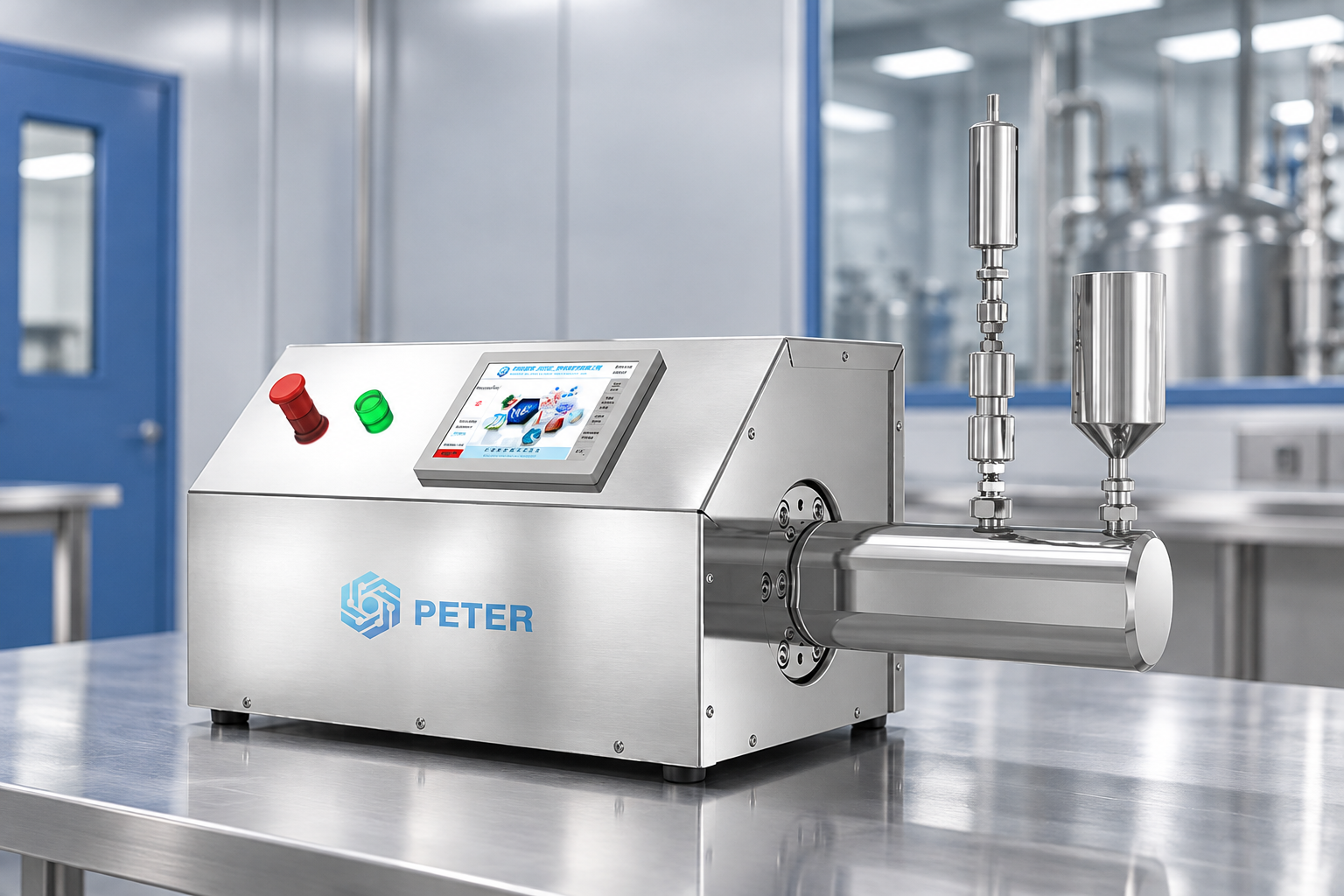
What a rotor-stator homogenizer does in an emulsion process
A rotor-stator homogenizer draws liquid into a rotating element and forces it through a narrow, high-shear gap and stator openings. Turbulence, velocity gradients, and local stresses break dispersed domains and help distribute one phase through another. The result depends on rotor geometry, gap, speed, residence time, recirculation pattern, viscosity, interfacial tension, surfactant response, and temperature. A nominal rpm value therefore cannot predict a universal droplet size across different heads or formulas.
In practice, a rotor-stator unit is often used for wetting powders, making a coarse premix, reducing droplets, or keeping solids suspended. It may be paired with a tank agitator, an inline loop, or a downstream high-pressure step. Buyers should state which duty is required. A unit sized for powder wet-out may not provide the residence-time control or thermal management needed for a narrow final emulsion distribution.
The words homogeniser mixer and homogenizing mixer are used interchangeably in many quotations, but they do not guarantee the same mechanical arrangement. Ask for a process drawing, wetted materials, head geometry, usable batch volume, minimum working volume, and whether the stated performance was measured in a vessel, inline, or recirculation setup.
Set the formulation and sample compatibility boundary
Before a trial, record the continuous and dispersed phases, approximate phase ratio, viscosity range, solids or powders, pH, ionic strength, surfactant or emulsifier system, temperature limits, and any oxygen or light sensitivity. A rotor-stator homogenizer creates mechanical energy; it does not establish chemical compatibility. Some formulas shear-thin during processing, while others thicken, aerate, or release heat as the interface changes.
Check materials of construction and seal exposure
Compatibility review should cover the product-contact metal or polymer, elastomers, lubricants that could contact the product, shaft coatings, and cleaning agents. The supplier should identify the material grade used for each wetted part and provide a compatibility statement or data sheet where available. Do not infer pharmaceutical, food, or cosmetic suitability from a generic stainless-steel label. The intended market and product claims determine which hygienic, extractables, allergen, or migration evidence is needed.
Sample compatibility also includes the analytical method. Dilution, temperature change, vigorous shaking, or long transfer lines can alter an emulsion before particle-size analysis. Define the sample container, fill level, mixing before measurement, dilution medium, hold time, and test temperature. Keep an untreated premix sample and a processed sample from the same batch so that any change can be attributed to the process rather than to different starting material.
Use a repeatable premix
Premix the phases using a recorded addition order, time, speed or power setting, and hold time. If a powder is added, record sieve or screen practice and the time allowed for wetting. Large agglomerates can overload a head and create a false impression that more shear is always better. If the premix separates before the trial, correct that feed condition first or document it as a controlled variable.
For teams comparing alternatives, a homogenizer product range can be a starting point for discussing laboratory, pilot, and production routes. Product selection still requires the actual formula, batch volume, target quality attributes, and cleaning requirements.
Choose the right mixing architecture
The best emulsion homogenizer is the one that provides the required quality with a controllable thermal and cleaning burden. Vessel-mounted heads are simple to deploy for batch work and can combine incorporation with circulation. Inline heads can improve pass-to-pass consistency when flow and recirculation are controlled. High-pressure systems may be considered when a formulation requires a different energy regime or a finer endpoint, but they should be evaluated against the same material, stability, and validation criteria.
| Architecture | Useful duty | Main process question | Typical trade-off |
|---|---|---|---|
| Vessel-mounted rotor-stator | Batch incorporation, wetting, and coarse-to-intermediate dispersion | Is the head positioned and submerged consistently at the working volume? | Accessible setup, but local circulation and vortexing can vary with fill level |
| Inline rotor-stator loop | Repeatable passes and controlled recirculation | Can flow, residence time, and temperature be measured for each pass? | Better process control, with extra piping, hold-up, and cleaning points |
| High-pressure homogenizer | Applications requiring a high-energy pressure-based interaction step | Does the formula and quality target justify pressure, cooling, and maintenance complexity? | Potentially different droplet regime, with greater utility and wear-part demands |
| Two-stage train | Separate coarse incorporation from final size control | Which stage owns each quality attribute and how is material transferred? | More controllable duties, but more equipment, transfers, and validation work |
For technical context on pressure-based alternatives, see CAS PETER’s high-pressure homogenizer working principle guide. It should inform a comparison, not replace a trial on the target emulsion.
Troubleshoot performance by symptom and cause
Performance troubleshooting should change one controlled variable at a time where possible. Log speed, pass count, working volume, inlet and outlet temperature, current or load, visible aeration, and the time between processing and sampling. The table below keeps common observations separate from unverified root-cause assumptions.
| Observed symptom | Checks before changing equipment | Useful confirmation |
|---|---|---|
| Droplet result varies between runs | Premix age, phase ratio, fill level, head position, speed, pass definition, and sampling time | Replicate runs using the same premix and a written sampling protocol |
| Temperature rises quickly | Shear duration, recirculation loop, cooling capacity, viscosity change, and starting temperature | Time-stamped inlet and outlet readings plus a product-specific temperature limit |
| Foam or entrained air appears | Vortex depth, suction location, leak points, surfactant level, and return-line discharge | Visual inspection, mass balance, and a controlled low-aeration run |
| Size improves but separation returns | Emulsifier hydration, coalescence, storage temperature, large-droplet tail, and hold time | Time-series size data, microscopy or another suitable large-droplet check, and visual stability records |
| Load or noise changes unexpectedly | Foreign material, blocked screen, shaft or seal condition, viscosity shift, and cavitation risk | Stop-and-inspect procedure, maintenance record, and an empty-system check where permitted |
A failed trial should not automatically be “fixed” by adding another pass. Additional exposure can increase heat, oxidation, foam, wear, or recoalescence. First determine whether the measurement is valid and whether the feed met the agreed specification.
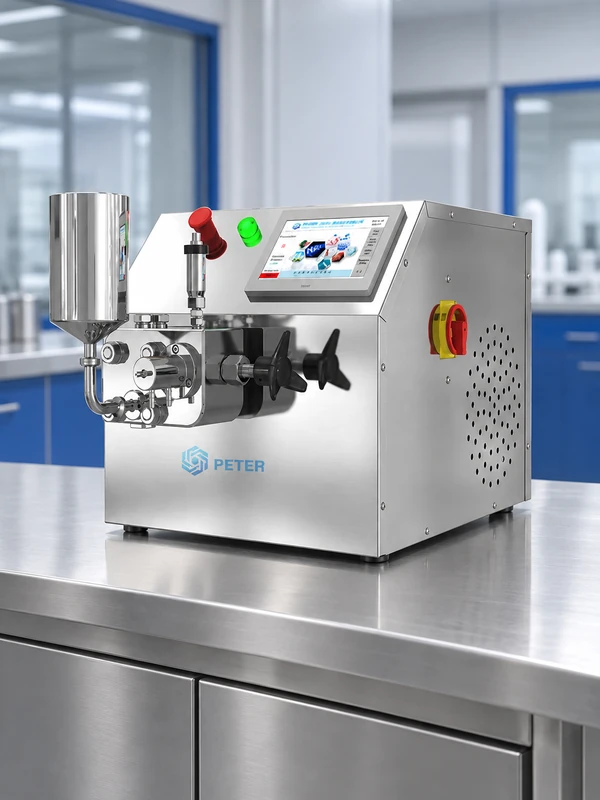
Validate the result, not just the machine setting
Validation begins with a written target: for example, a particle-size distribution range at a named sampling time, acceptable visual appearance, viscosity window, and a stability checkpoint. Avoid defining success as “maximum shear” or “smallest average.” A valid endpoint is linked to how the product performs in storage, filling, dosing, coating, or use.
Use a small, risk-based matrix that varies speed or energy input, pass count, and temperature while holding the premix constant. Record replicates and randomize run order when practical. Analyze more than one aliquot per condition if the sample is heterogeneous. ISO 13320:2020 provides guidance for laser-diffraction particle-size analysis, while ISO 22412:2017 covers dynamic light scattering. Select the method that represents the product and size range, document refractive-index or viscosity assumptions, and retain raw data. Neither standard establishes a universal acceptance limit.
For regulated products, the FDA’s process-validation guidance emphasizes process design, qualification, and continued process verification. A rotor-stator trial is usually development evidence, not a complete validation package. Define what must be repeated at pilot or production scale, including mixing time, energy input, temperature history, residence pattern, cleaning, yield, and sampling.
Teams evaluating a pressure-based emulsion route can also review CAS PETER’s high-pressure homogenizer emulsion support guide for questions to include in a trial brief. The same discipline applies to a rotor-stator system: define the feed, measurement, and transfer assumptions before comparing quotes.
Selection checklist for engineering and procurement
- Define the duty: state whether the machine must wet powders, make a premix, reduce droplets, suspend solids, or deliver a validated final emulsion.
- Describe the material: give phase ratio, viscosity range, solids, pH, temperature sensitivity, air sensitivity, corrosivity, and cleaning chemistry.
- Specify the process envelope: working-volume range, batch or inline arrangement, desired throughput, allowable heat rise, pass strategy, and utility limits.
- Specify evidence: require a trial report with settings, configuration, temperatures, sample timing, analytical method, replicates, deviations, and raw-data availability.
- Price the lifecycle: include power, cooling, seals, wear parts, cleaning, changeover, training, service response, product hold-up, and downtime.
CAS PETER can be included in this comparison as a supplier for homogenization equipment discussions. Keep the first contact technical: send the application brief and ask which configuration, trial conditions, documentation, and service assumptions are included. Do not treat a maximum rating, a catalog photograph, or a single sample result as proof of suitability.
Maintenance that protects emulsion repeatability
Maintenance for a homogeniser mixer should protect both mechanical condition and process evidence. Inspect the rotor, stator, shaft, bearings, seals, clamp or mounting points, screens, and electrical connections at an interval based on duty and the supplier’s manual. Trend vibration, noise, motor load, temperature, and observed throughput so that gradual wear is visible before a batch fails.
Clean promptly using a procedure compatible with the product-contact materials. Document cleaning agent, concentration, temperature, contact time, rinse endpoint, visual inspection, and any swab or rinse test required by the product risk assessment. A cleaning method that works for a food emulsion may not be appropriate for a cosmetic, biotech, or pharmaceutical formulation. Lubrication points and lockout procedures should be unambiguous, and replacement parts should be traceable to the approved configuration.
After a major repair, verify the machine with a defined check batch or water-based mechanical test only when that test is relevant to the risk. A maintenance sign-off is not a substitute for product-specific requalification when the repair can change shear exposure, residence time, or contamination risk.
Frequently asked questions
What type of homogenizer mixer is best for mixing and emulsion processing?
The best type depends on whether the duty is powder wetting, premix formation, droplet reduction, or a validated final emulsion. A vessel-mounted or inline emulsion homogenizer can be appropriate for many batch and recirculation duties, while a high-pressure route may be justified by a different target and process envelope. Compare repeatable quality, temperature control, cleaning, and lifecycle cost rather than speed alone.
How do you choose a homogenizer mixer?
Start with the material and target quality attributes, then define working volume, viscosity, phase ratio, allowable heat rise, pass strategy, cleaning, utilities, and validation evidence. Request a controlled trial using the actual or representative formulation and require a report that connects settings to measurements. A quote without a defined test method or acceptance criterion is incomplete.
When should homogeniser mixer be considered?
Consider a homogeniser mixer when an agitator alone cannot deliver the required dispersion, wetting, or droplet distribution within the available time and temperature window. It is especially useful when a team can define the feed, shear duty, and measurement method. Do not add one solely because another product uses a homogenizer; first confirm that the process problem is mechanical mixing rather than formulation or stability.
What maintenance does a homogenizer mixer need?
Routine care typically includes inspection and cleaning of the rotor-stator assembly, shaft, seals, bearings, screens, mounts, and controls, with intervals set by duty and the supplier’s manual. Trend noise, vibration, load, temperature, and throughput, and record all wear-part changes. After repairs, verify the configuration and repeat any product-specific qualification affected by the change.
How can emulsion homogenizer performance be validated?
Define an acceptance window for the relevant particle-size distribution, viscosity, appearance, and stability endpoints at named sampling times. Run controlled replicates with a fixed premix, record speed, pass count, and temperature, and use a fit-for-purpose method such as laser diffraction or dynamic light scattering with documented sample preparation. Scale-up still needs confirmation because geometry, residence time, cooling, and recirculation can change the result.
References
- International Organization for Standardization. ISO 13320:2020, Particle size analysis – Laser diffraction methods.
- International Organization for Standardization. ISO 22412:2017, Particle size analysis – Dynamic light scattering (DLS).
- U.S. Food and Drug Administration. Process Validation: General Principles and Practices, January 2011.
- International Council for Harmonisation. ICH Q8(R2): Pharmaceutical Development, Step 4, August 2009.
Conclusion
Reliable emulsion mixing is a controlled chain: compatible materials, a repeatable premix, defined shear exposure, managed temperature, fit-for-purpose measurement, and maintenance that preserves the same process conditions. The most useful homogenizing mixer is not the one with the most impressive catalog number; it is the one that can demonstrate a repeatable quality window for your material and transfer that evidence to the intended scale. Use the CAS PETER homogenizer range as a basis for a documented discussion, and share your formulation constraints, target attributes, batch plan, and validation needs when requesting a configuration or trial.