

What Is a Homogenizer? Types Uses and Buying Basics
A practical guide to homogenizer mechanisms, applications, capacity, total cost and procurement checks for laboratory, pilot and production teams.
When Maya, a process engineer in Rotterdam, encountered a visible cream layer after a formulation had passed through a running unit, she increased recirculation and shortened the sampling interval; the batch still failed its visual uniformity check within minutes. This illustrative scenario does not point automatically to a bad machine. The root cause can be a mismatch between the homogenizer type, feed viscosity, inlet stability, residence time and the quality attribute being measured. A defensible purchase therefore starts by asking what the process must change, how that change will be measured, and whether the machine can repeat it at the required capacity. This article answers those questions and separates generic terminology from an equipment specification.
Summary: To define homogenizer in procurement terms, treat it as process equipment that applies controlled mechanical energy to reduce droplet or particle-size differences and improve dispersion or emulsion uniformity. The most useful first distinction is between high-pressure flow-through, rotor-stator and ultrasonic mechanisms; ISO 13320 describes laser-diffraction particle-size analysis, but it is a measurement method rather than a product certification. We recommend documenting the feed, target endpoint and three duty points (minimum, normal and maximum load) before comparing quotations. A suitable homogenizer machine is selected by demonstrated result, cleanability and lifecycle cost, not by the word “homogenizer” or motor power alone.
What does a homogenizer do?
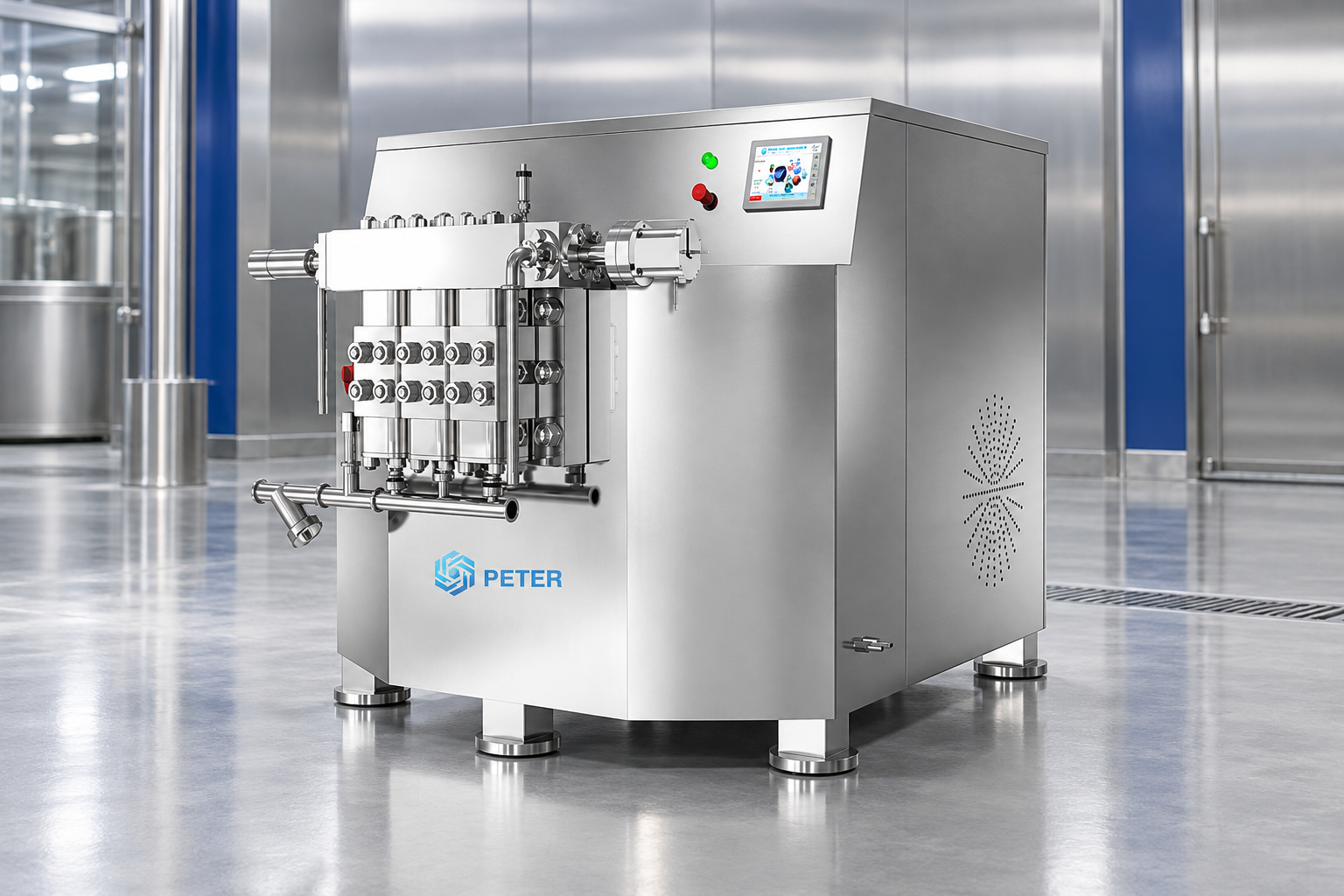
Homogenization reduces non-uniformity in a fluid system. In a purchase specification, define homogenizer by the change it must create, the feed it must accept and the evidence that will release the batch. Depending on the mechanism, a machine forces a pumpable feed through a restrictive interaction zone, drives material through a narrow rotor-stator gap, or applies high-frequency acoustic energy. The local pressure drop, turbulence, cavitation or shear can break droplets and agglomerates, but the final result still depends on formulation, temperature, solids loading, pass count and sampling location.
A homogenizer machine is therefore not a universal mixer. It may be used for emulsions, suspensions, dispersions, liposomes, cell disruption or particle-size reduction when the feed is compatible with the chosen mechanism. A buyer should name the acceptance attribute – for example, a particle-size distribution, phase-separation limit, assay result or visual-uniformity criterion – and specify the analytical method used to verify it. ISO 13320 is relevant when laser diffraction is appropriate; ISO 22412 is a separate dynamic-light-scattering method for suitable dispersed systems.
What are the main homogenizer types?
The four categories below describe operating principles, not a ranking. Some systems combine a premixer, circulation loop, cooling stage and pressure or high-shear finishing step. Product names can also overlap, so the request for quotation should state the physical mechanism and duty.
| Type | Main energy mechanism | Good fit to test | Limits to verify | Typical cost drivers |
|---|---|---|---|---|
| High-pressure | Pump-driven flow through a valve or interaction zone | Repeatable emulsion and fine-dispersion finishing for pumpable feeds | Inlet pressure, viscosity, abrasive solids, heat rise and number of passes | Pressure boundary, pump, valve geometry, cooling, wear parts and controls |
| Rotor-stator | Local shear in a narrow rotating gap | Wet-out, deagglomeration, premixing and moderate dispersion duties | Air entrainment, heat, scale-up similarity and gap or head wear | Drive, head material, seals, bearings, tank and cleaning access |
| Ultrasonic | Acoustic cavitation from a probe or flow-through horn | Small-volume laboratory dispersion or cell-disruption studies | Foaming, local heating, probe erosion, batch volume and scale-up | Generator, probe replacement, cooling and acoustic enclosure |
| Membrane or microfluidic | Controlled flow through small channels or porous structures | Defined laboratory or continuous dispersion development | Clogging, pressure drop, feed cleanliness and channel throughput | Disposable or precision channels, pumps, sensors and cleaning method |
Where does a polytron homogenizer fit?
A polytron homogenizer generally refers to a rotor-stator laboratory instrument or brand-specific naming used for probe-style high-shear processing. It can be useful for small samples, tissue disruption and rapid bench experiments, but the term by itself does not state pressure, flow, particle-size endpoint or production capacity. Confirm the head geometry, sample volume, temperature control and cleaning method before comparing it with a flow-through high-pressure system.
How do homogenizers work in a real process?
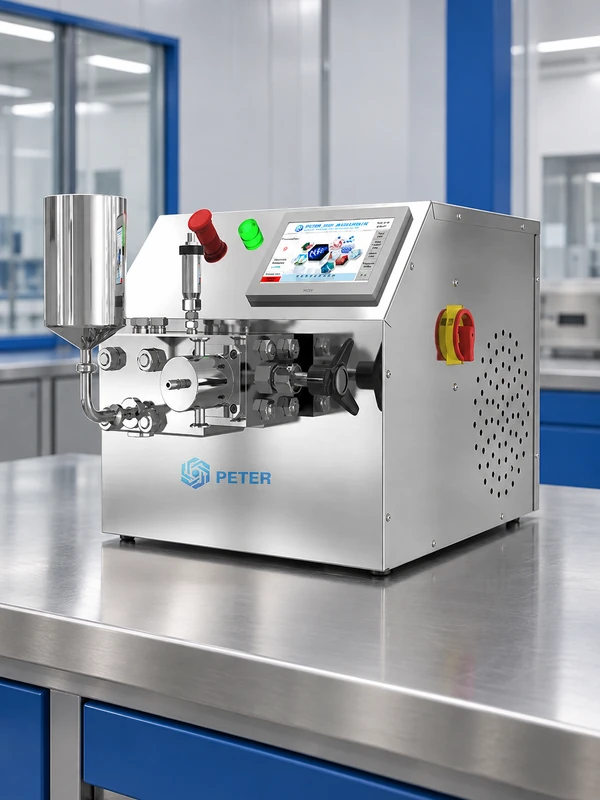
A useful process map has five stages: feed preparation, controlled inlet, energy application, heat or pressure management, and analytical verification. High-pressure equipment uses a pump to establish flow and a restriction to create the interaction zone; rotor-stator equipment creates a high-shear region at the head; ultrasonic equipment couples acoustic energy into the sample. A pass count and residence time should be recorded because one pass at a defined condition is not equivalent to several uncontrolled recirculation loops.
Stable operation begins before the interaction zone. Entrained air, oversized particles, unstable temperature or a feed that is too viscous can cause cavitation, pressure fluctuation, blocked passages or an apparently inconsistent result. For scale-up, compare the variables that control the endpoint – pressure or tip speed, flow, energy exposure, temperature and sampling position – instead of copying only rpm or nominal tank volume. Use the high-pressure homogenizer working-principle guide for a deeper review of pressure, valve geometry, passes and measurement.
| Variable | Why it matters | What to record | Decision signal |
|---|---|---|---|
| Feed condition | Determines pumpability, wetting and blockage risk | Viscosity at operating temperature, solids, particle size and air content | Stable inlet without surging, foaming or unplanned filtration |
| Energy exposure | Controls breakup while affecting heat and wear | Pressure or speed, flow, pass count, run time and temperature rise | Endpoint improves without exceeding formulation or equipment limits |
| Sampling plan | Prevents a non-representative sample from driving the purchase | Location, timing, container, mixing state and analytical method | Repeatable result across the batch and across trial runs |
| Post-process stability | A small initial size does not prove storage stability | Time, temperature, separation, size drift and relevant assay | Acceptance criterion remains valid after the stated hold period |
Which homogenizer is best for capacity and application?
Capacity is a duty calculation, not a label. An illustrative batch estimate is throughput = usable batch volume divided by total cycle time; total cycle time should include charging, premixing, homogenization passes, cooling, discharge and cleaning. For a 100 L usable batch that requires 40 minutes of processing plus 20 minutes of setup and discharge, the illustrative average is 100 L per hour before cleaning downtime. Replace those assumptions with measured plant data before sizing a production line.
Laboratory work may prioritize small hold-up volume, fast changeover and sample recovery. Pilot work must preserve a credible scale-up path, while production work adds utilities, automation, pressure-boundary documentation, spare parts and validated cleaning. The benchtop and pilot-scale guide explains why a bench result should be translated through feed condition, pass count, temperature and endpoint rather than volume alone.
| Stage | Primary objective | Capacity questions | Documentation to request |
|---|---|---|---|
| Laboratory | Screen formulation and mechanism | Minimum sample, recovery, temperature control and repeatability | Head or valve options, sample limits, cleaning instructions and test record |
| Pilot | Bridge formulation and process conditions | Batch size, hold-up, recirculation, number of passes and scale-up variables | Utility schedule, P&ID or flow path, acceptance protocol and wear-part list |
| Production | Repeatable throughput and controlled quality | Hourly demand, peak schedule, cleaning time, redundancy and maintenance windows | Commissioning plan, manuals, material data, spare strategy and service scope |
How should homogenizer cost and total cost of ownership be compared?
Purchase price is only one line in a homogenizer budget. Compare quotations at the same accepted duty point and include pump and pressure hardware, cooling, controls, product-contact materials, installation, qualification support, operator training, cleaning tools, seals, valves, probes and planned wear parts. A machine that needs an extra pass, a slower feed or a longer cleaning stop can have a higher cost per accepted litre even when its capital price is lower.
An illustrative annual-cost model is: capital recovery + utilities + labor + cleaning consumables + planned wear parts + service + rejected or reworked batches. State the batch count, hours, energy assumptions and replacement intervals; do not present the illustration as a supplier quote. For products covered by food or drug controls, also price sampling, records and any validation work needed to demonstrate a controlled process.
What standards and compliance checks matter?
Standards and regulations apply according to the product, destination market and claims, not simply because equipment is called a homogenizer.
- ISO 13320 is a laser-diffraction particle-size analysis method. It supports measurement planning; it does not certify a machine or guarantee product stability.
- ISO 22412 covers dynamic light-scattering particle-size analysis for suitable dispersed systems. Confirm concentration, dilution and sample preparation before comparing results.
- 21 CFR 117.35 addresses sanitary operations for covered human-food facilities in the United States. It informs hygienic handling and cleaning controls, but it is not a homogenizer certification.
- 21 CFR 211.110 addresses in-process sampling and testing for drug manufacturing. A buyer must connect the requirement to the product quality system and validation strategy.
- ISO 22716 provides cosmetics GMP guidance for production, control, storage and shipment. Applicability depends on the market and the organization’s quality system.
Unsupported claims about certification, sterile processing, particle size or compliance create commercial risk: a quotation can be technically mis-scoped, a validation package can be rejected, and a buyer may need to repeat testing. Request the exact declaration, test report, material information and operating limits that apply to the selected configuration.
What should buyers check before ordering?
- Write the endpoint first: define the measured size distribution, separation limit, assay or other acceptance attribute, along with the test method and sampling plan.
- Describe the worst feed: provide viscosity at operating temperature, solids loading, particle-size range, air sensitivity, shear sensitivity, temperature limit and required batch or hourly throughput.
- Run a representative trial: use the intended formulation or a justified surrogate; record inlet condition, energy input, passes, temperature, flow and post-process stability.
- Price the complete system: include tank, pump, cooling, controls, piping, filtration, cleaning, installation, training, spares and planned wear parts rather than comparing the base machine only.
- Review service evidence: ask for manuals, drawings, utility requirements, product-contact materials, inspection intervals, replacement procedures and a clear statement of what the supplier has tested.
CAS PETER is one supplier to include in a structured review of high-pressure homogenization. Buyers can review the published PT-20 high-pressure homogenizer and pilot-type PT-40 pages against the written duty and acceptance test. Published configuration details should be confirmed with the supplier before purchase.
Frequently asked questions
What is a homogenizer machine used for in homogenizer selection and operation?
A homogenizer machine is used to reduce droplet or particle-size differences, disperse solids, stabilize an emulsion or disrupt cells, depending on its mechanism and the formulation. Selection should start with the target quality attribute, feed condition and capacity, then verify the result with a defined method. It is not a substitute for a premixer, pump or cooling stage when those duties are required.
How does a homogenizer machine work?
A homogenizer machine applies controlled mechanical or acoustic energy to a flowing or contained feed. High-pressure systems use a pump and restriction, rotor-stator units create a narrow-gap shear zone, and ultrasonic units use cavitation; the actual result depends on pressure or speed, flow, temperature, pass count and sampling. Confirm the endpoint with an appropriate analytical method rather than judging by appearance alone.
What is the difference between a homogenizer machine and polytron homogenizer?
The term homogenizer machine covers many mechanisms and scales, while a polytron homogenizer usually describes a laboratory rotor-stator instrument or a brand-specific name for that style of high-shear device. A polytron-type unit can be effective for small-volume tissue or formulation work, but it does not imply the pressure, flow or production capacity of a high-pressure system. Compare mechanism, sample range, heat control, cleaning and measured endpoint.
Which factors affect homogenizer machine performance?
Feed viscosity, solids concentration, particle or droplet size, temperature, air content, inlet pressure, energy input, residence time, pass count and sampling method all affect performance. Wear in valves, rotor-stator heads, probes or seals can also change the result over time. Trend the process and product endpoint together, and test the worst expected condition before approving capacity.
How many homogenizers should a laboratory or plant buy?
Buy the number required by duty, schedule, cleaning segregation and business continuity rather than by a generic rule. One unit may be adequate for intermittent laboratory screening, while production may need redundancy or dedicated equipment for incompatible products and cleaning regimes. Calculate peak demand from accepted throughput and total cycle time, then include maintenance and changeover windows.
How much does a homogenizer cost?
There is no defensible universal price without the mechanism, pressure or speed, flow, capacity, wetted materials, controls, cooling, documentation and service scope. Compare complete quotations at the same tested duty point, then add utilities, wear parts, labor, cleaning, installation and the cost of failed or reworked batches. A lower capital quote is not necessarily the lower cost per accepted batch.
Conclusion: define the result before you define the machine
homogenizers are process tools, not interchangeable labels. The reliable decision sequence is to define the product endpoint, characterize the feed, choose the mechanism that can create the required energy exposure, test laboratory or pilot conditions, and then scale capacity around measured cycle time and cleaning needs. A polytron homogenizer may be appropriate for small high-shear work, while a high-pressure system may be more appropriate for a pumpable production stream; neither choice can be justified by name alone. Start a structured comparison with CAS PETER’s homogenizer range, and contact its technical team with the formulation, capacity, endpoint and compliance context so the proposed configuration can be checked against a written trial plan.
References
- ISO 13320: Particle size analysis – Laser diffraction methods. International Organization for Standardization.
- ISO 22412: Particle size analysis – Dynamic light scattering. International Organization for Standardization.
- 21 CFR 117.35, Sanitary operations. U.S. Electronic Code of Federal Regulations.
- 21 CFR 211.110, Sampling and testing of in-process materials and drug products. U.S. Electronic Code of Federal Regulations.
- ISO 22716: Cosmetics – Good manufacturing practices. International Organization for Standardization.