

Can High-Pressure Homogenization Replace Sterilization or Sterile Filtration?
A formulation can leave a homogenizer with a smaller particle size and still require the same microbiological controls as before. The confusion often begins when high pressure, heat generated during processing and published microbial-reduction results are treated as interchangeable evidence of sterility. They are not. For a sterile pharmaceutical product, replacing a validated process step changes the basis on which the product is manufactured and released. For food, a change to microbial controls also needs its own safety assessment. This article separates particle-size processing from microbial inactivation, explains why filtration is a different operation, and identifies the evidence needed before assigning a microbiological role to a homogenizer.
High pressure homogenization should not be substituted for sterilization or sterile filtration merely because it uses high pressure. Its usual process role is particle or droplet size reduction, dispersion or cell disruption. Any intended microbial-inactivation claim requires validation for the actual formulation, organisms and operating conditions, including relevant worst cases. A reduction in measured bioburden is not proof of sterility, and neither establishes endotoxin removal. For sterile drug manufacture, 21 CFR 211.113 requires validation of aseptic and sterilization processes. Define the microbiological objective separately from the physical product-quality target before selecting or removing a process step.
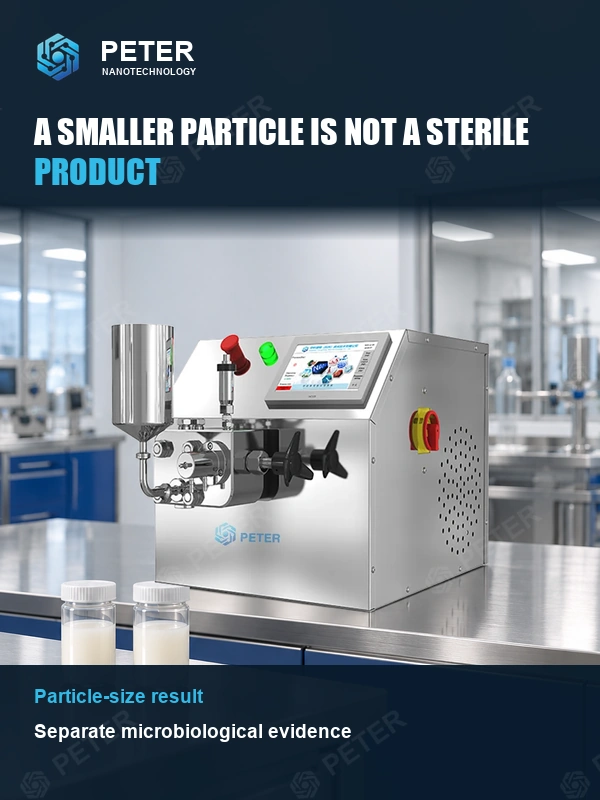
A smaller particle is not a sterile product
Particle-size measurements describe a physical distribution. They do not identify surviving microorganisms, establish a validated lethal effect or demonstrate that downstream handling prevented recontamination. An acceptable size result can therefore coexist with an unacceptable microbiological result.
The Tetra Pak homogenizer chapter discusses droplet breakup and the position of homogenizers in processing systems, including aseptic arrangements. It does not make all homogenization a sterilizing process. Keep the pressure-and-flow operation used in a homogenizer distinct from high-pressure processing of packaged foods: equipment, exposure conditions and validation evidence cannot be transferred simply because both use the phrase “high pressure.”
When specifying a high-pressure homogenization system for formulation work, put particle-size targets and microbiological requirements in separate sections of the specification. The equipment supplier and the process owner can then identify what each trial actually demonstrates.
| Operation | Primary question it answers | Evidence it does not automatically provide |
|---|---|---|
| Homogenization | Did the process achieve the required physical product properties? | Sterility, validated microbial lethality or endotoxin removal |
| Validated sterilization | Does the defined cycle deliver the required sterilizing effect? | Protection against contamination introduced after the cycle |
| Validated sterilizing filtration | Does this filter-process combination retain the relevant microbial challenge? | Universal compatibility with every suspension or removal of endotoxin |
| Aseptic processing | Are sterile materials protected during handling and filling? | Correction of an inadequately sterilized starting material |
Microbial reduction needs its own process evidence
Some homogenization conditions can affect microbial viability, but a result belongs to the tested conditions. Organism selection, initial load, formulation, temperature history, pressure, exposure and recovery method all affect what the result means. A study on one liquid cannot establish a claim for a different pharmaceutical emulsion or a production process with different holding conditions.
A homogenization microbial inactivation study must define its intended claim before testing. The protocol needs an appropriate challenge, sampling locations, a justified detection and recovery method, process boundaries and acceptance criteria. Where injured organisms are relevant, the recovery method must not hide them. This work belongs with qualified microbiology and validation specialists rather than a particle-size demonstration.
For US finished pharmaceuticals, 21 CFR 211.113 distinguishes prevention of objectionable microorganisms in nonsterile products from contamination prevention and validated aseptic and sterilization processes for products claimed to be sterile. Those are process obligations, not a machine certification.
Sterile filtration is not just a finer size-reduction step
Filtration separates material; homogenization changes the dispersed phase. A formulation may foul a filter, retain an intended ingredient or change composition during filtration. Reducing droplet size does not prove the drug can pass through the chosen filter with acceptable recovery, nor that microbial retention has been validated under actual operating conditions.
The FDA aseptic-processing guidance addresses sterilizing-filter validation and integrity testing in their process context. Its requirements should not be reduced to choosing a nominal pore-size label. Product compatibility, process duration, pressure conditions, microbial challenge and the relationship between integrity tests and retention need appropriate support.
A formulation that cannot use the proposed sterile filtration step needs an alternative validated manufacturing strategy. It does not acquire a substitute sterilization step merely by increasing homogenization pressure or adding more passes.
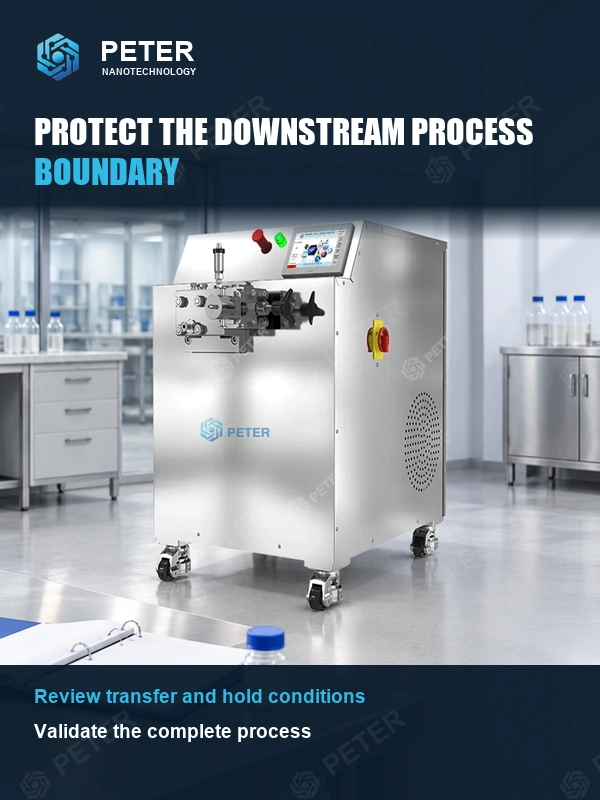
Protect the downstream process boundary
Decide whether homogenization occurs before or after the relevant microbial-control step. Upstream processing needs suitable bioburden and hold-time controls. Downstream use raises questions about equipment preparation, sterile boundaries, seals, connections, transfer, sampling and interventions. The installed configuration and operating procedure matter as much as the process diagram.
For a proposed homogenizer configuration, ask which documented features and procedures support the intended location in the process. The public model listing alone does not establish aseptic suitability.
Review the technical package alongside the site’s cleaning-validation requirements rather than treating cleanability and sterility as the same claim. Equipment cleaning and a validated microbiological process answer different questions and require their own acceptance evidence.
| Boundary to document | Question the process owner must answer |
|---|---|
| Feed and holding period | What microbiological limits and maximum hold conditions apply? |
| Homogenization step | Is its role physical processing, microbial reduction, or a separately validated sterilizing claim? |
| Transfer and downstream equipment | How is contamination prevented after the relevant control step? |
| Sampling and release | Which physical, microbial and other quality tests support acceptance? |
| Change control | What must be re-evaluated after formulation, seal, equipment or cycle changes? |
Do not overlook endotoxin or the time between steps
Killing organisms and controlling endotoxin are different objectives. The FDA guidance specifically cautions that sterilizing-grade filters and moist-heat sterilization have not been shown to be effective in removing endotoxin. There is no basis to assume that homogenization solves this problem either. Control the sources and handling conditions relevant to the product, and use appropriate validated methods where endotoxin control is required.
The same guidance calls for data-supported time limits across production phases. A laboratory trial processed immediately after preparation may not represent a batch held for hours before and after homogenization. For EU sterile medicinal products, review the contamination-control requirements in EU GMP Annex 1 against the complete process, not just the equipment purchase.
Frequently Asked Questions
Can high-pressure homogenization replace sterilization?
Not without a separately justified and validated sterilization process for the actual product and conditions. Routine particle-size results, pressure settings or microbial reductions do not establish that substitution.
Can homogenization replace sterile filtration?
No automatic substitution is valid because the two operations have different roles. If the formulation cannot tolerate the proposed filter, develop and validate an alternative process rather than assuming homogenization provides equivalent microbial control.
Does homogenization reduce microbial load?
It can under some conditions, but the extent is formulation-, organism- and process-dependent. A measured reduction needs an appropriate sampling and recovery method and must not be described as sterility without the necessary validation.
What is the difference between particle-size reduction and sterilization?
Particle-size reduction is a physical product characteristic; sterilization is a validated microbiological process objective. The tests used to demonstrate one cannot replace the evidence required for the other.
Which aseptic controls are still required after homogenization?
The controls depend on where the homogenizer sits relative to the sterile boundary. Assess equipment preparation, transfer, holding, sampling and interventions, with the applicable environmental and process controls.
How should a pharmaceutical process define the homogenizer’s microbiological role?
State the intended role explicitly in the process description and qualification strategy. Assign measurable acceptance criteria and distinguish physical quality, bioburden control, sterility assurance and endotoxin requirements.
References
- Tetra Pak Dairy Processing Handbook: Homogenizers
- 21 CFR 211.113: Control of microbiological contamination
- FDA: Sterile Drug Products Produced by Aseptic Processing
- European Commission: EudraLex Volume 4, including Annex 1
Conclusion
A homogenizer should be specified for a defined process role, with evidence that matches the claim. Use particle-size and product-quality data to demonstrate physical processing; use appropriately designed microbiological validation to support microbial-control claims. If a filtration or sterilization step is being changed, assess the entire process, including holding time, downstream transfer and contamination risks, before approving the change. Do not let a small particle-size result stand in for a sterile-product strategy. When discussing CAS PETER homogenizer options, provide the intended process position and the required documentation as well as the formulation target. The decision should rest on an agreed, validated manufacturing process rather than on the equipment name or pressure rating.