

Chitin Nanofiber Homogenization: Balance Fibrillation with Molecular Integrity
Chitin nanofiber high pressure homogenization trials should evaluate fibrillation and molecular integrity together. A more translucent suspension or a finer-looking network does not establish that the starting polymer has retained its original molecular properties. Characterize the feed and any pretreatment, compare controlled processing conditions, then combine microscopy with measurements appropriate to the intended film, coating or suspension. Confirm machine compatibility before processing fibrous material. The most useful endpoint is a reproducible material that meets its application requirements with an acceptable processing burden, rather than the maximum number of passes or the smallest reported width.
Distinguish chitin fibrillation from other particle processes
Chitin nanofibers are not interchangeable with chitosan nanoparticles or cellulose nanofibrils. Those names describe different materials and preparation questions. A trial should state the starting chitin source, its prior treatment and the intended final form before selecting pressure conditions or analytical methods.
For a fibrillation study, the question is whether the process separates the material into a useful fibrous structure while preserving the properties that matter downstream. For another application, a suspension containing larger fibers may already meet the requirement. Defining the required function early prevents the development team from pursuing increasingly intensive treatment without a clear product benefit.
The word “nano” also needs evidence. Appearance, viscosity and a single particle statistic cannot establish the complete fiber morphology. Ask the analytical laboratory which microscopy method and preparation procedure can characterize the relevant dimensions. Document both the representative structures and any remaining coarse material instead of selecting only the most attractive image.
What two original studies contribute
The accessible abstract of a study of alpha-chitin nanofibrillation in water reports structural and molecular changes after repeated high-pressure homogenization. It describes a heterogeneous fiber network and a reduction in the measured degree of polymerization. The practical lesson is that successful fibrillation can coexist with molecular change; visual dispersion quality alone is not a sufficient integrity check.
A Georgia Tech research paper on chitin nanofibers for barrier films examined pretreatment together with homogenization intensity. Its reported film results show why pretreatment and pressure history should be considered jointly. The findings belong to the studied chitin preparations and film-making conditions, rather than providing a universal reduction in pressure, pass count or energy for other feedstocks.
These sources answer complementary questions. One emphasizes structural and molecular characterization, while the other connects pretreatment and processing with a particular application. Neither evaluates CAS PETER equipment. This article uses the first paper’s accessible abstract and the university-hosted reproduction of the second paper’s first page and abstract; it does not imply access to the first paper’s full methods or supplementary data.
Build a feed identity sheet before processing
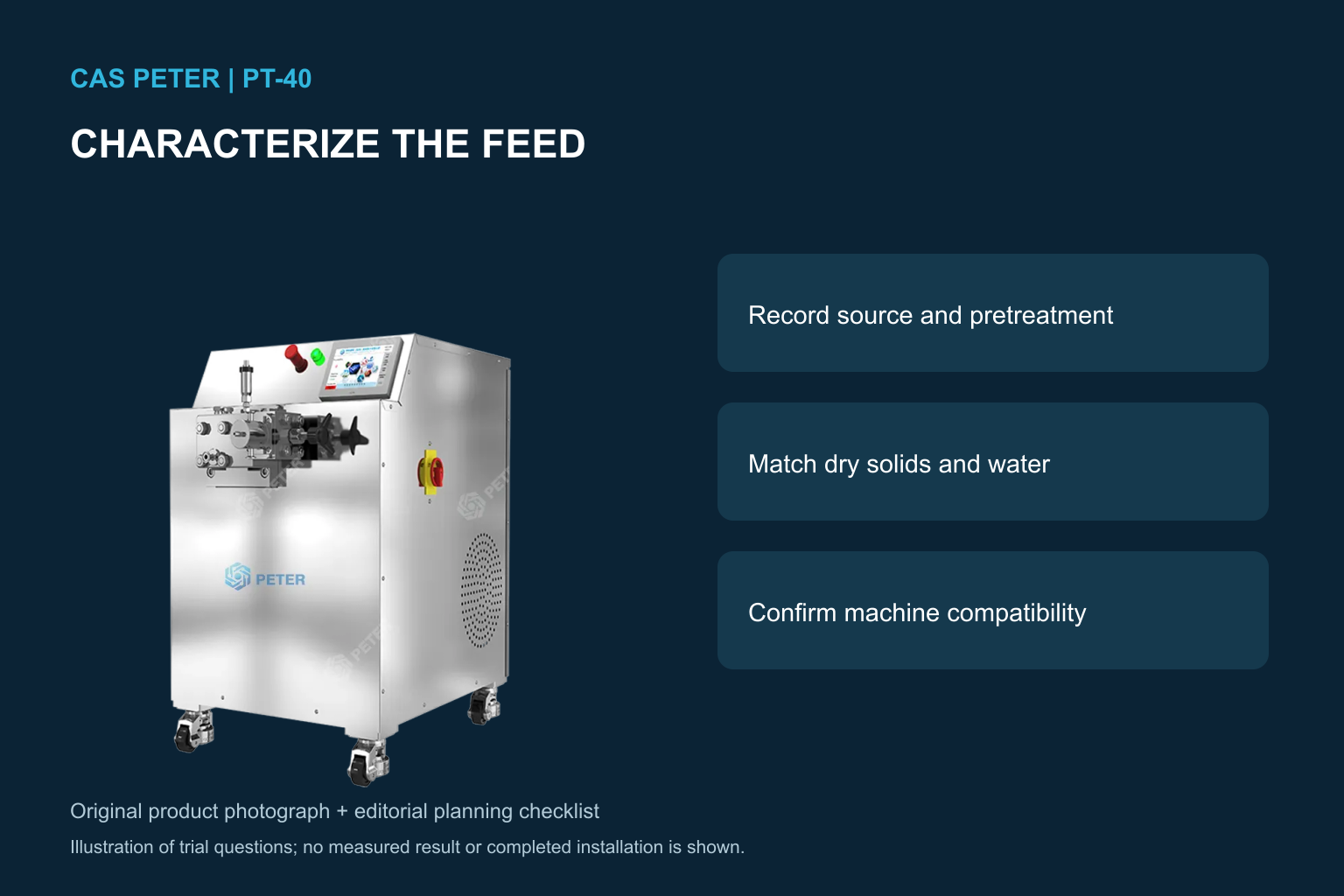
Record the source and lot of the chitin, how it was purified, whether it was previously dried, and what mechanical or chemical treatment it has already received. Do not classify two feedstocks as equivalent simply because their labels both say “chitin powder.” Retain a sample of the starting material for later comparison.
Record the solids basis and how it was established. If water content differs between lots, a nominal powder addition may not produce the same dry-material concentration. Note the water source, pH, conductivity where useful, mixing procedure and hydration history. Keep those details attached to the sample identifier throughout analysis.
Describe the coarse fraction and visible contaminants before requesting a machine trial. Fibrous or poorly dispersed feed can raise handling questions that are not answered by an average particle size. Give the equipment supplier representative material information and ask for explicit feed acceptance criteria. Do not force an unapproved feed through a restricted flow path to reproduce a published experiment.
Separate pretreatment effects from homogenization effects
If the study includes a pretreatment, retain material before and after that operation. Each pretreated group should then have its own unhomogenized comparison where feasible. This makes it possible to distinguish a change already present in the feed from a change associated with the subsequent pressure step.
Avoid changing several unrecorded variables between groups. Washing history, residual reagents, pH adjustment and solids concentration may all change alongside pretreatment. Write the preparation route as an actual batch record rather than a short label such as “modified chitin.” Include material recovery so that improved appearance is not achieved by silently discarding a substantial coarse fraction.
A useful first design is a small matrix of defined feed preparations and manufacturer-approved processing conditions. The appropriate matrix depends on material availability and the project’s analytical capacity. Keep enough sample for controls and application tests, and do not let an oversized pressure screen consume the material needed to interpret the result.
Track processing burden without inventing an efficiency claim
Record pressure, pass routing, inlet and outlet temperatures, recovered mass and processing time. Define what counts as one pass in the actual setup. A complete batch pass and a period of recirculation are not automatically equivalent exposures for every portion of the material.
If energy use is part of the decision, measure it on a stated basis. Pressure and pass count alone do not establish the total electrical energy required by a complete processing route. Pretreatment, cooling, pumping and recovery may also matter to the project’s comparison. Report the measured scope instead of calling a lower pass count an equivalent percentage reduction in total production energy.
Set stopping criteria before the run. These might include a plateau in a useful morphology metric, no further application improvement, unacceptable recovery loss or a manufacturer-defined operating limit. A stopping rule helps prevent extra passes from being treated as progress merely because they can be performed.
Use a measurement plan that preserves the material question
| Decision | Evidence to collect | Main interpretation limit |
|---|---|---|
| Has fibrillation progressed? | Representative microscopy and a stated image-analysis method | Selected images can miss coarse or heterogeneous material |
| Has the polymer changed? | Appropriate molecular characterization with validated sample preparation | A molecular result may depend on dissolution and recovery |
| Has chemical pretreatment changed the feed? | A suitable composition or acetylation measurement | Pretreatment and pressure effects must be separated |
| Is the suspension practical to handle? | Flow and resting behavior at matched solids and age | Dilution or different shear history can alter the comparison |
| Does the material meet its intended use? | Controlled film, coating or suspension performance tests | Results do not automatically transfer between applications |
This table is an editorial trial framework rather than a published acceptance specification. It follows the distinction between structure, molecular properties and application performance illustrated by the linked research. Agree on methods and acceptance criteria with the laboratory before choosing the preferred condition.
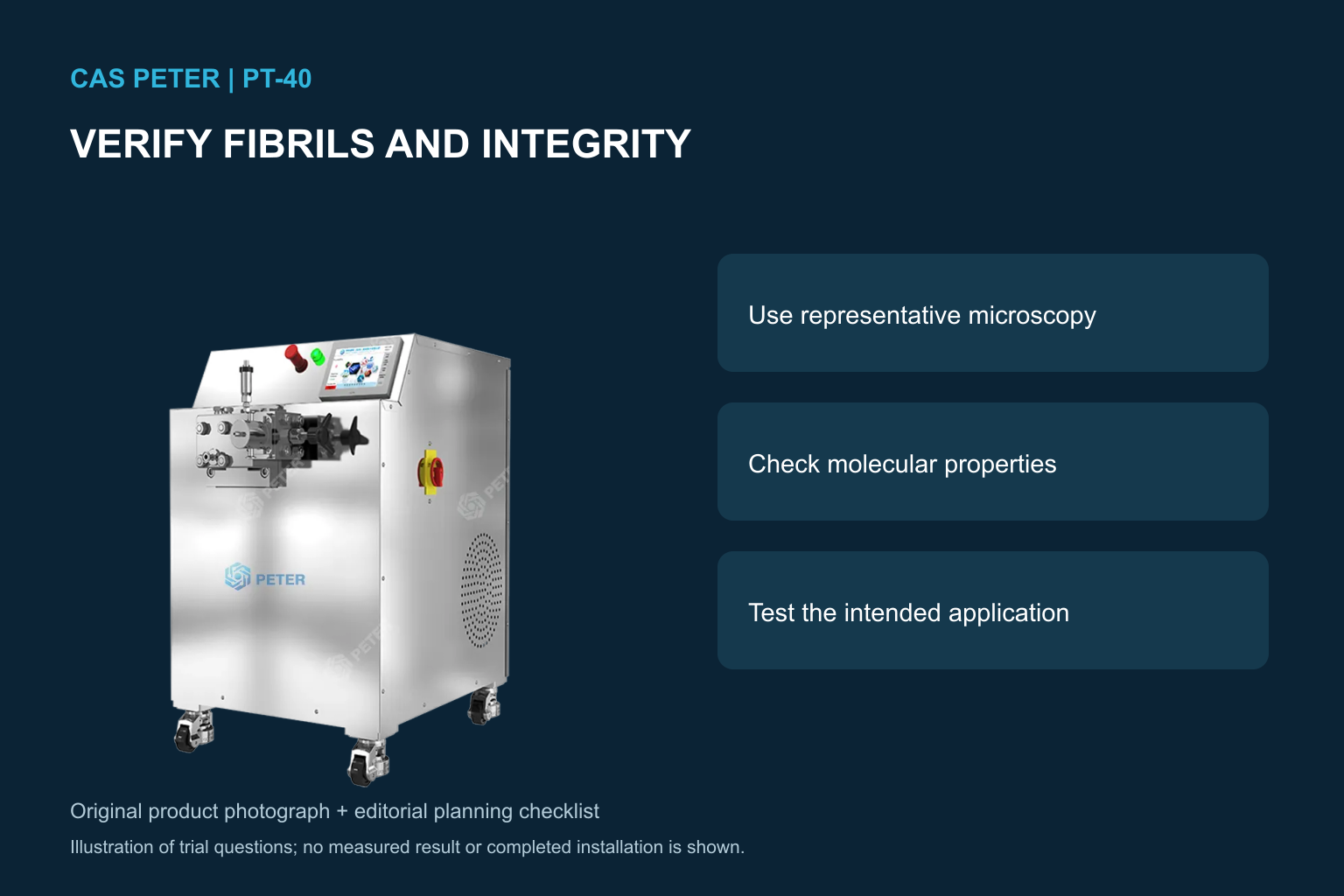
For microscopy, record how the sample was diluted, deposited and dried or otherwise prepared. Ask whether the preparation can change the appearance of the network. Report the sampling approach and the number of fields assessed rather than presenting one image as the entire batch.
For molecular measurements, confirm that the analytical preparation actually represents the material being compared. If dissolution or separation excludes part of a sample, record that limitation. A change in recovered analytical fraction should not be presented as a complete molecular description of all processed material without supporting evidence.
Test the intended film or coating under matched conditions
When the target is a film, control the casting basis, drying procedure, final thickness and conditioning environment. Compare the material at the same relevant application basis, rather than allowing a thicker film to appear superior because more material was used. Keep preparation records linked to the original homogenization batch.
Choose the property tests from the actual intended use. Barrier measurements, mechanical performance and appearance answer different questions. A trial aimed at a specific barrier function should not be selected solely on optical clarity. Conversely, a mechanically acceptable film may still fail the required barrier condition.
Do not transfer a result from one humidity or test configuration to another without confirmation. Report the conditions that accompanied the observation. If the final application is a coating on a substrate, include that substrate and the coating process in a later validation stage instead of assuming a free-standing film represents the finished article.
Interpret integrity alongside useful performance
An observed reduction in molecular size is not automatically either acceptable or unacceptable. Its significance depends on the material specification and the final use. The important point is to detect and report the change rather than assume that a fibrous appearance proves molecular preservation.
A condition that produces a more uniform network but no improvement in the intended application may not justify its extra processing burden. A less intensive condition can be preferable if it meets the complete specification reproducibly. Compare the agreed endpoints together and retain a record of why the selected condition was chosen.
The cellulose nanofibril trial guide offers related background on defining a feed and a process target, but cellulose-specific findings are not chitin evidence. The wetted-material and abrasive-slurry guide supports a separate compatibility discussion; it does not establish that every chitin preparation is suitable for a particular valve or seal arrangement.
Prepare a supplier brief for a controlled trial
The CAS PETER PT-40 product page provides a pilot-type equipment reference for discussion. Confirm the actual installed configuration and feed restrictions with the manufacturer. The model name and product image do not establish permissible fiber dimensions, slurry viscosity, chemical compatibility or an achievable nanofiber specification.
Provide representative feed information, preparation history, expected solids range, pH and the purpose of the trial. Include the microscopy and application tests that will determine success. Ask how the batch will be routed, cooled, collected and cleaned out so that recovery and processing history can be documented.
Use the broader dispersion-methods guide to frame equipment selection, then keep the chitin-specific evidence attached to the final decision. Repeat the chosen condition with an independent preparation before committing to a larger program. A reproducible material record is more useful for scale-up than an isolated attractive micrograph.
Further learning: colloidal stability
The NPTEL lesson below provides neutral background on stability in dispersed systems. It is useful context for interpreting changes after a suspension rests. It does not validate chitin fibrillation, molecular integrity or film barrier performance.

Educational source: NPTEL-NOC IITM. Watch the lesson on YouTube.
Frequently asked questions
Does a translucent chitin suspension prove nanofibrillation?
No. Appearance is a screening observation. Use representative microscopy and a defined characterization method to establish the fibrous structures present, including any remaining coarse material and heterogeneity.
Can repeated homogenization change chitin molecular properties?
The accessible original study reports molecular change in its specific preparation. Do not assume the same magnitude for another feed. Include appropriate molecular characterization when preservation is part of the material requirement.
Should the trial always use the highest pressure and most passes?
No. Select manufacturer-approved conditions and stop when the agreed morphology and application requirements are met reproducibly. Additional processing needs a demonstrated benefit and should be assessed alongside recovery, temperature history and molecular integrity.