

Which High-Pressure Homogenizer Spare Parts Should a Factory Keep in Stock?
A spare seal is useful only if it fits the machine that has stopped. Factories can hold a shelf of replacement parts and still lose production because the valve revision is wrong, a packing set is incomplete, or the only serviceable plunger is waiting for delivery. The purchase price of a spare is therefore a poor guide to its importance. A small, inexpensive component can stop an entire batch, while an expensive assembly may be repairable within a planned shutdown. This guide explains how to turn a manufacturer’s parts list into a stock plan tied to the installed equipment, actual wear and replenishment time.
Start with the manufacturer-approved service items for each high pressure homogenizer: seals and plunger packings, pump-valve components, and the fitted homogenizing valve’s wear parts. Add long-lead components when their failure would stop production without a workable alternative. Stock quantities should cover expected consumption during replenishment plus a justified reserve, rather than a universal “one set per machine” rule. Keep the machine serial number, component revision and material specification with every stock entry. Review the plan after a formulation change, an unusual failure or a change in supplier lead time.
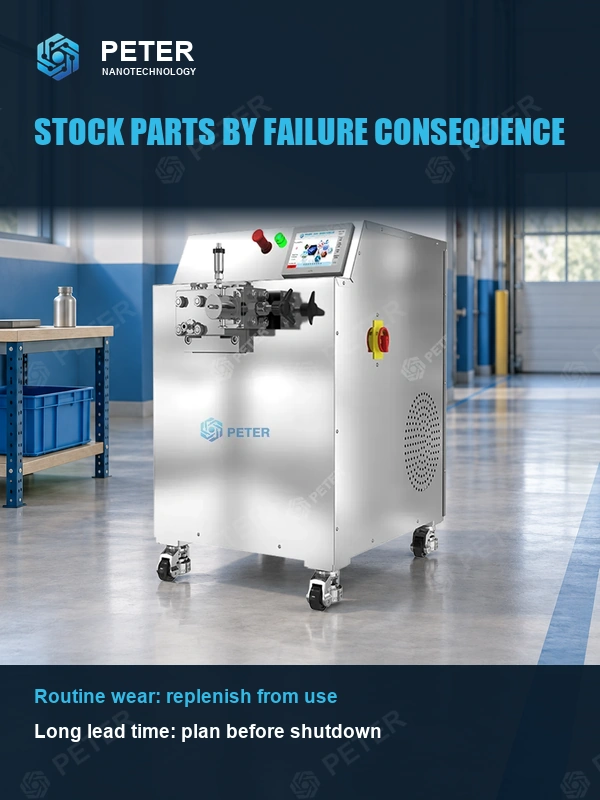
Stock parts by failure consequence
Separate predictable consumables from exceptional failures. Seals may need routine replacement, whereas a damaged plunger or valve component can require an unplanned intervention. Whether either belongs on the shelf depends on the installed design and your operating history; not every homogenizer uses the same parts or replacement procedure.
The Tetra Pak handbook describes a reciprocating high-pressure pump and precision homogenizing components. That arrangement explains why a parts plan should distinguish the pump section from the homogenizing device. A generic kit called “valve spares” is not enough to establish what it will repair.
| Part group | Why it may deserve local stock | What must be confirmed |
|---|---|---|
| Seals and plunger packings | Routine leakage or planned service can consume complete sets | Exact compound, dimensions, quantity per intervention and shelf-life rules |
| Pump-valve seats and associated parts | Wear or damage can interrupt filling and pressure delivery | Installed valve design and approved matched components |
| Homogenizing valve wear parts | Process wear may affect pressure control or product results | Seat, impact element and other parts actually fitted to this revision |
| Plungers | A damaged surface may prevent a durable seal repair | Inspection limits, material and approved replacement procedure |
| Special assemblies and controls | A rare failure can create a long stoppage | Lead time, repair route, interchangeability and consequence of failure |
Use lead time to decide how many sets to hold
A practical reorder point is expected consumption during replenishment plus a reserve for uncertainty. Use replenishment time from ordering to usable stock, including transport, incoming checks and release. If the factory shares a kit across several machines, calculate demand across that fleet rather than treating the same kit as available to each machine independently.
For example, suppose a factory uses two approved packing sets per month, replenishment takes six weeks, and it chooses a reserve of two sets. Using a four-week planning month, the illustrative reorder point is three sets of expected demand plus two reserve sets, or five. This is an inventory example, not a recommended quantity for any CAS PETER model. Low-frequency failures need a separate consequence review because an average monthly usage figure may hide a long outage.
For a production high-pressure homogenizer, ask the supplier to identify the minimum complete repair set as well as individual part numbers. A cheap seal that cannot be installed without another unavailable component is not an effective emergency spare.
Let wear evidence change the maintenance interval
Abrasive formulations can change the economics of homogenizer spare parts. Track the formulation, solids characteristics, pressure, operating hours and replacement reason together. A maintenance log that records only the date cannot show whether a shorter service life follows a new raw material, an inlet problem or an incompatible cleaning agent.
Do not keep increasing inventory to compensate for an unresolved fault. Repeated leakage after fitting new seals should trigger inspection of the mating surfaces and the approved installation method. Pressure instability also deserves a process check: the discussion of cavitation and air entrainment helps separate feed problems from an assumption that the valve is worn.
The HSE pressure-systems guidance links maintenance planning to equipment age, use and environment. Its safety principles are useful here, although the legal applicability of a particular pressure-system regime must be assessed for the actual installation.
Match every part to the installed revision
Purchasing should be able to distinguish a visually similar part from an approved replacement. Record the machine serial number, drawing revision, supplier part number, material or compound, installed quantity and packaging requirements. Keep certificates where the process requires them, and do not mix older and revised components without written compatibility confirmation.
When assessing a different homogenizer configuration, request its own illustrated parts list. A shared brand name or similar external appearance does not establish interchangeability between machines. For precision homogenizer valve parts, also ask whether the supplier requires a matched assembly or permits individual replacement.

| Stock record | Decision it supports |
|---|---|
| Serviceable quantity and allocated quantity | Shows what is actually available for the next repair |
| Order-to-release lead time and supplier revision | Determines when replenishment must start |
| Storage condition and expiry or review date | Prevents aged or damaged seals entering a repair |
| Last failure mode and hours in service | Separates routine wear from recurring faults |
| Approved substitution and repair instructions | Prevents informal material or dimensional substitutions |
Include storage and safe maintenance in the plan
Keep sealed parts in the manufacturer’s specified storage conditions, protected from contamination and damaging exposure. Rotate age-sensitive stock and keep returned, used or suspect components separate from released inventory. An emergency drawer should not become an undocumented source of mixed materials.
Stock availability does not authorize work on a pressurized machine. Repairs need the machine-specific isolation and depressurization procedure, competent personnel and any required post-maintenance checks. For finished pharmaceutical manufacturing, 21 CFR 211.67 requires written cleaning and maintenance procedures and records; it does not prescribe a universal spare-parts quantity. Tie the stock list to that controlled maintenance process.
Frequently Asked Questions
Which spare parts are most critical for a high-pressure homogenizer?
Start with the approved seals, packings and fitted pump-valve and homogenizing-valve wear components. Add any long-lead item whose failure would stop production and cannot be repaired or substituted through an approved route.
How many seals and valve seats should a factory keep in stock?
Use actual consumption during replenishment plus a reserve based on downtime risk. Confirm whether “one set” covers a single position, one pump block or a complete machine intervention before comparing quantities.
When should plungers and impact rings be replaced?
Replace them when inspection reaches the manufacturer’s rejection limits or the approved maintenance schedule calls for replacement. Do not invent a universal hourly interval or use surface appearance alone as proof that a part is serviceable.
How does product abrasiveness change spare-part requirements?
It can increase consumption of exposed wear parts, but the effect depends on the solids and operating conditions. Record service life by formulation and review the failure mechanism before merely increasing the stock quantity.
What information should appear in a homogenizer spare-parts list?
Include the machine serial number, part number and revision, material or compound, quantity per repair, approved supplier and storage requirements. Add lead time and reorder rules so the list supports purchasing as well as identification.
How should spare-parts lead time be included in the maintenance plan?
Use the full time until a part is inspected and ready for use, not just the supplier’s dispatch estimate. Review long-lead items before scheduled shutdowns and retain a reserve where a delay would stop an essential production line.
References
- Tetra Pak Dairy Processing Handbook: Homogenizers
- HSE: Pressure systems
- 21 CFR 211.67: Equipment cleaning and maintenance
Conclusion
A useful spare-parts stock is specific to the machine and the consequences of losing it. Begin with the approved parts list, identify what is consumed during routine service, and then assess the components whose delivery time could extend an unplanned shutdown. Use actual wear records to set quantities, and keep revisions, materials and storage conditions under control. Where failures repeat, investigate the cause instead of treating more stock as the permanent solution. When discussing CAS PETER homogenizer equipment with the supplier, send the serial number, formulation and maintenance history, and request an equipment-specific spare-parts proposal. That gives purchasing a defensible stock plan and gives maintenance parts it can actually use.