

Which Materials Should Not Be Processed in a High-Pressure Homogenizer?
A feed can look pumpable in a beaker and still be unsuitable for a homogenizer. A small fraction of hard particles may obstruct a restricted passage, fibers can behave differently from spherical particles, and a solvent-compatible vessel says nothing about the seals inside the machine. Sending an unfamiliar formulation straight to full pressure makes these uncertainties harder to separate. The useful question is not whether a material is “homogenizable” in general, but whether this formulation fits the feed, wear, chemical and safety limits of this exact configuration. Those limits should be settled before a production sample enters the equipment.
Do not feed dry bulk solids, unidentified contaminants, or a formulation outside the supplier-approved operating envelope into a high pressure homogenizer. Oversized particles, persistent fibers, abrasive slurries, highly viscous feeds and flammable solvents need specific evaluation; some may be processable with suitable preparation and equipment, while others require a different method. There is no universal maximum particle size or viscosity that applies to every valve, pump and formulation. Provide the full composition, temperature-dependent flow behavior and coarse-particle information, then agree on feed preparation, trial conditions and acceptance limits in writing.
Check the coarse tail before a trial
An average particle size does not describe the largest objects entering the pump. Ask how the sample was collected and whether sediment, foreign material or occasional agglomerates were included. A particle-size result from a diluted, carefully selected aliquot can miss the coarse fraction that matters most to the equipment.
The Tetra Pak handbook describes narrow passages in a homogenizing device. Its dairy example is a process description, not a universal allowable feed-size specification. The relevant limit must come from the supplier for the installed pump and valve arrangement, including particle shape, deformability and the possibility of agglomerates forming during storage.
For a proposed high-pressure homogenizer trial, send a representative sample and describe mixing and holding conditions. Do not remove inconvenient large particles from the trial sample unless the production process will remove them too.

| Feed condition | Why it needs attention | Decision before trial |
|---|---|---|
| Dry powder without a liquid feed phase | It is not a defined pumpable feed | Prepare an approved dispersion or choose another process |
| Oversized hard particles or foreign debris | Can obstruct or damage flow passages | Confirm the supplier’s feed limit and a controlled removal method |
| Long fibers or stringy material | Shape can matter more than the measured equivalent diameter | Obtain application-specific acceptance or use a different preparation method |
| Abrasive solids | Can increase wear and contaminate product with wear debris | Review wear-part materials, service life and contamination limits |
| Very viscous or yield-stress feed | May not replenish the pump reliably under actual inlet conditions | Validate feeding, temperature and permissible viscosity conditions |
| Flammable or reactive formulation | Introduces hazards beyond size reduction | Complete equipment, chemical and installation safety review |
Separate chemical compatibility from wear resistance
A hard wear part is not automatically resistant to the liquid carrying the solids. Likewise, a chemically resistant elastomer can be unsuitable for a particular dynamic seal duty. A homogenizer material compatibility review needs the formulation and cleaning chemicals, their concentrations, temperatures and exposure times, together with the actual metal grades and seal compounds.
The Trelleborg chemical-compatibility tool is useful for screening material and chemical combinations. It cannot certify an assembled homogenizer or replace a supplier assessment of pressure, motion, mixed solvents and cleaning cycles. In pharmaceutical service, 21 CFR 211.65 requires product-contact surfaces not to alter the product beyond established requirements; “stainless steel construction” alone is not that evidence.
Set a product-contamination criterion as well as a mechanical one. A slurry that runs without blockage but produces unacceptable wear debris has not passed the trial. Inspect the relevant parts through the approved procedure and agree how product contamination will be evaluated.
A solvent review must cover the whole installation
Do not assume a standard machine can process a flammable solvent because its liquid-contact metals appear compatible. The assessment also covers electrical equipment, potential ignition sources, ventilation, bonding and grounding where required, release conditions and the intended installation. Solvent vapor hazards can change with temperature, and a pressurized leak is not equivalent to handling an open beaker.
The HSE pressure-systems guidance identifies released flammable liquids or gases as a fire hazard. Applicable hazardous-area and pressure-equipment requirements depend on the jurisdiction and system. Ask qualified personnel to establish the required configuration; do not improvise a solvent trial to discover whether the standard machine is suitable.
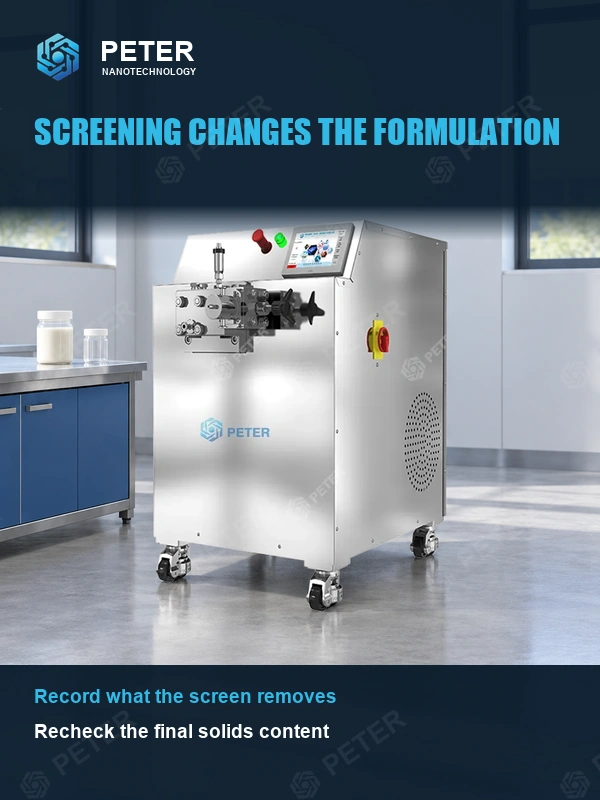
Screening changes the formulation
Pre-screening can remove unwanted coarse material, but it can also remove an intended ingredient. Record screen retention, rejected mass and the resulting solids concentration. If the retained fraction contains a functional component, the processed sample may no longer represent the product being developed.
Pre-mixing serves a different purpose: wetting powders and making the feed more uniform. It does not prove that every agglomerate is safe for the downstream valve. A sensible trial sequence establishes the homogenizer feed requirements first, then selects preparation steps that satisfy them without changing the product specification. The supplier must confirm the requirements for the chosen model rather than infer them from a product photograph.
| Trial record | What to agree |
|---|---|
| Composition and preparation | Actual formulation, mixing order and any removed fraction |
| Feed description | Temperature, solids basis, viscosity method and coarse-particle evidence |
| Machine configuration | Installed wetted materials, valve arrangement and supplier-approved limits |
| Pass/fail conditions | Feed stability, product quality, temperature and acceptable wear |
| Stop and review conditions | Leakage, abnormal noise, unstable pressure or a blocked feed route |
Treat the trial as an acceptance test, not a demonstration
The most useful high pressure homogenizer limitations are the ones recorded for the actual formulation. Define what successful processing means before starting: a quality target, reliable feeding, acceptable temperature and an acceptable maintenance burden. One successful small sample does not establish the entire production operating range.
If pressure fluctuates or output falls, follow the approved stop procedure and investigate the feed path rather than increasing pressure to force material through. The site’s guide to cavitation and entrained air explains why inlet behavior belongs in that investigation. Resume only when the cause and permitted operating conditions are clear.
Frequently Asked Questions
Which materials should not enter a high-pressure homogenizer?
Do not introduce dry bulk solids, foreign debris, unknown chemicals or feeds outside the approved machine envelope. For viscous, fibrous, abrasive or solvent-based formulations, obtain a specific assessment rather than treating the category as universally permitted or prohibited.
Can fibrous or oversized particles damage the homogenizer valve?
Yes, unsuitable fibers or large hard particles can obstruct passages or damage components. Ask for limits that address shape and coarse contaminants, not just an average particle diameter.
How do abrasive solids affect homogenizer wear?
They can accelerate wear in exposed components and change maintenance requirements. Evaluate both component condition and any unacceptable contamination of the product during a representative trial.
Can flammable solvents be processed in a standard homogenizer?
Only if the complete equipment and installation are explicitly suitable for the formulation and its hazards. A standard model listing or a stainless-steel housing does not establish that suitability.
What feed properties should be checked before a homogenizer trial?
Provide composition, temperature, solids loading, viscosity with its measurement conditions, coarse-particle information and any gas content or reactivity concerns. Include the cleaning chemicals and intended production holding time.
When is pre-screening or pre-mixing required?
Use them when they are needed to meet the confirmed feed specification and preserve the intended formulation. Record removed solids and preparation conditions so a successful laboratory trial can be reproduced in production.
References
- Tetra Pak Dairy Processing Handbook: Homogenizers
- Trelleborg Sealing Solutions: Chemical compatibility check
- 21 CFR 211.65: Equipment construction
- HSE: Pressure systems
Conclusion
Feed approval should come before pressure selection. Start with the material’s full composition and the particles that are easiest to overlook, then check how it reaches the pump under real temperature and holding conditions. Evaluate chemical compatibility, wear and installation hazards separately; passing one review does not settle the others. If screening or pre-mixing is required, make it a controlled production step and confirm that it does not change the intended formulation. When discussing a CAS PETER homogenizer application, provide a representative sample and written acceptance criteria. The outcome should be a defined operating envelope, a justified preparation method, or a clear decision to use another process.