

Microalgae Lipid Extraction After Homogenization: Measure Recovery Beyond Cell Rupture
Microalgae lipid extraction after homogenization should be evaluated by the target lipid recovered from a defined biomass input, alongside cell disruption and downstream separation. A high cell rupture percentage does not by itself establish a high usable oil yield. Species, cultivation history, slurry concentration, extraction chemistry and handling losses all influence the result. The practical objective is to find a treatment that makes the desired lipid fraction accessible while keeping extraction, clarification, temperature control and energy demand workable for the complete process.
This guide addresses recovery after mechanical treatment of a wet microalgal feed. It does not provide a solvent handling protocol or claim that one pressure suits every strain. For a broader introduction to mechanical release of intracellular material, see our high-pressure cell lysis guide.
Define the lipid product before defining success
“Lipid yield” can refer to total extracted material, neutral lipids, a selected fatty acid fraction or another analytical target. These are different endpoints. Decide which fraction matters to the intended product, which analytical method will measure it, and how impurities and residual moisture will be handled in the reported mass. A larger crude extract is not necessarily a larger quantity of the desired molecule.
Set the biomass basis at the same time. Wet paste mass is convenient for handling but changes with water content. A dry biomass reference makes treatment groups easier to compare, provided the dry matter method is documented and representative. Retain the wet feed quantities as well, because water content affects pumping, extraction and the amount of liquid handled downstream.
Define the process boundary. If recovery is measured only in a small analytical extraction, call it analytical extractability. If the objective is oil recovered after a proposed separation train, measure that output separately. Using the same word for both can make a promising laboratory screen look like a completed production demonstration.
Characterize the feed as a biological material
Record species and strain where available, cultivation and harvest conditions, storage duration, dewatering method and slurry preparation. A fresh wet culture and dried material that has been rehydrated should not be treated as equivalent controls. Preserve the feed history in the trial file so later changes can be investigated rather than attributed automatically to the machine.
Inspect the suspension for settling, clumps and entrained gas before processing. Confirm that the equipment can accept the actual feed and that sampling is representative. A top sample from a settling vessel may contain less biomass than the liquid reaching the pump, which can distort both disruption and recovery calculations.
The review of microalgal disruption and extraction methods describes how species, cellular structures and extraction strategy influence recovery. Its comparisons help identify variables to control; they do not establish a universal pressure, pass count or extraction yield for a new feed. Use literature to design questions that your own trial must answer.
Separate cell integrity from material release
Choose a cell integrity method appropriate to the organism and the available equipment. Microscopy, counting and other analytical methods may describe different aspects of the treated population. Define what qualifies as an intact cell, how fields or subsamples are selected and how ambiguous structures are handled. Keep untreated material as a reference for the scoring method.
Particle size and turbidity can provide supporting observations, but neither is automatically a direct count of ruptured cells. Fragments, released material and aggregation can change the signal. If an indirect method is used, explain what was measured and whether its relationship with disruption has been established for this material.
Collect material release data separately from the cell integrity score. For example, a chosen lipid assay can track target availability after a fixed extraction procedure, while a cell assessment documents mechanical changes. Agreement between the two is informative; disagreement is also useful because it identifies a limitation that a single result would conceal.
A Wageningen University thesis record on mild microalgae disruption frames disruption as part of an integrated biorefinery. Its abstract emphasizes product recovery and process evaluation. That is the relevant design lesson here; the university record is not evidence that a particular CAS PETER configuration has been tested with your species.
Hold the extraction procedure constant during the first screen
Use one defined extraction method to compare the first set of homogenization conditions. Record the biomass quantity, liquid composition, extraction time, temperature and separation sequence. If the extraction procedure changes between groups, the experiment no longer isolates the contribution of mechanical treatment.
Run an untreated control through the same handling sequence. Include the blanks and recovery controls appropriate to the analytical method. Where a separate reference extraction is used to estimate the total available target, identify it as a reference method and explain its limitations. It should not be assumed to recover every lipid quantitatively without supporting validation.
Solvent selection and safe handling require an approved laboratory procedure, compatible equipment and the relevant facility controls. Do not introduce an extraction solvent into a homogenizer simply because it appears in a published analytical method. Confirm wetted material compatibility, operating limitations and the intended separation of processing and extraction steps before any trial.
Build a whole-process observation table
The following qualitative table connects common observations with the next useful investigation. It is a planning aid rather than a set of measured outcomes or guaranteed mechanisms. Interpret it using the actual target assay and feed records.
| Observation | Possible interpretation to investigate | Useful next measurement |
|---|---|---|
| More ruptured cells but unchanged extracted target | Access is no longer the only limitation, or the assay misses a relevant fraction | Compare extraction conditions and target distribution in retained streams |
| More crude extract but little increase in desired lipid | Additional non-target material may be contributing | Measure composition rather than extract mass alone |
| Higher analytical recovery but difficult phase separation | Treatment may help access while increasing downstream handling difficulty | Record settling, separation time and target retained in interfaces or solids |
| Better recovery with a much warmer outlet | Temperature history may contribute to the result or quality change | Compare cooled samples and assess the target quality attributes |
| Different recovery from nominally similar batches | Biomass composition or preparation may have changed | Repeat a retained reference feed and review cultivation and dry matter records |
Track mass balance through the separation steps
Measure the quantities of the streams that matter to the process boundary. Record the recovered extract, residual solids, aqueous fraction and any interface or emulsion layer that is removed. Analyze selected retained streams when a material balance does not close. Discarded material can contain target lipid even when the collected extract appears satisfactory.
Label the denominator beside every recovery result. A mass of target per dry biomass input answers a different question from target concentration in the final extract. The first describes yield on a feed basis; the second describes composition or concentration. Report both when they drive different development decisions, rather than letting dilution make a process appear better.
Account for transfer and sampling losses consistently. Small laboratory vessels can lose a meaningful fraction of material on walls or in tubing. Record rinsing and whether rinse material is included in the final assay. A mass balance with clear uncertainties is more useful than an apparently precise recovery percentage that ignores unmeasured streams.
Record the operating burden with the recovery result
For each candidate treatment, record actual pressure, flow behavior, pass collection method, inlet and outlet temperatures and the amount of material processed. Where energy is measured, identify the meter boundary: the homogenizer alone, cooling equipment, or a wider system. Results with different boundaries should not be compared as if they measured the same demand.
Avoid claiming an energy optimum from pressure alone. Feed concentration, flow, motor loading, cooling and downstream separation can change the practical comparison. A slightly higher recovery may be unattractive if it creates a much larger separation burden or requires unacceptable temperature control. The decision should use the selected product objective and the complete measured process.
Our guide to viscosity, solids and feed particle size explains factors that affect practical capacity. For microalgal slurries, describe the feed that will actually be processed rather than quoting a water-based equipment capacity as a guaranteed production rate. Equipment suitability and trial conditions must be confirmed with the supplier.
Use an educational overview to understand the process context
The Los Alamos National Laboratory video below introduces algae as a feedstock and explains why cultivation, harvesting and conversion belong in the same development discussion. It is background for the whole-process viewpoint, rather than a homogenizer operating procedure or evidence of a particular lipid recovery result.
Educational source: Los Alamos National Lab. Watch the lesson on YouTube.
When comparing the video with a laboratory plan, identify which operations fall inside your experiment. A disruption screen may intentionally leave cultivation and final conversion fixed. That is a valid boundary, provided the report states it and does not extend the findings to untested operations or industrial economics.
Plan a representative equipment trial
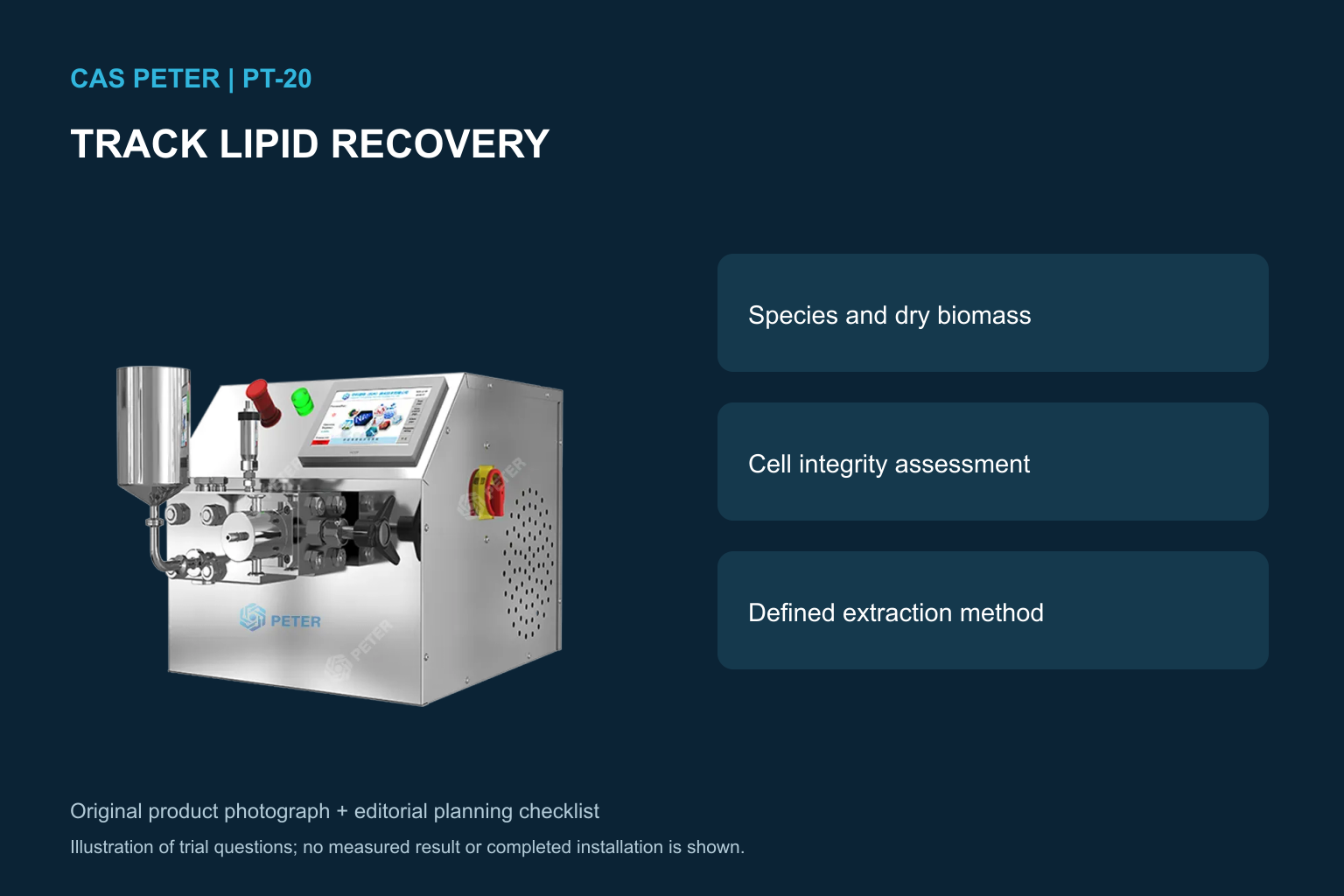
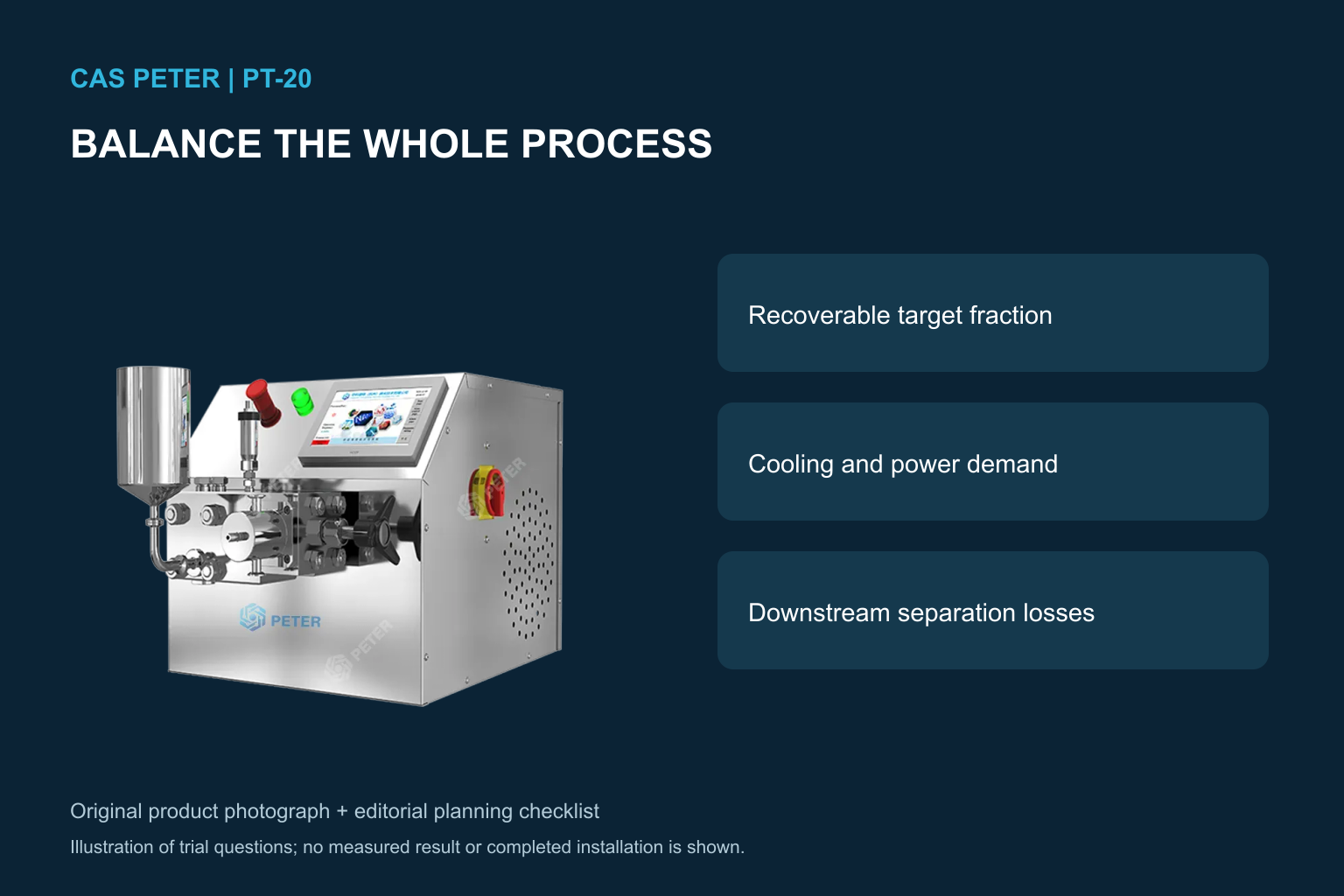
The CAS PETER PT-20 product page is a starting point for discussing a laboratory homogenization trial. Confirm the actual feed compatibility, sample quantity, configuration and cooling arrangement before selecting conditions. The product photograph in this article identifies the model; it does not show a completed microalgae installation or measured performance.
Send the supplier the species, slurry concentration, feed preparation, intended target and analytical plan. Ask how separate passes will be collected and how equipment hold-up will be handled in the mass balance. Define what material is needed for cell assessment, extraction, quality testing and repeat analysis before allocating the batch.
If repeat passes become difficult because released material changes the slurry, investigate that change explicitly. Our viscous cell lysate guide provides related process questions, while the mechanism in a microalgal feed still needs its own evidence. Stop adding treatment when the relevant benefit has plateaued or the operating burden outweighs a reproducible gain.
Frequently asked questions
Does complete cell rupture guarantee complete lipid extraction?
No. Extraction chemistry, target location, analytical method and downstream losses still influence recovery. Measure the desired lipid on a defined biomass basis and retain relevant process streams for investigating losses.
Should microalgae recovery be reported on wet or dry biomass?
Keep wet quantities for process handling and report a clearly defined biomass basis for comparisons. A dry biomass reference can help separate water-content changes from recovery changes, provided the dry matter method and sampling are documented.
Can an analytical extraction result predict production oil yield?
It can help screen treatments, but it does not by itself establish production recovery. A representative separation process, material balance and product quality assessment are needed before extending the result to the proposed production boundary.