

How Do Viscosity, Solids Loading, and Feed Particle Size Affect Homogenizer Capacity?
A machine’s listed flow rate does not tell a factory how much accepted formulation it will produce in a shift. The feed may become harder to pump after cooling, solids may settle during a hold, or an occasional coarse agglomerate may interrupt an otherwise stable run. Several passes and cleaning time can reduce net output even when the pump reaches its rated flow. These are different limitations, and each calls for a different response. This guide explains how viscosity, solids loading and feed particle size affect the capacity assessment, and how to turn a supplier trial into a production estimate that includes the actual formulation and operating schedule.
Homogenizer capacity depends on reliable inlet filling, the permitted pressure and power envelope, feed suitability and the quality achieved per pass. Higher viscosity or solids loading can make feeding more difficult, but there is no universal percentage reduction that applies to every formulation. Coarse particles and fibers introduce a separate passage and wear question; raising pressure does not make an unsuitable feed acceptable. Validate capacity using the production formulation across its expected temperature and composition range. Report machine flow and accepted output separately, including the pass arrangement, interruptions, recovery and any cleaning time included in the production estimate.
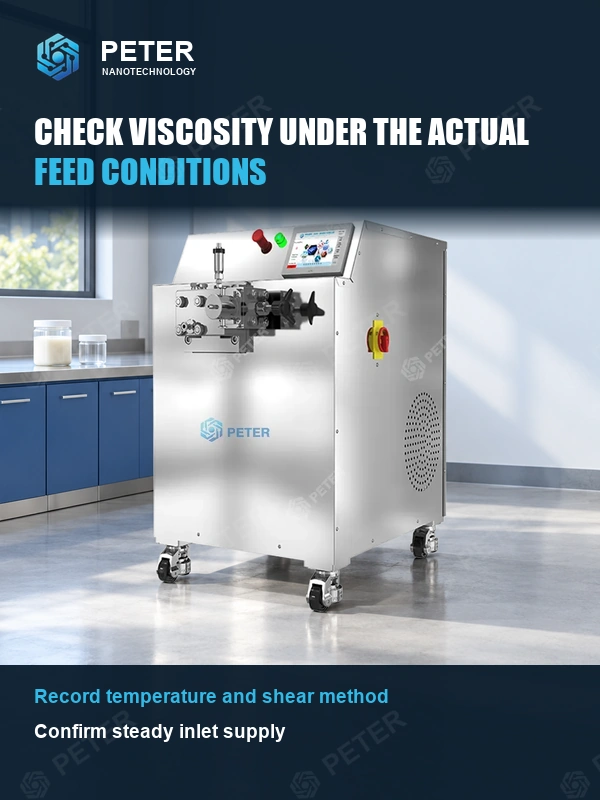
Check viscosity under the actual feed conditions
A viscosity number without temperature and measurement conditions can be misleading. A shear-dependent formulation may show different apparent viscosities under different measurement conditions, and a material with yield stress may resist initial flow even when a single reported number looks manageable. Ask how the viscosity was measured and whether it represents the condition at the machine inlet.
The Tetra Pak handbook describes the positive-displacement pump basis of homogenizer capacity and the tradeoffs between pump configuration, pressure and flow. It also discusses inlet pulsation and cavitation. Reliable filling is therefore part of the capacity question; a nominal displacement does not prove that an unfamiliar feed will be supplied satisfactorily.
For a homogenizer viscosity trial, record feed temperature, preparation, holding time and the viscosity method alongside the measured flow. A warm, freshly mixed laboratory sample may not represent a cooler production batch near the end of a holding period.
| Feed property | Possible production consequence | What to measure or confirm |
|---|---|---|
| Higher apparent viscosity | Increased difficulty supplying the inlet and maintaining stable filling | Viscosity method, feed temperature, inlet conditions and steady flow |
| Yield stress or time-dependent behavior | Start-up and restart may differ from an established run | Holding history, preparation and repeatable start conditions |
| Higher solids loading | Changes in rheology, settling, abrasion or feeding | Solids basis, batch uniformity, feed stability and wear considerations |
| Coarse particles or fibers | Obstruction risk or incompatibility with the permitted feed | Coarse-tail evidence, shape and supplier-approved limits |
| Entrained gas | Unstable feeding and uncertain volumetric output | Foam or gas condition and the approved feed preparation method |
Solids content is not a substitute for a rheology measurement
Two feeds at the same solids percentage can behave very differently. Particle shape, interactions and the liquid phase all contribute. State whether solids are reported by mass or volume, and use a consistent sampling method. A top-of-tank sample can understate what the pump sees if the formulation settles.
Abrasive solids may also reduce practical availability through maintenance, even if instantaneous flow is acceptable. Separate that long-term effect from a short-term throughput test. A supplier should know both the feed properties and the acceptable contamination and wear limits before recommending a configuration.
The earlier guide to cavitation and entrained air is relevant when capacity falls with unstable pressure or foam. Do not assume that every low-flow event is caused by viscosity; check the approved inlet arrangement and the condition of the feed.
Check the largest particles before increasing pressure
The relevant homogenizer feed particle size is not necessarily the average reported by an instrument. Record the coarse tail, hard agglomerates, fibers and possible foreign material. Describe how representative samples were obtained and whether sample preparation changed the objects that could enter the machine.
Pre-mixing can improve wetting and feed uniformity, while pre-screening can remove a problematic coarse fraction. Neither should be added without considering the formulation. If screening removes an intended ingredient, measure the rejected amount and confirm the resulting product still meets its composition requirements.
Pressure is selected within the approved machine and product envelope to achieve a processing result. It is not a general remedy for poor inlet supply or particles outside the feed specification. The HSE pressure-systems guidance emphasizes knowing the fluid characteristics and safe operating limits; a capacity test must remain within those limits.
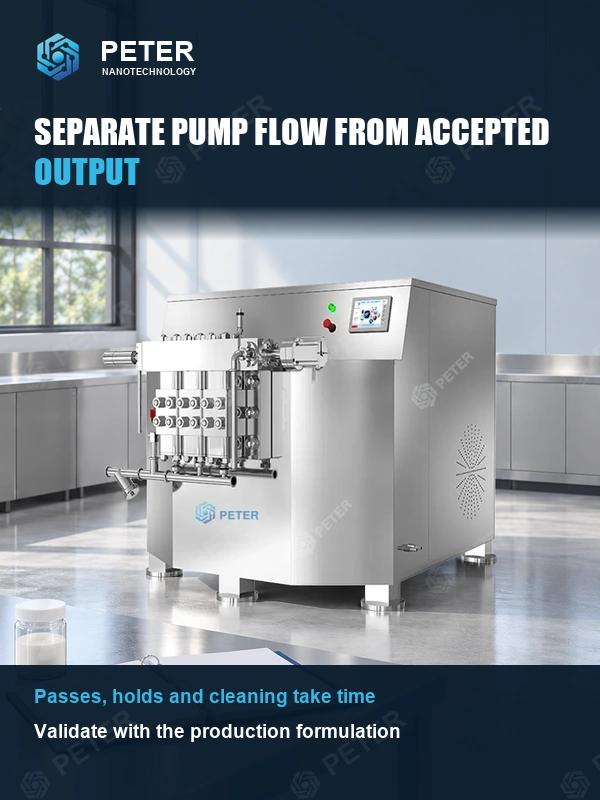
Separate pump flow from accepted output
For a separated batch-pass process, a useful first estimate of pumping time is batch volume multiplied by pass count, divided by measured flow for that formulation. Then add the other operations inside the chosen production boundary. This estimate assumes the specified flow can be sustained and does not describe the residence-time distribution of tank recirculation.
Consider a hypothetical 500 L batch requiring three complete separate passes at a measured 500 L/h. Pumping alone takes three hours. If preparation, transfer and cleaning included in the estimate add two hours, and accepted recovered product is 475 L, net accepted output is 475 / 5 = 95 L/h over that defined cycle. These are arithmetic examples, not PT-500 or PT-1000 performance claims.
When reviewing a production high-pressure homogenizer capacity, request the measured product flow, required pass arrangement and acceptance data together. A quotation should make clear which conditions support its flow statement and which operations are outside its scope.
| Capacity figure | Useful for | What must not be silently omitted |
|---|---|---|
| Instantaneous machine flow | Evaluating a stable operating point | Actual formulation, temperature, pressure and configuration |
| Average processing flow | Estimating the processing portion of a batch | Interruptions, starts and the defined pass arrangement |
| Accepted output per batch cycle | Planning production and delivery | Recovery, rejected product and included ancillary time |
| Accepted output per shift | Comparing staffing and operating plans | Changeovers, maintenance and the actual available operating hours |
Design the trial around the expected production range
Use the actual formulation and identify the conditions likely to be most demanding: a lower permitted feed temperature, the upper solids range, a longer hold or a restart after settling. Do not combine hypothetical worst cases indiscriminately; choose a justified test range that represents the process you intend to operate.
Record stable flow together with pressure, feed and outlet temperature, pass arrangement, product quality and recovery. Agree how unexpected leakage, noise, poor feeding or excessive temperature will be handled through the supplier-approved procedure. Include an assessment of whether the trial duration is enough to reveal the limitation being investigated.
For homogenizer viscosity comparisons, hold the measurement method and sample history consistent. The NIST measurement-uncertainty guidance supports the general need to account for measurement uncertainty; it does not supply a universal viscosity limit or flow correction for this equipment.
Put capacity conditions into the purchase specification
The purchase specification should name the formulation or agreed representative feed, operating range, quality target and basis for reporting output. Clarify who supplies the inlet system, cooling, preparation equipment and other required services. If these are not part of the equipment quotation, they still belong in the project’s capacity and cost assessment.
A successful trial should produce a reproducible set of conditions, not just a promising photograph or a peak reading. Keep the raw data and define what changes require a new assessment. This gives production a usable operating basis and prevents a later raw-material change from being mistaken for unexplained machine underperformance.
Frequently Asked Questions
How does viscosity affect homogenizer capacity?
It can make inlet feeding and pump filling more difficult, depending on temperature, rheology and the feed arrangement. Measure actual flow with the formulation rather than applying a universal viscosity correction to the rated flow.
How do solids loading and feed particle size affect flow rate?
Solids can change rheology, settling and wear, while unsuitable coarse particles can interrupt or prevent processing. Evaluate these effects separately and obtain the supplier’s feed limits for the installed configuration.
Can a high-viscosity product reduce homogenizer throughput?
Yes, if it prevents stable feeding or requires different permitted operating conditions. The effect is application-specific, so include representative temperature and holding conditions in the trial.
How does feed viscosity change pressure requirements?
It can affect flow resistance and the behavior of the feed, but the appropriate homogenization pressure must be established for the product and machine. Increasing pressure is not an approved cure for inadequate inlet supply.
When should a feed be pre-mixed or pre-screened?
Use them when needed to meet the confirmed feed specification and maintain a representative, uniform feed. Verify that screening or preparation does not remove or change an ingredient required by the product specification.
How should capacity be validated with a real production formulation?
Run a defined trial over the expected formulation and temperature range, with agreed quality and stop criteria. Report sustained machine flow, passes, accepted recovery and the time boundary used for the production estimate.
References
- Tetra Pak Dairy Processing Handbook: Homogenizers
- HSE: Pressure systems
- NIST Technical Note 1297: Measurement uncertainty
Conclusion
Capacity is a property of the machine and the process together. Establish the feed’s real viscosity, solids characteristics and coarse-particle behavior, then verify that the inlet arrangement can supply it consistently within the approved operating envelope. Measure the quality achieved per pass and convert flow into accepted output using a clearly defined production cycle. Keep trial conditions representative of the factory, including holding and restart conditions that affect the feed. For a CAS PETER homogenizer selection, provide those conditions and request a documented trial basis for the capacity estimate. That makes the quotation more useful for production planning and exposes the preparation, cooling or maintenance requirements that a peak flow figure can hide.