

Pigment Dispersion by High-Pressure Homogenization: An Ink Trial Checklist
Pigment dispersion by high-pressure homogenization should be judged by the performance of the finished ink, not by a small average particle size alone. A useful trial starts with a properly wetted, compatible feed and evaluates coarse material, viscosity, filtration, color development and storage behavior. Pressure treatment cannot substitute for selecting a suitable pigment and dispersant system. It also cannot establish printability without an application test. This guide outlines how to compare a homogenization route against the existing dispersion process while keeping formulation, sample preparation and the final ink requirements clear.
Identify the material that needs to be dispersed
A pigment dispersion is a solid-in-liquid system. Dissolving a dye is a different operation, and evidence for a liquid emulsion does not demonstrate breakup or stabilization of pigment agglomerates. Describe the pigment grade, surface treatment, vehicle, dispersant and other ingredients before asking which machine will give the desired result.
Clarify whether the objective is deagglomeration, a change in the coarse fraction, or another measurable improvement. Do not assume that an apparent reduction reported by one particle-size method proves fracture of primary crystals. The physical interpretation needs appropriate supporting evidence and a clear account of how the measurement sample was prepared.
The Colour Index introduction to pigments, prepared by the Society of Dyers and Colourists, distinguishes pigment structures and discusses dispersion. It provides useful terminology for the trial brief. It does not supply a universal milling recipe or establish compatibility with a specific homogenizer configuration.
Establish a stable baseline formulation
Retain the current process as a reference where one exists. Prepare the reference and candidate dispersions using the same ingredient lots and an equivalent composition. Record any change in dispersant, water, solvent or binder. Otherwise, an apparent equipment advantage may come from a formulation difference rather than the pressure treatment.
Define how the pigment is added and wetted before homogenization. Include mixing order, preparation time and any removal of coarse contaminants. Keep foam and entrained air observations in the record. A feed that changes during holding can make the first and last processing conditions incomparable even when the equipment settings are accurately recorded.
A study on polymer-dispersed pigments in water-based ink examined relationships involving dispersant characteristics, viscosity and printed properties. Its results reinforce the need to measure application behavior rather than infer it from size alone. They do not predict the behavior of every polymer-pigment pair or identify an optimum for a new ink.
Confirm feed and equipment compatibility
Share solids content, viscosity behavior, coarse-particle information and the complete liquid composition with the supplier. Ask about the approved operating envelope for the actual feed, including abrasiveness and wetted-material compatibility. A machine rated for one suspension is not automatically suitable for a different pigment loading or solvent mixture.
For a solvent-containing system, obtain configuration-specific confirmation of the relevant installation and operating requirements before testing. Do not infer solvent suitability from the equipment’s general application list. The trial plan must follow the manufacturer’s approved procedures and the site’s material-handling controls.
Define what happens if abnormal pressure, flow, temperature or blockage is observed. Do not use a higher setting as the default response to an unsuitable coarse feed. Preparation, composition and the flow path must be reviewed together. Retain records of any intervention, since it may change both the operating history and the material represented by the final sample.
| Trial question | Measurement or observation | What to hold consistent |
|---|---|---|
| Is coarse material controlled? | Appropriate distribution or coarse-particle test | Sampling and dilution method |
| Does the ink flow as required? | Viscosity under defined conditions | Temperature and measurement history |
| Does it produce the target appearance? | Controlled print or drawdown comparison | Substrate, film and drying method |
| Is filtration practical? | Defined filtration test and retained material | Filter, sample quantity and conditions |
| Does the result persist? | Storage and redispersion observations | Container, time and temperature |
This is an application-testing checklist, not a set of numerical ink specifications. The acceptance limits must come from the intended printing process and its qualified test methods.
Compare processing routes on equivalent terms
A bead mill and a high-pressure homogenizer apply different processing conditions. Compare them using a common feed and final ink requirement rather than treating elapsed treatment time as an equivalent exposure. Record the complete preparation and processing sequence for each route.
The Western Michigan University pigment-dispersion study investigated milling variables and pigment concentration in a laboratory bead-mill process. It provides a useful example of controlled dispersion experiments, while remaining evidence for that process. It should not be cited as a direct demonstration of high-pressure homogenizer performance.
For the candidate pressure route, retain configuration, pressure, flow arrangement, pass definition, feed and discharge temperatures, and recovered quantities. Identify any step that changes concentration or removes a fraction. A sample that meets an analytical endpoint only after substantial rejection needs to be evaluated with that loss included.
Look beyond the average particle size
Use a measurement appropriate to the dispersion and retain the distribution, including the coarse region relevant to the application. Explain the preparation method and whether filtration or centrifugation preceded analysis. A preselected analytical fraction cannot automatically represent the entire recovered batch.
If different methods give different results, review what each method measures before deciding which value is correct. A coarse-particle inspection and an optical distribution answer different questions. Keep an instrument’s stated interpretation distinct from physical conclusions about pigment structure or printing reliability.
The site article on DLS and laser diffraction after homogenization explains complementary measurement issues. Use it to frame the method discussion, then select and qualify the analytical approach for the actual ink. Do not convert a result for a dilute analytical sample into an unqualified statement about concentrated-product behavior.
Test color and print response under controlled conditions
Compare color using a consistent application method. Record the substrate, deposited film or printing conditions, drying procedure and reference. Differences in application thickness, substrate absorption or drying can affect appearance independently of the dispersion route.
Keep the distinction between visual inspection and instrumental measurement clear. If the development decision depends on a measured color or optical property, state the instrument conditions and the comparison basis. An attractive photograph is useful for documentation but does not replace a controlled assessment.
Chemical compatibility also matters. The American Chemical Society video below discusses a pigment whose behavior depends on its formulation environment. That cosmetic example is included to explain why pigment chemistry should be checked; it is not an ink formulation recommendation, a homogenization demonstration or evidence of print performance.
Include filtration and storage in the decision
If the intended process uses filtration, test it with an agreed filter and a defined amount of ink. Record flow or processing time, retained material and any changes to the collected dispersion. A result obtained through progressively finer filters can hide a substantial loss of pigment and alter color strength.
Monitor the dispersion after a defined storage interval using a method relevant to the project. Inspect settling and redispersion behavior and repeat the selected analytical tests where appropriate. Do not equate the absence of visible sediment with complete stability, or claim commercial shelf life from a brief development observation.
When a freshly processed sample changes during storage, review formulation and processing together. Additional pressure treatment may reduce initial agglomerates without providing adequate stabilization. The next useful experiment may concern the dispersant system or preparation sequence rather than a further increase in processing intensity.
Assess recovery, wear and reproducibility
Retain a material balance that identifies feed, recovered ink, samples and retained or rejected fractions. If the quality comparison uses a selected fraction, state its proportion of the batch. This keeps the commercial assessment aligned with the material that would actually be available for use.
For an abrasive pigment, discuss the inspection and maintenance plan for the intended duty. Ask which components require review and what evidence will be collected during a representative trial. Do not infer long-term wear performance from a short laboratory run or the appearance of a single finished sample.
Repeat the promising condition using an independently prepared feed. This tests the reproducibility of preparation and processing together. Keep unsuccessful conditions and observations in the record so the operating window is defined by evidence rather than a single favorable result.
Prepare the supplier trial brief
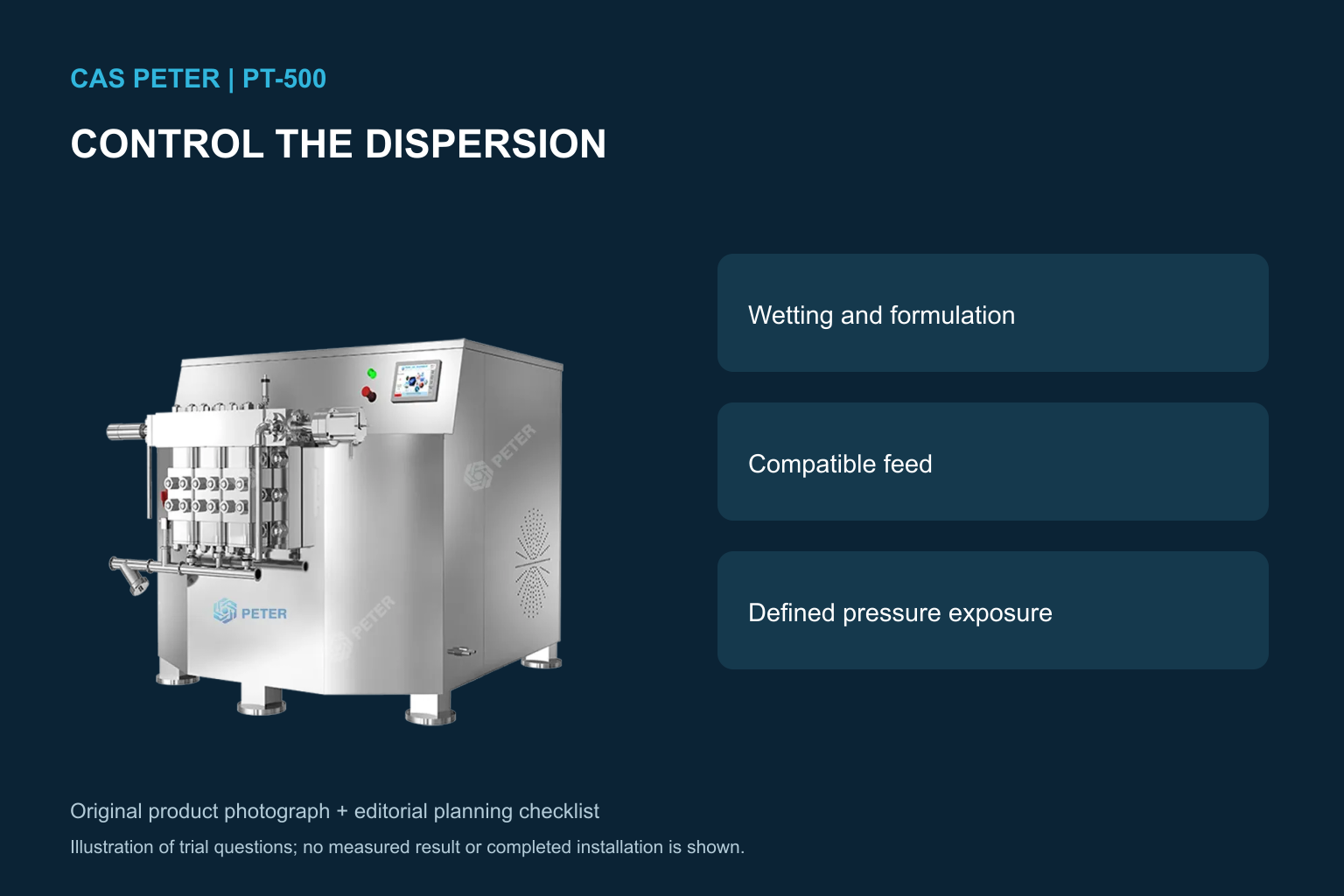
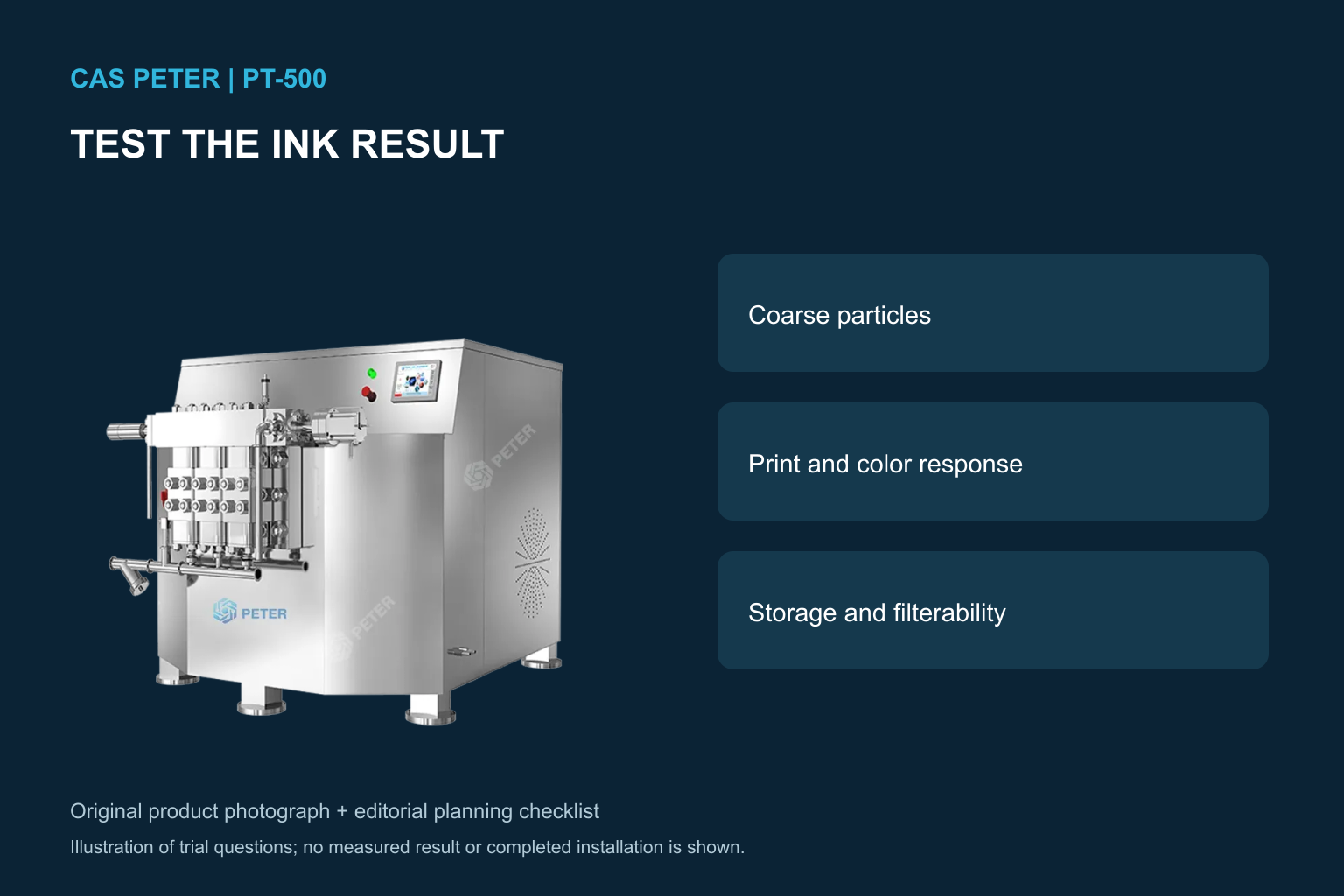
The CAS PETER PT-500 production model is a reference for an industrial dispersion discussion, subject to confirmation of the specific pigment, vehicle and operating configuration. The product photograph identifies the machine; it does not show that this ink has been tested or that every chemical feed is compatible.
Use the broader high-pressure dispersion-methods guide for process context and the graphene verification article for the separate distinction between dispersion evidence and material-structure claims. Neither replaces the ink-specific application and storage tests described here.
Provide the formulation, current process, available quantity, target printing application and the acceptance matrix. Request the actual pressure, temperature, recovery and sampling records from a representative trial. A useful decision compares accepted ink quality and practical recovery across routes, with unresolved compatibility or scale-up questions recorded explicitly.
Educational video: pigment chemistry and formulation
The following American Chemical Society Headline Science video explains the formulation context of ultramarine blue. It supports the chemical-compatibility discussion and is independent of homogenizer suppliers. Its application is cosmetics, so it should not be interpreted as a process demonstration for aqueous printing inks.
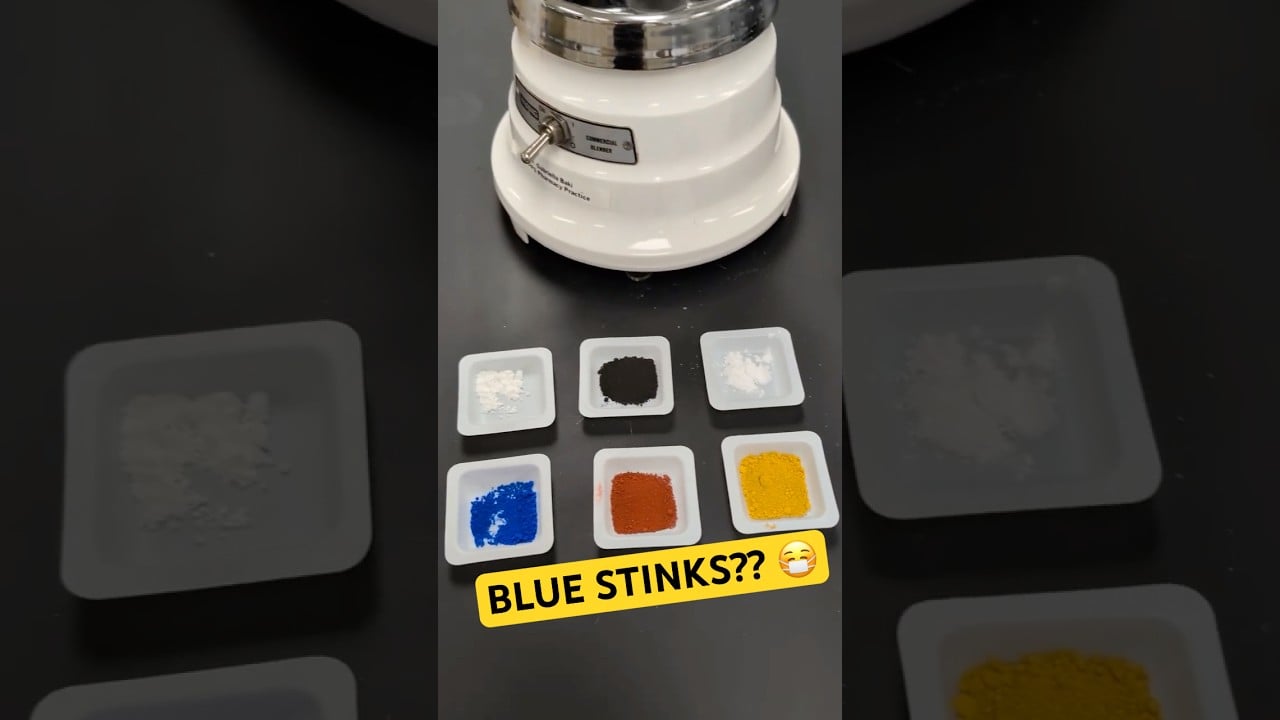
Educational source: American Chemical Society. Watch the lesson on YouTube.
Frequently asked questions
Can homogenization replace a dispersant?
Do not assume so. Mechanical treatment and formulation stabilization answer different questions. Evaluate the complete pigment-vehicle-dispersant system using the intended storage and application tests.
Does a lower average size guarantee better printing?
No. Coarse material, rheology, filtration, substrate interaction and formulation chemistry can affect the result. Compare controlled print or drawdown tests alongside the distribution.
Should a failed dispersion trial always use more pressure?
No. Review compatibility, feed preparation, sampling and stabilization first. Change processing only within the confirmed operating window and when the next experiment answers a defined question.