

What Is Homogenization? Beginner Guide to Homogenisers
When a formulation engineer in Singapore increases mixer speed to rescue a visibly separating emulsion, the batch can become warmer and still fail its consistency check. The reversal is process design: the question is not simply whether the machine is powerful enough, but whether the selected homogenization method, feed condition, number of passes, and measurement method match the formulation. This guide explains what is homogenizer equipment in practical terms, what a homogeniser does to a multiphase material, and how lab managers, formulation engineers, and procurement teams can compare electric and single-use options before they commit capital or a validated process.
Summary: Homogenization applies controlled mechanical energy to reduce droplet or particle size and improve distribution; it does not guarantee a stable product by itself. The result should be described with a measured distribution, such as laser diffraction under ISO 13320 or dynamic light scattering under ISO 22412, because those methods answer different size questions. Start by defining the target material, throughput, temperature limit, acceptable cleaning burden, and evidence needed for release. Then select a device and verify the process with representative feed, documented passes, and a fit-for-purpose test method.
What is homogenization used to control?
Homogenization is a process step that makes a mixture more uniform by applying energy to dispersed phases. Depending on the equipment, that energy can come from a narrow valve gap, a rotor-stator zone, impact, pressure drop, or related shear and turbulence. The objective may be a smaller droplet distribution in an emulsion, a finer solid dispersion, a more repeatable suspension, or cell disruption. The equipment label alone does not establish which objective has been met.
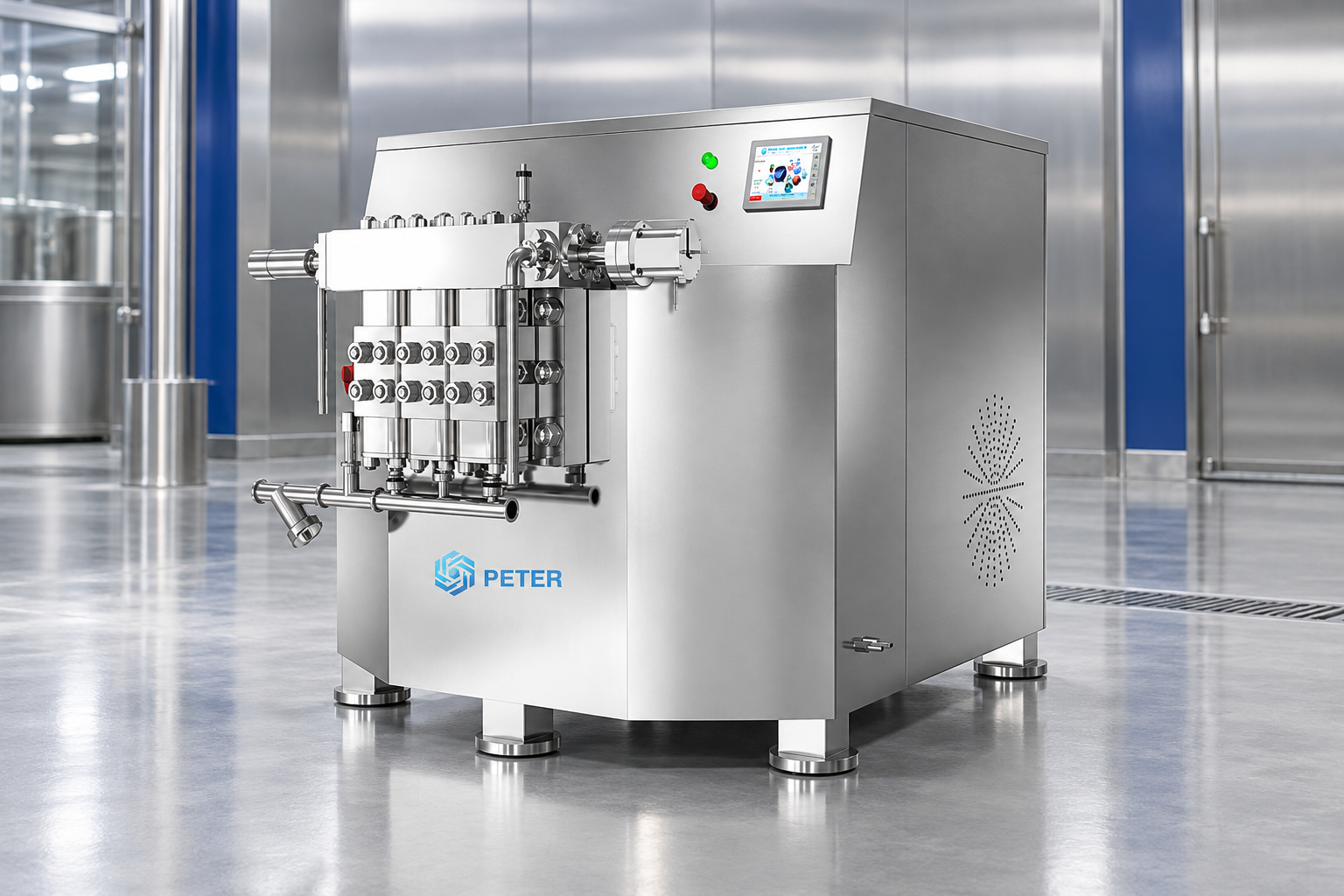
In practical terms, what is homogenizer equipment? It is a machine or tool that transfers controlled mechanical energy into a feed so that particles, droplets, or cells experience forces that change their size or distribution. A high-pressure unit normally combines a feed pump with a homogenizing interaction zone; a rotor-stator unit uses rotating and stationary elements; a single-use format may place the working element or vessel in a disposable fluid path. These categories can overlap in application, so the process brief should come before the purchase order.
Which results should be measured?
Choose the measurement around the product risk. ISO 13320 describes laser diffraction for particle-size distributions across a broad range, while ISO 22412 describes dynamic light scattering for hydrodynamic size of particles in suspension. A result from one method should not be treated as a direct substitute for the other. Also record solids loading, viscosity, temperature, dilution, sampling location, and time after processing, because each can change the observed distribution.
What does a homogeniser do inside the process?
Many buyers ask, what does a homogeniser do when the liquid already looks mixed? It exposes the feed to a repeatable high-energy zone that breaks larger droplets or agglomerates and redistributes the phases. The visible appearance can improve before the process is actually repeatable, so a simple visual check should be treated as a screening observation rather than a release result.
Process design links the machine to the material. Important inputs include the dispersed-phase concentration, viscosity, temperature sensitivity, solids hardness, air content, residence time, and whether the feed contains cells that must be opened or protected. Pressure, rotor speed, gap geometry, flow rate, and the number of passes are process variables, not universal product specifications. A change in any one can alter heat generation, shear history, and the final distribution.
Why can a stronger setting produce a worse batch?
More energy can increase temperature, promote oxidation, damage sensitive structures, or over-process a formulation that needs a controlled distribution rather than the smallest possible particles. It can also raise maintenance and cleaning demands. A practical development record therefore pairs each run with feed temperature, processing setting, flow or batch volume, pass count, and a post-process measurement. FDA Process Validation guidance treats process knowledge and continued verification as part of a controlled lifecycle; the same discipline is useful during laboratory scale-up even when a formal drug process is not involved.
How do electric and disposable homogenizers differ?
An electric homogenizer uses a powered drive to deliver mechanical energy through a probe, rotor-stator head, pump, or pressure system. It is usually considered when the lab needs repeatable runs, adjustable settings, a defined cleaning and maintenance program, and enough utilization to justify the installed equipment. “Electric” describes the energy source; it does not by itself indicate high pressure, high shear, batch size, or suitability for a particular formulation.
A disposable homogenizer uses a single-use or limited-use contact path, vessel, probe, or processing assembly. Its main value can be a lower cleaning burden and reduced carryover risk between products, but the contact materials, waste stream, supply continuity, and per-run cost must be qualified. A disposable format can still require a powered drive or controller, so “disposable” describes the fluid-contact strategy rather than the machine’s power source.
| Dimension | Powered reusable setup | Single-use or disposable setup | Procurement question |
|---|---|---|---|
| Process control | Settings and fixtures can be standardized across runs. | Control depends on the drive plus the validated disposable assembly. | Which variables must be logged for repeatability? |
| Changeover | Requires a documented clean, inspect, and release sequence. | Reduces contact-path cleaning between compatible runs. | Is the time saved greater than consumable and disposal cost? |
| Cross-contamination risk | Managed through cleaning validation or a justified laboratory procedure. | Reduced only when the single-use path is intact and correctly handled. | What evidence is required for the intended market? |
| Capacity planning | Useful when utilization is high enough to spread capital cost. | Useful when batches are occasional, segregated, or contamination-sensitive. | What is the annual run count and peak demand? |
| Waste and supply | Lower consumable volume but needs spares and maintenance. | Creates recurring consumable demand and disposal requirements. | Can the supplier support lead times and material traceability? |
How should capacity, cost, and scale-up be planned?
Capacity is more than the vessel label. Define the smallest and largest practical batch, the feed’s solids and viscosity range, target processing time, allowable temperature rise, and the number of batches per shift. A unit that is comfortable at one volume may be inefficient at another if the pump, working zone, or recirculation loop is outside its useful operating window.
Use total cost of ownership rather than purchase price alone. Include utilities, cleaning agents, labor, disposable assemblies, spare wear parts, calibration or verification, downtime, waste handling, and the cost of an out-of-specification batch. For an illustrative comparison, a reusable unit may have higher initial capital but lower cost per run at high utilization, while a disposable path may be financially sensible when changeovers are frequent and batch volumes are small. The calculation should use the site’s actual run schedule and validated cleaning time.
| Process situation | Primary evidence to collect | Likely priority | Common mistake |
|---|---|---|---|
| Early formulation screening | Small-feed behavior, temperature trend, and a repeatable size method. | Flexible setup and low sample loss. | Choosing the largest unit before the recipe is stable. |
| Lab-to-pilot transfer | Energy history, pass count, residence time, and sampling plan. | Comparable process variables across scales. | Scaling by volume alone without matching shear history. |
| Routine multi-product work | Cleaning record, changeover time, carryover assessment, and spare parts plan. | Repeatability and predictable uptime. | Ignoring labor and maintenance in the cost model. |
| Contamination-sensitive work | Contact-material compatibility and single-use handling evidence. | Segregation and documented material traceability. | Assuming “disposable” removes every validation obligation. |
| Pilot or production preparation | Throughput at representative viscosity, temperature, and solids loading. | Capacity margin and service support. | Using a marketing flow figure as a guaranteed formulation result. |
Which standards and tests matter?
Standards help define how a result is measured; they do not automatically certify a homogenizer. ISO 13320 is relevant when laser diffraction is used to report a particle-size distribution, and ISO 22412 is relevant when dynamic light scattering is used for hydrodynamic particle size. For pharmaceutical operations, FDA 21 CFR 211.110 addresses sampling and testing of in-process materials, while FDA’s Process Validation guidance describes a lifecycle approach to process understanding and ongoing verification. USP <729> is relevant to globule-size distribution in lipid injectable emulsions when that dosage form and jurisdiction apply.
Commercial consequences depend on the destination market, intended use, and claim set. A laboratory screening method may need a documented procedure and traceable records, while a regulated pharmaceutical or food process may require additional qualification, sanitation, material, and change-control evidence. Ask the supplier which statements are supported by a model-specific manual, test report, or certificate; do not infer a product certification from the name of a standard test method.
How can a buyer select a homogenizer with less risk?
- Write the process window first. State feed composition, viscosity, temperature limit, target distribution, batch range, and whether the goal is emulsification, dispersion, or cell disruption.
- Define the measurement before the trial. Select laser diffraction, DLS, microscopy, rheology, or another method that answers the product question; document sampling and dilution conditions.
- Run representative material. A water trial can confirm basic operation but cannot prove performance with the real solids, viscosity, air content, or temperature sensitivity.
- Compare lifecycle cost. Include cleaning, consumables, wear parts, utilities, operator time, waste, service response, and the cost of failed batches.
- Request boundary evidence. Ask for operating limits, contact-material information, maintenance requirements, and a written statement of what is and is not validated for the intended use.
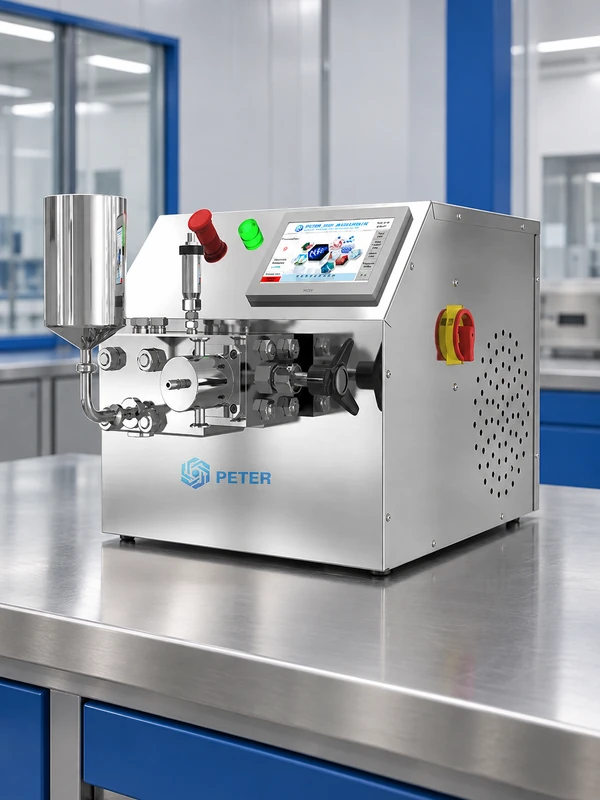
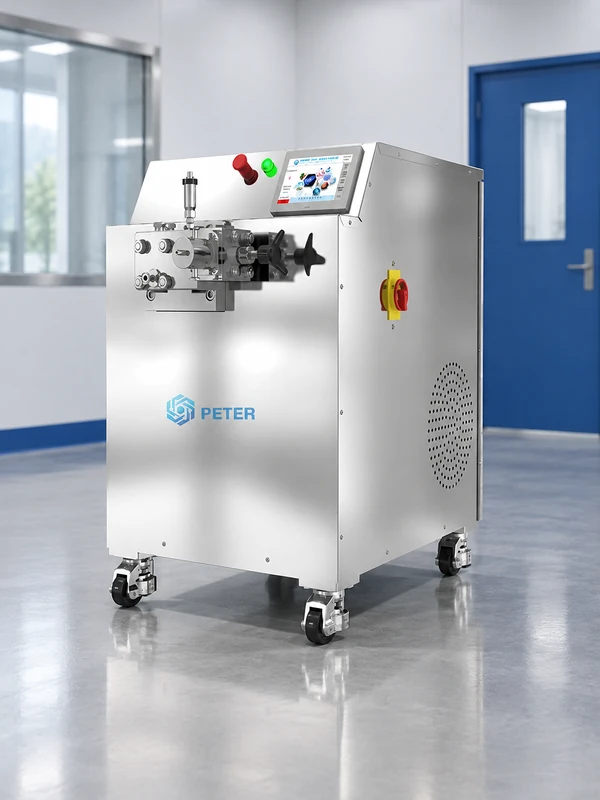
CAS PETER presents experimental and production-type high-pressure homogenizer options through its homogenizer product catalogue. Buyers can use the same evidence checklist to compare a PT-20 high-pressure homogenizer or a PT-40 pilot-type unit, then confirm the exact configuration and documentation for the process.
Frequently asked questions
What is a homogenizer machine used for in homogenizer selection and operation?
A homogenizer machine is used to make a multiphase feed more uniform by reducing or redistributing droplets, particles, agglomerates, or cells through controlled mechanical energy. The correct machine depends on the material, target distribution, throughput, temperature limit, and cleaning strategy. Confirm the result with a defined test method rather than appearance alone.
How does a homogenizer machine work?
The feed passes through a high-energy zone such as a valve gap, rotor-stator head, or related working geometry. Pressure drop, shear, turbulence, impact, and sometimes cavitation act on the dispersed phase; the dominant mechanism depends on the equipment and formulation. The practical answer to what does a homogeniser do is therefore process-specific: it changes the feed through a controlled energy history rather than through a nameplate label. For a deeper process explanation, see CAS PETER’s high-pressure homogenizer working-principle guide.
What is the difference between a homogenizer machine and disposable homogenizer?
“Homogenizer machine” describes the equipment that applies the process, while “disposable homogenizer” describes a single-use or limited-use contact path or processing assembly. A disposable setup may still use an electric drive, and a reusable machine may be configured for different working heads. Compare the full workflow, including material compatibility, waste, changeover, and documentation.
Which factors affect homogenizer machine performance?
Feed viscosity, solids loading, dispersed-phase concentration, temperature, air content, working geometry, pressure or speed, flow rate, and pass count all affect performance. Sampling and measurement conditions can also change the reported result. Establish a controlled process window and repeat the test with representative material before drawing a scale-up conclusion.
When should a team choose an electric homogenizer?
An electric homogenizer is usually considered when a team needs repeatable powered processing, adjustable operating conditions, and a documented reusable workflow. It can fit laboratory development, pilot work, or production support depending on its verified operating range. Confirm the actual working volume, material limits, and service requirements for the chosen configuration.
When is a disposable homogenizer a sensible choice?
A disposable homogenizer can make sense when changeovers, segregation, or cross-contamination control dominate the decision and the recurring consumable cost is acceptable. It still requires checks for contact materials, supply continuity, disposal, handling, and process evidence. Use it when the complete workflow is simpler or safer for the intended application, not merely because the word disposable appears in the specification.
References
- ISO 13320:2020, Particle size analysis — Laser diffraction methods.
- ISO 22412:2017, Particle size analysis — Dynamic light scattering.
- U.S. FDA, Process Validation: General Principles and Practices.
- 21 CFR 211.110, Sampling and testing of in-process materials and drug products.
- United States Pharmacopeia, General Chapter <729> Globule Size Distribution in Lipid Injectable Emulsions.
Homogenization succeeds when the process question, measurement method, and equipment boundary agree: define the feed and target first, compare reusable and single-use costs second, and verify the result under representative conditions before scaling. For teams evaluating laboratory or pilot capacity, CAS PETER’s benchtop and pilot-scale guide can support the next review; contact the supplier with your material, batch range, and evidence requirements so the proposed configuration can be checked against the real process.