

Cellulose Nanofibrils by High-Pressure Homogenization: Feed and Trial Design
Producing cellulose nanofibrils by high-pressure homogenization starts with a suitable fiber suspension, not a universal pressure setting. Pretreatment, residual coarse material, solids concentration and feed history determine whether the suspension can be processed and whether the resulting fibrils suit the intended application. A useful trial therefore tracks feed preparation, fibrillation quality, recovered solids and energy within a defined boundary. It also confirms equipment compatibility before introducing fibers. This guide focuses on those practical decisions, helping a development team distinguish a promising nanofibril route from a visually smooth suspension that has not yet been characterized.
Define the intended cellulose product
Nanocellulose is a family of materials rather than a single specification. A project seeking a fibrillar network for a coating may need different properties from one seeking a reinforcement additive. Write the application and the required evidence before comparing treatment severity. Appearance alone cannot establish fibril dimensions, purity, aspect ratio or performance in the final formulation.
Clarify whether the project targets cellulose nanofibrils, a broader microfibrillated fraction, or another cellulose material. Do not use results for a chemically isolated nanocrystal route as proof of a mechanically fibrillated product. The names should reflect the material actually observed and the characterization method used.
Research on fit-for-use nanofibrillated cellulose from recovered paper compared pretreatments and homogenization conditions against final material properties. Its useful lesson for planning is that the appropriate quality depends on use, and that pretreatment changes the response to subsequent processing. It does not establish that any recycled pulp can be processed directly in any homogenizer.
Characterize the incoming fiber suspension
Document the cellulose source, prior drying, storage history, chemical treatment, washing and the method used to disperse the feed. Include the dry-solids measurement rather than relying on a nominal recipe. A partially settled suspension can deliver a different fiber concentration to the machine from the concentration measured in the preparation vessel.
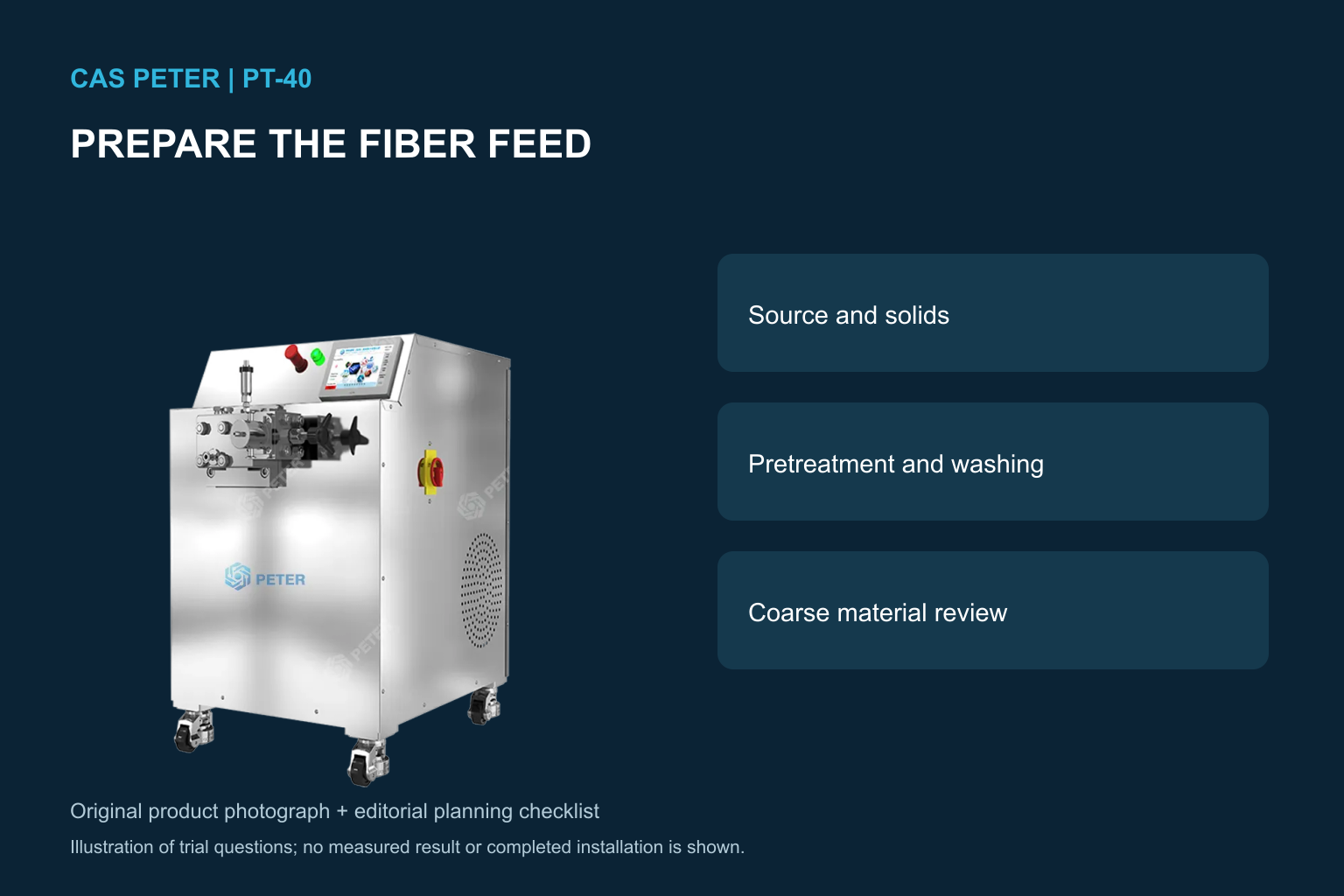
Identify coarse fibers, hard contaminants, residual grit and any material that could obstruct the flow path or accelerate wear. Ask the equipment supplier to review representative feed information and the intended processing route. A stated feed-particle limit is not automatically a validated limit for long, flexible fibers or a heterogeneous pulp.
Record pH and the relevant residual chemicals after washing. Compatibility includes seals, wetted metals and the complete flow path, not only the visible processing head. A pretreatment suitable for isolating cellulose in a laboratory paper does not authorize processing an incompletely washed suspension in a particular machine.
Treat pretreatment as part of the production route
Mechanical refining, enzymatic treatment and chemical pretreatment create different starting materials. Compare complete routes rather than presenting homogenization as an isolated final step with an identical feed. Keep the untreated reference and explain whether each reported yield is based on original biomass, purified cellulose or the material entering the homogenizer.
The soybean-residue pretreatment study examined how preparation affected the structure and properties of the resulting nanofibrillated cellulose. Its chemical conditions and repeated homogenization sequence belong to that experimental material system. They provide evidence that feed preparation matters, not a safe operating recipe for another residue or an unconfirmed equipment configuration.
A practical screening plan can compare a small number of well-defined preparations at matched dry-solids content. If washing, refining or fractionation removes material, weigh and record those streams. Otherwise, an apparently better fibrillation yield can conceal a lower overall recovery from the starting biomass.
| Trial stage | Record to retain | Decision supported |
|---|---|---|
| Incoming feed | Source, drying history, solids and coarse fraction | Is the feed representative and compatible? |
| Pretreatment | Chemistry or mechanical route, washing and losses | What material actually enters homogenization? |
| Processing | Configuration, pressure, passes and temperature | Can the treatment be reproduced? |
| Characterization | Microscopy and application-relevant properties | Was the required fibrillation achieved? |
| Recovery | Accepted solids, rejects and retained material | Is the route useful beyond sample appearance? |
This qualitative matrix combines the feed and characterization questions raised by the two studies. It specifies no universal fibril dimension, energy target or acceptance limit.
Establish a compatible operating window
Agree a manufacturer-reviewed starting condition and a clear response to abnormal flow or pressure behavior. Operators should follow the equipment’s approved procedures. Increasing pressure to force an unsuitable feed through a restriction is not a substitute for proper preparation or compatibility review.
Keep solids, starting temperature and preparation method controlled while screening treatment severity. Specify whether a pass is a complete separated transfer or a nominal tank turnover in a recirculation arrangement. Those exposures are not interchangeable. Retain a sample after selected stages so the team can observe when additional treatment stops providing useful improvement.
Record flow behavior and recovery as well as the target material properties. A condition that produces a useful analytical sample but repeatedly interrupts processing may not be a practical production route. Include any filtration, dilution or separation required to make it operate, since those steps affect both material balance and process cost.
Prove fibrillation using more than visual clarity
Use a characterization package suited to the target. Microscopy can help establish morphology, while rheology and application testing answer different questions about the suspension or formulated product. Explain sample preparation and the limits of each method. Drying or dilution used for observation can alter the structure presented to the instrument.
If a particle-size method assumes spherical particles, do not report its numerical output as a directly measured fibril width or length. Ask what physical quantity the method provides and whether its interpretation is appropriate for a fibrous distribution. Retain representative images, method settings and the basis for any selected fraction.
The University of Maine nanocellulose resources offer institutional context and links for the wider field. They are useful for understanding material families and research applications. They do not replace characterization of the particular suspension or establish a performance claim for the equipment shown in this article.
Calculate energy on an explicit solids basis
For a measured process-energy total, specific energy on a dry-solids basis equals the energy used divided by the relevant dry mass. State whether that mass is the incoming cellulose or the accepted recovered product. Also state which operations are inside the energy boundary: homogenization alone, or preparation, cooling, washing and separation as well.
As an illustrative calculation, 2 kilowatt-hours used while processing 0.1 kilogram of dry cellulose corresponds to 20 kilowatt-hours per kilogram of that feed. If only 0.08 kilogram becomes accepted material, the same measured energy corresponds to 25 kilowatt-hours per kilogram of accepted product. These figures explain the denominator and are not measured machine performance.
Compare routes using consistent boundaries and a comparable final quality. A lower energy number can be misleading if it excludes pretreatment or produces a less fibrillated material. Conversely, the most intensively treated sample may be unnecessary if a milder condition already provides the application properties required.
Make the application test decide the endpoint
Choose an application test before the final optimization round. For a coating or composite, assess the property relevant to that system using a controlled formulation and preparation method. Do not infer the final behavior from a suspension image alone. Record the cellulose addition basis and whether other ingredients changed between comparisons.
Retain the handling observations that determine usability: mixing sequence, consistency after storage, ease of transfer and reproducibility between preparations. A sample that performs well only immediately after processing may require a different stabilization or storage strategy. Define the observation period according to the development objective, without converting a short test into a shelf-life guarantee.
When comparing treated and untreated materials, hold the rest of the application recipe as consistent as the experiment allows. If formulation adjustments are necessary, report them openly. This distinguishes the effect of the cellulose route from the effect of a changed binder, solids content or dispersion procedure.
Prepare a representative pilot trial
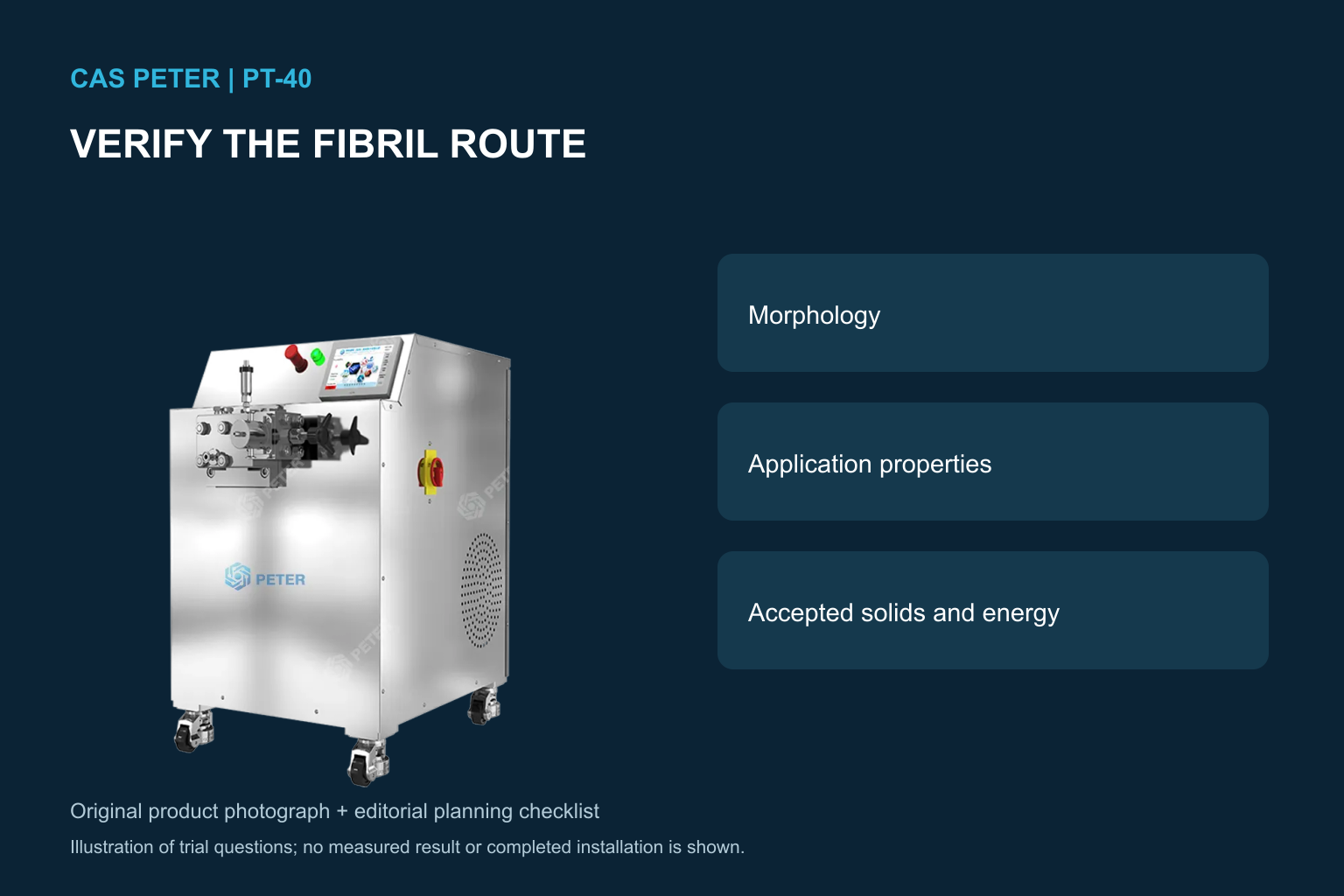
The CAS PETER PT-40 pilot model can be a starting point for a scale-up discussion, subject to specific confirmation of fiber-feed suitability, wetted materials and the proposed configuration. Its public page contains differing throughput and minimum-volume statements. Obtain a written configuration-specific rating rather than selecting a favorable value from the page.
Use the broader dispersion-methods guide for process context. The articles on feed properties and capacity and particle-size measurement choices cover complementary questions without replacing the fibril-specific evidence required here. Share the full feed and characterization package when requesting a trial.
Ask for pressure, flow, thermal and interruption records, recovered material quantities and an agreed sampling plan. The trial outcome should say which preparation worked, which operating window was demonstrated, which quality was achieved and which questions remain unresolved. An equipment photograph demonstrates the model’s appearance, not successful cellulose processing.
Educational video: understanding the material family
TAPPI’s educational introduction explains nanocellulose and its broader material context. The University of Maine links to this video in its resources. Use it as an introduction to the material family, while relying on the actual trial and characterization records for production decisions.
Educational source: TAPPIVideo. Watch the lesson on YouTube.
Frequently asked questions
Can raw pulp go directly into a high-pressure homogenizer?
Do not assume so. Confirm the feed’s fiber characteristics, contaminants, solids, preparation and chemical compatibility with the supplier before testing. A nominal particle-size limit alone is not a complete fiber-feed assessment.
Is a smoother suspension proof of cellulose nanofibrils?
No. Appearance should be supported by appropriate morphology and property measurements. State the methods, sample preparation and material fraction behind the characterization.
Should the trial always maximize fibrillation?
No. Define the application requirement and compare accepted quality, recovery and process demand. Additional treatment is useful only when it provides a demonstrated benefit within the confirmed operating window.