

Curcumin Nanoemulsion Light Stability: Separate Retention from Droplet Size
Curcumin nanoemulsion light stability should be evaluated by measuring curcumin retention as well as droplet behaviour under a defined exposure. A fine, uniform-looking emulsion can still lose its intended chemical component. High-pressure homogenization is one formulation-development step; it does not by itself establish protection against light, a commercial shelf life or a health benefit. Build the trial around the actual formulation, packaging and intended use. Compare exposed samples with matched protected controls, and keep preparation, temperature and analytical recovery consistent before deciding that a processing change improved stability.
Separate chemical retention from physical stability
The first question is what must remain acceptable. A product may have requirements for curcumin content, colour, visible separation, droplet distribution and behaviour after dilution. These are related development questions, but none should be used as a substitute for all the others. Define the required outcomes individually and agree which measurement will support each decision.
A published curcumin emulsion study examined formulation variables and light exposure alongside physical measurements. Its observations support testing protection in the actual emulsion environment rather than assuming that encapsulation removes light sensitivity. Its experimental exposure conditions are specific to that work; they are not a validated commercial shelf-life method for another product.
Keep the intended claim modest and measurable. “Retained curcumin under the stated test” is a different claim from “stable in all beverages” or “improves absorption in people.” A formulation trial cannot establish clinical efficacy or product-specific regulatory permission. This article addresses development testing, not dosing, treatment or permission to market a finished formulation.
Document the complete formulation before processing
Record the curcumin ingredient identity, assay basis, oil, emulsifier, water quality and every additional ingredient. State whether concentration refers to the supplied ingredient or the measured curcumin component. If the raw material contains other constituents, do not silently treat its total mass as pure curcumin. Keep batch certificates and the actual preparation record together.
Distinguish material that is dissolved in the intended oil phase from visible or analytically detected undissolved material. Decide how that distinction will be checked using an appropriate method. The presence of solids can change both sampling and interpretation. A droplet measurement alone cannot demonstrate that the intended component is fully incorporated into the proposed carrier system.
If you change the oil, emulsifier or ingredient loading, identify the sample as a new formulation. A pressure comparison should use a consistent formulation unless formulation differences are part of a planned experiment. Keep failed or less attractive formulations in the record because they reveal whether an apparent process benefit actually came from a recipe change.
Use research to identify variables, not to copy a recipe
A curcumin nanoemulsion investigation available through Europe PMC evaluated surfactant concentration and challenges relevant to product use, including changes in pH, salt and thermal conditions. It illustrates that an emulsion must be assessed beyond its freshly prepared appearance. Its formulation and processing conditions do not establish approved settings for CAS PETER equipment or for another ingredient system.
Use that evidence to form questions: does the final medium change the distribution, does the analytical recovery remain acceptable, and does a promising concentrate survive the intended next step? Answer those questions with the proposed product rather than transferring a published pressure or emulsifier level into a purchase specification.
Where ingredient selection affects food, cosmetic or pharmaceutical use, have the responsible product team confirm the applicable requirements. Equipment compatibility and formulation acceptability are separate reviews. Passing one does not imply passing the other. Avoid using an experimental research formulation as evidence that every ingredient or concentration is suitable for a commercial product.
Establish a reproducible starting sample
Prepare a sufficiently uniform coarse emulsion using an approved method, and collect a baseline sample before the high-pressure step. Record preparation order, temperature, hold time and observations such as visible solids or separation. The baseline should represent the feed actually entering the system rather than a specially selected sample from a different container.
Ask the supplier to approve the feed and proposed configuration before choosing trial conditions. Record actual pressure, flow, inlet and outlet temperatures and the processing arrangement. If samples undergo more than one pass, retain the pass identity. If the material recirculates, describe the circulation history without assuming that every portion received an identical treatment count.
Collect samples in containers that fit the exposure plan and analytical method. Use consistent fill and headspace conditions, and document any handling protection between collection and testing. A sample that sat on a bright bench before its baseline analysis may not represent the same starting point as one immediately protected from exposure.
Design the light comparison before turning on a lamp
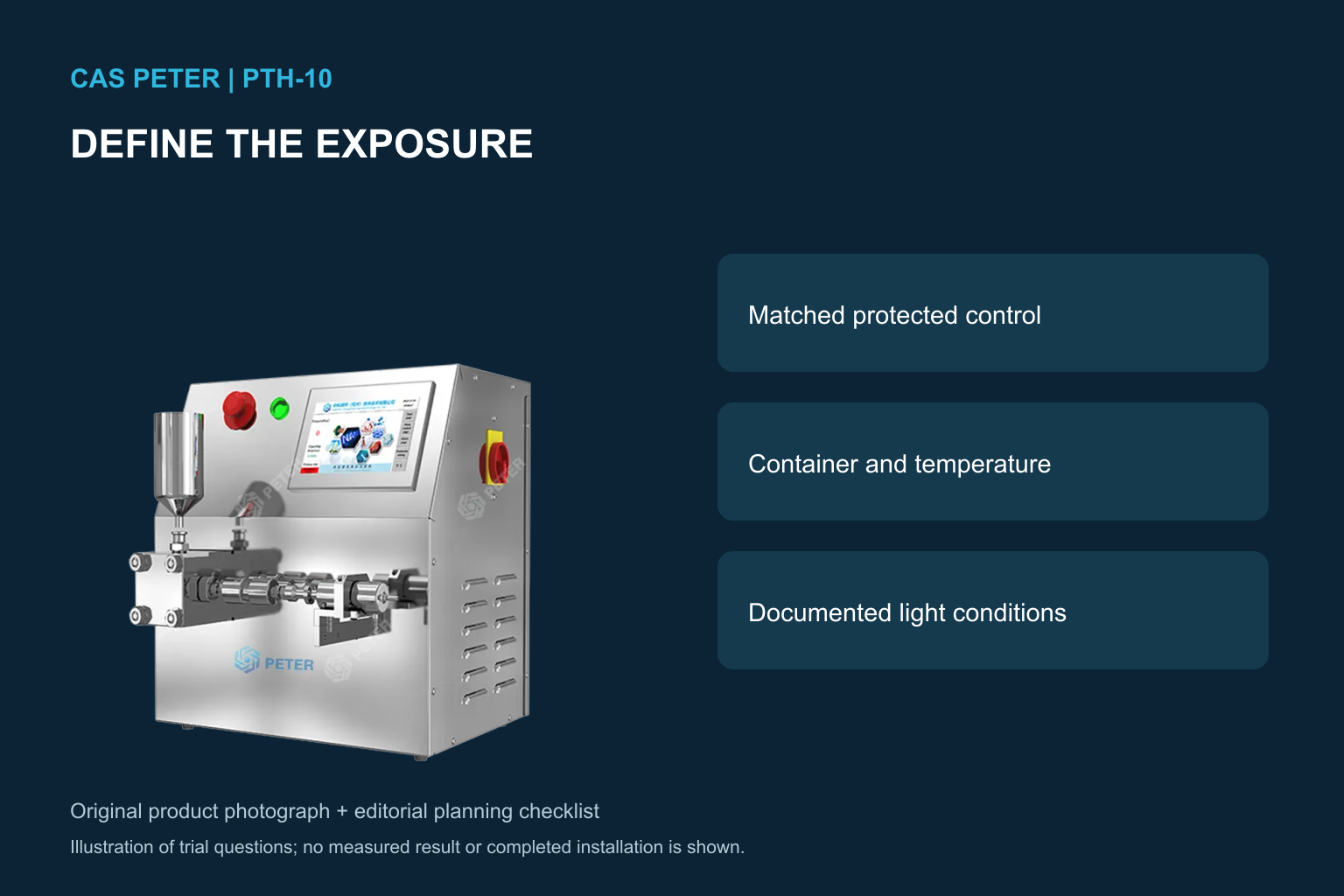
Specify the light source, exposure arrangement, distance or controlled geometry, container, temperature monitoring and collection schedule. Where quantitative exposure information is available, preserve it with the method. “Left under light” is too vague for a reproducible comparison. Match the protected control for storage duration, container and temperature as closely as the method permits.
Include the intended packaging as a separate comparison if packaging protection is part of the product concept. Do not call a material intrinsically more stable when the difference came from a more protective bottle. Likewise, a clear laboratory container can be a useful challenge condition without representing the customer’s final package.
The following table is an editorial study-design checklist. The linked research motivates separating chemical and physical outcomes; the controls and acceptance decisions must be established for the product being developed.
| Development question | Matched comparison | What to record | Decision supported |
|---|---|---|---|
| Does exposure affect curcumin retention? | Exposed and protected portions from one batch | Assay method, recovery, exposure and time | Chemical protection under that test |
| Does packaging change the outcome? | Same emulsion in candidate containers | Container identity, fill and exposure geometry | Packaging contribution |
| Does processing improve the starting dispersion? | Prepared feed and processed sample | Complete size result and sample preparation | Physical processing response |
| Does dilution change performance? | Concentrate and intended final medium | Dilution ratio, composition and mixing | Suitability for the next formulation step |
| Does a candidate reproduce? | Independent preparations at the selected condition | Ingredient lots and full preparation history | Evidence for a repeatable development result |
Measure curcumin with a suitable recovery check
Choose an assay that can distinguish the intended component in the actual matrix and has an appropriate extraction procedure. Agree with the analytical laboratory how extraction recovery, blanks and interference will be evaluated. A numerical concentration without those checks may reflect a preparation artefact rather than a real change in retained material.
Keep a time-zero result for each relevant sample group. Use a clearly stated basis when reporting retention, including any dilution corrections. When exposed and control samples differ, examine recovery and sample homogeneity before assigning the entire change to degradation. If extraction fails differently across formulations, their results may not be directly comparable.
Colour can be a useful additional observation when colour is part of the product specification. It should be measured under a consistent method and interpreted as its own property. Do not use a photograph or an apparently strong yellow colour to prove that curcumin content is unchanged. Retain the assay result alongside visual and physical records.
Follow the droplets through the intended use step
Measure the freshly prepared distribution and repeat the measurement at the defined storage points. Keep the medium, dilution, instrument method and reporting basis consistent. A mean value alone may hide a developing larger population or an unsuitable measurement. Our nanoemulsion stability testing guide explains how to build a broader physical evaluation.
Test the intended diluted product where dilution is part of use. Record the receiving medium and mixing sequence rather than describing the sample simply as diluted in water. Salt, acidity and other ingredients can make the final environment different from the concentrate. Our zeta potential interpretation guide provides context for one complementary measurement without treating it as a guarantee of stability.
For the general process framework, see the emulsion homogenization guide. The Harvard educational lecture below explains oil-water interfaces and stabilization. It is background learning about emulsions, not evidence that a particular curcumin formula or equipment configuration meets its intended specification.

Educational source: Harvard University. Watch the lesson on YouTube.
Compare candidates against a written decision rule
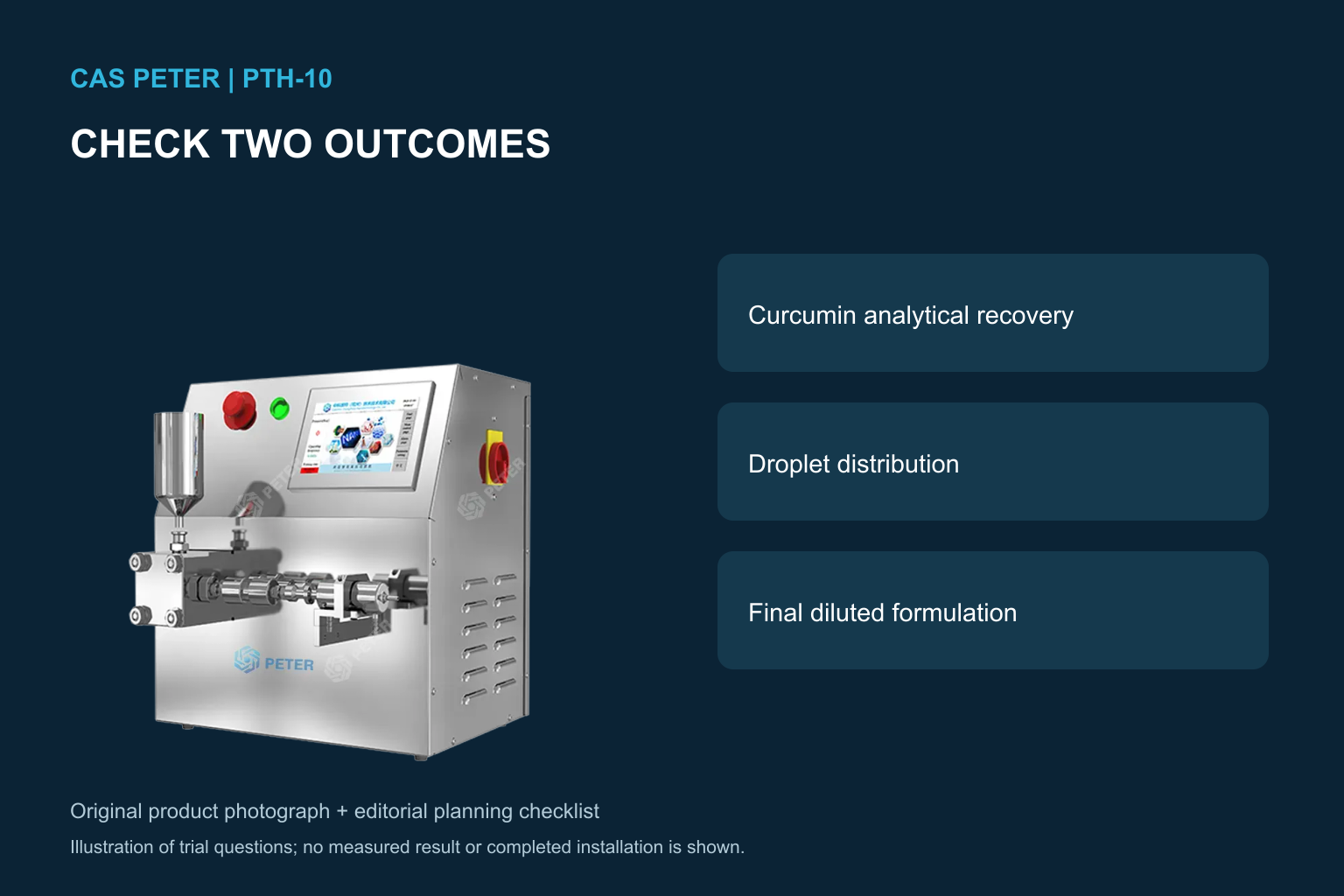
Agree the required chemical retention, physical behaviour and application properties before reviewing the most attractive trial result. Include the intended storage interval and test conditions. Do not select one processing condition for its smallest fresh droplet size while ignoring an unacceptable content result after exposure. Equally, do not dismiss a physically acceptable formulation solely because a different candidate produced a smaller number.
If two conditions meet the agreed requirements, compare the practical burdens: processing duration, thermal control, recovery, cleaning and repeatability. Confirm the preferred condition on independently prepared material. One successful sample is useful for screening, but it does not describe the range of normal ingredient and preparation variation.
The CAS PETER PTH-10 product page offers a starting point for a laboratory-equipment discussion. The photographed catalogue unit is not evidence of a completed curcumin trial. Provide the formula, feed condition, thermal limit, batch size and analytical target so the supplier can review compatibility and configuration before a trial is arranged.
Frequently asked questions
Does a smaller curcumin nanoemulsion droplet prove better light stability?
No. Droplet measurements describe physical behaviour, while light stability requires a suitable curcumin assay under defined exposure and control conditions. Evaluate both outcomes in the actual formulation and packaging before claiming that a processing change improved protection.
Can a protected bottle replace a formulation stability study?
Packaging may contribute protection, but its effect should be measured separately using matched samples and documented exposure. The result supports that formulation-container combination under the stated conditions. It does not establish that the unprotected emulsion has the same behaviour.
What information is needed before a curcumin homogenization trial?
Provide ingredient identities, loading basis, oil and emulsifier composition, feed preparation, batch volume, temperature limits and the intended final medium. Add the curcumin assay, physical acceptance tests and exposure plan. Ask the supplier to confirm compatibility rather than choosing pressure from an unrelated published recipe.