

Nanoemulsion Stability Testing After Homogenization
Nanoemulsion stability testing should follow changes over time under defined storage and handling conditions, using more than a single fresh droplet-size result. Establish an initial baseline, retain representative samples in suitable containers and monitor the attributes relevant to the intended product. Physical screening may include appearance, size distribution, separation and response to justified stresses. Chemical and microbiological quality require separate, suitable tests. Centrifugation, heating or freeze–thaw screening can reveal weaknesses, but none automatically converts a short experiment into a verified shelf-life claim.
This guide focuses on the testing plan after a homogenization trial. The nanoemulsion processing and equipment guide covers formulation and processing context; the steps here help determine whether an initially promising sample remains acceptable during the conditions it will actually encounter.
Define what “stable” means for the intended product
Write down the intended storage period, temperature range, container and handling conditions before designing a study. A refrigerated development intermediate, a cosmetic formulation and an industrial dispersion can have very different acceptance requirements. A physical observation by itself does not establish suitability for a medical, food or cosmetic use.
Separate the questions. Does the dispersed phase remain physically acceptable? Does an active or functional ingredient retain its required composition? Does the product meet its microbiological requirements? A sample can pass one category and fail another. Choose methods and limits for each applicable quality attribute rather than using a single broad label.
Keep the claim proportional to the evidence. If a study observes physical behavior for a defined period, report that observation and its conditions. Do not turn it into an unsupported commercial expiry date. For regulated products, the responsible formulation and quality specialists must establish the applicable programme.
Establish a baseline that later samples can reproduce
Take the initial sample after a defined post-processing interval and equilibration condition. Record formulation identity, raw-material lots where relevant, premix preparation, pressure, actual flow, pass arrangement and collection temperature. The starting result becomes more useful when another laboratory can understand precisely what was measured.
Retain an untreated or premix comparator if it answers a specific development question. Keep it under a clearly stated condition rather than assuming it represents the finished product. If testing several pressure conditions, use the same analytical preparation and timing so storage effects do not become confused with process differences.
The DLS and laser-diffraction comparison explains why different size outputs are not interchangeable. Stability assessment should follow a consistent, suitable measurement method; a switch from one instrument statistic to another can create an apparent trend that is not a real physical change.
Use a small set of complementary physical measurements
Visual inspection remains useful when performed consistently. Record the container, lighting, observation position and any visible layer, sediment or color change. Photograph the same view against a simple background. Decide whether the observation is made before or after a defined mixing step, and preserve the distinction.
Measure the size distribution using a method capable of addressing the product question. Include appropriate distribution information rather than an average alone. Where relevant, add pH, viscosity or another functional measurement using a controlled method. These observations can help identify a change, but they do not automatically identify its cause.
| Question | Useful observation | What it cannot establish alone |
|---|---|---|
| Has a layer or deposit appeared? | Consistent photographs and a defined separation observation | The underlying mechanism or chemical integrity |
| Has the dispersed population changed? | Comparable size distributions and method-quality indicators | Whole-batch uniformity from one selectively collected sample |
| Has the formulation environment shifted? | Controlled pH, conductivity or viscosity measurements where relevant | A universal pass/fail rule for every emulsion |
| Does handling reveal a weakness? | A justified stress test with recorded conditions and recovery observations | The equivalent number of months in normal storage |
| Does the useful ingredient remain acceptable? | A suitable chemical or functional assay | Microbiological quality without a separate assessment |
This is a development-planning table. Select the tests and acceptance limits for the actual formulation and intended use; it supplies no universal numerical specification.
Distinguish visible separation from irreversible change
A separated layer does not by itself tell you whether droplets have merged, formed clusters or simply redistributed. Different mechanisms can produce similar visual observations. Keep the original appearance record, then use suitable complementary measurements to investigate the change. If redispersion is part of the intended use, define how it is assessed rather than shaking the sample until it appears acceptable.
A formulation that redistributes under a particular mixing step may still have changed in another important way. Compare its distribution and relevant quality attributes before and after the specified handling. Do not treat successful redispersion as proof that every aspect of stability has been preserved.
Likewise, a clear or translucent appearance is not a complete stability test. Establish a baseline for the actual formulation and observe its evolution. The useful question is whether it remains within justified acceptance criteria, not whether it resembles an attractive reference photograph.
Design storage sampling around the container and the question
Use representative containers and record fill volume, closure, headspace and exposure to light where relevant. If the development study uses a different container from the intended pack, state that limitation. Packaging interactions and repeated opening can become part of the observed change.
Consider separate retained containers for destructive or contamination-sensitive tests. Repeatedly opening one container can change the sample and complicate interpretation. Plan the sample quantity for every time point, replicate, investigation and retain before running a costly formulation batch.
Keep sampling representative. A portion collected only from the top of a separated container can conceal material elsewhere. If the measurement question concerns the original spatial distribution, preserve it. If it concerns the product after a specified mixing step, apply that step consistently and record it. These are different sample states and should not share an ambiguous label.
Use centrifugation as a screen, with defined conditions
A centrifuge applies a stress different from normal storage. Specify the relative centrifugal force, duration, temperature and rotor or radius information needed to reproduce the condition. Revolutions per minute alone are insufficient for comparing different rotor geometries. Document whether the sample was diluted and what was measured before and after the test.
In a primary study of scale-up production of theranostic nanoemulsions, researchers evaluated storage behavior alongside centrifugation and filtration stresses. The work illustrates the value of observing more than the freshly produced size distribution. Its formulation, processing equipment and intended application do not establish acceptance limits for unrelated CAS PETER trials.
Compare stressed and unstressed controls under otherwise matched handling. A failed screen can guide formulation investigation, while a passed screen supports only the conclusion justified by that test. Neither outcome supplies a universal conversion from centrifuge minutes to storage months.
Keep accelerated screening separate from shelf-life prediction
Temperature cycling, elevated-temperature storage or freeze–thaw challenges may be useful when they address a credible exposure or development risk. Choose conditions with a reason, document the sequence and retain a suitable comparison condition. A stress that creates a different failure mechanism can mislead a prediction about normal storage.
A study of accelerated and longer-term stability of perfluorocarbon nanoemulsions investigated a predictive relationship within its own experimental system. Such a relationship requires supporting data; it should not be borrowed as a universal rule for another oil, emulsifier, ingredient or package.
For development, label a fast screen as a screen unless a prediction has been justified. Continue observation under the intended storage conditions for the claim being considered. If an accelerated result conflicts with normal storage, investigate the reason instead of selecting whichever result looks more favorable.
Prevent analytical preparation from hiding instability
Fix the dilution medium, ratio, sample temperature and preparation sequence. Changing the surrounding medium can change the behavior being studied. Filtering a stored sample may remove the oversized material that you were trying to detect, while analytical ultrasound can alter agglomerates before the instrument measures them.
The scale-up study cited above reports its dilution and equilibration conditions for DLS measurements, while the accelerated-stability study states the preparation and controls used for its stressed samples. Preserve comparable detail in your own record: concentration, medium, temperature, preparation and the instrument method. Their methods illustrate reporting discipline; they do not automatically validate a new material or prescribe its shelf life.
Review independent samples as well as repeat instrument readings when the question requires batch-level evidence. Multiple readings of a single prepared aliquot can show short-term instrument repeatability while missing the variation introduced by collecting and preparing different portions.
Compare homogenizer conditions using the stored result
When screening pressure and passes, compare the full development outcome: initial quality, stored quality, accepted recovery and temperature exposure. A condition that produces the smallest initial average may not deliver the most useful stored product. Keep formulation and analytical methods consistent enough to understand the difference.
The guide to homogenizer temperature rise helps frame the thermal record. Also specify whether the material received separate complete passes or tank recirculation; our processing-arrangement comparison explains that distinction. Processing history belongs beside the stability data.
For a CAS PETER PT-20 formulation trial, agree sample quantities and a stability observation plan before the demonstration. Equipment selection can then use evidence from the intended formulation rather than a generic claim of “nano” size or a single successful photograph.
Write a report that preserves failures and limits
Include the study objective, formulation and batch identity, container, storage history, sampling schedule, methods, raw results and acceptance basis. Record missed time points, temperature excursions, unusual distributions and changes in preparation. A graph without those conditions can suggest more certainty than the experiment supports.
Describe the actual observation period and distinguish completed results from planned tests. If only early screening is complete, say so. Preserve failed samples and exception records according to the site’s procedure so the team can investigate trends rather than repeating the same formulation decisions without learning.
Learn the physical-stability concepts
The NPTEL lecture below discusses stability of biphasic liquids. It provides background on dispersed systems; it does not establish a test specification, a commercial shelf life or performance of CAS PETER equipment.
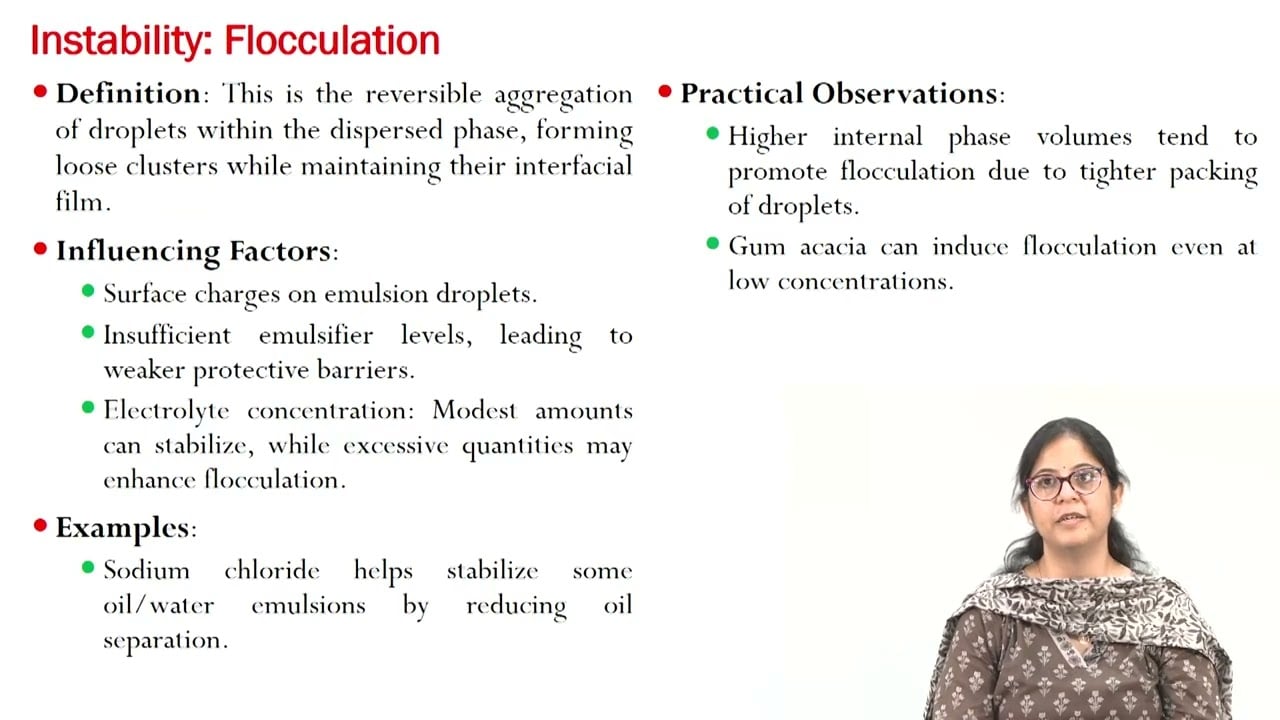
Watch the NPTEL physical-stability lecture.
Frequently asked questions
Does a small initial droplet size prove nanoemulsion stability?
No. Follow relevant physical and other quality attributes over time under defined conditions. A fresh size result is a baseline, not a complete storage study.
Can a centrifuge test determine shelf life?
Not by itself. It can reveal a response to a specified stress. A prediction of normal-storage behavior requires a justified relationship supported by appropriate data.
Should samples be mixed before a stability measurement?
Define the state you need to assess. Observe separation before disturbing the sample, and use a consistent mixing step only when that state is part of the intended test or use.
Which homogenizer setting produces the most stable nanoemulsion?
There is no universal setting. Compare representative trials using initial and stored quality results alongside temperature, passes and recovery, with a fixed formulation and suitable analytical methods.