

Soy Protein Gel Strength After Homogenization: A Controlled Texture Trial
Soy protein gel strength after homogenization should be assessed in a finished gel made with a controlled formulation and setting procedure. A smoother protein dispersion is a useful observation, but it cannot establish the texture, water retention or handling quality of the final food. Keep protein concentration, hydration, salts, other ingredients and gelation conditions consistent while testing the selected homogenization conditions. Measure hardness alongside an appropriate water retention test and a defined use test, then repeat promising conditions with a fresh batch before drawing a production conclusion.
Define which soy gel you intend to make
A soy protein isolate gel, an emulsion-filled gel, a starch-containing product and a traditional coagulated tofu are different systems. Identify the actual product and the stage at which homogenization will occur. Write a process map from hydration through mixing, treatment, gel setting, cooling and testing. This prevents results from one preparation route being transferred casually to another product.
Specify what acceptable texture means for the application. A product may need clean slicing, resistance to fracture during handling, a particular springiness, or low visible water release. Agree the primary measurement and its acceptance range before reviewing the experimental results. Include at least one practical use observation that corresponds to the product brief. A single high force reading may have little value if the food fails during normal handling.
The plant protein processing guide explains the wider formulation context. The protein solubility discussion covers a complementary ingredient question, while the starch trial guide is relevant when the gel formulation contains a starch component. This article focuses specifically on linking homogenization to finished gel performance.
What the research supports
An original study of homogenized soy protein isolate in cold-induced Chiba tofu gels investigated a defined preparation route and measured gel structure, texture, water holding and rheology. The protein pretreatment and subsequent gel formulation were both part of the experimental method. Its findings support evaluating several final properties together. The study does not establish a universal optimum for all soy products or for a different machine configuration.
A separate study of soy protein isolate and carrageenan cold-set gels examined how formulation affected texture, water holding and freeze–thaw behaviour. It is formulation evidence rather than a test of homogenization. Its relevance is that ingredients and the subsequent gel network can change the final result independently of pressure treatment. A useful homogenization comparison therefore controls those later stages.
The proposed workflow below is a trial framework. It does not assign literature values for pressure, gel strength or water holding to CAS PETER equipment. Select operating conditions through supplier review and product-specific development. Preserve the published preparation route when reporting research so that readers can see the boundary of the evidence.
Control protein hydration before the machine trial
Record the protein isolate grade, batch number, declared composition and storage history. Prepare the dispersion by a defined addition and mixing procedure. State whether concentration refers to ingredient mass or actual protein content. If the formulation uses several protein ingredients, record each one separately. Keep the water source and any adjustment of pH or salt content consistent across treatments.
Allow hydration according to the selected ingredient and formulation procedure, then verify that the premix is suitable for processing. Record visible clumps, foam and the dispersion’s temperature. If a premix cannot be sampled consistently, address that problem before comparing pressure conditions. Otherwise, differences between samples can originate from uneven feed rather than the treatment under investigation.
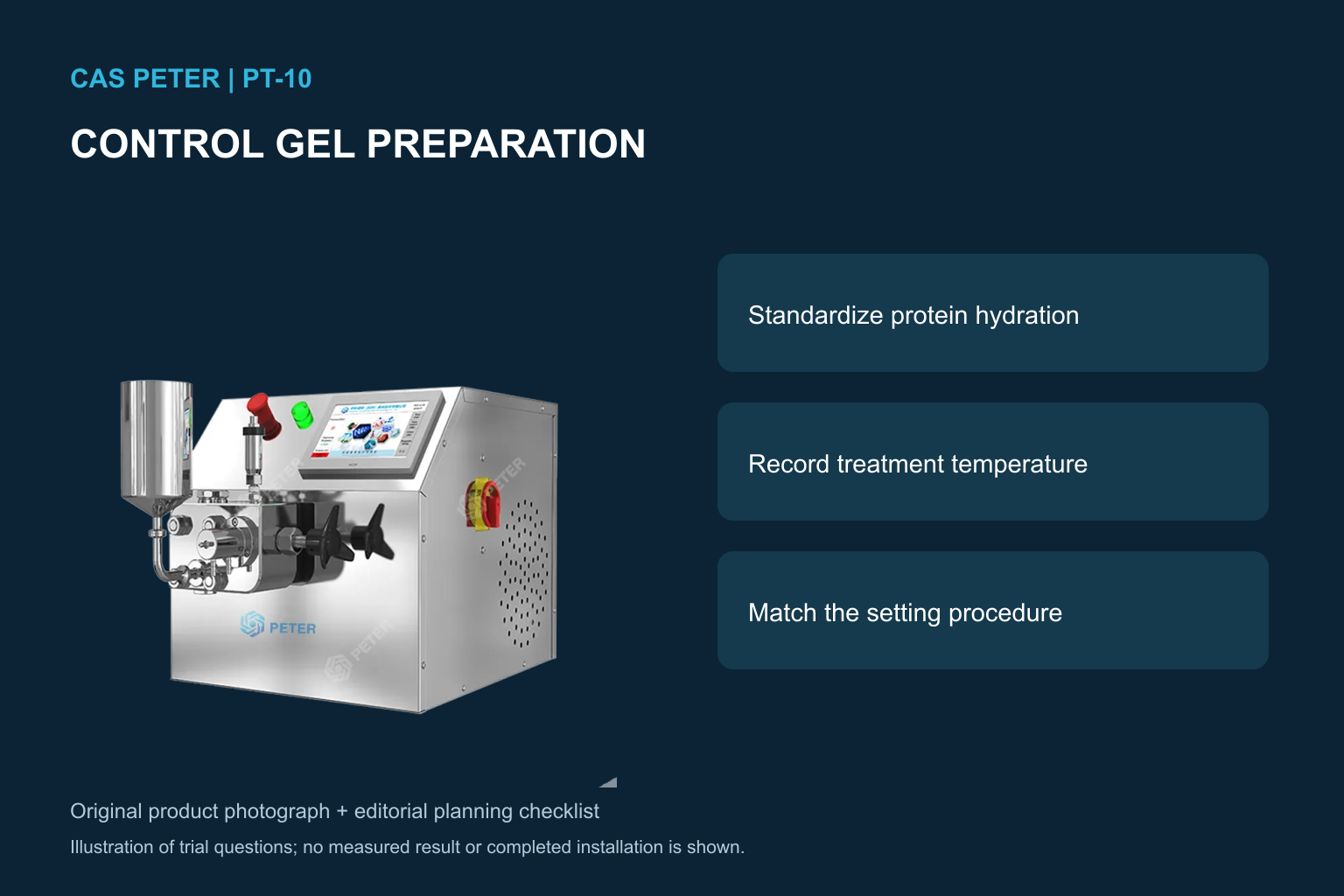
Reserve a matched untreated portion from the same premix. Keep its waiting time and temperature history documented. If the control receives additional mixing or cooling, record those steps explicitly. Arrange the processing order to reduce uncontrolled variation in hydration time and, where practical, repeat the experiment with a different order to investigate whether sample age is influencing the result.
Keep the treatment upstream of a reproducible setting step
Decide whether the trial treats a protein dispersion before addition of a gelling component or treats a more complete mixture. Review that decision with the formulation team and equipment supplier. A material that begins setting during the process may create a different feed condition. Confirm the processability of the actual mixture rather than assuming that a successful protein-only trial applies to every recipe.
Record actual pressure, flow, pass number, inlet temperature and discharge temperature. If the sample is cooled before gel preparation, record the cooling endpoint and elapsed time. Repeated passes should have a clear identity and thermal history. Avoid combining samples from different conditions unless pooling is part of the experimental design and its effect on interpretation has been considered.
Prepare all gels using the same ingredient addition sequence, mixing conditions, container geometry and setting procedure. Control the amount placed in each mould and the time between preparation and testing. Record temperature during the relevant stages. If a new ingredient or a different setting method is introduced halfway through the trial, begin a separately identified formulation comparison.
Choose texture measurements around the use case
Ask the laboratory to define sample dimensions, testing temperature, instrument geometry, speed and deformation settings. State whether the method measures a single compression, a repeated compression profile, penetration or another response. Keep the method identical across conditions. Preserve raw curves where available, because a summary force value can conceal fracture or other changes in the sample’s response.
Use consistent sample preparation. Cut specimens from defined positions in the gel and describe how damaged edges are handled. If surface drying can occur, document the exposure time before testing. Include independent gel preparations, not only multiple measurements on one piece, when judging process reproducibility. Instrument repetitions and independently prepared batches answer different questions.
Interpret hardness with springiness, cohesiveness or other appropriate measurements from the chosen method. Select only attributes that the method can support. For a slicing application, include a controlled slicing and handling observation. For a heated serving application, evaluate the finished gel after a defined heating procedure. The most useful texture target is connected to the intended product experience.
Measure water release with a defined procedure
Distinguish spontaneous liquid release in storage from water holding under an imposed test condition. Record the method, sample mass, test temperature and any centrifugal or mechanical conditions. Different procedures produce results that should not be treated as interchangeable. Use one method throughout a screening comparison and explain its relationship to the finished product’s handling requirements.
If reporting a retained-mass percentage, define the numerator and denominator in the report. For an illustrative weighed specimen of 10 grams that retains 9 grams after a specified procedure, the retained fraction is 90 percent on that mass basis. This calculation example is not a measured result and should not be labelled a universal water-holding method. A validated method may require additional corrections or a different calculation.
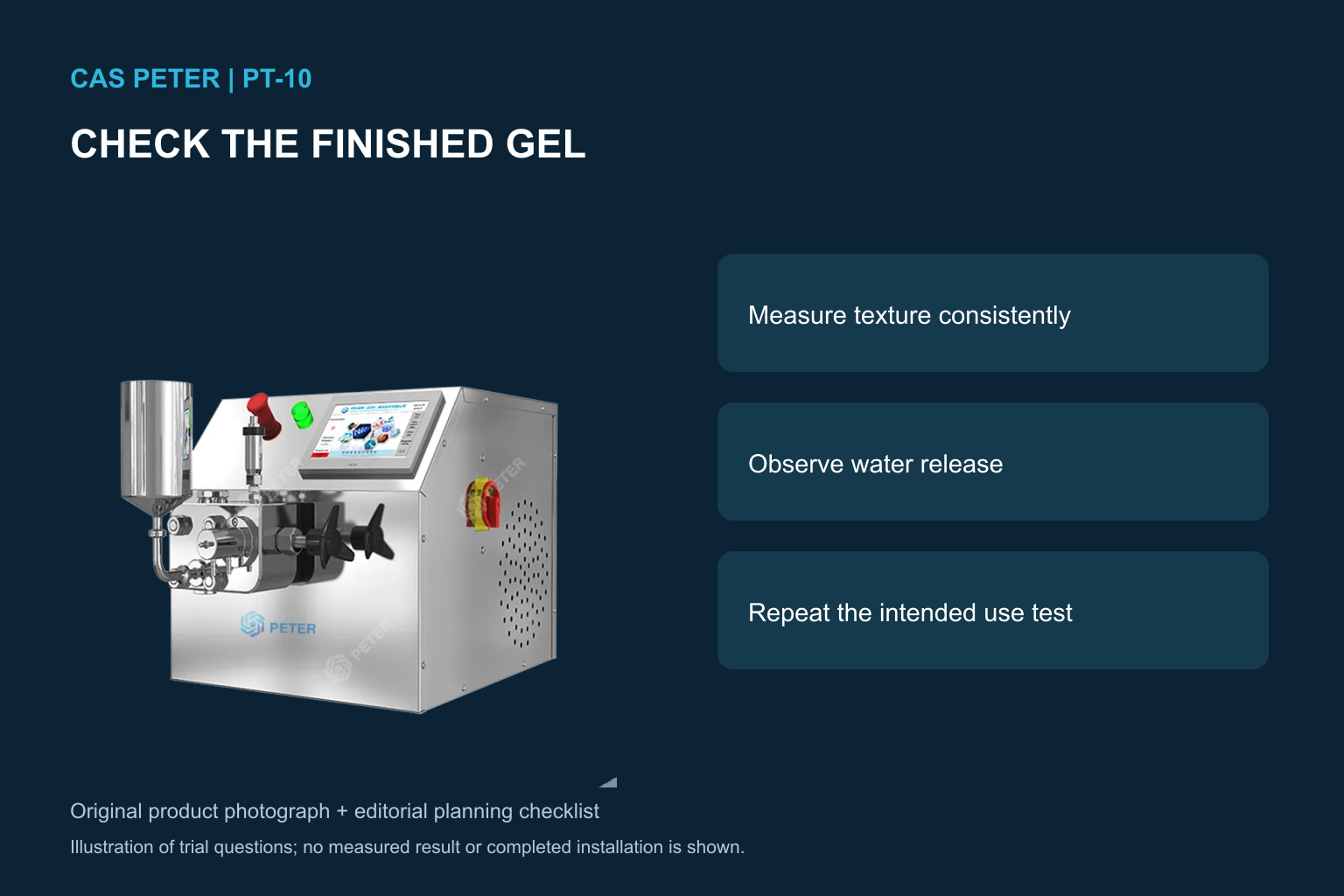
Observe the gel in its intended package as well. Record whether visible liquid appears before opening, after cutting and after the planned use step. Photograph the sample under consistent conditions and record its age. Keep the practical observation alongside the laboratory measurement so a product developer can see whether the selected method predicts the behaviour that matters.
Use a combined decision table
| Observation | Next check | Decision supported |
|---|---|---|
| Dispersion looks smoother | Prepare matched gels and measure their texture | Whether the physical feed change improves the final product |
| Hardness increases | Review fracture, springiness and use performance | Whether the texture change suits the application |
| Water holding improves in one test | Compare package liquid release under storage | Whether the laboratory result relates to product behaviour |
| Results vary between batches | Review hydration, ingredient lots and thermal history | Whether the condition is reproducible |
| One condition meets the brief | Repeat a new preparation and assess the intended use | Whether to progress to a larger verification trial |
This is a proposed qualitative decision framework. It does not prescribe a numerical specification or claim an observed CAS PETER result. Set limits from the product requirements and a suitable analytical procedure.
Include storage and the intended preparation step
Choose storage conditions and sampling times that match the development question. Keep container fill, closure and sample location consistent. If the product will be frozen, investigate the relevant freeze and thaw history as a separately controlled stage. Avoid judging freeze–thaw suitability solely from the fresh gel. Record actual conditions and any deviations so the quality team can interpret a failed sample correctly.
Perform the relevant preparation test after the chosen storage period. This might be slicing, mixing into a recipe or heating by a documented procedure. Use matched sample quantities and an agreed scoring method. Keep the operator or assessor unaware of the treatment identity when practical. Record an unacceptable handling result even if the instrument measurement appears favourable.
When interpreting several properties, apply the priority order established in the brief. A development report should state which condition satisfies the combined requirements and which property limits the alternatives. If no condition meets the brief, identify the next formulation or process question rather than selecting a sample solely because it has the highest measured strength.
Prepare a supplier enquiry with a testable question
The CAS PETER PT-10 product page provides a real equipment reference for discussing a protein dispersion trial. Send the supplier the actual feed composition, hydration procedure, required sample quantity and the location of homogenization in the overall process. Ask the supplier to confirm configuration suitability, product-contact materials, temperature control, feed preparation and cleaning requirements.
Include the planned texture and water retention tests in the enquiry. The supplier needs to know how much sample is required after startup and sampling losses. Agree how stable-running conditions will be recorded and how the material will be cooled or transferred before gel preparation. The equipment photograph identifies the catalogue model and is not evidence of a completed soy gel experiment.
For a promising condition, repeat the trial with a fresh premix before progressing to the intended scale. Preserve the relevant formulation, hydration and setting conditions while reviewing practical flow, recovery and changeover. Final acceptance should rest on reproducible finished gels and the project’s agreed use requirements.
Learn more about food protein functionality
The following NPTEL lesson introduces food proteins, structure, denaturation and functional behaviour including gels. It provides background for the formulation discussion and does not validate a particular machine setting or finished product.

Educational source: NPTEL IIT Kharagpur. Watch the lesson on YouTube.
Frequently asked questions
Does a smaller protein particle size guarantee a stronger gel?
No universal relationship can be assumed. Prepare the finished gel under controlled conditions and measure the properties required by the application. Formulation, hydration, setting and temperature history also affect the result.
Should the highest measured hardness determine the preferred treatment?
Select the condition against the complete product brief. Hardness should be considered with handling, fracture behaviour, water release and the intended preparation step, using methods appropriate to the finished gel.
Can I transfer a Chiba tofu study directly to conventional tofu?
Review the protein pretreatment, ingredients and gelation route first. Different soy products use different structures and preparation methods. Use the study to identify trial questions, then verify the result on the actual formulation and process.