

Pea Protein Solubility After Homogenization: Separate Dispersion from Dissolution
Pea protein solubility after homogenization should be measured as a defined soluble fraction, rather than inferred from a smoother appearance or smaller particles. High-pressure treatment can change aggregates and improve dispersion, but the outcome depends on ingredient history, hydration, pH, salts and heat exposure. A useful trial therefore pairs particle measurements with protein analysis after a controlled separation step, then checks the finished formulation. Increasing pressure until a suspension looks uniform does not establish that its protein has dissolved or that it will remain stable during storage.
This guide focuses on distinguishing dispersion from solubility in pea protein ingredients. For the wider formulation workflow, see our plant protein homogenization trial guide. The objective here is a defensible measurement and a practical decision about the next trial, rather than a universal pressure recipe.
Why a fine suspension can still contain insoluble protein
A commercial powder may include protein aggregates, carbohydrate material and other components that scatter light. Breaking larger structures into smaller suspended fragments can improve visual uniformity without moving all their protein into the fraction measured as soluble. Conversely, a change in sample clarity may reflect sedimentation or dilution rather than improved ingredient functionality. Appearance is useful for screening, but it cannot identify which mechanism caused the change.
Use three separate descriptions in the laboratory record: powder dispersibility during preparation, particle distribution in the hydrated suspension, and protein recovered in the operationally defined soluble fraction. These results answer different questions. Calling all three “solubility” makes comparisons between suppliers, instruments and processing conditions unreliable.
A study of pea protein isolate modification reports functional and structural changes after high-pressure homogenization. It supports investigating treatment as a formulation tool, while its ingredient and laboratory method remain part of the result. It does not establish that every commercial concentrate, extraction history or final beverage will respond identically.
Fix ingredient preparation before changing the machine
Record the supplier, grade, lot, declared protein content and available processing history. An isolate and a concentrate are not interchangeable controls. Even two ingredients with similar label protein percentages can behave differently after hydration. Keep a retained powder sample so that an unexpected result can be checked against the original material rather than reconstructed from purchasing records.
Prepare a common hydrated batch for the first comparison. Document the order of addition, water composition, mixing method, hydration duration and temperature. Confirm that the suspension is suitable for the proposed equipment before processing. Dry lumps, entrained air or uncontrolled feed preparation can make an equipment comparison into a powder handling comparison.
Measure pH after hydration and again at the point selected for sampling. If pH adjustment is part of development, record the reagent and its added quantity. Do not silently correct one treatment group to the target while leaving another at its natural value. That creates different formulations and prevents a clear interpretation of the homogenization step.
Define exactly what the soluble fraction means
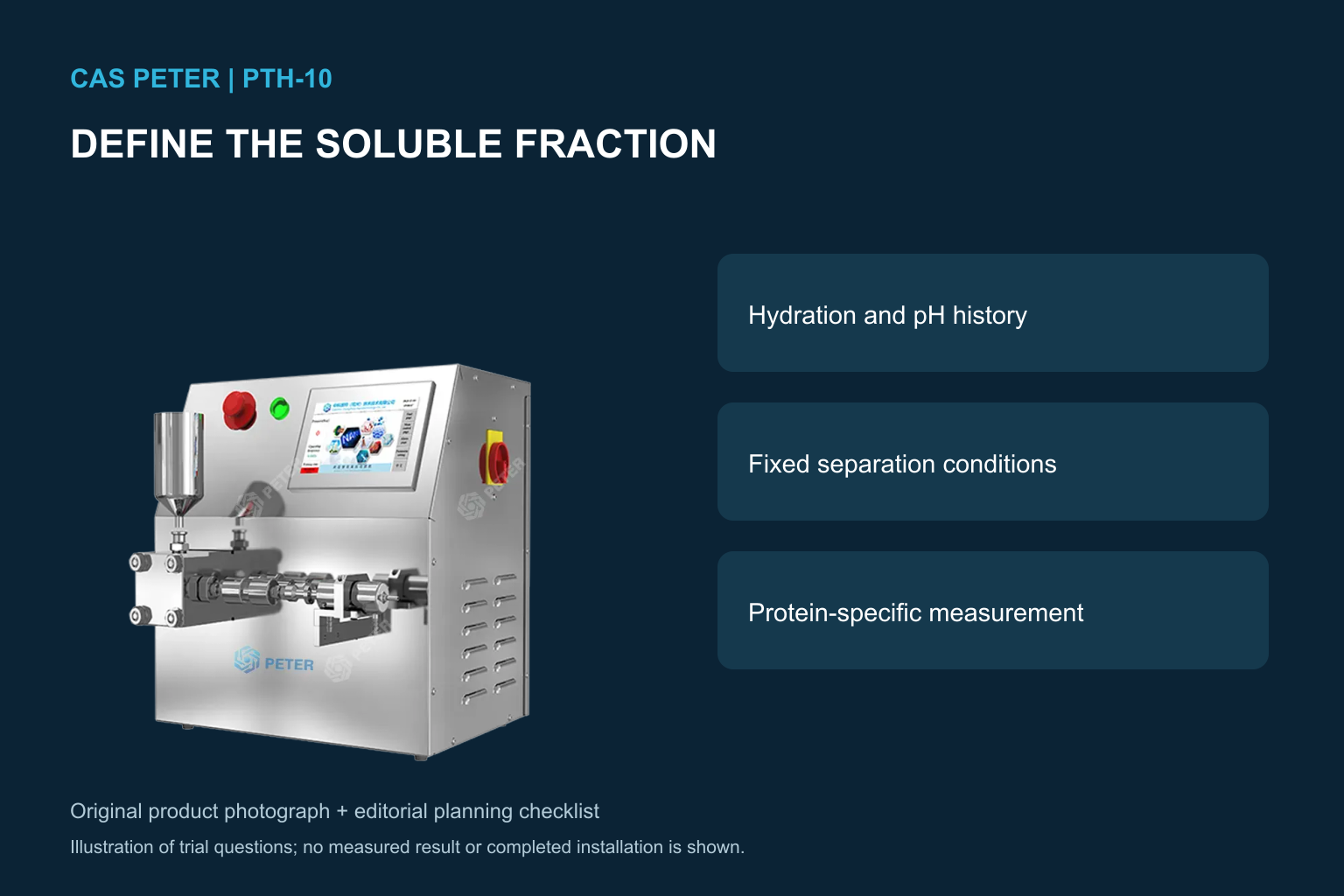
Choose the separation method before running the treatment matrix. A centrifugation procedure needs a defined relative centrifugal force, duration and temperature, together with the sample preparation and collection position. Reporting only rotational speed is insufficient when different rotors are used. Filtration creates another operational definition and should not be substituted midway through a comparison.
Decide how protein in the collected liquid will be quantified. A colorimetric assay, nitrogen method and dried supernatant mass do not necessarily measure the same thing. Nonprotein material can contribute to a dry residue, while some solution components can affect an assay response. Use a suitable blank and the controls required by the chosen analytical method.
A study of native pea protein functionality describes its own ingredient preparation and solubility method. That detail is useful because it shows why a literature value must travel with its method. Copying a reported percentage into a purchasing specification without the associated preparation and analytical conditions would remove information needed to reproduce it.
If expressing a soluble protein percentage, state the numerator and denominator in the report: protein measured in the separated liquid relative to protein initially represented in the test portion, with volume and dilution accounted for. If the denominator is powder mass instead, label the result accordingly. A spreadsheet should retain the raw measurements so a reviewer can reconstruct the calculation.
Build a comparison that can isolate treatment effects
Start with a hydrated untreated control and a small number of approved processing conditions. Keep the ingredient concentration and preparation common across groups. Record the actual pressure, number of complete passes, feed temperature, outlet temperature and time before analysis. A nominal setpoint alone does not describe the sample history.
Use separate collected passes when you need a known treatment count. Recirculation through a tank can create a distribution of exposure histories, which makes a “three pass” claim ambiguous unless the operating method supports it. Our high-pressure homogenization methods overview explains the broader process options; the trial record should identify the one actually used.
The following table is a qualitative planning aid, not a set of universal acceptance limits. Its purpose is to connect an observation with a useful next check. Ingredient-specific limits must come from the intended product and a reproducible method.
| Observation | What it establishes | What to check next |
|---|---|---|
| Smaller particles with unchanged soluble protein | Dispersion changed under the measurement conditions | Confirm sampling and ask whether suspension stability, rather than dissolution, is the real objective |
| Higher soluble protein with similar particle distribution | More protein reached the defined separated fraction | Check assay blanks, pH and repeatability before assigning a mechanism |
| Better initial result followed by sediment after heating | Initial performance did not survive the complete formulation process | Compare matched heat histories and final ingredient interactions |
| Different results between powder lots | The ingredient may be contributing to variability | Repeat a retained lot alongside the new lot under identical preparation |
| A clear liquid after long standing | Material may have left suspension | Measure sediment and sample representatively before claiming improvement |
Use pH and salt changes as controlled formulation variables
Protein interactions depend on the surrounding liquid. When an application needs an acidic product or added minerals, test those conditions explicitly. A result measured in water at one pH should not be treated as evidence for a different finished recipe. Introduce formulation changes deliberately so their contribution can be separated from equipment effects.
A useful sequence is to establish repeatability in a defined base suspension, then challenge the selected conditions in the intended formulation. Record whether salts and acids were added before or after homogenization. The order can change the material presented to the machine and the structures evaluated afterward. Preserve both records rather than reducing the process to a final pH number.
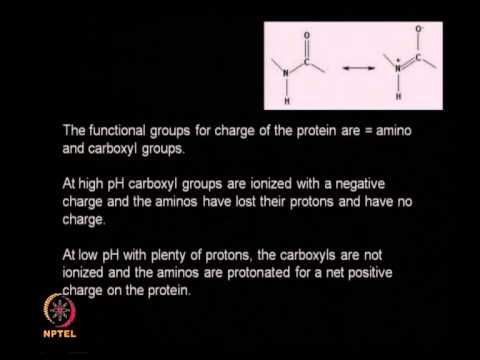
The educational lecture below explains precipitation as a protein separation operation. It provides background on solution conditions and soluble fractions, rather than a food recipe or a recommended chemical treatment for pea beverages. Any laboratory reagents discussed in the lecture require their own suitability assessment for a food application.
Educational source: nptelhrd. Watch the lesson on YouTube.
Check the product after its complete processing sequence
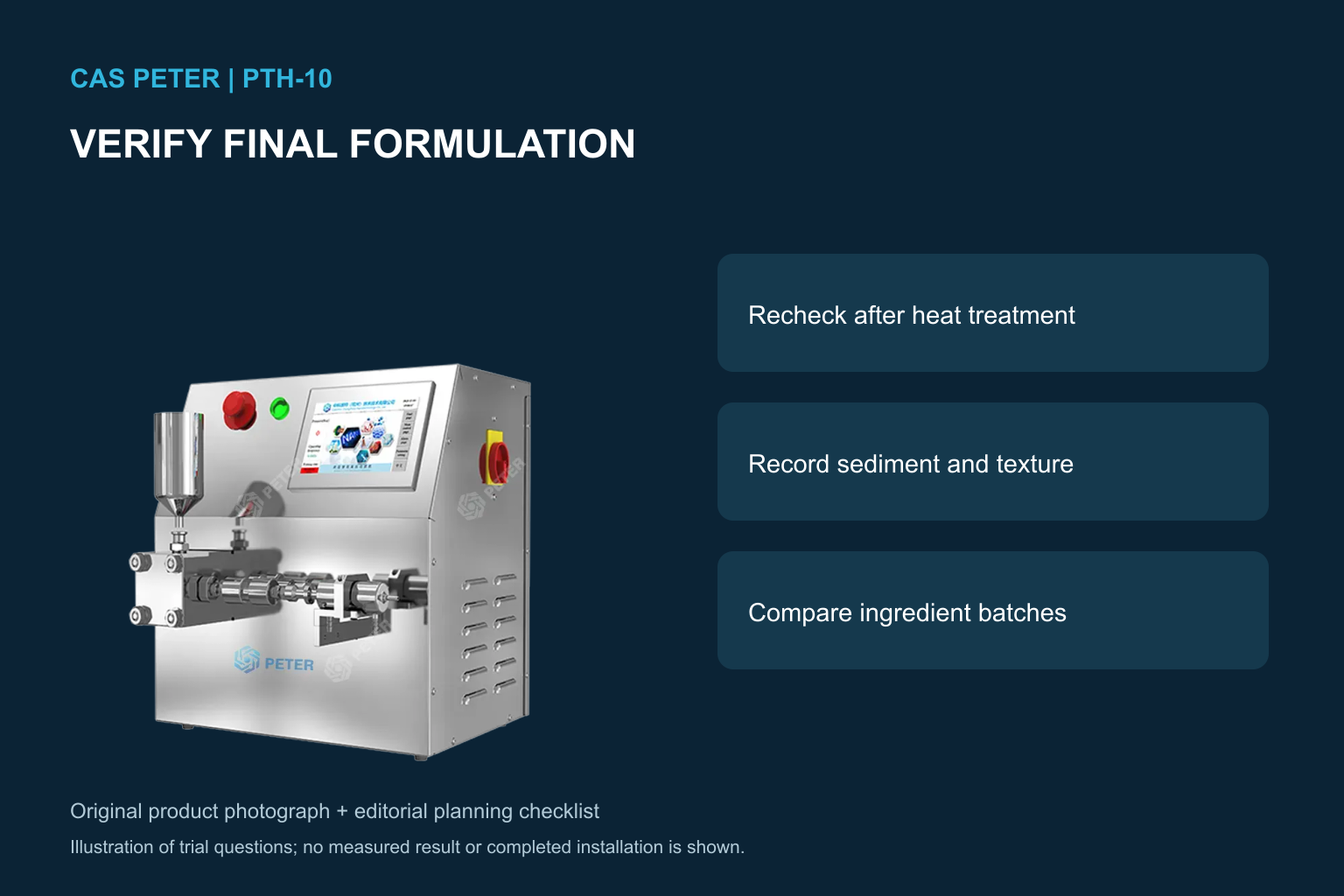
A soluble fraction measured immediately after homogenization is an intermediate result. If the finished product will be heated, diluted, fermented or blended with other ingredients, repeat the relevant measurements after those operations. Keep the sequence representative of production; reversing homogenization and heating solely for analytical convenience can create a different material.
For a beverage, examine the whole sample as well as the separated analytical fraction. Record sediment, visible aggregation, flow behavior and the intended texture. For an emulsifying ingredient, make a defined test emulsion and follow its behavior separately. A higher soluble fraction is useful only if it supports the function that motivated the processing work.
Use planned storage intervals and comparable containers. Define whether a sample is examined before or after shaking, and retain photographs with scale and lighting controlled. Redispersibility should be assessed by a repeatable procedure instead of a vague instruction to “shake well.” These records help distinguish an acceptable suspension from a formulation that merely looks acceptable on the first day.
Select equipment around the feed and the evidence required
The CAS PETER PTH-10 product page provides a starting point for discussing a laboratory trial. A model listing does not guarantee a particular pea protein solubility or finished beverage result. Confirm the proposed configuration against the actual feed, sample quantity, flow behavior, temperature limits and cleaning requirements before selecting operating conditions.
Send the equipment supplier a representative sample description and the complete proposed trial sequence. Include the hydration method, largest expected feed structures, solids content, pH range and any planned additives. Ask how the feed will be delivered, how separate passes will be collected and how the temperature history will be recorded. These questions produce more useful evidence than requesting the highest available pressure.
When particle data support the decision, use a method suited to the suspension. Our DLS versus laser diffraction guide discusses why different particle measurements may describe different aspects of a mixed sample. Keep the same preparation and dilution method across treatments, and avoid treating a single average diameter as proof of molecular dissolution.
Decide whether another pass is justified
Compare the additional treatment with a predetermined practical objective: greater usable soluble protein, less sediment after the complete process, better emulsifying performance or more consistent texture. Include repeatability and processing burden in the decision. A small apparent improvement that is within analytical variation is a reason to investigate the method, not automatically to add more processing.
Keep a concise decision sheet for each candidate condition. Attach the raw protein results, particle distributions, temperature record and finished product observations. Mark unresolved assay interference or inconsistent sampling before ranking treatments. The strongest condition is the one that meets the product objective reproducibly with an acceptable operating method, rather than the one that produces the most attractive isolated number.
Frequently asked questions
Does a smaller particle size prove that pea protein is more soluble?
No. Smaller suspended aggregates can improve dispersion without increasing the protein recovered by a defined solubility test. Pair particle measurements with a controlled separation and suitable protein analysis, then report both outcomes.
Can a published homogenization pressure be used as a production recipe?
It can inform a trial, but it is not a universal recipe. Ingredient preparation, formulation, equipment configuration, passes and temperature history must be evaluated for the actual product before choosing production conditions.
Should solubility be measured before or after heating?
Measure at the stages needed to answer the process question. An intermediate measurement helps identify homogenization effects, while a measurement after the intended heating and formulation sequence shows whether the benefit survives in the finished product.