

Fish Oil Nanoemulsion Oxidation After Homogenization: Test More Than Droplet Size
Fish oil nanoemulsion oxidation after homogenization must be checked independently from droplet size. A fine, visually uniform emulsion can still develop chemical deterioration during processing or storage. Compare the starting oil, premix and homogenized material using a suitable oxidation method, while controlling temperature, air contact, formulation and packaging. Then repeat the comparison in the intended food or delivery format. Approving the smallest droplet measurement alone leaves the main shelf-life question unanswered.
This guide is for formulation and process development. It does not establish a health claim, a universal shelf life or a food-safety release limit. Any commercial specification must be appropriate to the actual ingredient, final product, market and validated analytical procedure.
Separate physical stability from oxidative quality
Physical stability asks whether droplets grow, cream, flocculate or separate. Oxidative quality asks whether the oil’s chemical condition changes. Those questions require separate evidence, even when they are influenced by the same processing history. An emulsion may look unchanged while its oxidation results deteriorate, or it may separate without showing the same chemical change.
Start with two acceptance statements. One should describe the physical condition required by the application; the other should describe the acceptable chemical result using an agreed laboratory method. Keep the time and storage conditions attached to each statement. An immediate measurement cannot establish what will happen over a distribution period.
The emulsion homogenization guide explains the equipment context. For the physical branch of this trial, use the nanoemulsion stability testing workflow. Keep those observations alongside oxidation results rather than using them as a replacement.
What fish oil research demonstrates, and what it does not
A study of high-pressure homogenization and fish oil encapsulation evaluated processing conditions and wall materials, including oxidation in a freeze-dried product. Within that system, the condition giving higher encapsulation efficiency did not also give the most favorable oxidation result. The work supports checking more than one quality endpoint, but its dehydrated formulation is not a ready-made protocol for a liquid beverage.
A National Research Centre study of omega-3-rich oil nanoemulsions examined emulsifier choice, processing conditions and continuous-phase viscosity, and also monitored oxidative stability with rosemary extract. It illustrates that formulation and processing need to be considered together. It does not establish that any antioxidant addition or pressure setting will protect a different oil emulsion.
The development plan below is an original checklist for comparing a specific formulation. It does not copy either study’s settings or present their measurements as CAS PETER equipment results.
Establish the incoming oil baseline
Identify the oil source, supplier, lot, composition information, added antioxidants and storage history. Obtain the relevant certificate of analysis, then decide whether additional incoming checks are needed for the trial. If the starting oils differ between treatment arms, a later oxidation difference cannot confidently be assigned to the homogenizer.
Use one well-defined lot for initial screening and record when its container was opened. Minimize unnecessary transfers using a documented handling procedure suitable for the material. Keep an untouched retained sample under the agreed conditions, and distinguish it from the oil actually used to prepare the premix. Both references can help locate where a change first appears.
Include the aqueous phase and emulsifier in the material record. Record their lot identities, preparation method and any relevant storage restrictions. If a formulation change is necessary, treat it as a new comparison rather than silently replacing an ingredient during the pressure trial. Consistent documentation makes a result useful when the formulation is transferred to another team.
Use staged samples to locate deterioration
Collect samples from incoming oil, prepared premix, selected homogenization stages and the final collected batch. Agree on appropriate sampling and storage with the analytical laboratory before running the equipment. Some tests require a particular amount of recovered oil or a specific preparation procedure; discover those requirements before the trial consumes the available material.
Label each sample with collection time, treatment history and storage destination. Do not leave one sample warm on the bench while immediately cooling another if the goal is to compare process conditions. Give all samples the same post-collection handling unless the handling itself is the variable being tested.
For repeated-pass operation, retain clear information about material routing. A sample after a defined transfer is easier to describe than a sample collected from a mixed recirculation tank. If recirculation is the intended production mode, document it as such and investigate the resulting distribution of processing histories rather than implying identical exposure for every droplet.
Control temperature and air contact during the trial
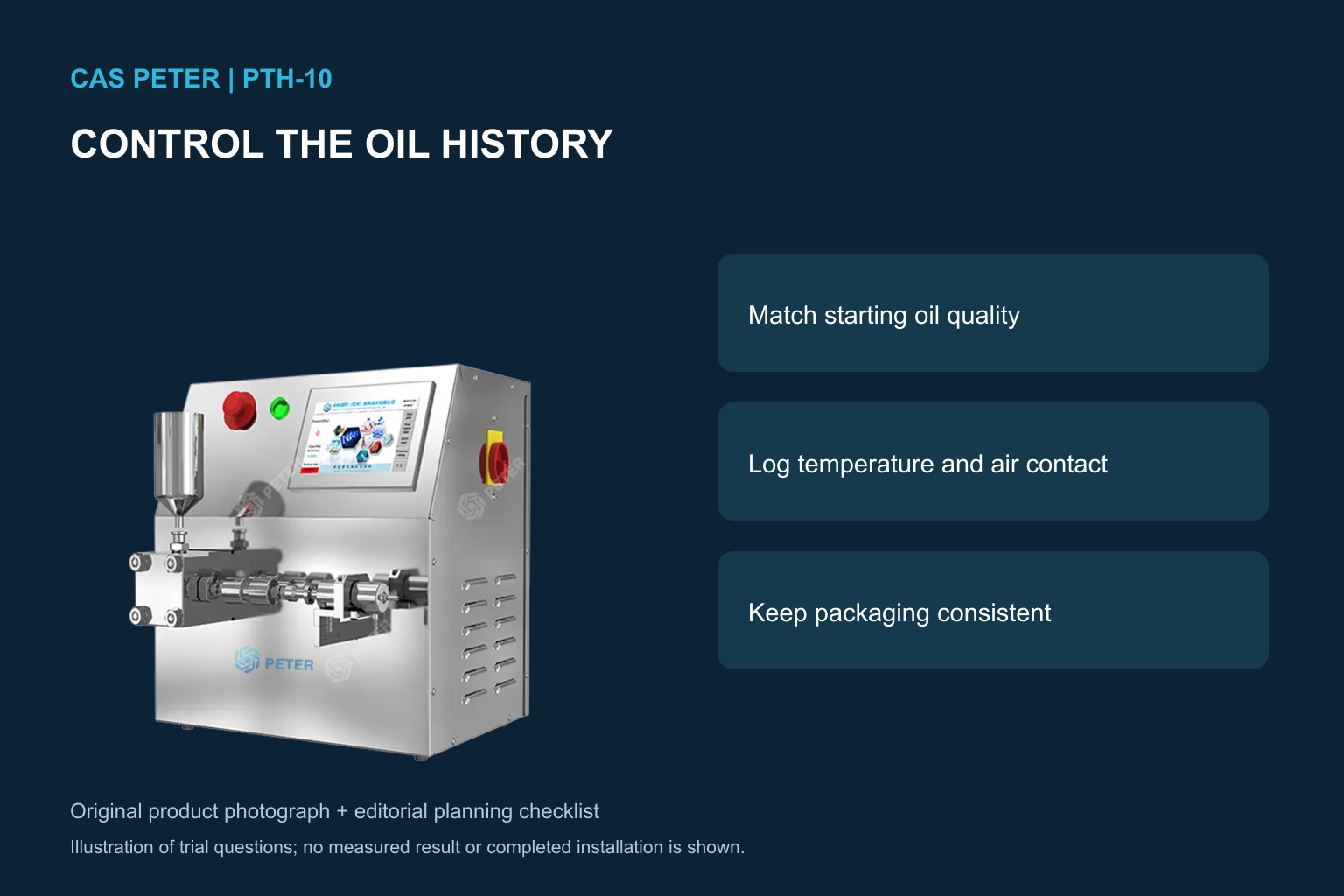
Record feed temperature, actual pressure, flow rate, pass sequence and temperatures at clearly identified points. Include the time spent in feed and collection vessels. Cooling the final product is useful, but a low collection temperature does not prove that the material avoided a warmer excursion during treatment.
Observe foam and air entrainment. Describe vessel filling, return-line position and agitation so that a repeat trial can reproduce the conditions. If gas-management changes are investigated, make them a separate, controlled comparison. Do not add an undocumented deaeration step to one trial arm and then attribute the entire difference to pressure.
The CAS PETER PTH-10 product page is the equipment reference for the illustrations. Before a material trial, confirm the complete formulation’s compatibility, temperature limits, processing path, cleaning needs and required sample quantity with the supplier. Neither a product photograph nor a published research condition proves compatibility with every fish oil formulation.
Select oxidation tests that suit the matrix
Ask the laboratory which methods are appropriate for the actual emulsion and its ingredients. The extraction step, sample color, emulsifiers and antioxidants may influence method suitability. Record whether results are expressed on recovered oil, total emulsion or another basis. Comparisons become misleading when the denominator changes between samples.
Where appropriate, discuss complementary measurements of earlier and later oxidation products rather than choosing a single convenient number. Use the laboratory’s validated procedure and interpretation for the matrix. This article supplies no universal peroxide, anisidine or combined-index acceptance limit for finished emulsions.
Document blanks, controls, repeat measurements and reporting limits. If a result is unexpectedly low after a processing change, first establish that the method still performs as intended in that sample. A change in extraction recovery or interference should not be celebrated as improved oxidative stability. Retain enough sample for a confirmatory analysis when practical.
Compare observations using a practical decision table
| Trial observation | What it establishes | What remains unresolved | Next useful action |
|---|---|---|---|
| Smaller droplets immediately after treatment | A physical change occurred under the measurement conditions | Oxidative quality and storage behavior | Test chemical quality and retain storage samples |
| Similar size with different oxidation results | Size alone does not explain the entire difference | Whether formulation, thermal history or handling caused it | Review matched controls and process logs |
| Good initial results but deterioration during storage | Initial quality did not predict the whole storage period | Packaging and storage contributions | Repeat in the intended container and exposure conditions |
| A changed antioxidant system improves one test | The formulation change may be useful for that endpoint | Method suitability, other quality attributes and permitted use | Validate the assay and application before approval |
| Extra passes bring little physical benefit | Further treatment may have limited practical value | Whether the shorter treatment meets all requirements | Compare the least severe acceptable process |
The table is a proposed decision aid informed by the cited studies’ use of multiple quality endpoints. It contains no numerical release criteria or guaranteed direction of response.
Design storage around the actual package
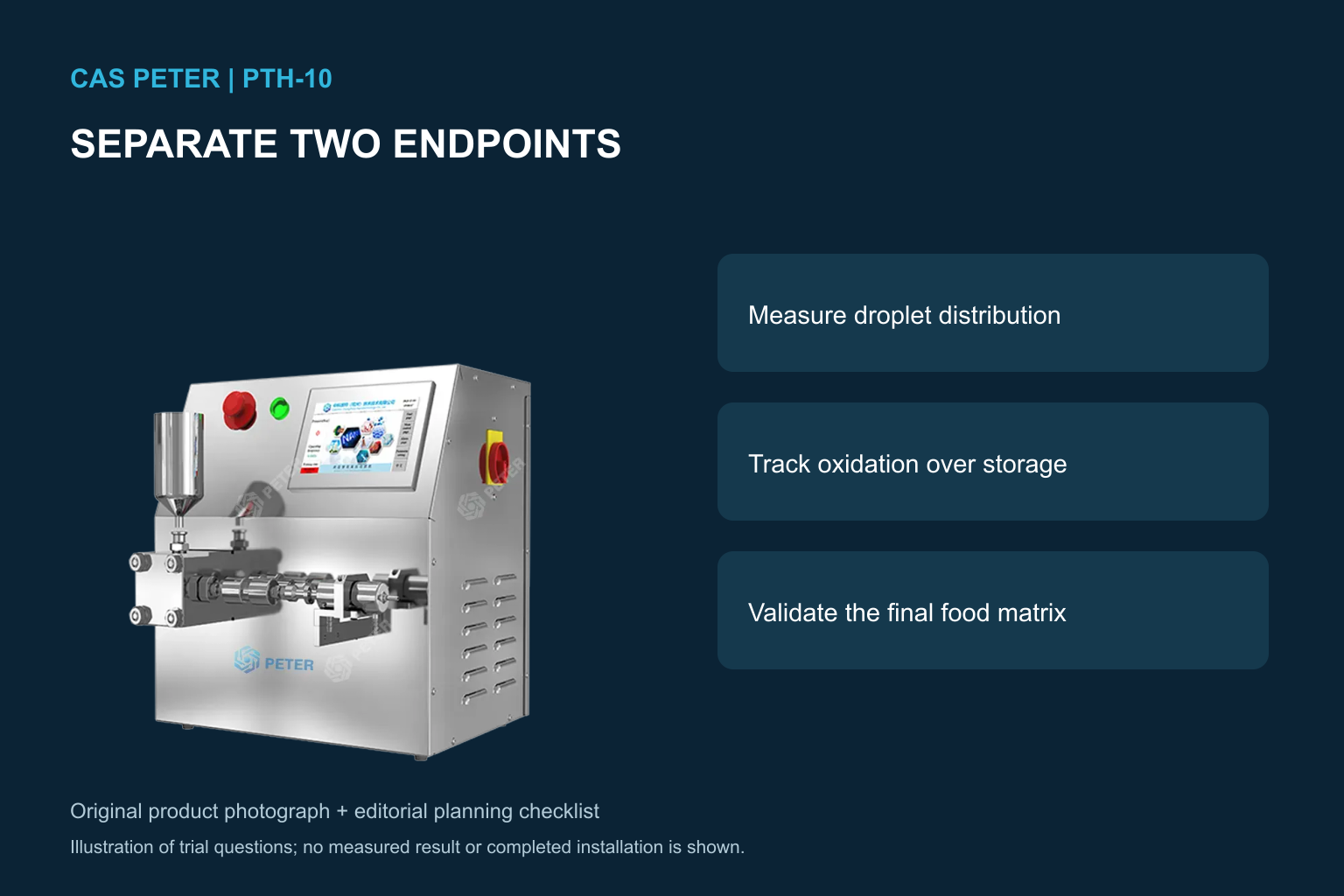
Use the planned container, closure and fill condition whenever possible. Record storage temperature, lighting, orientation and whether containers are opened during the test. Repeatedly opening the same container creates a different exposure from opening separate retained units at each interval. Choose the arrangement that represents the question and document it.
Include a realistic storage condition and any justified stress condition as separate arms. A stress test can screen differences, but converting it into a commercial shelf life requires a validated relationship to the actual product. Avoid multiplying a few accelerated observations into a shelf-life promise without supporting data.
At each interval, compare oxidation with droplet distribution and visible appearance. Keep out-of-specification or unexpected observations in the record. If the formulation includes flavors or other ingredients, decide which additional sensory or analytical checks are appropriate and who is qualified to interpret them. Tasting an experimental product is not a substitute for analytical or safety approval.
Validate dilution, blending or drying after homogenization
If the emulsion will be diluted into a beverage, test that dilution under the intended mixing conditions and storage package. If it will be dried, separate the liquid emulsion result from the dried ingredient result and any reconstituted product result. Each stage introduces a new material history and should have its own sample identity.
Consider how other ingredients change the measurement environment. Record final composition, pH adjustment and the time between blending and testing. When comparing physical measurements, the zeta potential interpretation guide can help avoid treating one instrument result as a universal stability certificate. Oxidation still requires its own suitable evidence.
Before scale-up, repeat the preferred condition using an independent preparation. Include representative oil lots when lot variability matters to the intended specification. Request a longer trial if production involves extended holding, cooling drift or repeated collection. A small screening batch cannot establish the stability of a complete production campaign.
Prepare the inquiry and approval package
Provide the supplier with the complete formula, oil specification, starting premix condition, target batch quantity, permitted temperature range, processing mode and cleaning requirements. State both the physical target and the chemical quality question. Ask how samples and temperature records will be collected, rather than requesting the highest available pressure as the default solution.
The approval package should contain material identities, sample map, process log, analytical procedures, raw results, storage conditions and the agreed decision. Identify the final product format that was tested. If only the liquid intermediate was evaluated, retain that limit in the conclusion so that later teams do not assume a dried or diluted product has already passed.
Educational video: the physical emulsion background
This NPTEL lesson introduces emulsion technology and the physical formulation context. Use it to understand the droplet and interface side of the trial. It does not replace oxidation assays, establish a shelf life or provide a fish oil production recipe.
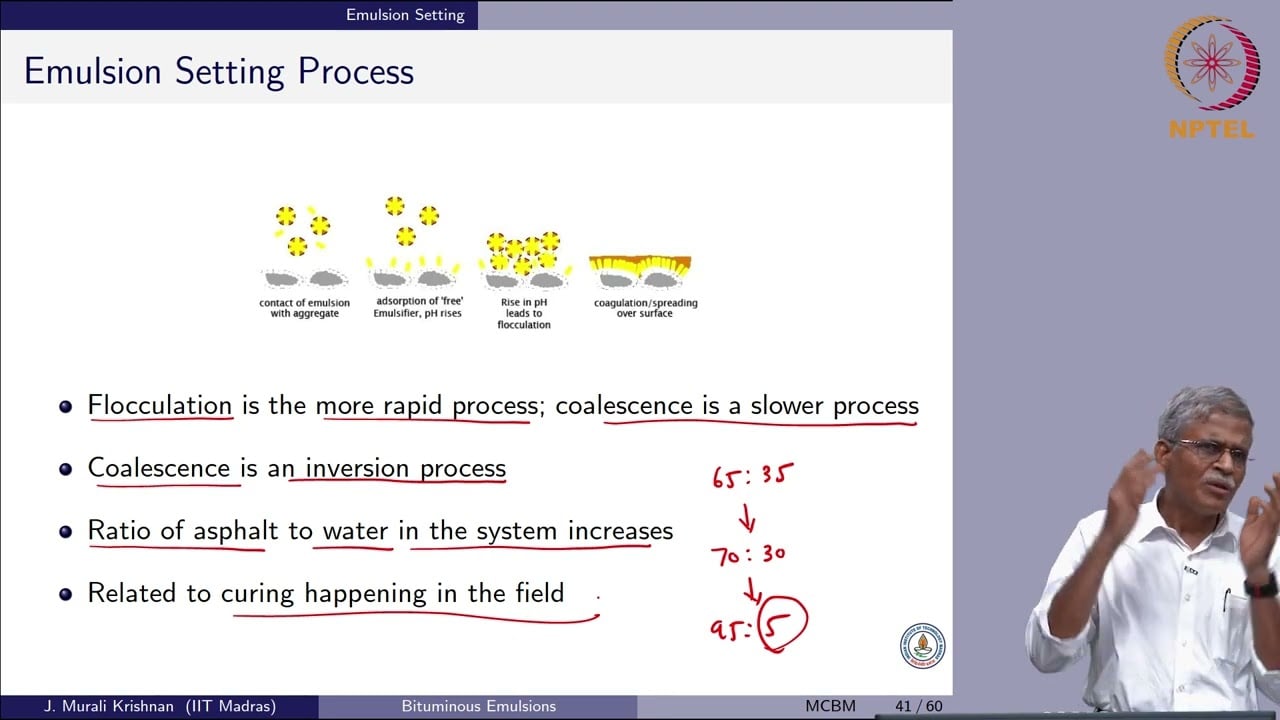
Educational source: NPTEL-NOC IITM. Watch the lesson on YouTube.
Frequently asked questions
Does the smallest fish oil droplet size guarantee better oxidation stability?
No. Droplet measurements and oxidation measurements answer different questions. Compare both using matched formulation, processing and storage conditions, and choose the condition meeting the complete product specification.
Can an antioxidant replace temperature and packaging controls?
Do not assume so. Evaluate the permitted antioxidant system in the actual formulation together with process history, method suitability and storage packaging. Its presence alone does not establish protection throughout shelf life.
Can a liquid emulsion result approve a dried fish oil ingredient?
No. Drying, storage and reconstitution create additional material histories. Evaluate the intended final format and record which stages have been tested before making an approval decision.