

Titanium Dioxide Dispersion After Homogenization: Separate Settling from Aggregation
Titanium dioxide dispersion after homogenization should be evaluated by separating particle aggregation from sedimentation. A smaller size result in the upper liquid can mean that larger material has settled, rather than that the complete suspension has become finer. Compare the full batch, a defined upper sample and a consistently remixed sample, then track both particle size and solids concentration. The useful process is one that gives the required handling and application behavior over time, with acceptable equipment compatibility and repeatability.
This guide concerns aqueous titanium dioxide suspension development. It does not establish suitability for food, cosmetics, medical use or a particular coating. Powder grade, surface treatment, formulation, intended use and applicable requirements must be assessed separately.
Define the kind of stability the application needs
A continuously stirred process and an unstirred storage container ask different questions. In one application, mild settling followed by easy redispersion may be acceptable. In another, concentration variation during withdrawal may be unacceptable even if the sediment can eventually be mixed back. Write the required behavior before selecting treatment conditions.
Describe the actual storage period, container geometry, withdrawal point and mixing available at use. Add a practical test of the redispersion procedure if the process depends on it. Specify what equipment and mixing sequence will be allowed. A laboratory operator’s vigorous shaking is not evidence that a production tank can recover the same suspension.
The high-pressure dispersion methods guide provides broader process context. This article focuses on how to interpret a titania suspension after treatment; it does not assume that all metal oxides or surface-treated grades respond in the same way.
Read the research within its material boundaries
An experimental study of water-based nanofluids compared dispersion methods and evaluated titanium dioxide suspensions with dispersants. Its static and shaken samples showed why size measurements need a sampling history: settling changed the measured population, while remixing revealed information unavailable from the upper liquid alone. The results concerned the particular powders, concentrations and formulations examined, not every titania slurry.
A separate study of dilute titanium dioxide-water nanofluids prepared suspensions by ultrasonication and adjusted pH for stabilization. It also examined rheological behavior. That work is useful evidence that powder form, medium and preparation belong in the stability assessment; it is not a high-pressure homogenizer operating recipe.
The development workflow below is an original practical framework. It uses these studies to identify questions, without adopting their settings as an equipment recommendation or claiming that CAS PETER has reproduced their results.
Identify the powder and prepare a representative feed
Record supplier, grade, lot, crystal form where specified, surface treatment and primary particle information from the actual material documentation. Distinguish the supplier’s primary particle description from the agglomerate distribution in your prepared feed. A nominal powder size is not a measurement of the suspension entering the machine.
Obtain the relevant safety information and use an approved procedure for powder handling and wetting. Do not improvise open powder addition or aerosol-producing mixing. The purpose of the development trial is to evaluate a controlled liquid feed, with material handling practices appropriate to the powder and workplace.
Document water quality, pH, conductivity where relevant, dispersant identity, concentration basis and mixing order. Specify whether solids percentages are by mass or volume. Changing that basis between trials can produce a substantial formulation difference while leaving the same number on a worksheet. Retain a prepared-feed sample and record how long it stood before processing.
Check whether the premix contains visible lumps or foreign matter, and ask the equipment supplier what feed preparation is required. Do not use a high-pressure unit as an assumed remedy for an unqualified feed. Oversize material, abrasive behavior and formulation compatibility need review before the sample is introduced.
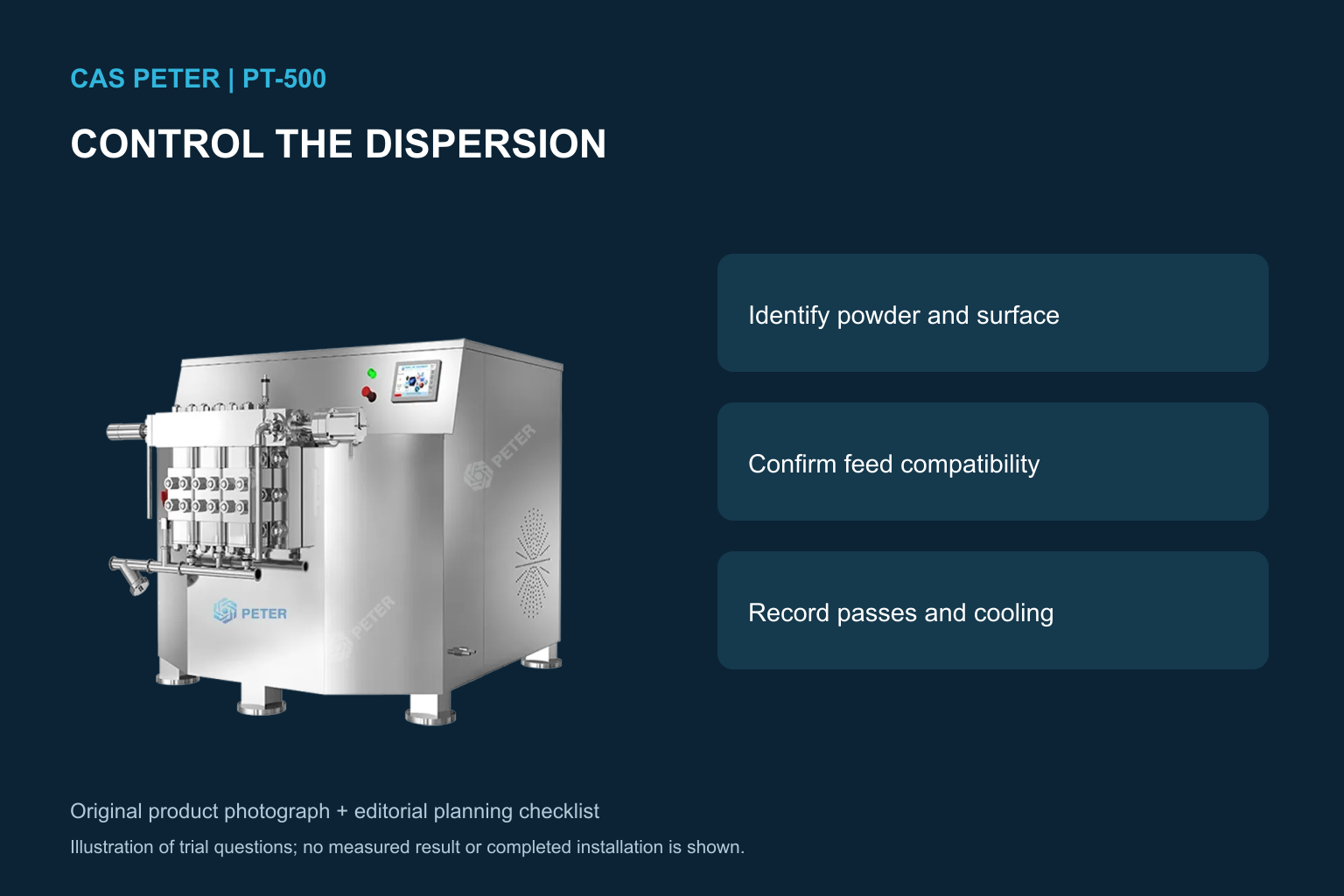
Confirm the machine configuration before discussing pressure
Provide the supplier with solids loading, viscosity, medium composition, pH range, temperature limits and representative feed-size information. Include whether the material is expected to be abrasive and what cleanliness or contamination restrictions apply. Request confirmation for wetted components, seals, processing path and the proposed cleaning procedure.
The CAS PETER PT-500 product page is the actual machine reference used for the illustrations. Its photograph does not demonstrate that every titanium dioxide slurry can be processed on every configuration. Throughput, pressure, wear behavior and cleaning must be established for the proposed feed and installation.
Review the guide to wetted materials and abrasive slurries before agreeing a trial. An apparently good dispersion is not enough if the process causes unacceptable wear or contamination. Include an inspection and sampling plan appropriate to the intended use, with criteria agreed by the responsible engineering and quality teams.
Run a small, interpretable process comparison
Use an untreated premix reference and a limited set of supplier-approved treatment conditions. Record actual pressure, flow, passes, inlet and outlet temperatures, cooling arrangement and material routing. If the formulation is changed during development, give the new formulation its own identity rather than combining its results with the original series.
Collect samples consistently after the defined treatment. Avoid comparing a warm fresh sample with a control that has stood overnight without documenting that difference. Record the delay before each analysis. If the selected measurement requires dilution, preserve the diluent composition and preparation procedure across samples.
Set a stopping rule before the run. If additional treatment gives no useful improvement in the required application, investigate formulation or feed preparation rather than automatically increasing passes. More processing is not evidence of a more successful product, and it may introduce additional cooling, wear and handling requirements.
Use a sampling map that can reveal sedimentation
Prepare separate retained containers where practical, with matched fill quantity and geometry. At each interval, photograph the container before disturbance and note visible layers or sediment. Define the upper-liquid sampling height and collection method. A sample from an unspecified position cannot support a reliable comparison between storage intervals.
After the undisturbed observation, apply the agreed redispersion method to a separate matched unit or to the same unit using a documented sequence. Then collect a representative bulk sample. Avoid using extra mixing only on the poorer-looking sample; that changes the test and can hide a difference relevant to the application.
Pair particle-size observations with a suitable concentration measurement. If the upper sample contains less solid than the bulk, a finer measured distribution may reflect selective settling. Report that interpretation as a possibility to investigate, not as proof of particle breakage. Inspecting only the clear upper layer can systematically exclude the material most likely to cause handling problems.
Match the measurement method to the question
Use an appropriate size method for the distribution and formulation, and preserve its settings and preparation procedure. For a practical discussion of what different methods measure, see DLS versus laser diffraction after homogenization. Neither method can repair an unrepresentative sample or establish primary particle fragmentation from a single average.
Where the sample needs dilution, ask whether dilution changes pH, ionic environment or dispersant balance. If the measurement preparation changes the dispersion, its result may not represent the undiluted batch. Record the procedure and test its effect before comparing a long series of processing conditions.
Zeta potential can contribute to the assessment, but should be interpreted alongside formulation, size, concentration and observed behavior. Avoid approving a batch solely because it crosses a generic numerical threshold. The relevant question is whether the complete formulation retains the behavior required by the intended application under the tested conditions.
Interpret paired observations, not isolated averages
| Observation after storage | Possible interpretation | Comparison needed | Practical implication |
|---|---|---|---|
| Upper liquid becomes finer and less concentrated | Larger material may have settled out | Compare upper and remixed bulk samples | Do not call the whole batch more finely dispersed |
| Size returns after the defined remix | Sedimentation may be reversible under that procedure | Repeat storage and redispersion cycles | Decide whether the actual user can perform the same recovery |
| Coarse material remains after remixing | Aggregation or an insufficient recovery procedure may be involved | Compare microscopy or another appropriate size assessment | Investigate before accepting the storage behavior |
| Immediate size looks favorable but concentration varies during withdrawal | Bulk handling is not represented by the initial sample | Simulate the intended withdrawal sequence | Reassess mixing, vessel design or formulation |
| Similar size measurements give different application results | The measured average does not describe all relevant properties | Compare flow, concentration and the end-use test | Keep application performance in the approval criteria |
This table is an original qualitative interpretation aid informed by the cited studies’ use of complementary stability measurements. It is not a set of validated limits for all titanium dioxide grades.
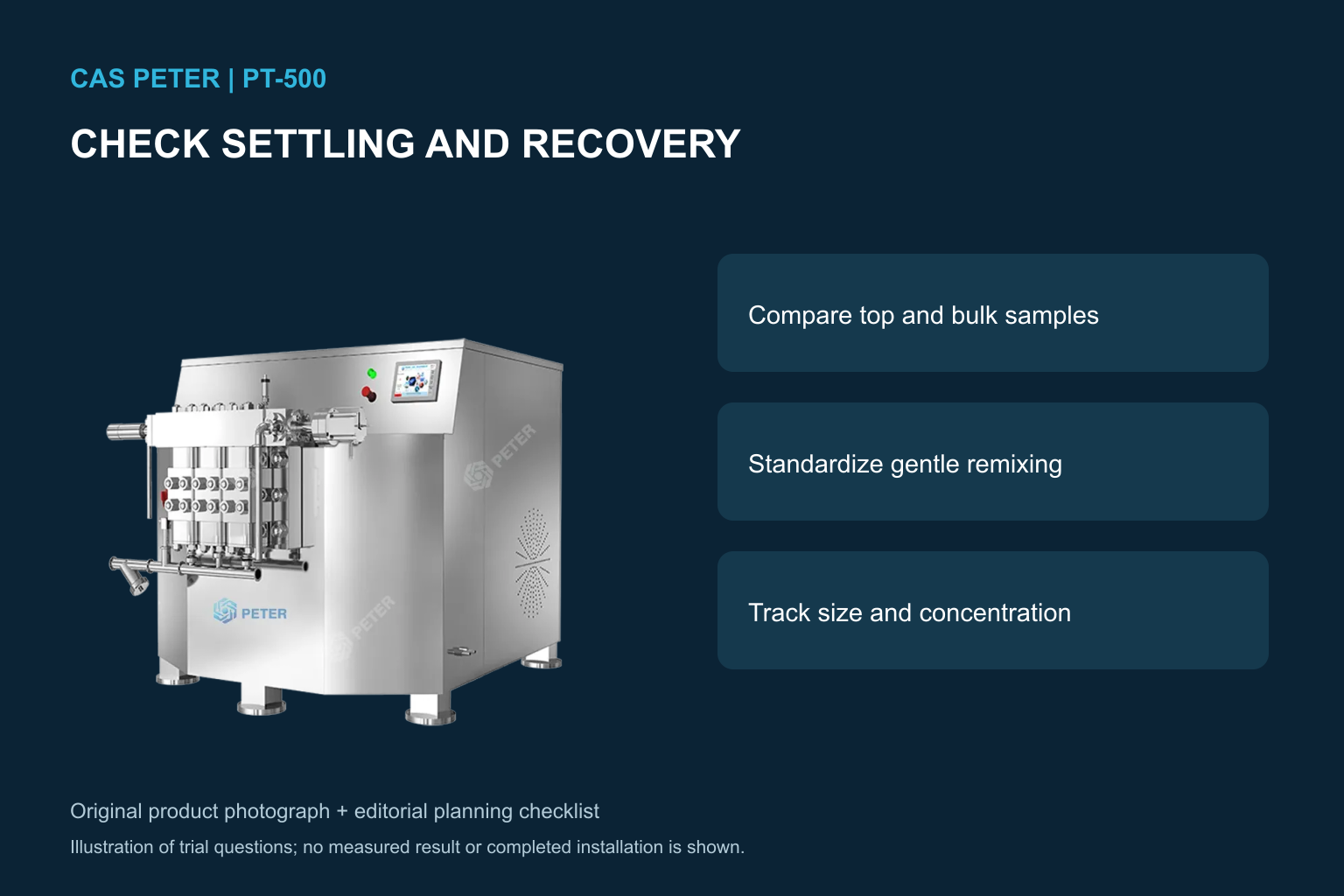
Verify use conditions and repeated recovery
If the material will circulate, test a representative circulation arrangement and include the expected stopped period. A suspension that behaves well while moving may settle during shutdown. Check restart behavior and where concentrated material might collect, using an approved equipment procedure. State which parts of the plant the development arrangement represents.
For a coating or other formulated product, carry the dispersion through the planned blending and application steps. Define the relevant quality test independently. A water-based nanofluid result cannot establish optical performance, coating quality or photocatalytic activity for a different formulation. Such claims require their own appropriate application evidence.
Repeat the preferred condition with an independently prepared feed. If the process relies on redispersion, repeat the storage and recovery sequence rather than showing one successful shake. Include representative material lots when supplier variability matters. Record unsuccessful recovery as carefully as successful recovery so that the operating boundary remains visible.
Build an acceptance record useful for scale-up
Keep the powder documentation, formulation, feed preparation, process log, sampling map, analytical settings and application result together. Store photographs with the time and sample identity, not only a favorable final image. Include concentration data for samples used in size comparisons when settling could have altered their composition.
For a production inquiry, state storage and restart requirements alongside target size and throughput. Ask how the proposed system will handle cooling, solids management, wear review and cleaning. Agree on which results justify moving forward and which require another trial. The best development report makes the tested limits clear enough that the next team can reproduce the decision.
Educational video: stability against settling and aggregation
The following NPTEL lesson explains colloidal stability, including aggregation and sedimentation. It supports the interpretation of the paired observations above. It does not provide a titanium dioxide formulation or authorize a machine setting.

Educational source: NPTEL-NOC IITM. Watch the lesson on YouTube.
Frequently asked questions
Why can the upper liquid show a smaller particle size after storage?
Larger material may have settled below the sampling point. Compare solids concentration and a representative remixed sample before concluding that the complete suspension has become finer.
Is a redispersible sediment always acceptable?
No. Acceptability depends on storage, withdrawal and mixing available in the intended application. Define and test the recovery procedure, including repeated storage cycles where relevant.
Can a published nanofluid study specify a PT-500 operating condition?
No. Published conditions apply to the tested material and apparatus. Confirm feed compatibility and configuration with the supplier, then qualify the actual formulation using a representative trial and application tests.