

Starch Retrogradation After Homogenization: Verify Changes During Storage
Starch retrogradation after homogenization must be assessed during controlled storage; a thinner paste immediately after processing does not establish slower ageing. Compare a matched untreated preparation with homogenized samples, then follow flow, gel firmness, water release and, where available, thermal or structural measurements over the intended storage period. Keep starch identity, cooking, concentration and cooling consistent. This separates an initial processing effect from the subsequent change that matters to the finished food.
For ingredient developers, the useful question is whether the selected treatment preserves the required texture throughout use. Maximum viscosity reduction is rarely a complete purchasing specification. A pumpable intermediate may still form an unsuitable gel later, while a modest initial change may produce acceptable storage behavior.
Define the storage problem before choosing pressure
Write the observed failure in terms of the application. A sauce may become difficult to pour, a filling may release water, and a chilled gel may become too firm. These observations deserve separate measurements because they need not move together. Identify which change creates rejection and which properties are desirable at the start of storage.
Also define the material leaving the homogenizer. Processing a native starch suspension before cooking is different from processing an already gelatinized paste. If one sample enters as intact hydrated granules and another enters as a cooked network, an identical pressure label does not create an equivalent comparison. Document the sequence before selecting trial conditions.
The broader food homogenization guide provides application context. This article focuses on storage-related changes in starch, rather than a general recipe for starch modification or a replacement for product-specific shelf-life work.
What the research supports—and what it does not
A primary pea starch and gallic acid study measured retrogradation by reheating previously gelatinized samples after controlled cold storage. Its results did not support a blanket claim that homogenization alone prevents retrogradation: treatment without sufficient complexing ingredient could show more retrogradation than the untreated material, while the higher gallic acid formulation behaved differently. The relevant lesson is that processing and composition must be evaluated together. The study’s recipe, washing, drying and analytical sequence are specific to that investigation.
A separate lotus seed starch investigation examined changes in granule structure, pasting, thermal properties and digestion after high-pressure homogenization. It demonstrates why the initial starch state and the subsequent preparation steps deserve attention. It is not a direct storage-life guarantee for a finished sauce or gel, and its processing conditions are not CAS PETER operating recommendations.
These studies justify a controlled comparison rather than a universal anti-retrogradation claim. Neither establishes that every starch, food matrix or machine configuration will respond in the same direction. Avoid treating high hydrostatic pressure vessel studies as equivalent evidence for flow-through homogenization.
Prepare comparable starch batches
Start with one identified starch lot. Record botanical source, supplier description, modification status, moisture information and the date the container was opened. If available, retain the supplier’s amylose or functional specification. Do not infer composition from a generic name such as “food starch.” Keep a retained portion of the original material for investigation.
Calculate addition on a consistent basis. A wet ingredient and a dry powder can deliver different amounts of starch even at the same weighed addition. Record water and other ingredients separately, and weigh the preparation before and after cooking when evaporation may matter. An unrecognized solids difference can make storage comparisons misleading.
Describe hydration, agitation, cooking and holding in enough detail for another operator to repeat them. Include the order in which sugar, acid, salt or protein enters the preparation. If the commercial product contains these ingredients, first establish a simple comparison and then confirm promising conditions in the actual recipe. Do not silently compare a purified starch experiment with a formulated food.
Separate treatment effects from cooling effects
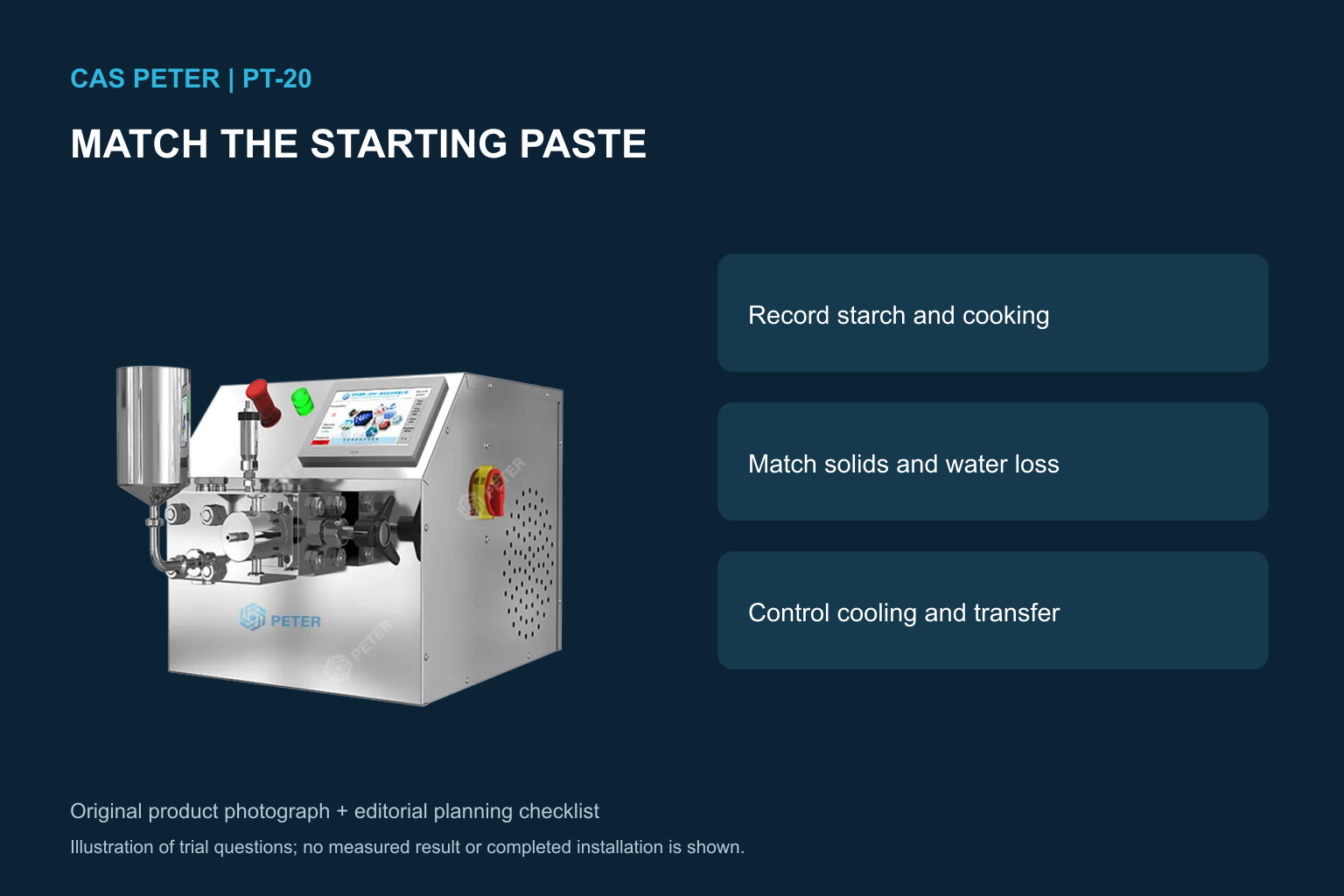
Use an untreated control that experiences the same preparation and transfer schedule as closely as practical. If the homogenized material becomes warmer, record inlet and outlet temperature and the cooling history. A control held cold throughout processing may answer a different question from a control exposed to a comparable thermal history.
For repeated passes, record collection time, intermediate holding and cooling. A pass number does not explain how long the paste remained warm or how its viscosity changed before the next pass. If a recirculation arrangement is used, document the arrangement and sampling point rather than assuming every portion receives identical treatment.
Keep sample filling and cooling reproducible. Choose suitable containers, equal fill quantities and a defined storage location. Identify when the storage clock starts. Differences in container geometry, exposed surface or cooling delay can become unintended experimental variables. Retain separate containers for destructive measurements so that repeated opening and stirring do not alter the samples being aged.
Build a measurement plan around the failure
The following table is an editorial trial-planning guide, not a table of acceptance limits. It combines practical observations with the distinction between thermal retrogradation measurements and functional testing illustrated by the cited studies. Select methods that your laboratory can validate for the actual formulation.
| Question | Suggested comparison | Important control | Meaning of an unfavorable result |
|---|---|---|---|
| Does the paste thicken during storage? | Flow curves at initial and later sampling points | Same measurement temperature and shear history | Investigate ageing behavior before changing pressure |
| Does the gel become too firm? | A defined texture test on separately stored portions | Container geometry, setting history and test position | Compare the storage trend with the product’s texture requirement |
| Does water separate? | Quantify released liquid with a defined collection method | Sample mass, storage conditions and handling | Check formulation and storage stability alongside texture |
| Is crystalline ordering changing? | Suitable thermal or diffraction analysis | Sample preparation and water content | Use structural evidence to interpret functional changes |
| Does the actual food still perform? | Application test after the intended holding period | Recipe, reheating and serving conditions | Reject a promising laboratory result if application performance fails |
Agree on sampling times before the trial. Include an initial point after a defined equilibration period, intermediate checks and the required endpoint. A comparison only at the beginning and end can miss a temporary firming or water-release problem that matters during distribution. Longer testing should follow the product’s realistic use conditions, not an arbitrary convenient laboratory week.
Read flow and texture results carefully
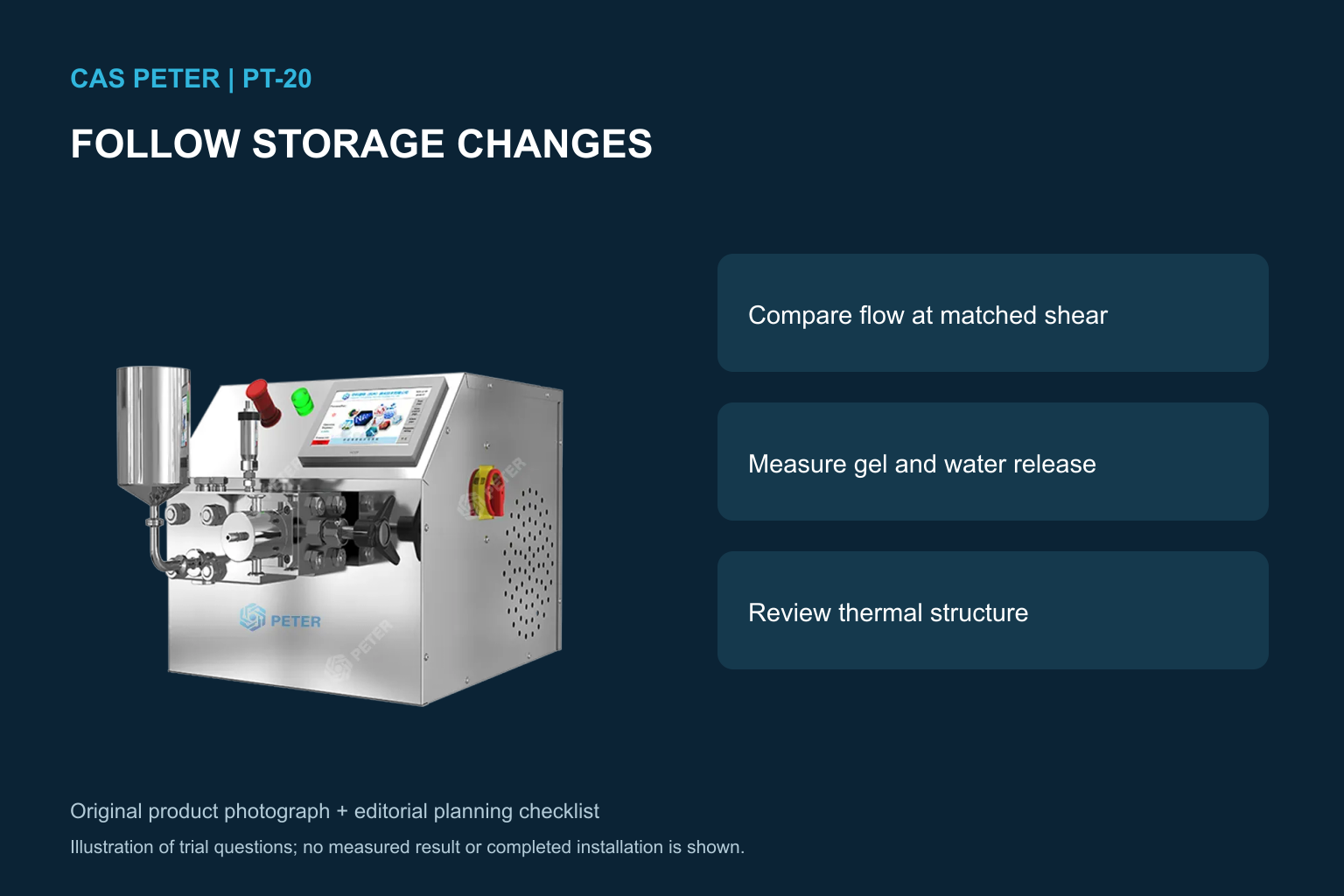
When measuring viscosity, report the test temperature and the conditions of the instrument. A single value without shear information is difficult to interpret for a paste that changes under handling. Use the same loading procedure, rest period and measurement sequence for every sample. Save the full result rather than only the number selected for the report.
For gels, define whether the sample is tested intact, cut, mixed or reheated. These are different product experiences. A filling evaluated after vigorous stirring should not be compared with an untouched control. Record visible skin formation, trapped air or uneven setting because these may explain irregular texture results.
Discuss relative change as well as the final value. A treated paste may begin much thinner and increase substantially during storage while still ending below the control. That could satisfy a pouring requirement, yet it does not by itself prove that molecular reassociation was reduced. Separate the commercial conclusion from the proposed structural explanation.
Use thermal tests to support a defined interpretation
A laboratory using differential scanning calorimetry should specify sample hydration, conditioning, the initial thermal scan, storage and the repeat scan. Ask the analyst which transition is being integrated and what the chosen normalization means. Comparing unlike preparations can create apparent differences that belong to the method rather than to storage behavior.
Do not substitute a pasting setback value, a firmness reading and a reheating enthalpy for one another. They offer different views of a changing material. If they disagree, investigate the reason instead of selecting only the measurement that favors the treatment. A useful report can state that the paste remains functional even when the structural explanation is not fully established.
Ingredient interactions deserve a separate study when additives are being introduced. The pea starch paper included a complexing ingredient, so its outcome cannot be attributed solely to pressure. A formulation screen should retain a no-additive control and compare the same additive level with and without the selected process where feasible. This keeps the formulation contribution visible.
Investigate failed comparisons in a practical order
If all samples change unexpectedly, first check preparation records, starch identity and storage temperature. If only one container behaves differently, examine filling, sealing, sampling and test handling. A process explanation becomes more convincing after these simpler sources of variation have been addressed.
If the treated sample is acceptable initially but fails later, use the stored series to locate the change. Review water release, texture and flow together. Then test one reasonable cause at a time, such as an unmatched cooling delay or an ingredient addition sequence. Increasing treatment severity without understanding the failure can sacrifice the starting texture without solving the storage problem.
A different hydrocolloid behaves differently. The article on oat beta-glucan and viscosity changes provides a complementary example of why flow should be verified for the actual ingredient. For the initial process-stage distinction in starch, see the starch homogenization trial guide. These complementary checks help avoid assigning every texture change to one mechanism.
Turn the result into an equipment trial request
When discussing the CAS PETER PT-20, provide a representative feed description, preparation sequence, batch quantity, viscosity behavior, intended processing temperature and cleaning requirements. Ask the supplier to confirm feed suitability, configuration, cooling needs and a safe trial plan. The product photograph identifies the machine; it does not prove that a particular starch paste or pressure is suitable.
State the acceptance requirement as a functional outcome with a defined method and storage period. Include acceptable initial texture, later texture, water release and repeatability across independently prepared batches. Keep the operating window provisional until the complete preparation and storage sequence has been repeated. Record rejected conditions as well as successful ones so that scale-up begins with a useful boundary.
Educational background: food rheology
The following NPTEL lesson introduces food rheology, which helps explain why flow measurements need defined conditions. It is background education rather than a starch storage protocol or a machine endorsement.

Educational source: NPTEL IIT Kharagpur. Watch the lesson on YouTube.
Frequently asked questions
Does a lower viscosity after homogenization prove less retrogradation?
No. It establishes an initial flow change under the measurement conditions. Compare storage trends with matched controls, then use suitable thermal or structural measurements when making a specific retrogradation claim. Final food performance remains a separate acceptance requirement.
Can a study on one starch determine the settings for another?
No. Botanical source, modification, preparation stage and other ingredients can change the response. Use published work to choose questions and measurements, then confirm a suitable operating window with the equipment supplier and representative material.
Should every starch trial include a storage test?
Include storage testing whenever texture, water release or later use affects acceptance. A short processing trial can screen feed handling, but it cannot establish the behavior of a product that will be chilled, transported, reheated or held before use.