

Astaxanthin Nanoemulsion Storage: Separate Color, Retention and Droplet Stability
Astaxanthin nanoemulsion storage stability requires separate evidence for the active ingredient and the droplets that carry it. A sample can remain visually uniform while astaxanthin retention falls, so droplet size, color and chemical analysis should not be treated as interchangeable measurements. Establish a post-processing baseline, store matched samples in defined packaging, and follow both physical change and active recovery. Compare light, temperature and handling under controlled conditions before deciding that a homogenization treatment has improved the usable storage period. The target is the intended formulation in its intended product, not a clear-looking laboratory vial alone.
Define the ingredient and the product being stored
Record the astaxanthin source, declared assay, carrier oil and other components delivered with the ingredient. A commercial extract and a purified analytical standard have different roles. Do not describe the amount of extract added as the amount of astaxanthin present unless its actual composition supports that calculation.
Specify whether the sample is a concentrated ingredient, a finished beverage, a cosmetic preparation or another product format. Dilution, pH adjustment and mixing with other ingredients can create a different storage environment. Test the form that will be supplied and the form in which it will be used when those are different.
Keep oil fraction, emulsifier identity and emulsifier concentration on a clear mass basis. Record whether a quoted percentage refers to the aqueous phase or the complete emulsion. Formulation records that omit this distinction are difficult to reproduce and can create misleading comparisons between batches.
The emulsion homogenization guide introduces the broader process. Here the decision is narrower: whether the stored astaxanthin formulation retains its required chemical and physical properties after processing.
Read the research as formulation-specific evidence
A peer-reviewed study of astaxanthin nanoemulsions examined krill- and argan-oil systems produced with a particular annular-valve technology. It reported droplet refinement and storage observations for those formulations. The equipment and formulation were specific to that work; neither its pressure conditions nor its smallest reported sizes establish the capability of another homogenizer.
A separate ginseng-saponin formulation study, available as an accepted manuscript, illustrates why physical and chemical stability need different measurements. During the tested storage conditions, droplet behavior and astaxanthin retention showed different sensitivities to temperature. The authors also examined pH and salt effects within that formulation. These findings support separate tests, not a universal shelf-life claim.
Neither paper establishes that an arbitrary emulsifier or oil will protect the active in a customer’s product. The checklist below is a proposed development workflow. It is not a claim that the published formulations were made using CAS PETER equipment or that their results transfer to the pictured model.
Establish a useful baseline immediately after processing
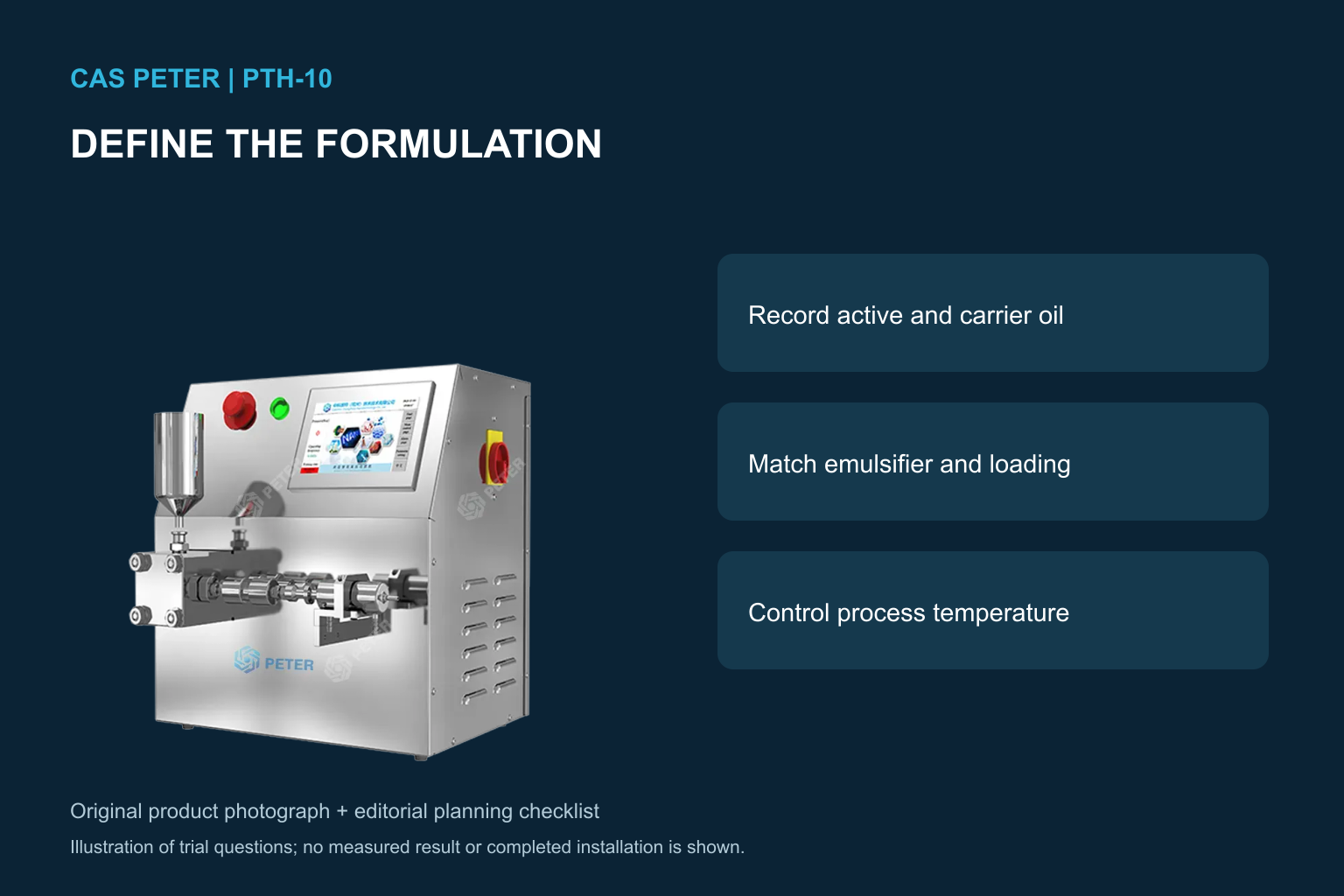
Take a representative sample of the coarse emulsion and another after the selected homogenization treatment. Record processing order, actual collected mass, inlet and outlet temperatures, pressure, passes and cooling. Distinguish complete passes through the machine from circulation time, especially when the setup uses a recirculating vessel.
Analyze active concentration at the appropriate preparation stages. If the post-processing sample already has low recovery, a storage comparison cannot tell you whether the initial loss came from ingredient preparation, processing, sampling or extraction. Preserve a well-characterized starting point before interpreting later changes.
Set a consistent delay between processing and the first measurement. Store samples awaiting analysis under a defined procedure. A warm sample left on the bench for a variable interval can introduce an uncontrolled exposure before the official storage test begins.
Separate active retention, color and physical stability
Chemical retention requires an analytical method suitable for the actual ingredient and formulation. Specify which astaxanthin species the method reports and whether a result represents the same defined analyte across all time points. Include an appropriate calibration, formulation blank and extraction recovery assessment. A method that works in the carrier oil may not work unchanged in an emulsified product.
Report concentration together with the sample basis. Evaporation, phase separation and selective sampling can change measured concentration without representing the same change in the total amount present. Check container mass where appropriate, and apply a documented sampling procedure that captures the material intended for analysis.
Color is useful for appearance assessment, but scattering, dilution and illumination also influence what is observed. Measure it under a consistent geometry and sample preparation procedure. A visual photograph can document a defect, but it cannot replace a specific chemical assay. Avoid presenting a similar color as proof that the same active amount remains.
Physical stability needs its own observations. Record creaming, an oil layer, sediment and visible aggregates before disturbing the container. Then measure droplets using a procedure appropriate for the sample. When dilution is required, verify that it does not dissolve, destabilize or selectively exclude the structures being investigated.
Design storage groups that answer one question at a time
Use matched containers with consistent fill volume, headspace and closure. If light exposure is being studied, include a protected control that otherwise follows the same temperature history. Record the light conditions rather than using a vague label such as room light. A window ledge, an illuminated cabinet and a closed carton are different exposures.
For temperature comparisons, record actual storage conditions and define how excursions are handled. Sample transport to the laboratory is part of the history. Do not let one group warm repeatedly while another remains undisturbed. Use separate containers for destructive measurements where repeated opening would change headspace or contamination risk.
Test the intended packaging as part of development. A protective laboratory bottle may help isolate a mechanism but does not establish the performance of the commercial package. If the emulsion is supplied as an ingredient, include its subsequent dilution or incorporation step in a separate compatibility study.
This decision table draws on the distinction between chemical retention and physical behavior in the cited studies. It proposes comparisons rather than numerical acceptance limits.
| Result pattern | Next check | Keep constant | What the result does not prove |
|---|---|---|---|
| Similar droplet size, falling active assay | Verify extraction recovery, then compare matched exposure groups | Formulation, sampling and analytical method | Physical stability alone does not establish retention |
| Color changes, assay remains comparable | Check optical conditions and physical structure | Sample concentration and measurement geometry | A color change alone does not quantify degradation |
| Oil layer or creaming appears | Inspect distribution and sample the defined whole product | Container geometry and storage age | A clear lower phase is not representative of the whole vial |
| Concentrate passes, diluted product fails | Test final pH, salts and ingredient compatibility | Concentrate batch and dilution procedure | Concentrate stability does not establish final-product stability |
| More passes produce smaller droplets | Compare active recovery and storage results | Oil, emulsifier and thermal history | A smaller mean does not establish a longer storage period |
Avoid optimizing only the smallest measured size
Choose a limited set of supplier-approved process conditions and compare the complete result. More passes add processing exposure and handling, so retain their temperature and time records. If the smallest droplets provide no useful advantage in the finished product, that condition may not justify its extra processing burden.
Review the distribution rather than only a single mean diameter. Use the nanoemulsion stability testing guide to plan complementary observations. A narrow initial distribution is useful information, but a storage decision still needs chemical retention, visible appearance and performance in the intended formulation.
The zeta potential interpretation guide explains another commonly overused indicator. A large magnitude measured in a diluted laboratory medium should not be converted into a universal stability guarantee. Record the measurement medium, pH and conductivity, and test the product under its actual formulation conditions.
Set acceptance criteria around the intended application
Agree on the critical outcomes before reviewing the samples. A formulation developer may need a retained active amount, acceptable color and no visible separation through a defined storage interval. Set those limits from the product specification, analytical uncertainty and relevant product requirements. Do not invent a universal percentage that applies to every astaxanthin system.
Evaluate independent preparation batches as well as multiple measurements from one batch. Repeated instrument readings show analytical variation; they do not establish manufacturing reproducibility. Keep the batch identity in the data and show the range of outcomes when deciding whether a treatment is ready for a larger run.
Accelerated exposure can help screen formulations and identify failure modes. It does not automatically establish the real-time storage period. A product may respond differently when temperature, light and packaging change together. Confirm the chosen formulation under the intended conditions and maintain the applicable safety and regulatory review separately from physical stability development.
Prepare the equipment enquiry with the actual feed
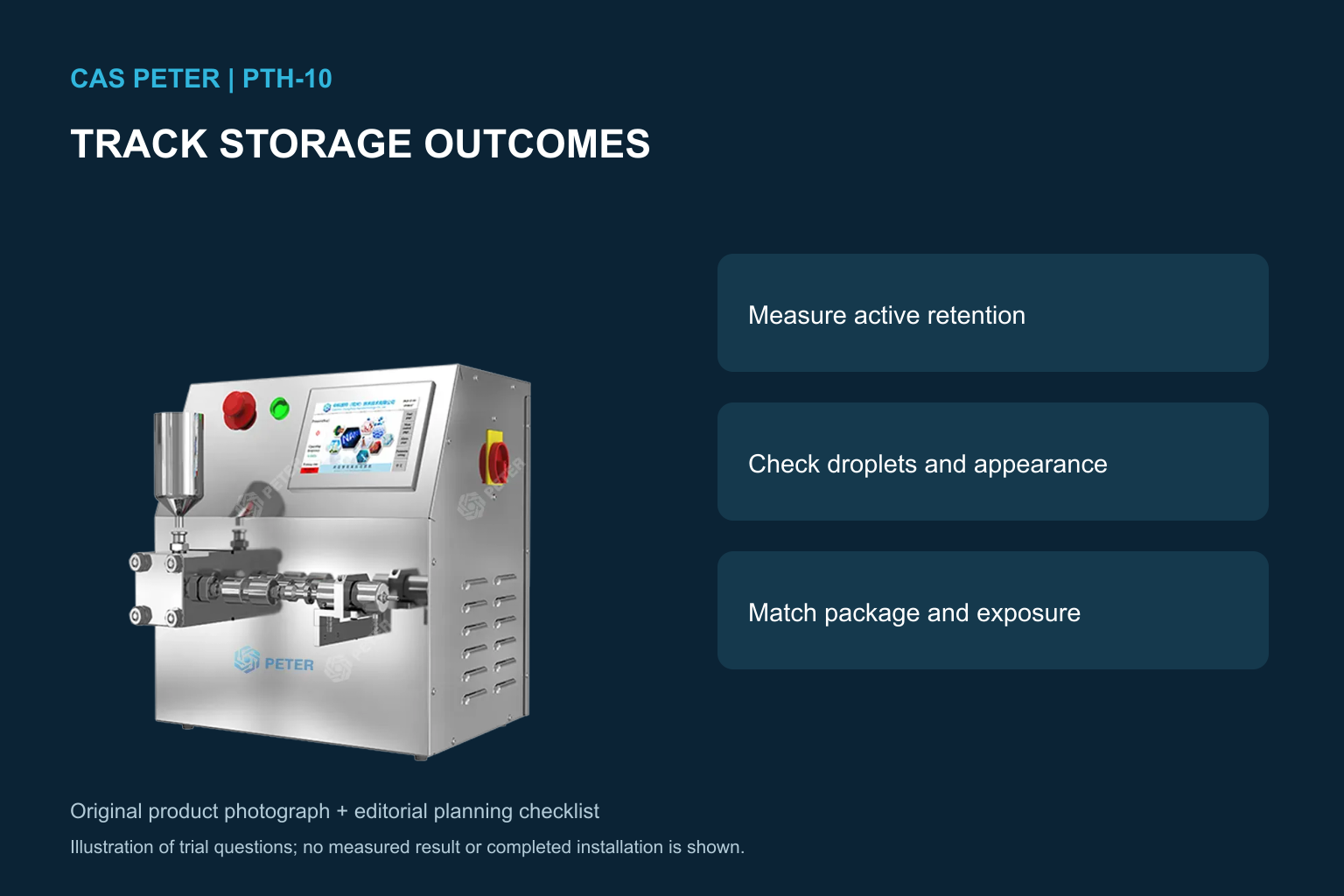
The CAS PETER PTH-10 product page provides a model reference for discussing a development configuration. Confirm the permitted formulation, wetted materials, feed limits, sample quantity, temperature control and cleaning method with the supplier. The product photograph does not document an astaxanthin trial or establish a particular droplet size.
Send the oil and aqueous compositions, viscosity information and intended product format with the enquiry. Identify any solvent or sensitive ingredient and provide the relevant handling information. Ask how representative samples will be collected and how residence history will be documented. These questions make an equipment trial more informative than requesting the highest available pressure.
Keep an approved process record for the selected condition, including preparation, cooling, sampling and storage setup. When a later ingredient lot or package changes, review whether the existing evidence remains applicable. A storage claim belongs to the defined formulation and process that were actually evaluated.
Further learning: emulsion technology
The following NPTEL lesson explains emulsion concepts that help interpret droplet formation and interfacial stabilization. It is educational background rather than a formulation recommendation or an astaxanthin retention guarantee.
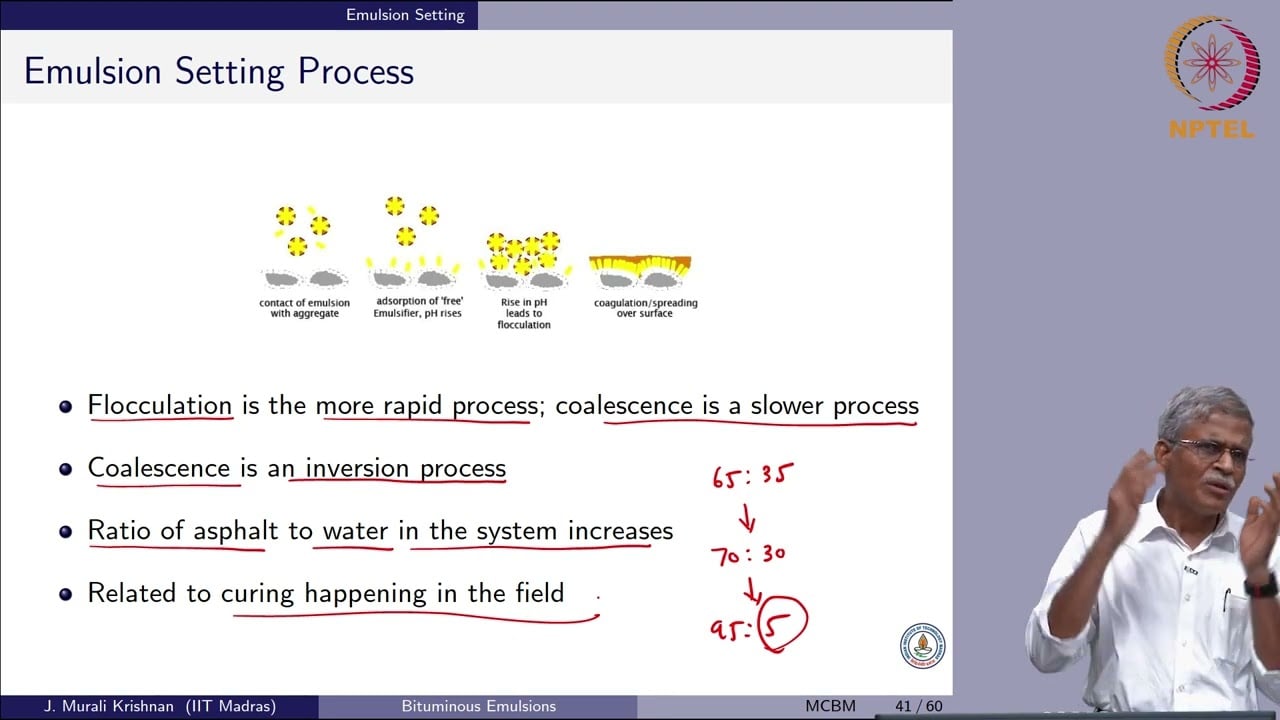
Educational source: NPTEL-NOC IITM. Watch the lesson on YouTube.
Frequently asked questions
Can unchanged droplet size prove astaxanthin remains intact?
No. Droplet measurements describe physical structure. Use a suitable chemical assay with extraction recovery controls to assess astaxanthin retention during storage.
Is color a suitable replacement for an astaxanthin assay?
Color is useful for appearance monitoring but can also change with scattering, concentration and measurement conditions. It should support, rather than replace, a defined chemical analysis.
Can a stable concentrate be assumed stable in an acidic beverage?
No. Dilution and final-product ingredients create another environment. Test the actual beverage formulation, package and storage conditions before extending a concentrate’s stability conclusion.