

Rice Protein Foaming After Homogenization: Separate Expansion from Foam Life
Rice protein foaming after homogenization should be judged by both the amount of air incorporated and the life of the resulting foam. A larger initial foam can still drain quickly or collapse before filling. Compare an untreated, fully hydrated reference with processed samples using the same protein concentration, pH, whipping method and observation schedule. Keep the pressure treatment separate from the later aeration test. This guide explains how to design that comparison for a whipped ingredient or food development project, and how to discuss a trial with an equipment supplier without assuming that smaller protein aggregates guarantee a better finished foam.
Define which foam problem needs solving
Start with the product failure. A beverage topping that loses height during service presents a different problem from a foam that cannot reach the required initial volume. A baked product introduces additional demands during heating. Write an acceptance statement for the actual application before choosing pressure settings. For example, specify that the foam must retain a defined height and release no more than an internally agreed amount of liquid over the intended holding period. Establish those limits from the product brief rather than borrowing an unrelated research result.
Keep three outcomes in separate columns: initial expansion, retained foam and drained liquid. Record any visible large bubbles or uneven structure as observations. These observations help describe a failure but do not independently identify a molecular mechanism. If a processed sample starts taller but finishes below the control, report the tradeoff directly. Calling it improved foamability without reporting collapse would conceal the result that matters to production.
The wider plant protein homogenization guide helps position this experiment within ingredient development. This article focuses specifically on air incorporation and foam holding, rather than treating solubility or gel strength as substitute acceptance tests.
What the research supports, and where it stops
The published abstract of a high-pressure homogenization study on rice protein reports different responses among functional properties: emulsifying activity and emulsifying stability did not simply improve together as pressure increased. This study did not provide the foam endpoint used here. It supports treating each functional measurement separately, rather than using a general claim of improved protein functionality to predict the finished foam.
A second physical modification study also reports increased foaming activity alongside reduced foaming stability under its tested conditions. These are research observations for specific materials and methods, not promised CAS PETER outcomes. The accessible journal records are abstracts rather than complete experimental protocols. Therefore, the procedure below is a proposed comparative development workflow, not a reproduction of either publication. No pressure, pass count or expected performance from those papers is presented as a validated machine setting.
Qualify the rice protein before processing
Record whether the ingredient is an isolate, concentrate, hydrolysate or a blended preparation. Include supplier, batch, declared protein content and any known heat or drying history. Two powders described simply as rice protein can differ in preparation and handling. Preserve a retained powder sample so an unexpected result can be checked against the original batch instead of being blamed immediately on the homogenizer.
Prepare enough hydrated feed to split across all conditions. Document water composition, ingredient addition order, mixing time, pH and temperature. Check for floating powder, persistent lumps and settling before dividing the feed. Do not compare a well hydrated treated sample with a freshly wetted control. If filtration or screening is necessary for equipment compatibility, apply the same preparation to the reference and record what was removed.
Measure the concentration on the basis that the application actually uses. A comparison at equal powder mass is not automatically a comparison at equal protein content when ingredient grades differ. For a single ingredient batch, keep preparation consistent and report the basis plainly. Avoid adjusting the pH of only the treated sample; a formulation change would then be mixed into the processing comparison.
Separate pressure treatment from the whipping test
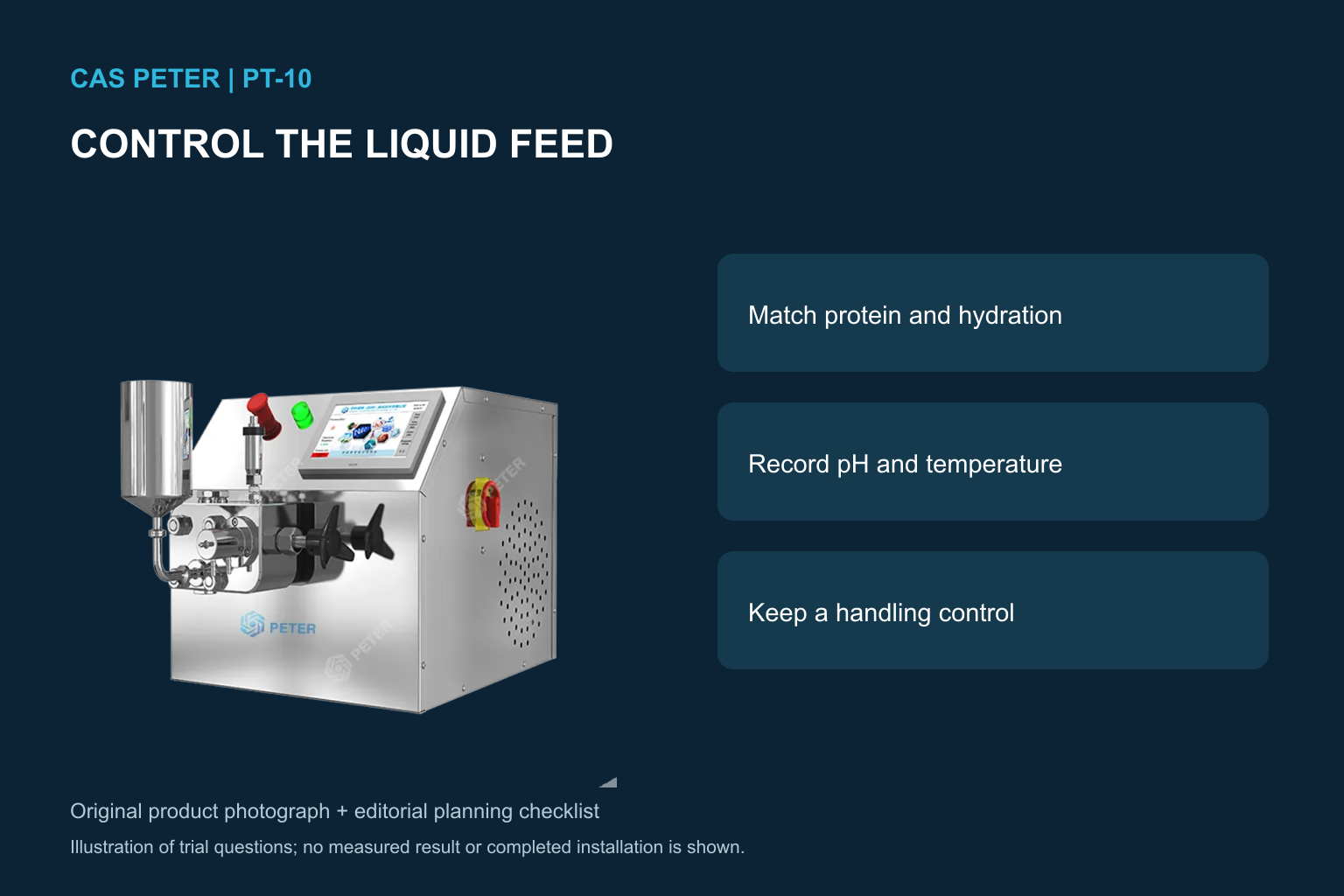
A high-pressure homogenizer prepares the liquid feed; it is not the instrument used to define the foam test in this workflow. Collect the treated liquid under controlled conditions, allow the agreed equilibration period, and then aerate measured portions using a separate, repeatable whipping method. Match the vessel, fill volume, tool geometry, speed, duration and starting temperature. Record the actual settings used, rather than describing the procedure only as vigorous mixing.
Include a handling control that experiences the same waiting time and transfers without the pressure treatment. Where thermal exposure differs materially, consider a separate temperature-history control designed by the development team. Log inlet and outlet temperatures and any cooling between passes. Do not attribute all changes to pressure when the samples have also experienced different heating or holding periods.
Begin with a limited trial matrix after the supplier confirms feed suitability. Keep formulation fixed while investigating processing intensity. If formulation must change, test it as another factor with its own reference. Stop increasing treatment when the application result no longer improves or when temperature, feed delivery or equipment behavior moves outside agreed operating conditions. A research maximum is not a target that must be reached.
Use a measurement sheet that distinguishes outcomes
The following is a qualitative planning table. It contains no published performance limits. Choose observation times, repeat numbers and pass criteria before running the experiment, using the intended product holding time and the precision of the available methods.
| Question | What to record | How to make the comparison useful | What the observation cannot prove |
|---|---|---|---|
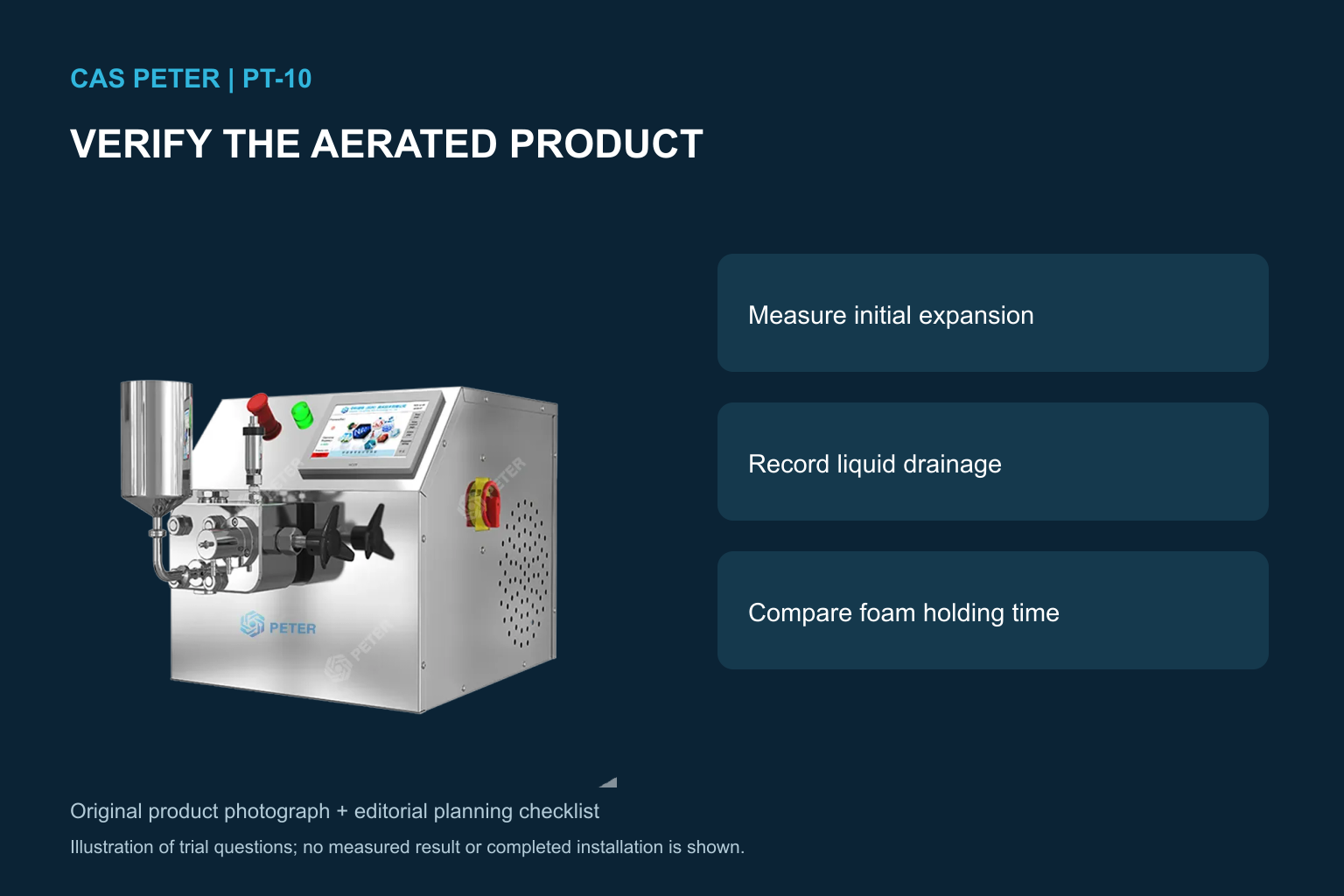
| Does the feed incorporate air? | Liquid starting volume and initial foam or total aerated volume | Use one clearly defined volume convention and fixed whipping conditions | A tall initial foam does not establish holding stability |
| Does the foam persist? | Remaining foam height or volume at planned times | Use the same vessel and time origin for every sample | One late photograph cannot describe the collapse history |
| Does liquid drain? | Collected liquid at each observation time | Keep collection geometry and temperature constant | Drainage alone does not establish protein unfolding |
| Are bubbles becoming uneven? | Images at fixed magnification and sampling position | Compare representative fields from independent preparations | Selected attractive images do not represent the whole foam |
| Does it work in the product? | Holding, filling or heating result in the intended formulation | Preserve the actual downstream process | A buffer test cannot guarantee finished food performance |
For volume calculations, define exactly what is being measured. If the method uses total aerated volume, an expansion percentage can be reported as 100 multiplied by the increase over initial liquid volume, divided by that initial liquid volume. Record both volumes in the same unit. Do not apply this expression to foam-only volume without explaining the changed convention. A value is meaningful only when the vessel scale and reading method are sufficiently repeatable.
Read the failure pattern before changing settings
If expansion improves but drainage accelerates, retain both results and examine the formulation and liquid properties before demanding another pressure pass. If expansion is unchanged but foam holds longer, that may be valuable for a product with a service-time requirement. If both worsen, confirm feed preparation, sample temperature and whipping repeatability before concluding that the material is unsuitable for homogenization.
Use a small set of independent preparations to distinguish a reproducible effect from a single successful whipping run. Repeating three readings from one foam is useful for measurement consistency, but it does not replace preparing and processing another sample. Record variability and unusual runs. Establish the repeat design with the development team; the number needed depends on the decision and the observed scatter.
Particle measurements can help describe the liquid before aeration, but should remain supporting evidence. The particle measurement comparison guide explains why method choice and sample preparation matter. A reduction in a reported average size does not show that an air interface will survive the finished product’s complete handling sequence.
Verify the foam in its intended formulation
Move promising conditions into the complete recipe without silently changing the amount of protein, sugar, fat or stabilizer. Use the same incorporation order and downstream handling. If the final recipe contains other functional ingredients, a simplified rice protein dispersion may not predict its response. Keep the screening result and application result as separate stages in the report so an apparent contradiction can be investigated.
For a filled product, observe the effect of transfer and the intended holding temperature. For a heated application, compare the actual heating process. Establish relevant hygiene and food safety controls separately; improved foaming is not evidence of microbial control. Do not describe a development sample as shelf stable from a short foam test. Confirm suitability for the intended market through the responsible formulation and quality teams.
A related soy protein gel trial illustrates a different endpoint: a finished gel is assessed by its own function. The same reasoning applies here. A successful rice protein foam is one that meets the agreed aeration and holding requirements, even when another sample has a more impressive dispersion measurement.
Prepare an equipment trial brief
The CAS PETER PT-10 product page provides a starting point for discussing laboratory equipment. Send the supplier the actual ingredient specification, solids content, feed viscosity at a stated temperature, visible coarse material, planned trial quantity and target outcome. Ask for confirmation of feed compatibility, required preparation, cooling arrangements, suitable wetted materials and the usable operating envelope for that formulation. The product image identifies the equipment; it does not demonstrate rice protein foam performance.
Request a trial record that connects every collected sample to formulation, measured operating conditions, pass history and temperatures. Include the sequence in which samples were prepared and tested. Require the reference and treated samples to follow the same foam measurement method. The useful deliverable is a traceable comparison of finished foam behavior, together with recovery and handling observations, rather than a pressure value alone.
Further learning: food rheology
The following neutral university lesson introduces food rheology. It supports discussion of flow behavior and test conditions; it is not a rice protein whipping protocol or an equipment demonstration.

Educational source: NPTEL IIT Kharagpur. Watch the lesson on YouTube.
Frequently asked questions
Does higher pressure always improve rice protein foam stability?
No. The cited rice protein studies show that foam formation and stability can respond differently. Select a treatment through matched trials that measure initial expansion, drainage and foam retention in the intended formulation.
Can a smaller particle size replace a foam holding test?
No. Particle size describes the liquid dispersion under the measurement conditions. A foam holding test directly checks the aerated structure over the required time and handling sequence.
What should be sent to CAS PETER before a trial?
Send the ingredient specification, formulation, solids level, viscosity and temperature, coarse material observations, available sample quantity and the required foam performance. Ask for written confirmation of feed suitability and the trial configuration before choosing operating settings.