

Solid Lipid Nanoparticle Storage After Homogenization: Verify Crystal State and Payload
Solid lipid nanoparticle storage after homogenization should be assessed after a defined cooling and conditioning sequence, with crystal-state and payload measurements alongside particle size. A small initial diameter does not prove that the lipid matrix will remain unchanged or retain its contents. Record how the dispersion passes from the hot process to its stored state, then compare samples of the same age using methods suited to the actual formulation. The practical goal is a reproducible stored carrier with acceptable payload recovery and application behavior, rather than the smallest fresh particle size obtainable from the machine.
Separate manufacturing success from storage success
A hot dispersion leaving a homogenization step and a conditioned solid lipid carrier are different observation points. Label them separately in the study. Otherwise, a change associated with cooling may be misreported as storage failure, while a later change may be hidden by comparing samples that never shared the same starting state.
This guide focuses on the period after processing: conditioning, crystal-state comparison, payload balance and stored-product performance. It complements the hot versus cold homogenization trial guide, which addresses a different route-selection question. It does not prescribe a medicinal formulation or establish clinical safety, efficacy or regulatory acceptability.
Start by defining the required storage form. An aqueous dispersion, a dried powder and a carrier already incorporated into a cream need different verification plans. Do not combine those forms into one stability claim merely because they originated from the same homogenized batch.
Research supports measuring more than diameter
An original efavirenz-loaded SLN and NLC study examined hot high-pressure homogenized carriers using particle characterization, thermal analysis, payload measurements and storage testing. Its results differed between the storage conditions studied. The finding is a reason to investigate the stored formulation as a complete system; it is not a transferable shelf-life claim or a set of machine settings for other lipids and active ingredients.
A study comparing crystalline lipid particles and monoolein dispersions used high-pressure homogenized triglyceride nanoparticles and a model transfer experiment. It reported changes associated with crystallization and discussed the influence of sample separation on characterization. That work supports keeping physical state and preparation history visible in the measurement record. Its model transfer assay should not be equated with clinical release or absorption.
The experimental plan below is a proposed verification workflow. It does not reproduce either study’s formulation. Use formulation-specific analytical development and avoid assigning a particular crystal form solely from particle size, appearance or a generic schematic.
Define the stored material precisely
Record the lipid identity, supplier, grade and lot, along with surfactant, payload and water composition. Include the actual quantities used and the intended final concentration. A change of commercial lipid grade can matter even when the familiar ingredient name remains the same, so keep lot information available for interpretation.
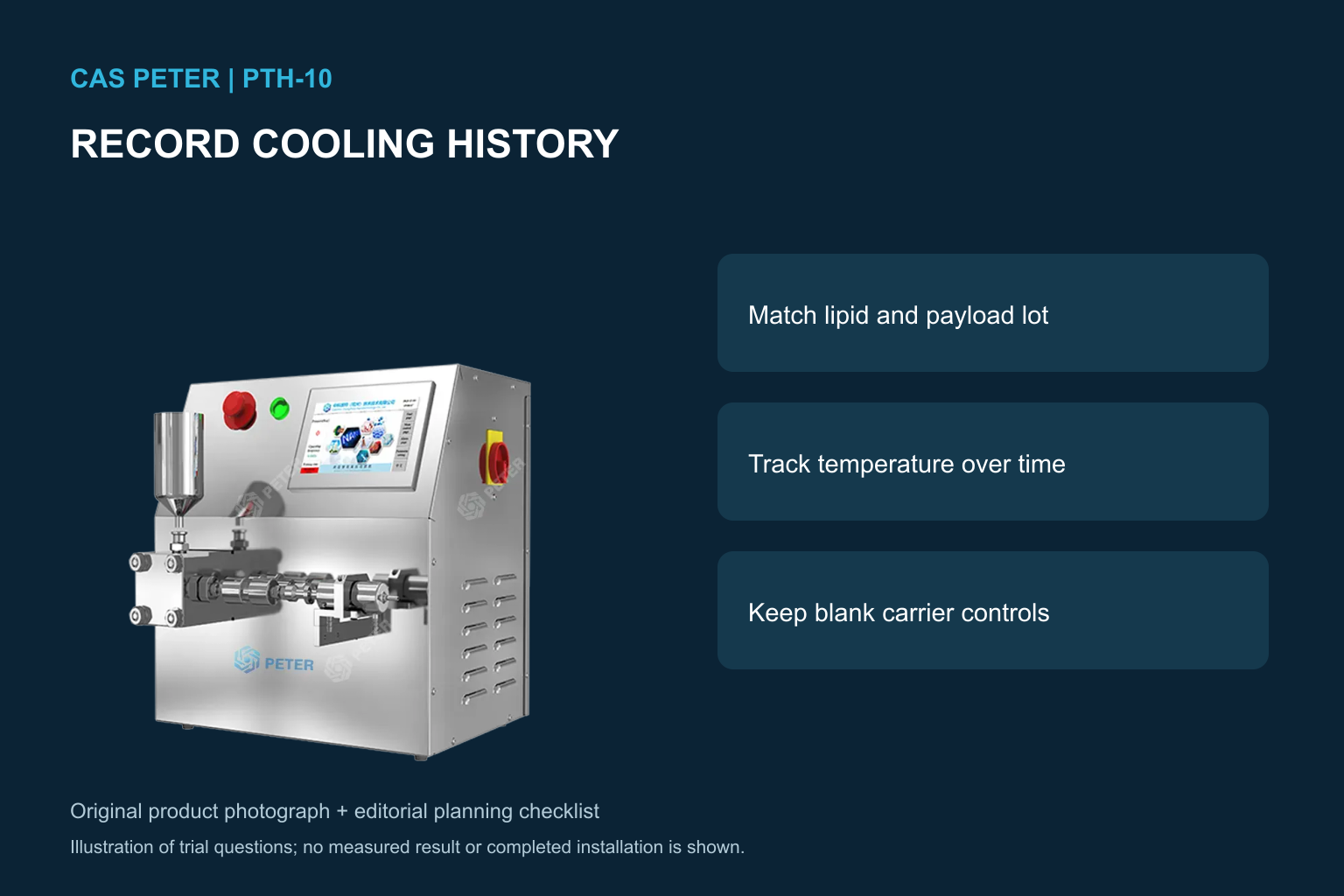
Prepare a blank carrier alongside the loaded formulation when practical. The blank helps distinguish signals belonging to the carrier from those introduced by the payload. Also retain suitable bulk lipid and payload references for the analytical laboratory. These controls should receive clearly documented preparation and thermal histories rather than being treated as interchangeable powders.
State whether the payload is expected to be dissolved, dispersed or associated with another phase during manufacture. If that status is uncertain, identify it as a question for the study. An attractive fresh dispersion does not establish where the active ingredient resides or whether an assay has recovered it completely.
Make cooling part of the process record
Record temperature against time from the final pass through the point selected as the storage baseline. Include the vessel, batch quantity, agitation and transfer operations. A single outlet temperature does not describe the cooling exposure of an entire vessel, especially when the first and last material arrive at different times.
Define a consistent conditioning interval before baseline testing. The interval should be justified for the formulation and practical manufacturing sequence rather than selected only because the laboratory is available. Keep early observations if they help explain how the baseline develops, but do not mix them silently with the later conditioned measurements.
When comparing two pressure conditions, hold the subsequent cooling procedure as constant as practical. If cooling is also being studied, name it as a separate factor. This allows the team to distinguish a pressure-related effect from a change introduced by the way the hot material was collected and conditioned.
Use thermal and structural methods with appropriate controls
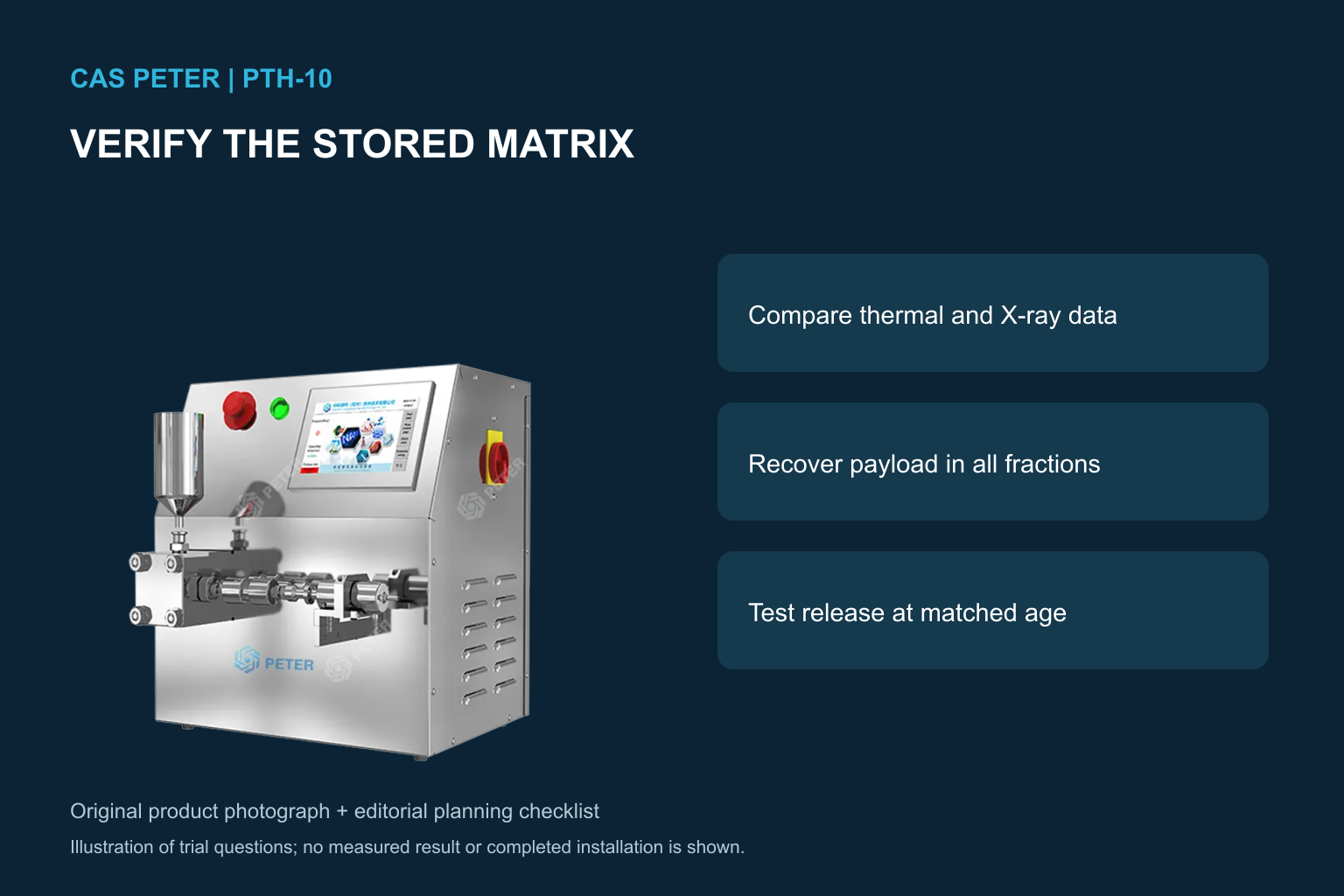
Discuss differential scanning calorimetry with the laboratory to compare relevant transitions and thermal behavior. Report sample preparation, heating or cooling program, normalization basis and the reference material. If enthalpy is normalized to total dispersion mass in one case and lipid mass in another, an apparent difference may reflect the reporting basis rather than a changed carrier.
Where the decision requires a crystal-form assignment, consider an appropriate diffraction method and expert interpretation alongside thermal results. Ask what the method can distinguish in the actual multicomponent formulation. Do not turn every shifted or broadened thermal peak into a confident polymorph label without adequate supporting evidence.
Keep the state of the analyzed sample visible. Drying, concentrating or otherwise preparing a sample may change what is being examined. If a dry analytical specimen is used to discuss an aqueous commercial dispersion, document that connection and its limits. Use comparable preparation across time points so that the storage comparison remains meaningful.
Measure payload recovery before calculating retention
First establish a suitable total assay for the formulation. A method that incompletely extracts the active ingredient can make the fresh batch look underloaded and a later batch appear to gain material. Include recovery checks and the relevant blank matrix so that changes in assay behavior are not mistaken for carrier behavior.
If free and associated fractions are separated, validate the separation for that formulation. Consider material retained on a membrane, adsorbed to a tube, left in sediment or altered during centrifugation. A clear supernatant does not by itself prove that the measured fraction represents all unassociated payload.
Report the total recovered quantity and the quantities in the measured fractions with their definitions. Use the same denominator across the study. Encapsulation efficiency, loading capacity and percentage of initial payload remaining answer different questions. State which quantity the commercial decision actually needs instead of using the terms interchangeably.
Interpret storage observations as a linked set
The table is an editorial decision aid, not a specification or a reproduction of measured research data. The studies linked above support examining state, preparation and carrier performance together; the follow-up comparisons must be adapted to the actual analytical methods.
| Storage observation | What it does not establish alone | Next investigation |
|---|---|---|
| Similar particle size but changed thermal behavior | That payload retention is unchanged | Compare total assay and separated fractions |
| Increased hydrodynamic diameter | Whether growth, aggregation or shape change dominates | Review structural evidence and a complementary sizing method |
| Lower associated payload with stable total recovery | Whether redistribution or a separation artifact occurred | Check fraction recovery and inspect excluded material |
| Lower total payload recovery | Whether degradation, sampling or extraction explains the loss | Review assay suitability and an appropriate chemical profile |
| Visible gel or sediment | Whether the whole batch remains representative in a small sample | Characterize the bulk and document sampling behavior |
A useful report keeps apparently conflicting measurements together. Do not discard a thermal change because the size result looks acceptable, or reject a formulation solely because one measurement shifted without checking what that measurement represents.
Choose storage conditions that match the decision
Use the intended package and storage condition in the verification stage. Document the container material, closure, headspace, fill quantity, light exposure and sampling approach. If the trial uses a different package, describe the study as a formulation screen rather than evidence for the final commercial presentation.
Separate intended-condition testing from stress testing. A deliberately stressed sample can reveal a vulnerability or help compare candidates, but it does not automatically predict a precise shelf life. Avoid assigning an expiry period from a short study without an appropriate stability program and product-specific scientific justification.
Plan enough sample units to avoid repeatedly opening and returning the same container when that would change the exposure. Keep independently manufactured batches distinguishable. Repeated instrument readings from one batch cannot establish manufacturing consistency or show that another lipid lot will behave identically.
Verify release or application behavior at matched age
If release is part of the specification, compare samples at defined storage ages using a method developed for the formulation. State the receiver medium, separation arrangement, sampling corrections and recovery. The test should distinguish changes in the carrier from limitations of the analytical system or movement across an experimental barrier.
For a nonmedical application, test the property the user actually needs after storage and incorporation. A carrier that looks stable in water may behave differently in a finished cream or another formulation. Keep the incorporation procedure fixed and examine whether the stored material still delivers the intended application behavior.
Use the nanoemulsion stability testing guide for complementary observations such as size and visible separation, while retaining the crystal-state and payload checks specific to solid lipid carriers. Do not describe an SLN as a conventional liquid emulsion when the state of its lipid matrix is the central question.
Put the equipment discussion in context
The CAS PETER PTH-10 product page provides a real equipment reference for a laboratory process discussion. Confirm the proposed feed, temperature handling, wetted materials, collection arrangement and cleaning requirements with the supplier. The product image and model name do not prove suitability for a particular active ingredient or manufacturing standard.
For the wider process background, consult the emulsion homogenization guide. Build an equipment trial brief that includes the downstream cooling and conditioning steps, rather than asking only for a target fresh diameter. Require traceable records and sufficient sample quantity for the planned storage and analytical program.
Educational background on colloidal stability
The lesson below offers neutral background on colloidal stability. It helps place particle interactions in context, while the actual crystal form, payload balance and stored-product behavior still require formulation-specific measurements.

Educational source: NPTEL-NOC IITM. Watch the lesson on YouTube.
Frequently asked questions
Can unchanged particle size prove that stored SLNs retain their payload?
No. Particle size is one physical observation. Assess total payload recovery, any separated fractions and the relevant matrix-state measurements. A stable size result cannot establish unchanged payload location or chemical integrity.
Should every thermal peak change be called a polymorphic transition?
No. Interpretation requires suitable references, a consistent method and consideration of the complete formulation. When crystal identity is important, obtain appropriate structural evidence and expert analysis rather than assigning a form from a peak shift alone.
Can a short stress study establish commercial shelf life?
Not by itself. Stress studies can reveal vulnerabilities and support candidate selection. Commercial shelf life requires an appropriate program using the intended formulation, package, storage conditions and acceptance criteria, with the scientific and regulatory review relevant to the product.