

Xanthan Gum Homogenization: Distinguish Shear Thinning from Lasting Viscosity Loss
Xanthan gum homogenization can change the flow behavior of a hydrated solution, but a low viscosity reading does not identify the cause by itself. Distinguish viscosity measured during shear from viscosity measured after a defined rest, and compare samples at the same temperature, concentration and measurement history. If a change persists, investigate structure and molecular properties with suitable methods rather than assuming incomplete hydration or automatic recovery. The useful trial endpoint is the required behavior of the finished formulation, with a reproducible flow profile, rather than an isolated viscosity value taken immediately after pressure processing.
State whether the goal is preservation or modification
A producer may want to preserve xanthan’s thickening contribution while processing another ingredient. Another project may deliberately seek a less structured, more easily handled gum solution. These goals require different acceptance criteria. Describe the desired low-shear behavior, pouring or pumping response and post-processing recovery before choosing the trial conditions.
Do not use the vague instruction “make the solution uniform” as the entire brief. Specify whether visible powder lumps, inconsistent hydration, a high pumping load or a persistent change in texture is the actual problem. The homogenizer should be assessed against a defined material and outcome, not asked to compensate for every uncertainty in upstream preparation.
The dispersion methods guide provides wider process context. Xanthan solution behavior is a separate question from the size reduction of an insoluble mineral suspension, even though both projects can involve pressure processing and a viscosity measurement.
What the available original research supports
A Purdue thesis record on mechanically modified xanthan solutions reports decreased viscosity and elasticity after dynamic high-pressure treatment. Its abstract describes structural and molecular characterization and observations during storage that were consistent with persistent modification under the conditions studied. The accessible record is an abstract, not the complete thesis; it does not justify copying a detailed protocol or promising the same outcome for another gum grade.
A Penn State record of original polysaccharide research reports viscosity reductions in processed xanthan, alginate and carrageenan solutions as pressure and cycle number were varied. The abstract describes a reduction followed by a plateau within the investigated conditions. It does not establish a universal residual viscosity, a recommended setting for a commercial formulation or a direct molecular mechanism for every sample.
Together, these records directly address the possibility of a lasting change. They justify checking recovery instead of assuming that all thinning is temporary. The workflow below is a proposed trial plan, with conditions and acceptance criteria to be established for the actual feed.
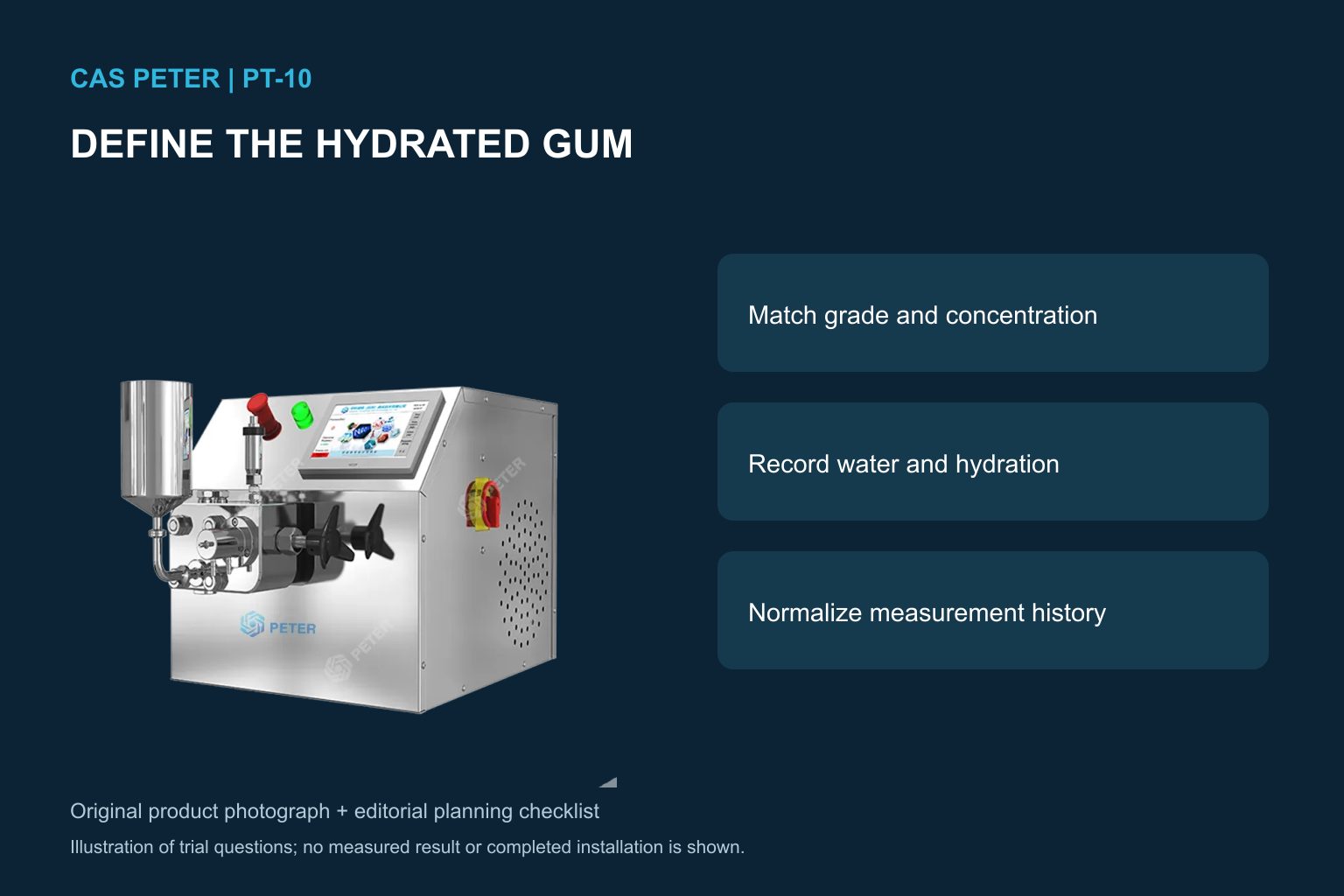
Begin with a fully described hydrated feed
Record the gum supplier, grade, lot and mass basis. Confirm how powder moisture or a supplied premix is handled in the concentration calculation. Use one preparation method for the comparison, including powder addition order, mixing history, hydration time and temperature. Keep the actual water composition and any added salt, acid or other ingredients in the record.
Prepare enough feed for controls and all planned conditions from the same parent batch when feasible. Divide it in a way that preserves concentration. If the parent mixture is not uniform, the trial may begin with different feeds despite identical sample labels. Record the preparation’s appearance and any evidence of unhydrated material before attributing later differences to pressure processing.
A pressure step should not be used to hide an unknown hydration problem. First determine whether the baseline preparation is reproducible. If preparation itself is part of the project, compare it explicitly as a factor and avoid calling that experiment a pressure-only comparison.
Separate shear thinning from change over time
Shear thinning describes how apparent viscosity varies with shear rate under specified measurement conditions. Recovery concerns what happens after a defined mechanical history and rest. These observations are related but are not interchangeable. A flow curve taken under increasing shear cannot by itself establish how the solution will behave after storage or after the next manufacturing operation.
Define the measuring sequence before testing samples. Record loading, equilibration, preshear if used, rest period, measurement range and test temperature. Use the same sequence for control and processed samples. If the rheometer procedure substantially changes the sample, use separate portions for the different questions rather than repeatedly testing the same cup without a plan.
Measure soon enough after processing to capture the intended early state, then repeat at predefined later intervals. Select the intervals for the manufacturing decision rather than choosing only a convenient overnight reading. Keep temperature and handling comparable throughout. A change caused by cooling during the rest interval should not be described as structural recovery without further evidence.
Capture a flow profile rather than one convenient number
Ask the laboratory to select a suitable geometry and measurement range for the sample. Record the limits of the instrument and the possibility of artifacts relevant to the material. Compare the full useful flow curve and report any uncertainty where the signal is unreliable. Do not interpret a numerical result beyond the method’s working range merely because the software produced it.
If low-shear structure matters for suspension or product appearance, include a method relevant to that behavior. If pumping or dispensing is the commercial concern, test a representative operation as well. An instrument reading at one arbitrary speed may rank two preparations differently from the actual application.
Keep the comparison within a consistent temperature and concentration basis. Report any intentional dilution separately. Diluting a sample to make it easier to measure changes the material being evaluated and may remove the very behavior the trial is intended to study.
Use a decision table to avoid premature explanations
The table is a proposed interpretation framework rather than measured xanthan data. The two research records above establish that persistent change is possible, while each proposed follow-up still needs a suitable method and representative sample.
| Observed behavior | Premature conclusion to avoid | Useful next check |
|---|---|---|
| Lower viscosity immediately after processing | All loss is irreversible chain damage | Normalize temperature and repeat after defined rest |
| Higher viscosity after resting | Complete recovery has occurred | Compare the full control and treatment flow profiles |
| Persistent difference at matched conditions | Molecular weight must have decreased | Examine molecular and structural evidence separately |
| Similar high-shear values but different low-shear behavior | Both feeds are functionally equivalent | Test suspension, texture or dispensing as required |
| Large differences between feed preparations | Pressure setting is the sole cause | Review concentration, hydration and measurement history |
Keep alternative explanations open until the measurements distinguish them. A diagnosis should connect the actual evidence to the process question rather than attach a familiar mechanism to every downward trend.
Investigate persistent changes with the right methods
If the difference remains important after matched conditioning, discuss molecular characterization with a laboratory experienced in polysaccharides. The research records demonstrate the value of looking beyond viscosity. However, a viscosity result alone is not a direct molecular weight measurement and should not be converted into an unsupported chain-length claim.
Ask how the sample preparation, solvent conditions and analytical method affect the interpretation. Aggregation, recovery through the analytical system and the fraction actually measured need to be understood before comparing distributions. Provide an untreated reference prepared from the same gum lot whenever possible.
Structural methods and rheology should be interpreted together with appropriate expertise. A consistent change in several observations is more informative than a single attractive number, but it still needs an explanation tied to the formulation. If the available evidence cannot distinguish mechanisms, report that uncertainty and make the process decision using validated functional performance.
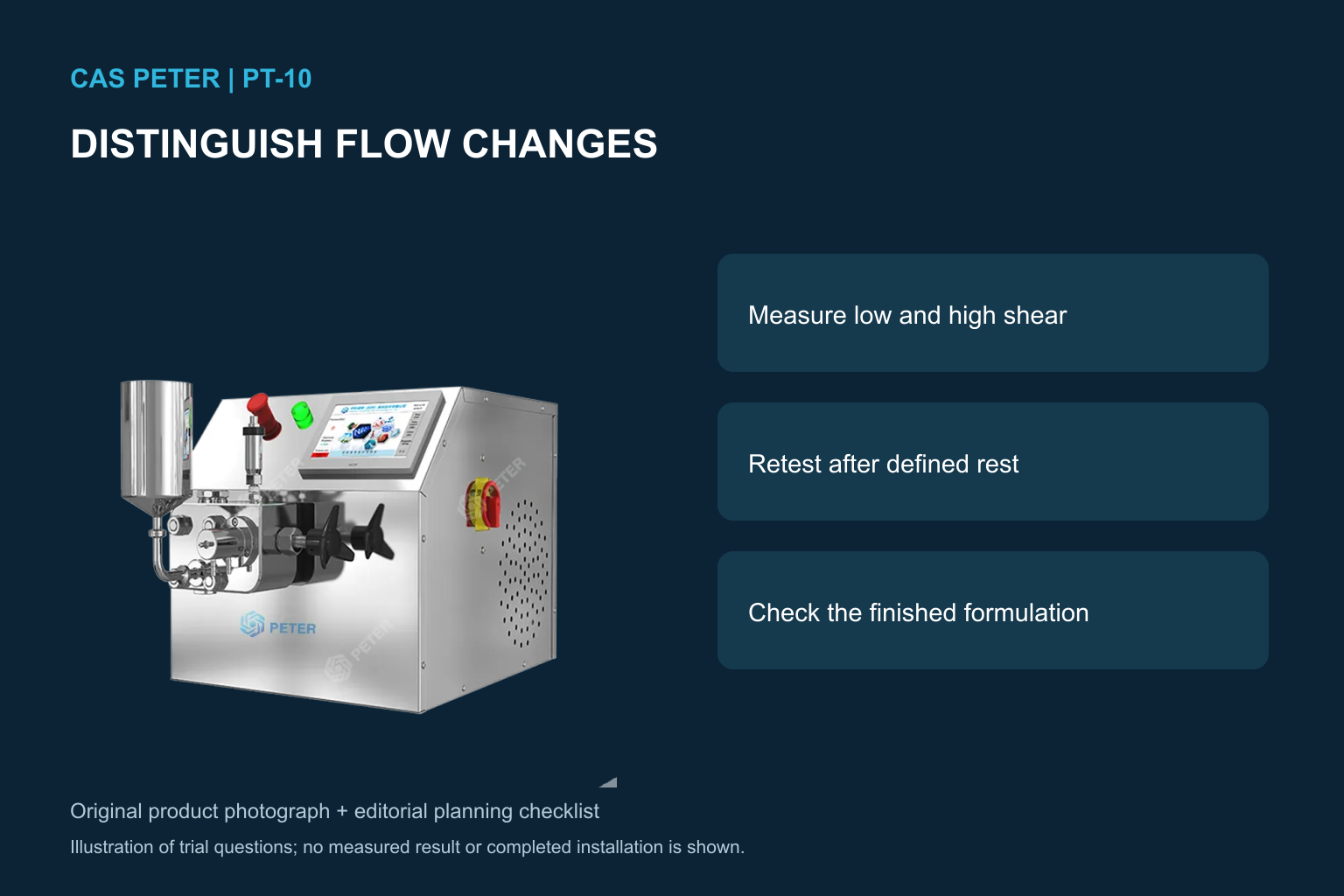
Test the gum in the actual formulation
After screening the hydrated solution, compare it in the intended product using a fixed incorporation sequence. Keep gum concentration and other ingredients constant. A result in water does not establish how the treated gum will behave in a formulation containing oil, solids, salts or other polymers. Describe that later test as application verification rather than assuming direct transfer.
Choose a property the product actually needs: a reproducible pour, resistance to unwanted separation, a specified dispensing response or another established quality measure. Define the method and observation period. Avoid claiming a general improvement when the trial only reduced one viscosity reading.
If another hydrocolloid is being considered, evaluate it on its own functional requirements. The oat beta-glucan processing guide offers a complementary example, but its behavior should not be substituted for xanthan results. Different polymer identity and formulation context remain part of the comparison.
Control exposure before requesting more processing
Record the actual pressure, number of passes, inlet and outlet temperatures, processing duration and collected quantity. Distinguish a discrete pass from recirculation through a mixed vessel. Keep start-up material and any hold periods traceable. Two runs with the same displayed pressure may not represent the same overall treatment history.
If a condition already meets the functional target, additional processing needs a specific reason. A plateau or an acceptable low-shear profile should prompt a decision about useful performance, repeatability and handling rather than an automatic request for more passes. Test independent preparations before selecting the condition for a larger-scale run.
The feed viscosity and homogenizer capacity guide explains why the feed description matters for equipment discussions. Do not infer throughput from a trial performed on a differently prepared or differently concentrated gum solution.
Prepare a practical equipment brief
Use the CAS PETER PT-10 product page as a real laboratory equipment reference. Provide the feed concentration, hydration method, measured flow behavior, temperature range and expected sample quantity for a configuration discussion. Confirm the proposed feed’s suitability, handling arrangement and cleaning requirements before a trial.
Request a record that connects each collected sample to its actual processing history. Ask for enough material to complete both early and rested measurements without repeatedly disturbing the same container. Agree on who controls sample temperature and when the laboratory clock starts.
Choose the condition that reproducibly delivers the required finished-product behavior. Preserve the control data and record the limits of the study, including gum lot, preparation method and storage duration. That makes the result useful for the next scale without pretending that one laboratory run covers every commercial grade.
Educational background on food rheology
This neutral lesson introduces rheology concepts relevant to interpreting a flow curve. It provides background for distinguishing measurement conditions and material behavior, while the actual xanthan formulation still requires its own controlled comparison.

Educational source: NPTEL IIT Kharagpur. Watch the lesson on YouTube.
Frequently asked questions
Will xanthan viscosity always recover after homogenization?
No. Original research records report persistent changes under particular dynamic high-pressure conditions. Determine recovery for the actual gum, preparation and process by comparing matched measurements after defined resting intervals rather than assuming all thinning is temporary.
Does a lower viscosity prove molecular chain degradation?
No. Viscosity alone cannot identify a unique mechanism. First normalize temperature, concentration, hydration and measurement history, then obtain suitable molecular or structural evidence if the distinction is important to the process decision.
Should the lowest viscosity condition be selected for production?
Only if that behavior meets the actual product requirement and remains reproducible. A useful gum may need low-shear structure as well as acceptable pumping behavior. Compare the complete functional profile and finished formulation instead of selecting one minimum reading.