

Vitamin E Nanoemulsions for Edible Films: Test the Dried Packaging
A vitamin E nanoemulsion for an edible film should be judged by the dried film and its intended contact conditions, not only by the droplet size of the liquid feed. Compare matched formulations, quantify retained tocopherol, and measure film mechanics and release separately. A uniform emulsion may be a useful intermediate without proving that the finished package is strong, protective or suitable for a particular food. This guide explains a development workflow for separating those endpoints before an equipment or formulation decision.
Begin with the packaging function
Write down what the film must do during handling and food contact. A free-standing wrap, a cast laboratory specimen and a coating deposited directly on food have different practical requirements. Define the intended substrate, contact environment, drying route and handling steps. Then specify which measurements will determine whether the proposed film is useful.
Identify the ingredient precisely. Vitamin E can refer to different compounds and commercial preparations. Record whether the formulation uses alpha-tocopherol, an esterified ingredient, a mixture or a carrier-oil preparation. Do not treat them as analytically interchangeable. The assay and reference material should match the ingredient actually purchased.
The emulsion processing guide provides the broader process context. Here the commercial question is whether a particular emulsion helps produce a suitable dried film. It is not whether a small liquid droplet, by itself, proves antioxidant protection or a consumer health benefit.
Read the evidence at the correct scale
A pea-protein film study investigated alpha-tocopherol incorporation using nanoemulsion and protein pH-shifting treatments. In its formulation, the combined approach helped preserve film mechanical performance compared with direct addition. The study also assessed antioxidant activity and release. Those endpoints did not all respond in the same way, illustrating why they must be evaluated separately.
A second study of tocopherol-containing chitosan films evaluated release into selected food simulants and examined the balance between film properties and migration. That was a different polymer system and preparation method. It supports checking the contact medium and film behavior, but its release results are not performance specifications for a pea-protein nanoemulsion film.
Neither study establishes a universal droplet-size target, approved commercial packaging claim or guaranteed shelf-life extension for your food. Use the research to identify the questions that need testing. Reproduce any proposed recipe changes with your own ingredients, drying conditions and intended application.
Build formulation controls before changing the machine
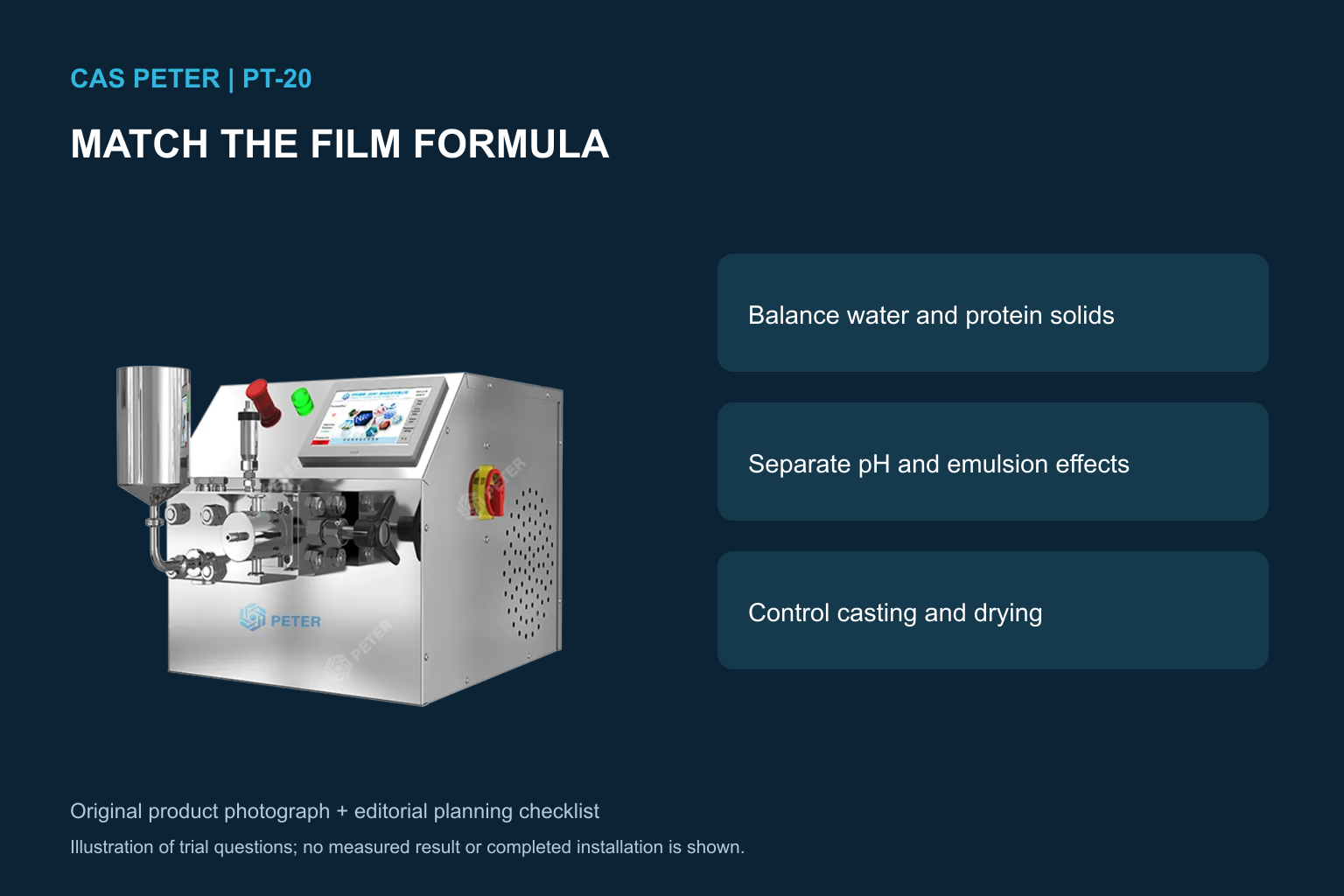
A useful comparison separates direct tocopherol addition, emulsion incorporation and changes in the film-forming polymer. If pH treatment is part of the project, include an appropriate pH-treatment control. Otherwise the effect of protein treatment may be assigned to homogenization even though both changed together.
Balance the final water, polymer, plasticizer, emulsifier and active-ingredient quantities across the relevant comparisons. Adding a prepared emulsion also adds its continuous phase and stabilizer. If those additions change the total composition, state that clearly. A formulation comparison can still be valuable, but it is not an isolated comparison of droplet size.
Keep the ingredient lot and hydration history constant for the initial screen. Record preparation order, mixing time, any heating, and the elapsed time before casting. Prepare independent batches for confirmation. Multiple measurements cut from one film sheet provide useful within-sheet information but do not substitute for independent process batches.
Qualify the emulsion as an intermediate
Record the coarse-emulsion preparation and the temperature history through homogenization. Pressure and pass count are trial variables, not a universal instruction. Check the feed and wetted-material compatibility before processing, particularly when the formulation includes solvents, unusual pH conditions or ingredients that can change during handling.
Characterize the emulsion at a defined age and with a documented measurement method. Include distribution information rather than only a single average. State the dilution medium, because the measurement preparation should not introduce an uncontrolled formulation change. Visible separation, foam and large outliers deserve investigation even when the headline size value appears attractive.
The nanoemulsion stability testing article explains additional checks on a liquid intermediate. Keep those results linked to the film batch. An emulsion that changes substantially between preparation and casting can produce inconsistent films even if its first measurement passed.
If the finished film is the actual target, avoid spending every trial on making the smallest possible droplets. Reserve enough material and time to cast, dry, condition and test comparable specimens from each promising process condition.
Standardize casting, drying and conditioning
Control the amount of dry solids applied per unit area. Recording only wet casting volume can hide a difference in polymer concentration. Measure thickness at multiple locations on the dried specimen, and identify edge regions or visibly defective areas before cutting test pieces. Document which areas were included in the result.
Record drying temperature, time, airflow and the surface used for casting. Keep the interval between drying and testing consistent. If specimens are conditioned in a controlled environment, report that environment and the duration. A film tested immediately after removal from the dryer is not directly comparable with one equilibrated before measurement.
Inspect for visible oil-rich regions, bubbles, pinholes, uneven thickness and incomplete removal from the substrate. Photograph the defects and retain representative specimens. Do not exclude a failed sheet silently while reporting only the best part of another batch. Production usefulness includes the ability to make a consistent film, not merely an isolated intact strip.
For complementary reasoning about evaluating the final deposited material, see the carnauba wax coating trial guide. Its wax-specific findings do not transfer to protein films; the shared principle is to assess the finished layer under its intended conditions.
Measure mechanical and barrier properties separately
Choose mechanical methods that reflect the intended handling problem. Record specimen dimensions, thickness, orientation, test speed and conditioning. Report tensile strength and extensibility as separate quantities where measured. A formulation can improve one without improving the other, so the acceptance decision should follow the use case rather than a single ranking.
Do not infer water-vapor resistance from a smooth surface. If moisture transfer matters, test it under defined conditions with the appropriate specimen and calculation basis. Likewise, opacity and color are separate optical outcomes. An attractive surface photograph cannot establish either a mechanical or barrier specification.
The following table is a proposed development checklist. It contains no claimed performance limits or borrowed material-property values.
| Development question | Comparison to keep controlled | Evidence needed before acceptance |
|---|---|---|
| Did emulsion incorporation improve handling? | Final composition, thickness and conditioning | Mechanical results from independently prepared films |
| Did more active remain in the film? | Added tocopherol basis and analytical extraction | Recovery-checked assay of the dried material |
| Is release suitable for the application? | Contact medium, temperature and area-to-volume ratio | Release profile plus retained active where feasible |
| Does the layer manage moisture as required? | Test environment, thickness and exposed area | A defined barrier measurement, not visual appearance |
| Is the manufacturing route consistent? | Casting, drying and handling sequence | Yield, defects and variability across batches |
Follow tocopherol through drying and contact
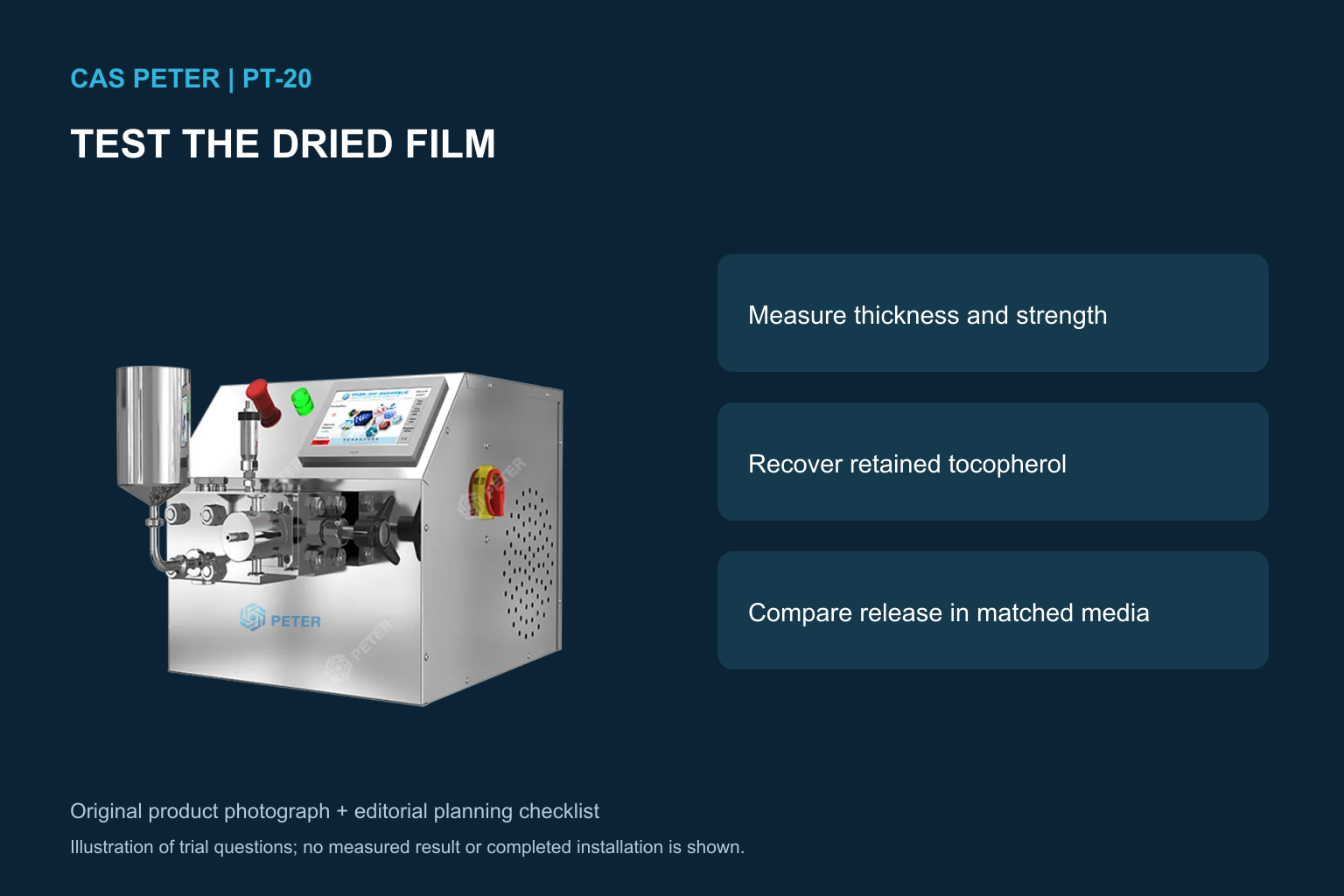
Measure the liquid formulation and dried film on a consistent mass basis. Ask the laboratory to establish that its extraction recovers tocopherol from the actual polymer matrix. A poor extraction can resemble degradation. Keep a record of added quantity, recovered quantity and any uncertainty rather than interpreting every missing fraction as a chemical loss.
For release testing, define exposed film area, thickness, contact-medium volume, temperature and sampling schedule. Account for removed and replaced liquid when calculating cumulative release. State whether the reported result describes concentration in the medium, cumulative mass released or percentage of initially recovered film content.
A food simulant is a defined laboratory environment, not the food itself. Label it accurately and justify its role in development. Confirm promising results with the intended food-contact conditions before making a product claim. Avoid transferring diffusion coefficients between different polymers or contact media merely because both contain vitamin E.
Keep radical-scavenging assays separate from chemical retention and actual food oxidation tests. If protection of a food is the objective, design that food comparison explicitly. A laboratory antioxidant assay does not, by itself, establish the length of commercial shelf life.
Match the equipment discussion to the process stage
The CAS PETER PT-20 product page offers a real catalogue reference for discussing laboratory emulsion development. Confirm configuration, material compatibility, cleaning and the usable operating envelope for the proposed feed. The product photograph is an equipment reference; it is not a documented film-manufacturing installation or evidence of a particular film result.
Send the supplier the emulsion composition, viscosity range, trial quantity, cooling requirement and planned analytical sample demand. Explain whether homogenization is applied to the active emulsion before blending or to a larger film-forming mixture. Those are different process arrangements and should not be treated as equivalent without testing.
This neutral NPTEL lesson provides background on emulsion formation. It supports understanding the liquid preparation stage and does not replace the dried-film tests described above.
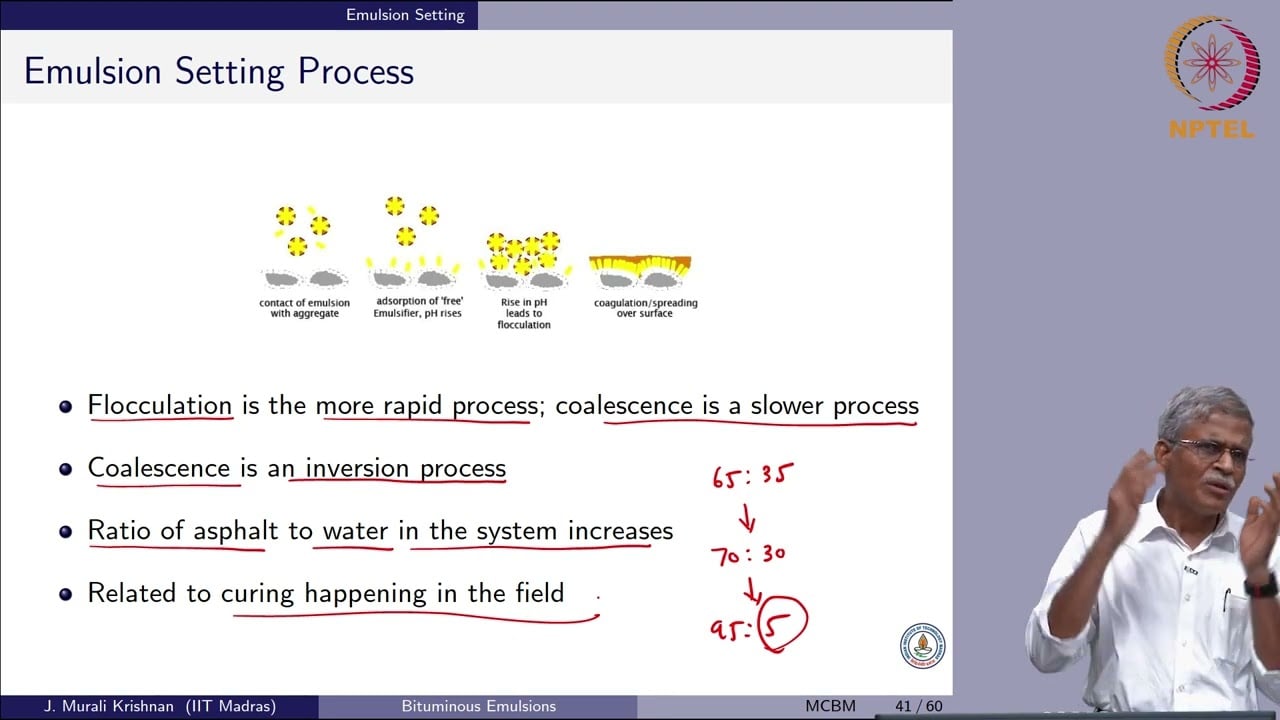
Educational source: NPTEL-NOC IITM. Watch the lesson on YouTube.
Frequently asked questions
Does a smaller vitamin E droplet guarantee a stronger film?
No. Final composition, polymer treatment, drying, thickness and conditioning also belong in the comparison. Measure mechanical performance on independently prepared dried films rather than using emulsion size as its substitute.
Can an antioxidant assay establish packaging shelf life?
No. A laboratory antioxidant assay measures its defined response. Evaluate the intended food, package, storage conditions and relevant quality endpoints before making a shelf-life claim.
Can release results be transferred between different film polymers?
No. Treat polymer formulation, contact medium, temperature, thickness and test geometry as part of the result. Use another study to plan measurements, then verify the proposed film under the intended conditions.