

Naringenin Nanosuspension Homogenization: Qualify Redispersion After Drying
Naringenin nanosuspension homogenization should be qualified through the drying and reconstitution steps when the intended product is a powder. A small particle size in the original liquid is only the starting point. Compare that liquid with the reconstituted material using a fixed water volume, mixing procedure, active concentration and analytical method. Include the coarse particle population, recovered naringenin, solid state and dissolution behavior. The objective is to preserve a useful formulation through the complete process, rather than to show that an aggressively mixed powder can eventually produce a small particle-size reading.
Define whether the target is a suspension or a dissolved product
A nanosuspension contains dispersed solid particles stabilized in a liquid. It is not automatically a molecular solution, a nanoemulsion or a liposome. For naringenin development, state the intended physical form before selecting a homogenization method or interpreting a size result. Record the active material identity, lot, purity information, starting particle condition and complete stabilizer formulation.
If the final product is dried, add the drying route and intended reconstitution instructions to the development brief. A formulation that works as a freshly prepared liquid may not meet the requirements of a stored powder. The relevant question becomes whether the particles can be recovered under the mixing action available to the eventual user, at the concentration required for the next step.
The nanoparticle homogenizer selection guide gives broader equipment context. For this specific trial, physical characterization and manufacturing development must remain separate from any therapeutic claim. Laboratory formulation results do not establish clinical safety, efficacy or a recommended dose.
What two primary studies contribute to trial design
A naringenin nanosuspension study used premilling followed by high-pressure homogenization and compared HPMC with SDS as stabilizers. Its method also included freeze-drying with a cryoprotectant and subsequent redispersion. The stabilizer influenced measured size, storage behavior and release in that particular formulation. The paper provides a reason to retain both formulation and downstream handling in the experimental record; it does not establish a universal drying recipe or a validated redispersion specification for a different process.
A separate naringenin nanocrystal study compared several stabilizers and found that similar particle characteristics did not guarantee the same dissolution behavior. Its preparation used an antisolvent route, so it should not be presented as proof of a high-pressure homogenization setting. Its relevant lesson is narrower: stabilizer choice may matter beyond an initial size measurement.
The proposed workflow below converts those distinctions into questions to test. It does not transfer their pharmacological results, research pressures, stabilizer concentrations or biological outcomes to a CAS PETER machine or a commercial product.
Establish a liquid baseline before drying
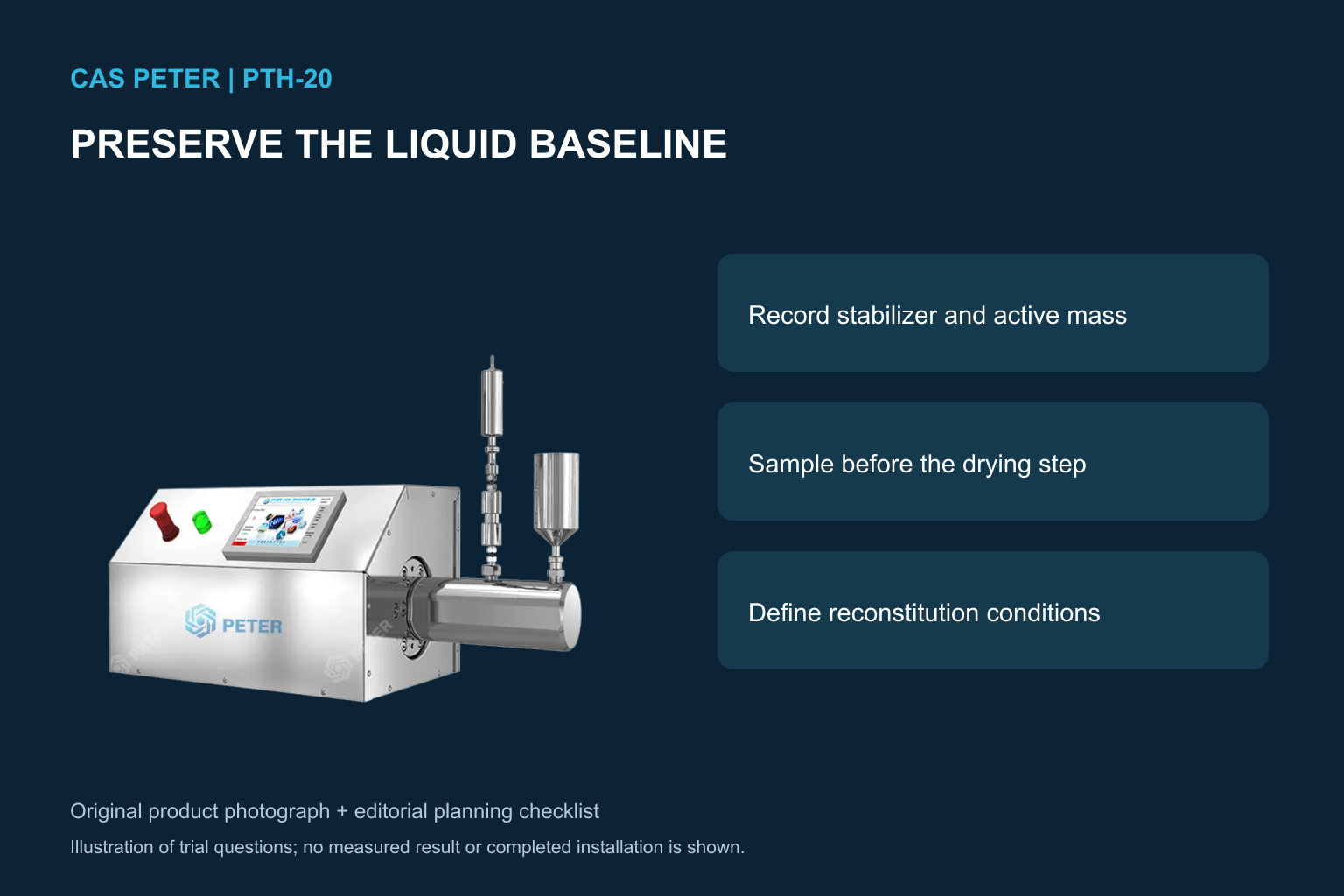
Collect a representative sample after the homogenization process has reached the defined endpoint. Record pressure, passes, inlet and outlet temperatures, cooling, feed mass and usable recovery. Identify startup material and any excluded coarse fraction separately. A baseline that omits difficult material cannot fairly represent the liquid sent to the dryer.
Characterize the liquid at the intended concentration where the method permits. If dilution is necessary, record the dilution medium, ratio and any mixing or sonication. Retain the full size distribution and method settings. An average value alone is insufficient for detecting a small quantity of large particles that might later dominate sedimentation or handling problems.
Take matched portions for active-content measurement and solid-state characterization as appropriate. Record the time between processing and analysis. Also retain a liquid hold control where feasible, so changes caused by storage time can be distinguished from changes caused by drying. Label the controls by their actual processing histories rather than calling every unprocessed portion simply “raw material.”
Keep the drying formulation visible in the comparison
Write the complete drying feed composition, including stabilizer, cryoprotectant or other drying aid. State whether amounts are relative to the total liquid, dry solids or active ingredient. Those bases are not interchangeable. Record the addition sequence and mixing method so that an apparent improvement is not actually a consequence of a changed preparation procedure.
Compare drying conditions using portions from the same liquid baseline where practical. Record the dryer settings that are available, the recovered powder mass, container closure and storage conditions. Keep separate records for material on collection surfaces and the powder intended for use. Do not silently exclude poorly recovered fractions when calculating an apparent manufacturing success.
A powder’s visual appearance is useful for identifying gross differences, but a free-flowing powder is not proof of preserved particle dispersion. Likewise, a collapsed or irregular cake does not by itself identify the mechanism of an observed redispersion failure. Link the physical appearance to measured recovery and the defined reconstitution test before deciding which part of the process needs adjustment.
Use a reconstitution procedure that the final process can reproduce
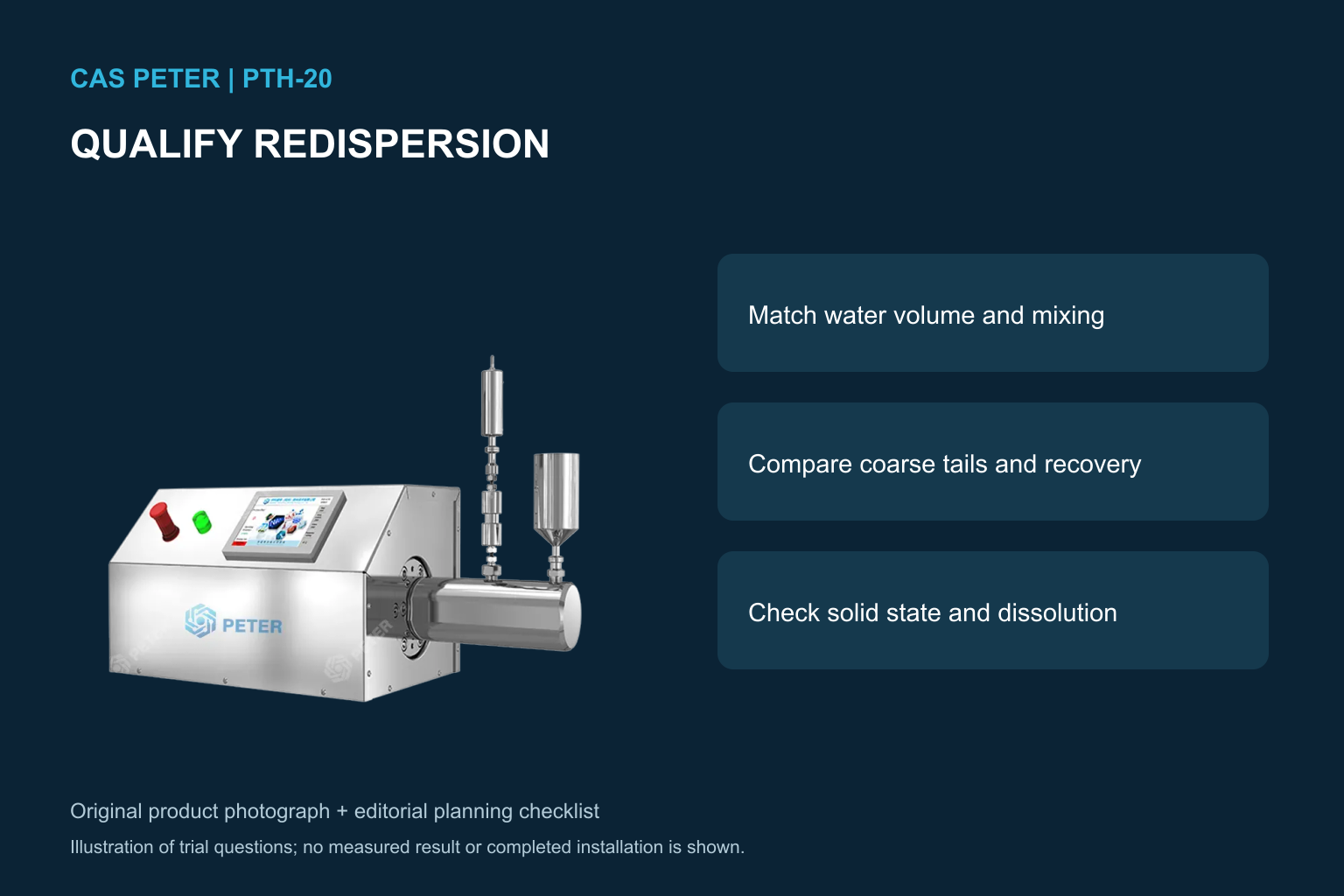
Specify the water or medium, volume, temperature, order of addition, mixing device, mixing time and delay before measurement. Keep the final active concentration matched to the liquid baseline or explain how the analytical comparison accounts for the difference. Avoid comparing a heavily diluted reconstituted sample with a concentrated original suspension without acknowledging the changed conditions.
Start with the intended gentle reconstitution method. If stronger laboratory mixing is investigated, record it as a separate condition rather than replacing the original result. For example, a powder that only recovers after a laboratory disruption step may still be useful for an industrial premix, but it has not demonstrated easy reconstitution under a simple-use instruction.
Collect samples from a defined location after the mixing period, and inspect the container for residue. A clear supernatant or a sample taken only from the well-dispersed region can conceal unrecovered material. Record visible floating material, sediment, wall deposits and the time needed for wetting as observations alongside instrumental measurements.
A practical acceptance panel for the dried formulation
The table is a proposed development checklist. No numerical limit is implied; set limits from the intended product specification, analytical capability and repeatability of the control.
| Endpoint | Compare before drying and after reconstitution | What a failure may require investigating | What the result cannot prove alone |
|---|---|---|---|
| Particle-size distribution | Average, distribution width and coarse tail using one preparation method | Aggregation, incomplete wetting or changed sampling | Therapeutic performance |
| Visible recovery | Residue, sediment and undispersed material under fixed mixing | Reconstitution instructions and drying aids | Total active recovery without assay |
| Naringenin content | Validated assay on representative samples and relevant residues | Loss during processing, sampling or analytical preparation | Chemical stability from size alone |
| Solid state | Suitable diffraction or thermal methods with matched controls | Changes introduced during drying or storage | Dissolution behavior in every medium |
| Dissolution | Same medium, concentration basis and sampling procedure | Stabilizer effects and the redispersed material state | Clinical bioavailability |
| Stored-powder performance | Repeat the same panel after specified storage | Moisture exposure, package and formulation changes | A shelf life beyond the studied conditions |
Where a difference appears, preserve the original traces and sample records. A second analysis using the same sample can check instrument repeatability, but an independent preparation is needed to examine process repeatability. Keep those two kinds of replication separate in the report.
Interpret a small size result with appropriate caution
A low average after reconstitution can be misleading if large material has settled before sampling or if the measurement preparation includes a powerful dispersion step. Check the whole distribution and use representative microscopy when it can resolve the suspected coarse population. Record the imaging preparation, since drying a specimen for microscopy is itself a handling step.
If size returns close to the baseline but dissolution differs, review stabilizer composition, assay, solid state and the dissolution procedure. Do not conclude that the homogenizer failed simply because one downstream endpoint changed. Conversely, similar dissolution under one test condition does not excuse an unmanageable coarse tail if the next manufacturing step requires reliable suspension handling.
Use the drug nanocrystals versus nanoemulsions guide to keep the physical target clear. The silymarin nanocrystal dissolution article covers a complementary question about interpreting dissolution measurements. Neither establishes that a different active ingredient will behave like naringenin.
Troubleshoot the sequence rather than adding passes automatically
When the original liquid passes but the reconstituted powder fails, examine drying and reconstitution first. Check whether the same starting suspension was used, whether the drying aid amount was recorded correctly and whether the reconstitution procedure is practical. Increasing homogenization passes before drying may add processing time without addressing the actual source of the failure.
If the liquid baseline already contains unacceptable coarse material, review premilling, feed wetting, stabilizer preparation and machine compatibility before testing the dryer. Keep pressure, passes and thermal history distinct. A higher nominal pressure is not automatically a better condition if recovery worsens or a stabilizer system cannot maintain the intended state during the rest of the process.
For a stored powder, repeat the defined test at planned intervals using representative sealed containers. Do not repeatedly open the same test container without considering the handling change. Report the package and storage conditions, and avoid converting a short laboratory screening experiment into an unsupported commercial shelf-life statement.
Prepare a useful equipment inquiry
The CAS PETER PTH-20 catalogue page can support a discussion about a development configuration. Confirm suitability for the actual formulation, including solvent content, solids, viscosity, feed size, cleaning and cooling needs. The model photograph is a product reference, not evidence of a completed naringenin trial or a guaranteed pharmaceutical configuration.
Send the supplier the liquid formulation, active concentration, stabilizer preparation, intended trial volume and minimum recovered volume. Include the drying route, the reconstitution procedure and the acceptance panel, because the equipment trial should produce material that can be tested through those later steps. Ask for confirmation of compatible wetted materials and a documented sampling arrangement before selecting operating conditions.
A useful development decision identifies which formulation and process preserve the required endpoints with acceptable recovery. It also identifies unresolved tests. If redispersion is acceptable but dissolution remains uncertain, record that uncertainty explicitly rather than labeling the entire product qualified.
Educational context: colloidal stability
The university lesson below explains general colloidal stability. It offers background for comparing dispersed particles and their interactions; it does not provide a naringenin drying protocol or validate a medical use.

Educational source: NPTEL-NOC IITM. Watch the lesson on YouTube.
Frequently asked questions
Does a small particle size before drying prove good redispersion?
No. Test the dried material using a defined reconstitution procedure and compare the whole size distribution, visible residue and active recovery with the original liquid. The drying and storage steps need their own evidence.
Can strong sonication be used to claim easy reconstitution?
Only if that treatment represents the intended process and is clearly disclosed. A separate result under gentle, practical mixing is needed when the product is expected to reconstitute without a powerful laboratory dispersion step.
Does similar particle size guarantee similar dissolution?
No. Compare dissolution directly under matched conditions and assess stabilizer composition, solid state and analytical recovery. Similar size is one physical observation, not a substitute for the required downstream performance test.