

Drug Nanocrystals vs Nanoemulsions: Define the Homogenization Target
Drug nanocrystals and nanoemulsions are different formulation systems even when both are prepared using high-pressure homogenization and produce similar particle-size readings. A nanocrystal route targets solid active particles in a surrounding medium. A nanoemulsion targets liquid droplets dispersed in another liquid, with the active located according to the formulation. Choosing between them requires evidence about phase state, composition, chemical integrity and the intended development objective. A small average size does not resolve those questions. This guide explains how to define a useful equipment trial without confusing size reduction with proof of a particular drug-delivery structure.
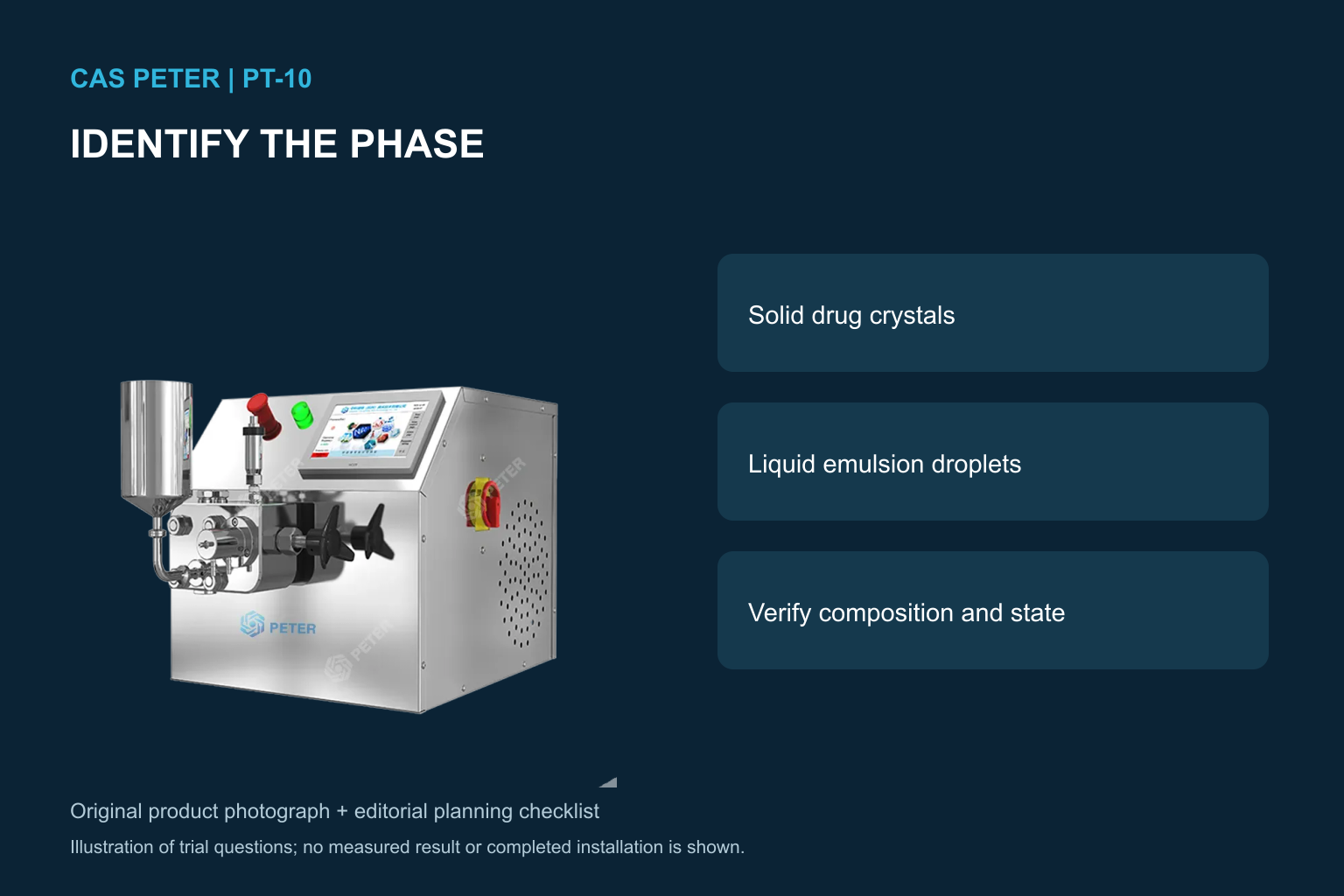
Identify the phase that the process is changing
Begin with a material description rather than a machine setting. State whether the feed contains solid drug particles, an oil phase containing dissolved material, or a mixture of structures. Explain what is expected to change during processing and what evidence will establish that change.
A nanosuspension can contain solid drug particles with stabilizing ingredients in a liquid medium. The term nanocrystal additionally requires evidence supporting the crystalline character of the particles being described. Do not assume that a nanoscale instrument result establishes crystallinity or that every drug nanosuspension is entirely crystalline.
A nanoemulsion is a liquid-in-liquid dispersion. Its droplets can carry dissolved ingredients, but they are not interchangeable with solid drug crystals. If a formulation contains both liquid droplets and solid material, the analytical plan should investigate the mixed system rather than force it into whichever label is more convenient.
Use formulation evidence before choosing the route
The article on nanocrystals and nanosuspensions describes top-down size reduction and bottom-up formation routes, and emphasizes the solid-material context. It helps define the system being developed. It does not establish that homogenization is preferable for every active or that a particular machine will deliver a required particle state.
The review of nanoemulsion formulation and characterization addresses liquid dispersions and the measurements used to evaluate them. Its descriptions provide the contrasting formulation context. Results for a particular emulsion should not be transferred to a nanocrystal suspension because both were made at high pressure.
For an equipment trial, give the supplier the physical state of the feed, composition, concentration, solvent system and available quantity. Include relevant sensitivity and compatibility information. A request for a target size without those details can produce a quotation that does not address the actual formulation problem.
Compare the questions that decide success
| Decision field | Drug nanocrystal route | Nanoemulsion route |
|---|---|---|
| Intended dispersed material | Solid active particles | Liquid droplets |
| Structural question | What solid state is present? | Which liquid phase is dispersed? |
| Composition question | How much active is in the recovered solids system? | Where is the active within the formulation? |
| Processing question | Can the prepared suspension be processed reproducibly? | Can the pre-emulsion be reduced and stabilized? |
| Storage question | Do particles grow, aggregate or change state? | Do droplets or phase behavior change? |
| Application question | Does the measured formulation meet its development target? | Does the measured formulation meet its development target? |
These are qualitative development questions, not release specifications. The exact analytical methods and acceptance limits depend on the material and intended product. A common size target does not make the two routes analytically equivalent.
Design the nanocrystal trial around solid-feed behavior
For a top-down route, describe the initial solid material and its preparation. Record the coarse fraction, suspension homogeneity, stabilizer and any pre-processing. Confirm that the feed is compatible with the proposed flow path, wetted materials and approved operating conditions before introducing it to the equipment.
Keep the starting material and preparation consistent while screening pressure or exposure. Collect representative samples at selected stages. Do not assume that another pass remains useful after the target distribution is reached; assess recovery, temperature, chemical integrity and solid-state evidence together.
If a filtration or separation step removes coarse particles, retain its material balance. A small-size result measured only after discarding a large fraction cannot represent the entire original feed. State whether the reported distribution belongs to the whole recovered suspension or an intentionally selected analytical fraction.
Design the nanoemulsion trial around droplet formation
Define the oil phase, aqueous phase, emulsifier system and the location of the active before treatment. Confirm whether the ingredient is fully dissolved in its intended phase at the preparation and processing conditions. Unrecognized solid material can make a nominal emulsion a more complicated dispersion.
Prepare a reproducible pre-emulsion and document mixing order, temperature and holding time. Compare processing conditions using equivalent feed preparation. Otherwise, a changed input droplet population or phase state can explain the apparent effect attributed to pressure.
After processing, retain distribution and stability measurements as well as active-content evidence. A small initial droplet result does not establish lasting stability, suitable administration properties or clinical performance. The equipment trial evaluates a process step in development; it does not approve a medicine or determine its use in patients.
Do not ask a size instrument to identify everything
A light-scattering result describes the sample under the selected measurement assumptions and preparation conditions. It does not, by itself, identify the chemical composition of a particle or determine whether it is solid or liquid. Clarify the measurement principle and the information needed from complementary methods.
The site guide to DLS versus laser diffraction explains why results from different measurement bases require care. For these formulations, also consider suitable evidence for solid state, morphology and composition. Select methods according to the claim being tested rather than collecting a long list of measurements without a decision question.
Explain any dilution, solvent exchange, drying or isolation used before measurement. Those operations may change the sample. Where preparation could alter the structure of interest, qualify the interpretation and consider a complementary approach. Keep the original dispersion, prepared analytical sample and observed result linked in the record.
Separate active loading, concentration and recovery
An active-content concentration says how much active is present per unit of the stated formulation basis. A recovery calculation compares recovered active with a defensible input amount. A loading or association calculation may use another denominator. Write each formula and unit explicitly before comparing formulations.
For a hypothetical example, recovering 80 milligrams of active from a 100-milligram input represents 80 percent active recovery, provided the quantities and analytical method are reliable. A high concentration in the collected portion does not change that recovery percentage. These values illustrate the bookkeeping and are not results for a formulation or machine.
Include retained material, analytical samples and rejected fractions in the reconciliation. If the assay measures total active without distinguishing degradation products adequately, it may not support a chemical-integrity claim. The analytical method must be appropriate for the question asked, particularly when processing introduces heat or extended holding.
Test behavior after the next development step
Storage can reveal changes not evident in an immediate size measurement. Set a defined observation period and conditions, and repeat the measurements that matter to the selected route. Investigate a change in distribution rather than describing it generically as instability without identifying the affected property.
If the next operation is drying, dilution or incorporation into another delivery format, include that operation in the development assessment. A satisfactory dispersion before the next step is not necessarily a satisfactory final intermediate. Define the acceptance point at the stage where a real decision will be made.
An informative comparison documents how the two routes differ in composition, preparation, process history and final testing. It should not present them as interchangeable samples differing only in pressure. If the intended product architecture is already fixed, the task may be optimizing that route rather than choosing between fundamentally different systems.
Connect the trial to a confirmed equipment configuration
The CAS PETER PT-10 laboratory model is a starting point for discussing small-scale cell-lysis, emulsification and dispersion work. Its public summary and technical table contain differing pressure and flow figures. Confirm the configuration-specific rating, temperature envelope, volume requirement and materials compatibility rather than selecting one conflicting value as a guaranteed specification.
Use the nanoparticle equipment checklist to organize supplier questions. The articles on liposome homogenization versus extrusion and nanoemulsion stability testing address neighboring decisions. A liposome is another distinct structure, so neither its production result nor a liquid-droplet stability result substitutes for evidence of drug crystallinity.
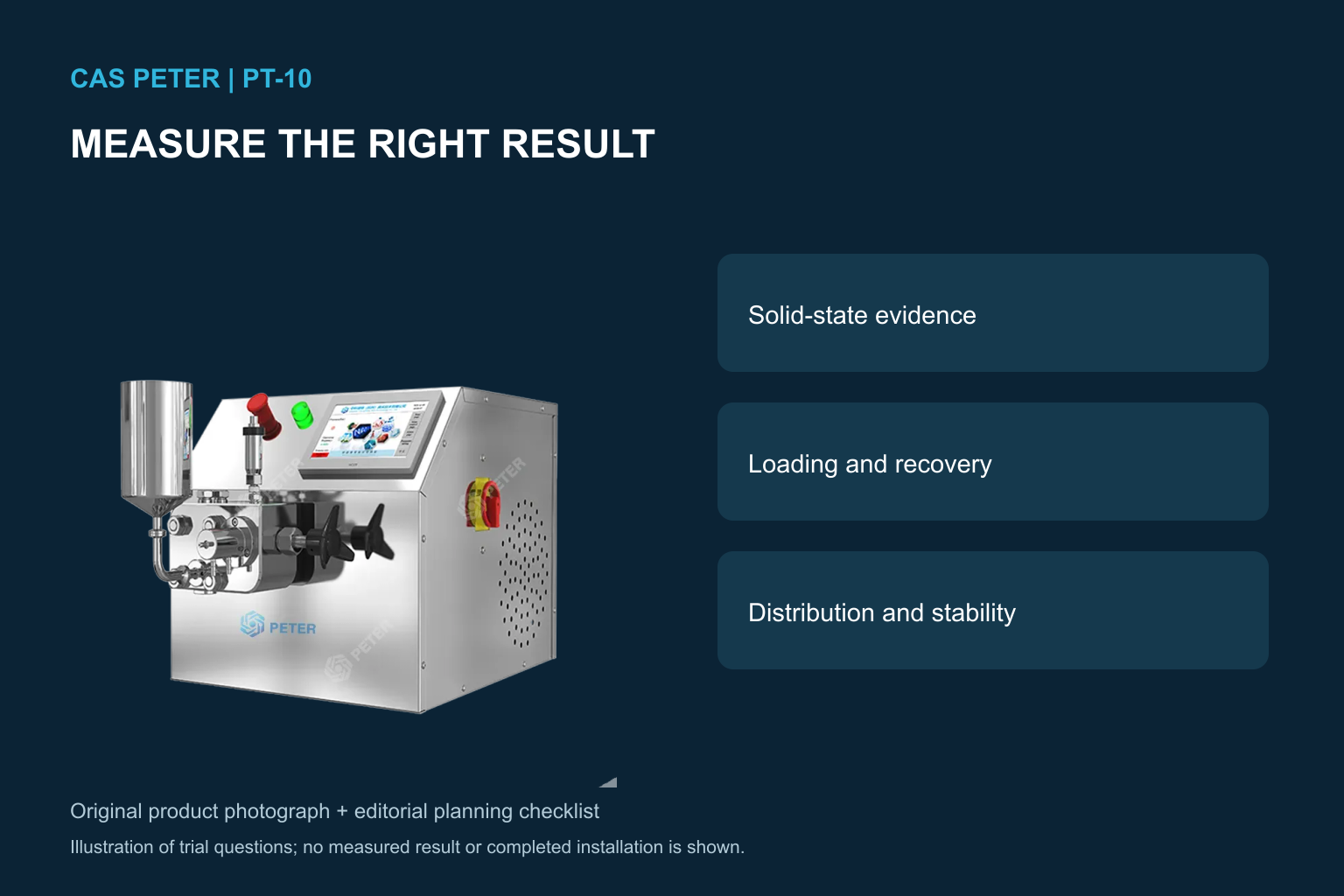
Provide the supplier with the target architecture, feed state, formulation, test methods and intended next step. Ask which operating window can be demonstrated with representative material and what records accompany the trial. The photographs in this article show the named equipment only; they do not demonstrate successful pharmaceutical processing or regulatory qualification.
Educational seminar: the drug-nanocrystal concept
The Queen’s University Belfast School of Pharmacy seminar below discusses drug nanocrystals. The university’s event record identifies the research topic, while the YouTube title names the speaker. It is included to explain the formulation concept and its research context, not to make a treatment recommendation or validate the pictured homogenizer.
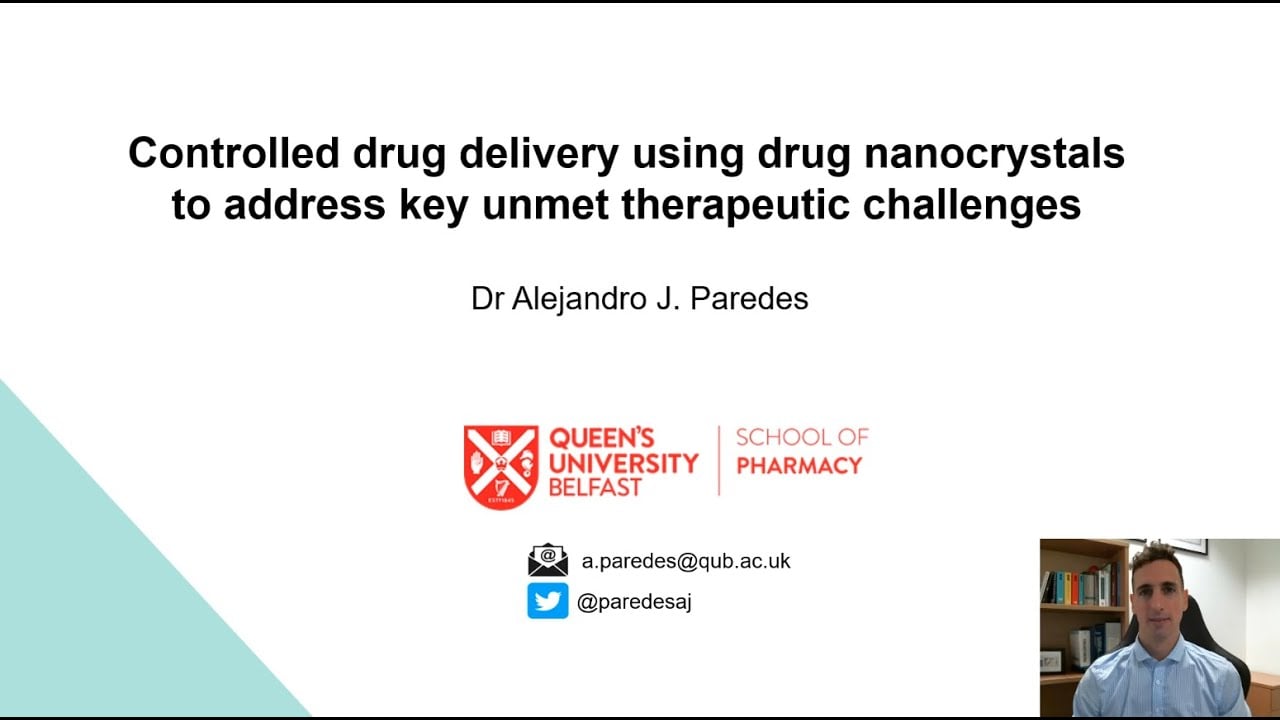
Educational source: QUB School of Pharmacy. Watch the lesson on YouTube.
Frequently asked questions
Can the same size reading prove both systems are equivalent?
No. Similar size measurements do not establish identical phase state, composition or behavior. Use complementary evidence to identify the intended solid particles or liquid droplets.
Is every nanosuspension a nanocrystal formulation?
No. A crystalline claim needs suitable solid-state evidence. Describe the material according to what was actually characterized rather than the preferred development label.
Can a laboratory homogenization trial establish a finished medicine’s suitability?
No. A process trial provides evidence for a defined development step. Product quality, safety, performance and regulatory requirements need their own appropriate evaluation.