

Liposome Homogenization vs Extrusion: How to Choose
Liposome homogenization and membrane extrusion are different ways to reduce the size of preformed lipid vesicles, and neither should be selected from a target diameter alone. High-pressure homogenization applies a concentrated mechanical treatment in a flow path; extrusion passes the dispersion through a defined membrane. Compare the resulting size distribution alongside lipid recovery, payload retention, temperature history and the demands of the next processing step. A smaller fresh size reading is useful only when the intended vesicle and its contents remain acceptable. There is no universal pressure, membrane pore size or pass count for every formulation.
This guide addresses selection of a post-formation size-reduction step. The broader nanoparticle-processing equipment guide provides purchasing context. Here, the emphasis is on designing a fair comparison and recognizing when a published result does not describe the equipment or formulation being considered.
Define the vesicle before comparing the machines
A liposome is a lipid-bilayer vesicle, so reducing its measured size is not the same development problem as reducing an oil droplet in a simple emulsion. Define lipid composition, dispersion medium, concentration and whether the material contains a payload. Describe the starting preparation and the attributes the final product must retain.
Keep the formation step separate from downsizing. If two candidate processes start with different hydration methods or lipid concentrations, their final results cannot be attributed entirely to the size-reduction equipment. Record the starting dispersion and, where possible, split a representative preparation into comparable trial portions.
Also distinguish the intended product from other lipid-based particles. A result for a different carrier architecture does not automatically establish performance for the liposome under investigation. Use the actual formulation and qualified analytical methods to define the acceptance question before discussing maximum machine pressure.
Understand the two size-reduction mechanisms
In high-pressure processing, the dispersion passes through the machine’s specified interaction region. The local mechanical treatment depends on the installed flow path as well as operating conditions. A valve homogenizer and a fixed interaction-chamber processor are not interchangeable simply because both show the same upstream pressure.
In membrane extrusion, the dispersion is driven through a membrane with a stated pore structure. Membrane material, condition, flow and formulation all belong in the method record. The nominal pore size is an input to the process; it is not a substitute for measuring the final distribution.
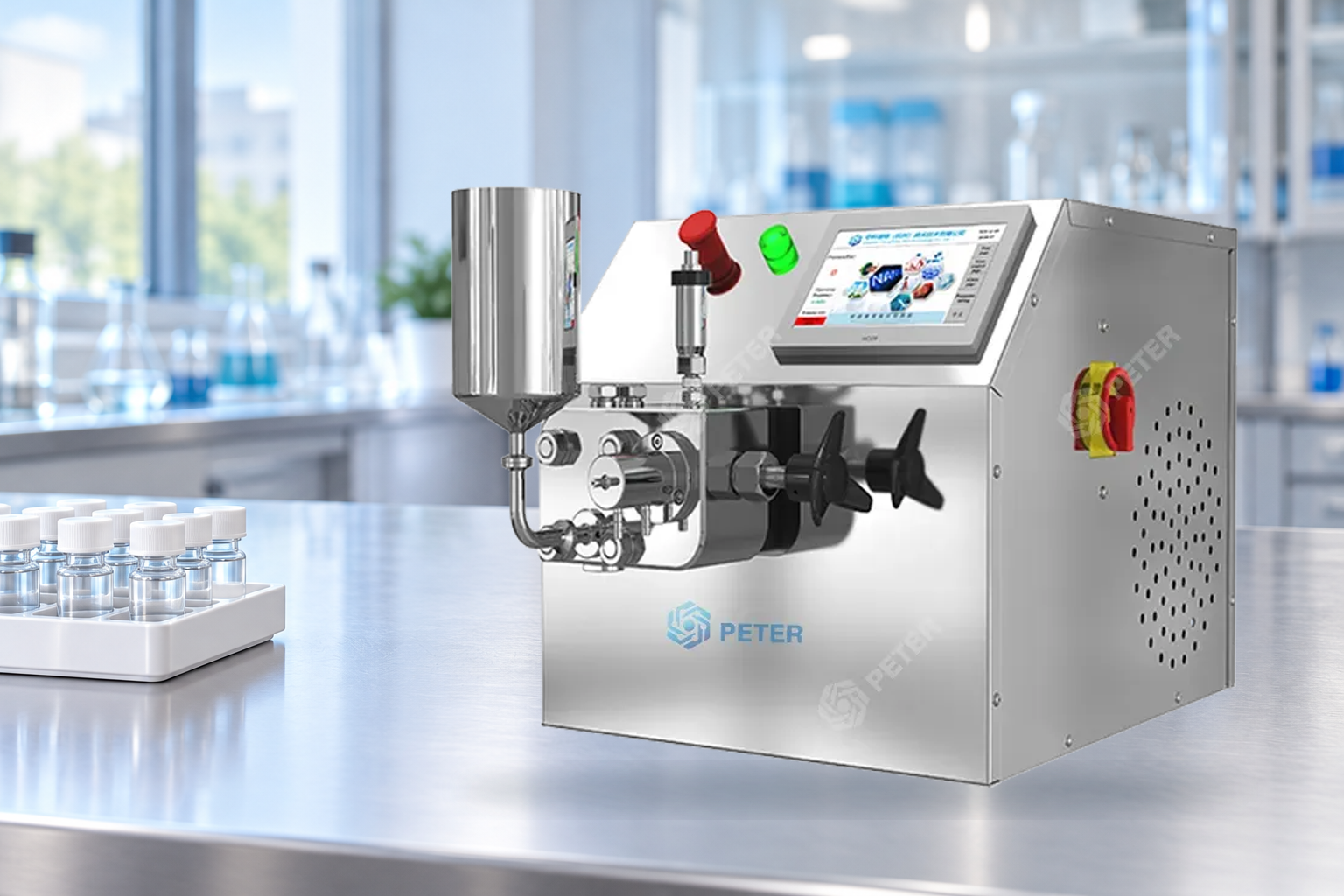
A research paper on scalable solvent-free liposome production used a high-shear preparation step followed by Microfluidizer processing and evaluated size, distribution and loading. It supports studying these attributes together. Its equipment, lipids and payloads differ from an untested CAS PETER configuration, so its results must not become a product guarantee or a transferred operating recipe.
Read comparison studies with the equipment type in view
The word “homogenization” is used for several mechanisms. Before applying a research comparison, inspect its methods section: identify the model, pressure or rotational speed, processing arrangement and analytical preparation. A category label in an abstract is not enough to establish a comparison between two high-pressure technologies.
For example, the primary study Evaluation of Extrusion Technique for Nanosizing Liposomes compared extrusion with several alternatives. Its experimental homogenization comparison used an Ultra-Turrax rotor-stator instrument, rather than a high-pressure valve homogenizer. Its ranking therefore cannot directly prove that extrusion is superior to every high-pressure homogenization process.
This distinction does not invalidate the study. It defines what its evidence can answer. Use a publication to understand its tested system, then design the missing comparison for your own formulation. Avoid combining one paper’s best extrusion result with another paper’s best pressure-processing result as though they were a controlled head-to-head experiment.
Compare quality, recovery and operating burden together
| Decision | High-pressure homogenization trial | Membrane-extrusion trial |
|---|---|---|
| Identity of the treatment | Document valve or chamber design and the measured operating window | Document membrane material, pore specification and installed arrangement |
| Distribution achieved | Measure after defined passes and controlled collection | Measure after the defined membrane sequence and cycles |
| Material recovered | Account for feed path, collection and residual hold-up | Account for membrane retention, transfers and discarded fractions |
| Payload condition | Assess retained and free payload using a suitable separation and assay | Apply the same qualified analytical comparison |
| Thermal exposure | Record inlet, discharge and post-cooling conditions | Record feed, apparatus and collection conditions |
| Practical operating burden | Review feed suitability, cleaning and configuration controls | Review membrane availability, blockage behavior and changeover |
This is a proposed trial-planning table, not a numerical specification. Determine limits from product requirements and establish what each measurement can reliably demonstrate. Neither route receives an automatic pass for producing an attractive sample photograph.
Measure size without treating it as proof of vesicle integrity
Select a size method appropriate to the sample and retain the distribution information and method-quality indicators. Use the same sample preparation, temperature, dilution and reporting basis across the candidate processes. An instrument average obtained after selective filtering can conceal the oversized material that matters to the decision.
The DLS and laser-diffraction guide explains why the outputs are not interchangeable. Even a well-controlled hydrodynamic-size measurement does not, by itself, establish bilayer organization or payload retention. Use additional characterization where these attributes determine acceptance.
Keep morphological questions separate from size statistics. If the intended vesicle structure matters, arrange a suitable structural assessment and define its sampling limitations. Do not infer that all particles share the intended structure merely because one mean size falls inside a desired range.
Use payload measurements with a stated denominator
When a payload is present, distinguish the amount remaining associated with the vesicles from free material and from material lost during processing. The analytical separation itself must be suitable: a method that changes the sample or selectively loses one fraction can distort the apparent retention.
As an illustrative example, suppose a preparation contains 10 mg of total measurable payload before downsizing. After processing and an agreed separation, 8 mg is measured in the accepted vesicle-associated fraction and 1 mg in the free fraction. Another 1 mg remains unexplained by the measured fractions. Reporting only that 8 of the 9 recovered milligrams is associated with vesicles would hide the unresolved recovery difference.
The numbers are arithmetic illustrations, not experimental data. Report the exact calculation basis and the mass or amount recovered, alongside any percentage. When the material is expensive, the quantity meeting all acceptance requirements can be more useful for process selection than the percentage calculated within a selectively recovered fraction.
Control temperature using the actual formulation limits
Choose a permitted temperature window from formulation knowledge, payload sensitivity and the installed equipment’s limits. The relevant question is not whether every liposome process should be cold or warm. It is whether the defined composition can be processed consistently without unacceptable changes under the chosen conditions.
For high-pressure trials, identify where temperature is measured. A cool collection sample does not describe every exposure upstream of the cooler. For extrusion, include the membrane assembly and feed conditioning in the thermal record. Compare histories that are relevant to the product instead of treating one final bottle temperature as a complete description.
Our homogenizer heating guide explains the processing side of that record. The useful operating condition is the one supported by product measurements, recovery and a repeatable temperature history, within the manufacturer’s approved envelope.
Build a comparison that separates formulation from processing
Specify the lipid preparation, starting distribution, concentration, available volume and target quality attributes before the trial. Choose a manageable set of justified conditions for each route. Preserve untreated controls and use comparable observation times after processing. If one sample waits much longer before analysis, a storage effect may appear to be a machine effect.
Document complete separate passes and distinguish them from tank recirculation. Equal nominal cycle counts need not mean equal exposure histories in different arrangements. Record actual flow, processing time, sample withdrawals and the amount recovered for analysis, so the trial can be reconstructed.
Include independent preparation or processing repeats where the decision requires evidence of reproducibility. Repeated readings from one cuvette are not independent manufacturing repeats. Keep the raw results and exceptions; a selected best result alone cannot show how consistently the process performs.
Evaluate scale-up and downstream processing as connected decisions
A larger machine or membrane area does not automatically reproduce a small trial. Reassess flow-path differences, residence and collection arrangements, cooling, recovery and the complete downstream sequence. A capacity statement should identify the formulation and quality condition supporting it.
Ask what happens after downsizing. Purification, concentration, storage and the intended packaging may change the measured population or recovery. The post-homogenization stability-testing guide offers general planning principles, although a liposome requires its own formulation-specific programme and is not simply a nanoemulsion.
For drug-development applications, the FDA liposome drug-products guidance addresses information for specified drug applications, including manufacturing and controls. A laboratory size-reduction comparison is only part of a wider development programme. It does not establish product approval, clinical suitability or compliance of the equipment.
Prepare an equipment enquiry around evidence
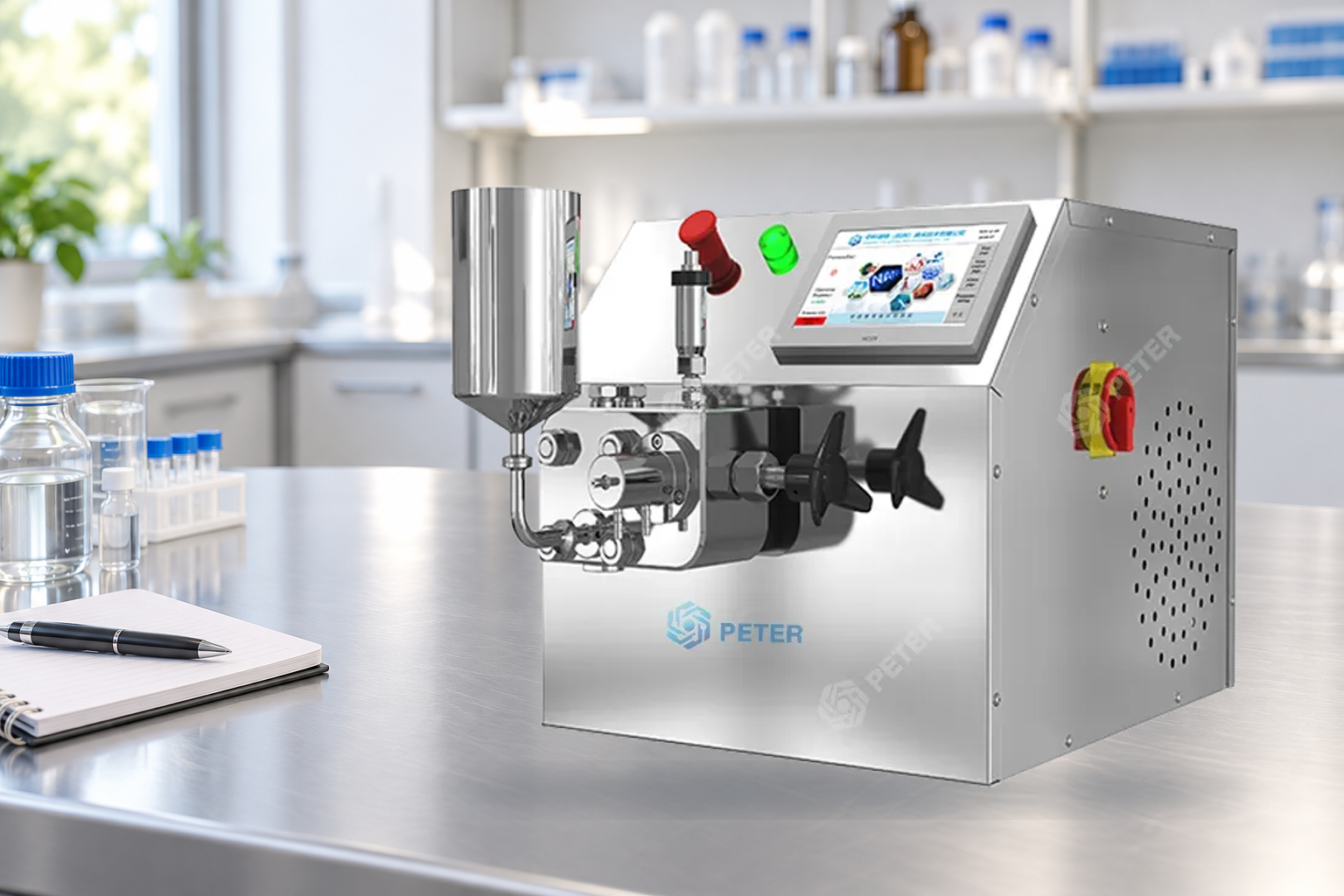
For a CAS PETER PT-10 laboratory homogenizer discussion, provide the intended formulation, starting material, available batch quantity, acceptance tests and thermal limits. Request confirmation that the feed and proposed configuration are suitable before agreeing operating conditions.
Ask for a representative-material trial record rather than assuming a published result from another manufacturer’s apparatus transfers to this machine. Request the actual flow, pressure history, pass arrangement, temperature record, recovery and analytical preparation together. The product photograph shows the equipment’s appearance; it does not document a completed liposome trial.
Learn the liposome background
NPTEL IIT Bombay’s introductory lecture provides educational context on liposomes. It supplements the comparison above and does not prescribe settings or validate CAS PETER performance.
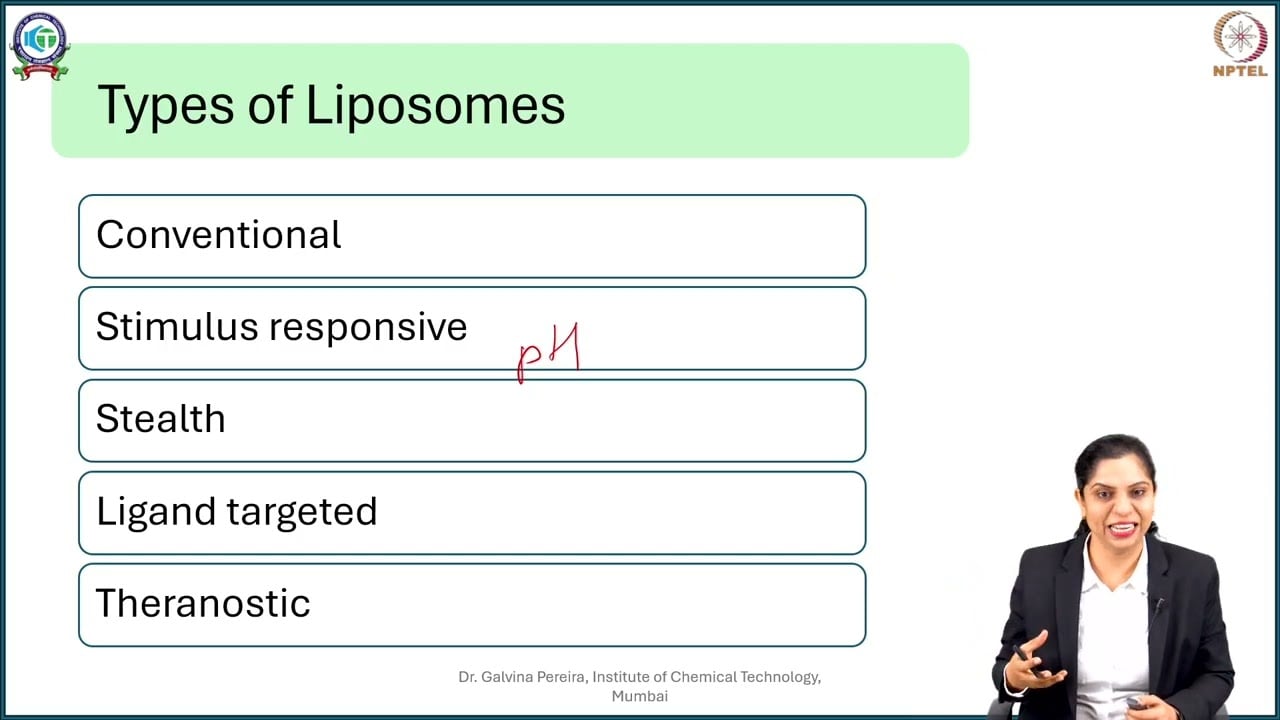
Watch the NPTEL liposomes lecture.
Frequently asked questions
Is liposome homogenization the same as membrane extrusion?
No. High-pressure homogenization applies mechanical treatment in a defined flow path, while membrane extrusion passes the dispersion through a membrane. Compare product results under documented conditions.
Does extrusion pore size equal the final liposome diameter?
Do not assume equality. Treat pore specification as a process input and measure the resulting distribution using a suitable method for the actual formulation.
Does a smaller DLS result prove that payload retention is acceptable?
No. Size and payload association answer different questions. Use suitable separation, assay and recovery measurements alongside the size distribution.
Which method is best for production?
Select from representative evidence for accepted product quality, recovery, operating burden and scale-up. A published comparison using another mechanism or formulation cannot decide the result universally.