

Palygorskite Homogenization: Separate Bundle Dispersion from Rod Shortening
Palygorskite homogenization should be judged by how effectively it separates bundles while retaining the rod characteristics needed by the application. A smaller particle-size reading alone cannot distinguish useful debundling from rod shortening or a change caused by sample preparation. Start with a characterized mineral feed, separate additive effects from mechanical treatment, and compare microscopy, slurry behaviour and storage performance. This guide explains a practical development framework for palygorskite, also known as attapulgite, without assuming that a published laboratory condition transfers directly to another mineral grade or homogenizer.
Identify the mineral and the desired dispersed structure
Palygorskite feed is not a collection of identical manufactured spheres. A commercial mineral grade can contain bundles, larger aggregates and other mineral components. Establish the supplier grade, available composition information, previous grinding and any purification before beginning a pressure comparison. Keep a representative untreated sample for later structural and application tests.
Define the target in terms of function. A rheology additive may need a particular response after mixing and rest, while a composite filler may depend on the dispersed rods surviving the next manufacturing step. Specify whether the intended endpoint is a wet concentrate, a diluted formulation or a powder that will later be redispersed. These endpoints require different sampling plans.
Avoid describing every reduction in apparent diameter as production of better nanorods. The size of a bundle, the length of an individual rod and the scale of a temporary cluster are distinct quantities. A useful development programme records which quantity each method can actually observe.
What the original dispersion studies show
An original study of aqueous palygorskite stabilization compared magnetic stirring, high-speed shearing and ultrasonication with different dispersants and pH conditions. It characterized the mineral and followed the dilute suspensions using several methods. Its results support controlling chemistry and sample preparation alongside mechanical treatment. It did not test high-pressure homogenization, so it cannot supply pressure settings or establish equivalent performance between the compared mixing methods and a pressure homogenizer.
The original mechanical–chemical dispersion study using sodium metaaluminate likewise evaluated a combined treatment. The authors considered dispersion, surface properties and the behaviour of the resulting suspension. This supports treating the additive as an experimental factor in its own right. It does not establish that chemical modification is necessary for every application, nor that a modified mineral will be compatible with any final formulation.
Together, these papers motivate a trial that separates bundle dispersion, individual-rod structure and formulation behaviour. The workflow below is a proposed engineering comparison. It does not represent a completed CAS PETER mineral trial, and the equipment photograph is not evidence that the pictured configuration has processed this material.
Prepare a feed that the equipment can actually accept
Discuss the mineral feed with the equipment manufacturer before introducing it. Supply the actual solids content, coarse-particle information, viscosity, additive chemistry and expected impurities. A pumpable-looking beaker does not establish that the feed is suitable for the inlet, valves, seals or other wetted components of a particular configuration.
Record screening or removal of coarse material, including the amount removed. If screening improves the apparent result, distinguish that effect from homogenization. Changing the feed composition by removing a substantial fraction also changes the application comparison. Preserve the original and prepared-feed measurements so that the processing boundary remains visible.
Document water composition and preparation conditions. Use the same water source and mixing procedure for the controlled comparison. If pH or an additive is adjusted, record the actual measured value, order of addition and elapsed time. Otherwise, a difference attributed to pressure may instead arise from a different chemical environment or hydration history.
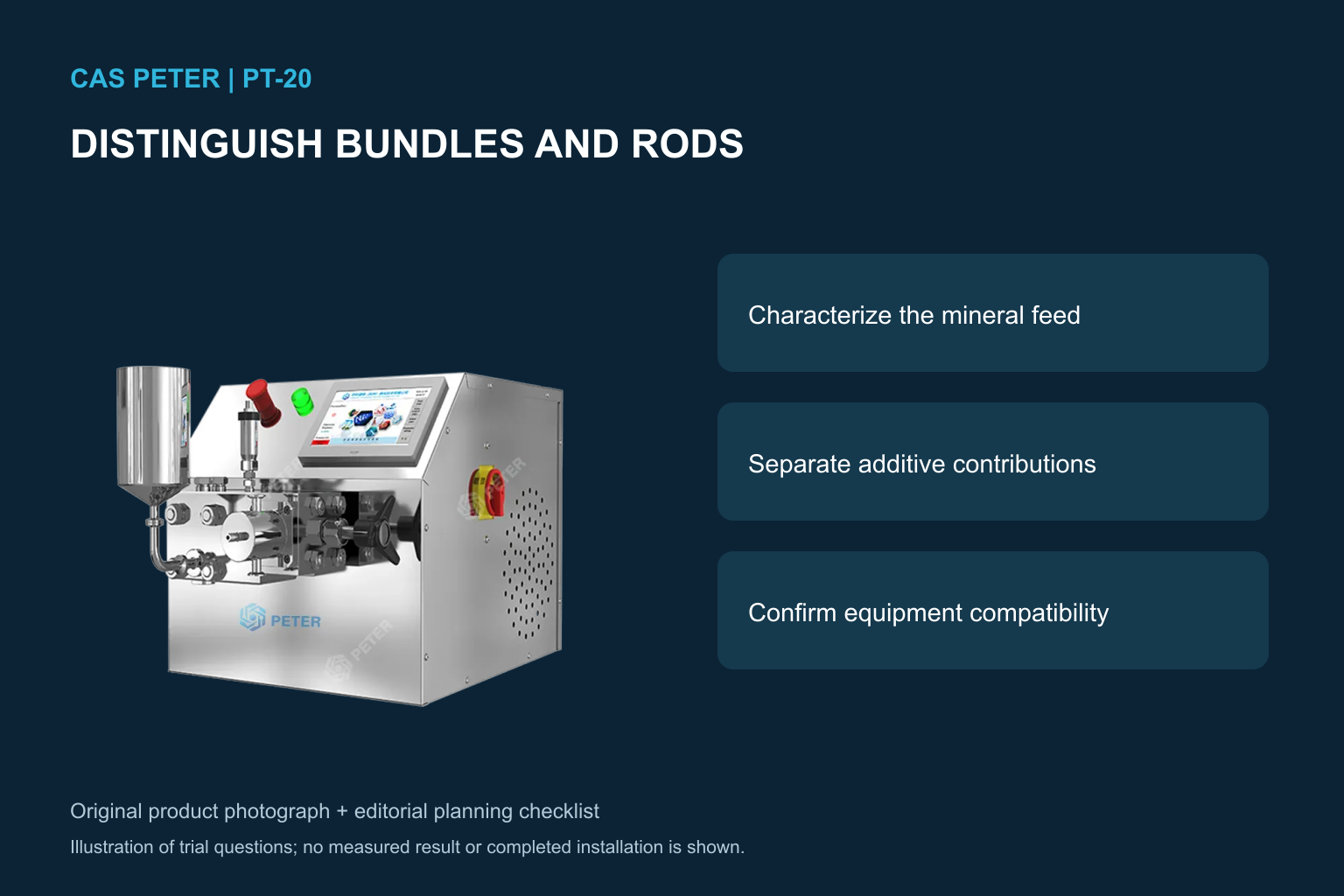
Separate the mechanical and chemical contributions
Use a comparison that can answer the actual question. A practical starting framework includes untreated prepared feed, additive-only feed, homogenized feed without the additive, and the combined treatment. Keep solids and handling history consistent where possible. If a group requires an extra preparation stage, record that difference rather than concealing it in a treatment label.
Within the mechanical comparison, change one principal factor at a time unless the trial has a formal experimental design. Record actual pressure, collection arrangement, flow observations, pass definition and measured product temperatures. A recirculating batch and material collected after a defined pass do not necessarily have the same treatment history.
For an additive comparison, include its effect on the final use. A modification that helps the concentrate disperse may influence another ingredient, drying behaviour or the eventual composite. Selection should therefore depend on the complete application test rather than the most uniform-looking laboratory suspension.
Use microscopy to ask whether rods remain intact
Compare images prepared through a consistent procedure. Drying, dilution and deposition on a specimen support can change apparent aggregation. Record these steps, and avoid comparing an aggressively dispersed microscopy sample with an untreated concentrated slurry as if they represented identical preparation.
Look for both remaining bundles and the individual rod population. When length or aspect ratio matters, use a documented measurement approach across enough representative fields to support the comparison. A particularly attractive image is not a population measurement. Report sampling and uncertainty in a form appropriate to the development stage.
Pair morphology with other structural evidence when the question requires it. Diffraction or spectroscopic results can help investigate changes in the material, but they answer different questions from microscopy. An unchanged crystal-related signal does not alone prove that rod lengths are preserved, just as shorter-looking objects in one image do not alone establish a bulk structural transformation.
Treat particle size as a method-dependent result
Keep the distribution and preparation details, including dispersing liquid, concentration, mixing and waiting time. Rod-like particles do not behave as ideal spheres, so instrument-reported equivalent sizes should be described carefully. Use them to compare consistently prepared samples rather than presenting one number as a complete physical description.
Check the coarse fraction with a suitable method. A small population of larger mineral particles may matter to process handling or final surface quality even when the average result looks favourable. Preserve the raw distribution and note whether the instrument and preparation are capable of detecting the failure mode of interest.
If dilution is necessary, compare the diluted behaviour with the actual concentrate. Dilution may change the network and interactions. A stable dilute measurement cannot independently establish that the production-strength slurry will remain uniform, pumpable or easy to recover after storage.
A decision table for bundle dispersion trials
This table is a qualitative planning tool based on the structural and colloidal distinctions examined in the cited studies. It contains no operating recipe or acceptance limits.
| Observation | What remains uncertain | Practical follow-up |
|---|---|---|
| Smaller equivalent particle size | Bundles separated, rods shortened, or both | Compare representative morphology and rod-length observations |
| Higher slurry viscosity | Useful network formation or difficult processing | Measure flow under defined shear conditions and assess handling |
| Combined treatment outperforms untreated feed | Relative contributions of additive and pressure | Include additive-only and mechanical-only controls |
| Good dilute stability but poor concentrate handling | Behaviour at the intended solids content | Test actual concentrate after defined rest and mixing |
| Fresh dispersion looks uniform but later settles | Reaggregation or changes during storage | Track layers, redispersion and the coarse population |
| Dried powder has poor functional recovery | Aggregation or changes introduced during drying | Compare a defined redispersion with the original wet reference |
Measure flow after a defined history
Specify the rheological method, temperature, sample loading, preconditioning and rest. A reading taken immediately after vigorous mixing describes a different state from one taken after a long hold. For a mineral used as a rheology modifier, that difference may be central to the application.
Use measurements that correspond to the practical task. Pumping, pouring and suspension at rest involve different flow conditions. A single viscosity value cannot represent all three. Keep the full test procedure and relevant flow curves where available, and connect the interpretation to the specific application requirement.
Observe recovery after rest or a controlled mixing cycle when it matters. The goal is not automatically maximum viscosity. A concentrate can become impractical to transfer even though a laboratory result appears to indicate stronger structure. The preferred condition balances the required application function with realistic manufacturing and handling constraints.
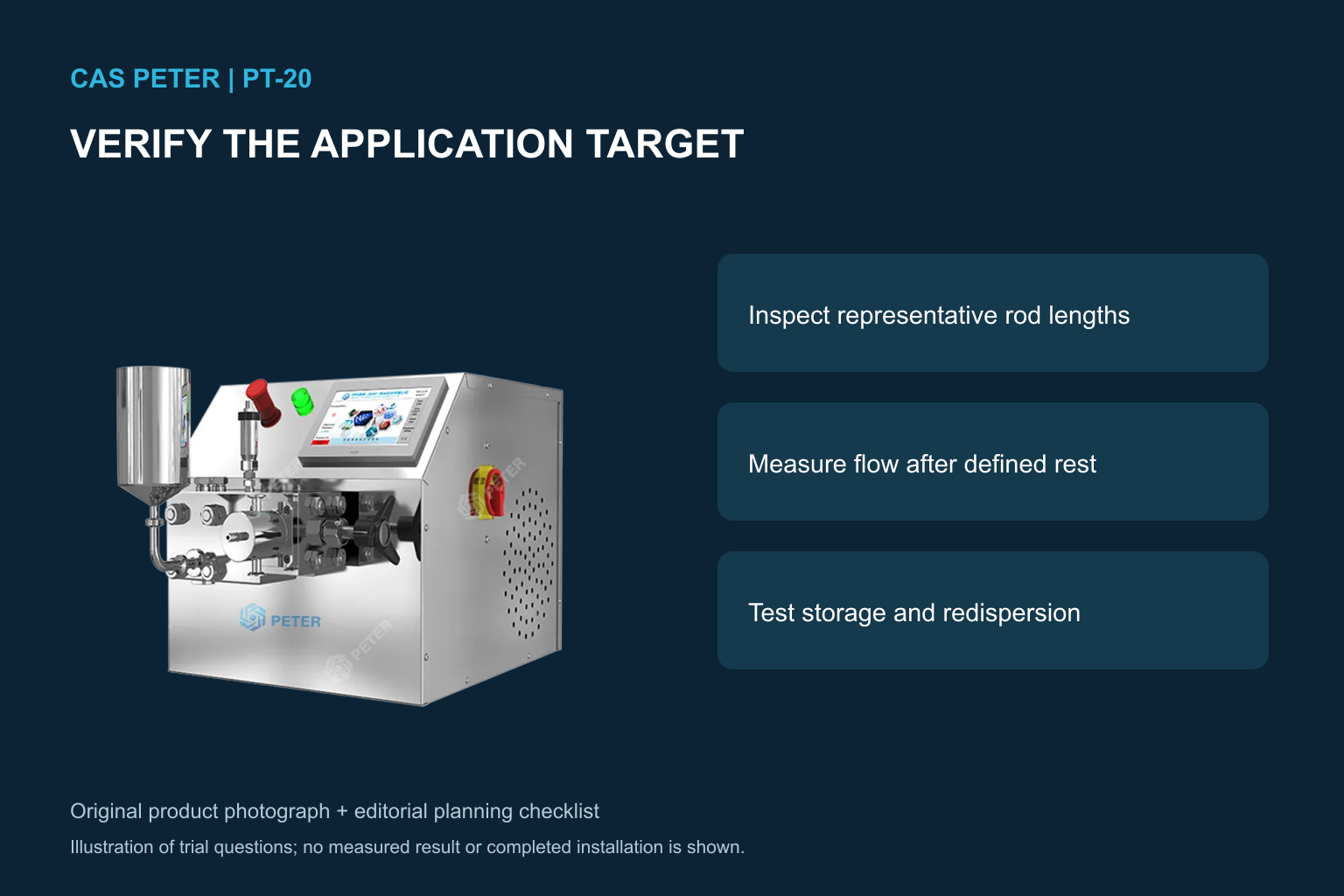
Follow the mineral through storage and the next process
Store matched samples under a documented container, temperature and handling schedule. Photograph settling and describe the effort needed for redispersion. Distinguish a loose sediment that returns with the intended mixing step from a hard deposit that persists. Set the actual acceptance criteria through the application programme.
If the material will be dried, retain a wet reference and assess the reconstituted powder using a defined liquid, solids level and mixing procedure. If it will be incorporated into a polymer or coating, test that finished system. A favourable aqueous dispersion does not by itself establish reinforcement, barrier performance or coating quality.
Keep the additive content and mineral mass basis explicit when comparing finished formulations. Otherwise, apparent gains may reflect a different mineral loading or a contribution from the modifier. Report the composition and processing history necessary for another team to reproduce the comparison.
Discuss equipment using the real slurry
The CAS PETER PT-20 product page supplies the actual equipment reference pictured here. It is a starting point for configuration review, not a statement of suitability for abrasive mineral feed or chemically modified palygorskite. Ask the manufacturer to assess the actual feed and proposed trial before processing.
Provide solids, particle distribution, flow data, water and additive chemistry, available sample quantity and intended recovery. Discuss wetted materials, wear inspection, seals, cooling, cleaning and the handling of rejected or retained material. Make compatibility and recoverability part of the trial plan instead of assuming that a nominal pressure capability answers those questions.
The dispersion methods guide gives the broader processing context. The wetted-materials and abrasive-slurry guide complements the equipment review, while the bentonite structural recovery article illustrates why a rested flow measurement can differ from a fresh one. Bentonite and palygorskite have different structures; do not transfer one mineral’s processing conditions to the other.
Choose the endpoint before increasing treatment
Stop comparing conditions solely by their pressure labels. Build the final ranking from morphology, coarse material, flow, stored behaviour and application performance. State which result is directly measured and which interpretation remains provisional. Repeat the promising condition with independently prepared feed to test robustness.
A useful report retains the untreated and prepared-feed identities, additive controls, actual treatment history and downstream tests. If a more intense condition produces no useful application improvement, that is relevant to equipment selection. The trial should identify a defensible process window, not merely the most severe condition the equipment can deliver.
Educational background: rheology
The following NPTEL food-rheology lesson is included only for general concepts about flow and measurement. It is not a palygorskite experiment, a mineral-processing recipe or validation of the machine shown here.

Educational source: NPTEL IIT Kharagpur. Watch the lesson on YouTube.
Frequently asked questions
Does a smaller particle-size reading prove better palygorskite dispersion?
No. It can reflect bundle separation, rod shortening or preparation effects. Combine consistent particle measurements with representative morphology and tests of the actual formulation and intended function.
Should every palygorskite trial include a chemical modifier?
No. Treat modification as a formulation choice that must suit the final application. When evaluating a modifier, include controls that distinguish its contribution from mechanical homogenization and consider its downstream effects.
Can a stable dilute sample approve a concentrated slurry?
No. Test the intended solids concentration under realistic storage and handling conditions. Dilution can change interactions and flow, so the diluted instrument sample cannot independently establish concentrate performance.