

Bentonite Homogenization Trials: Measure Structural Recovery After Rest
Bentonite homogenization trials should measure what happens after the slurry rests, not only how easily it flows immediately after processing. Standardize clay preparation, hydration, solids and temperature, then compare controlled shear conditioning, recovery during rest and a practical restart test. A lower outlet viscosity does not by itself prove permanent dispersion improvement, while a higher rested viscosity is not automatically a defect. The useful endpoint depends on whether the slurry must remain suspended, restart reliably, pump into the next operation or form a controlled coating. Establish those requirements before deciding whether pressure processing is appropriate.
Separate immediate flow from recovery over time
A sample tested immediately after vigorous handling has a different mechanical history from one taken from a quiet storage bottle. Comparing the two can make processing appear to have changed the material when the difference is mainly the state in which it was measured. Record time since mixing, time since the last pass and the sampling action for every comparison.
Use precise language in the trial record. Shear thinning describes a dependence of apparent viscosity on shear rate. Thixotropic behavior includes a dependence on the duration and history of shear and recovery. Neither label alone supplies the recovery time needed for a specific process. A flow curve, a rest experiment and a restart observation answer related but different questions.
The dispersion methods overview provides the wider mechanical-processing context. This article focuses on the time-dependent handling requirement of a bentonite slurry. It does not establish that a particular homogenizer can accept every clay grade or that pressure will produce exfoliated platelets.
What the source material actually demonstrates
A primary study of betaine-functionalized bentonite compared flow, oscillatory response and time-dependent behavior in modified clay slurries. It showed that formulation and pH affected the measured rheological response. That supports treating composition and measurement history as controlled variables. It does not show that unmodified bentonite will respond identically, nor does it validate high-pressure homogenization as a substitute for chemical functionalization.
A university-hosted extract of research on bentonite in polymer solutions discusses structures formed at rest and the difficulty of representing their response with a simple time-independent flow model. The publicly accessible file is an extract, not the complete paper. Its limited but relevant contribution is that the suspending medium and time-dependent response matter when interpreting clay rheology.
Neither source establishes a CAS PETER pressure, pass count, wear life or guaranteed recovery percentage. The following protocol is a proposed way to test a compatible feed and intended application, using the actual slurry rather than treating literature observations as an operating recipe.
Fix preparation and hydration before starting the machine
Record the clay supplier, grade, lot and any available mineral or treatment information. Distinguish an unmodified grade from an organically modified material. Keep the water source, solids basis and additive composition explicit. A mass fraction based on dry clay is not interchangeable with one based on the complete wet mixture.
Document the powder addition sequence, premixing procedure, hydration time and temperature. Use matched preparation for the control and every processed portion. If the batch continues changing while it waits, record that delay and investigate it before attributing differences to pressure. Do not compare a freshly wetted control with a fully hydrated processed sample.
Keep containers covered where appropriate and check for mass loss during preparation and holding. Standardize how the slurry is transferred and sampled. A vigorous stir just before one measurement but not another can reset the structure differently. For initial screening, portions from a common prepared batch make this comparison easier; repeat the selected condition with independent batches before accepting it as robust.
Confirm that the feed and machine are compatible
Ask the equipment supplier to review the actual feed, including the largest particles, viscosity, solids, additives and abrasiveness. A slurry that flows under strong mixing may still be difficult to feed after standing. The inlet behavior must be considered alongside the desired pressure treatment.
Confirm wetted materials, seals, permitted feed condition, cooling and cleaning requirements. Discuss how startup, shutdown and blockage would be handled within the equipment’s documented procedure. Do not force an unqualified feed through a small passage to determine whether it can be processed. Do not infer compatibility or wear resistance from a catalogue photograph.
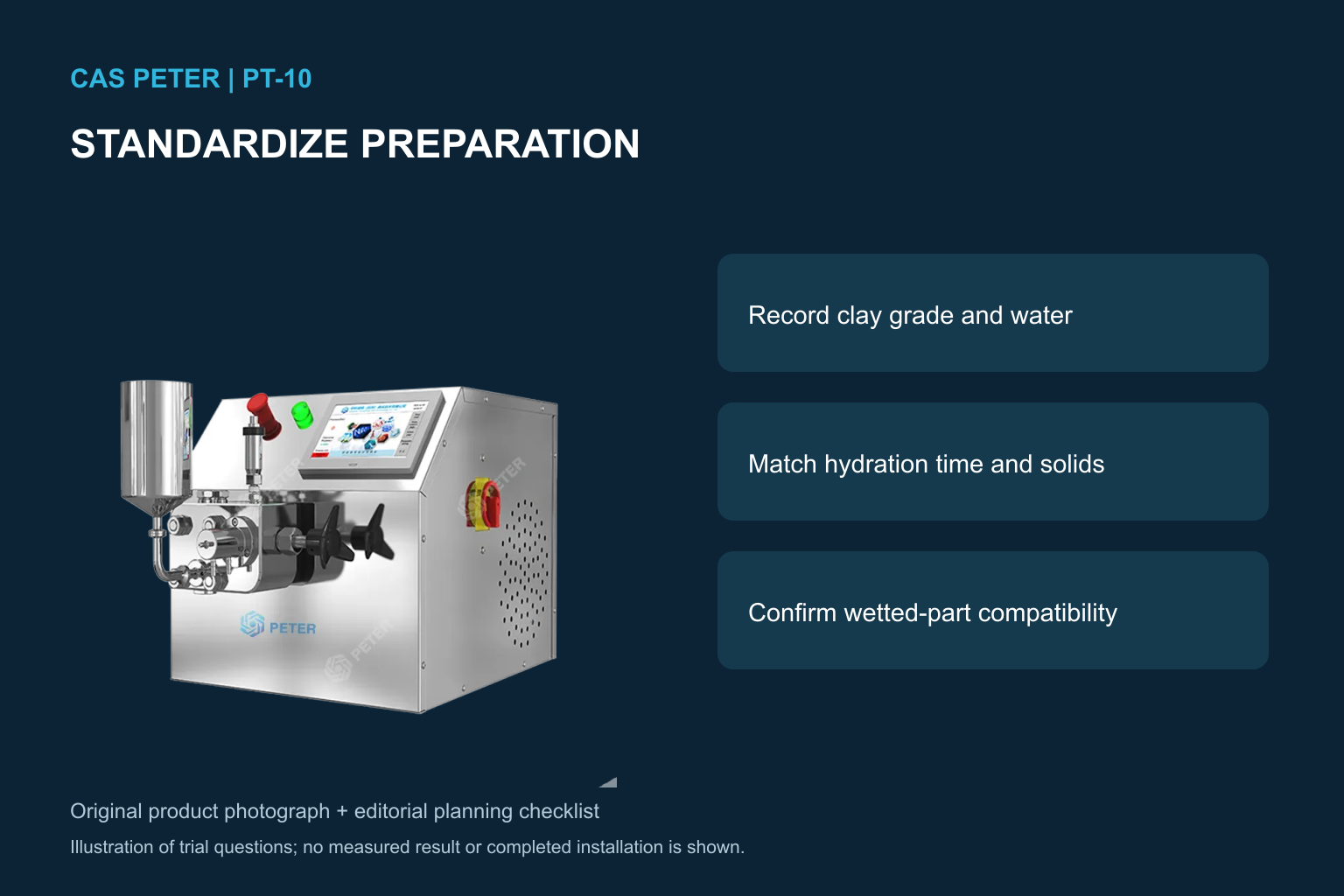
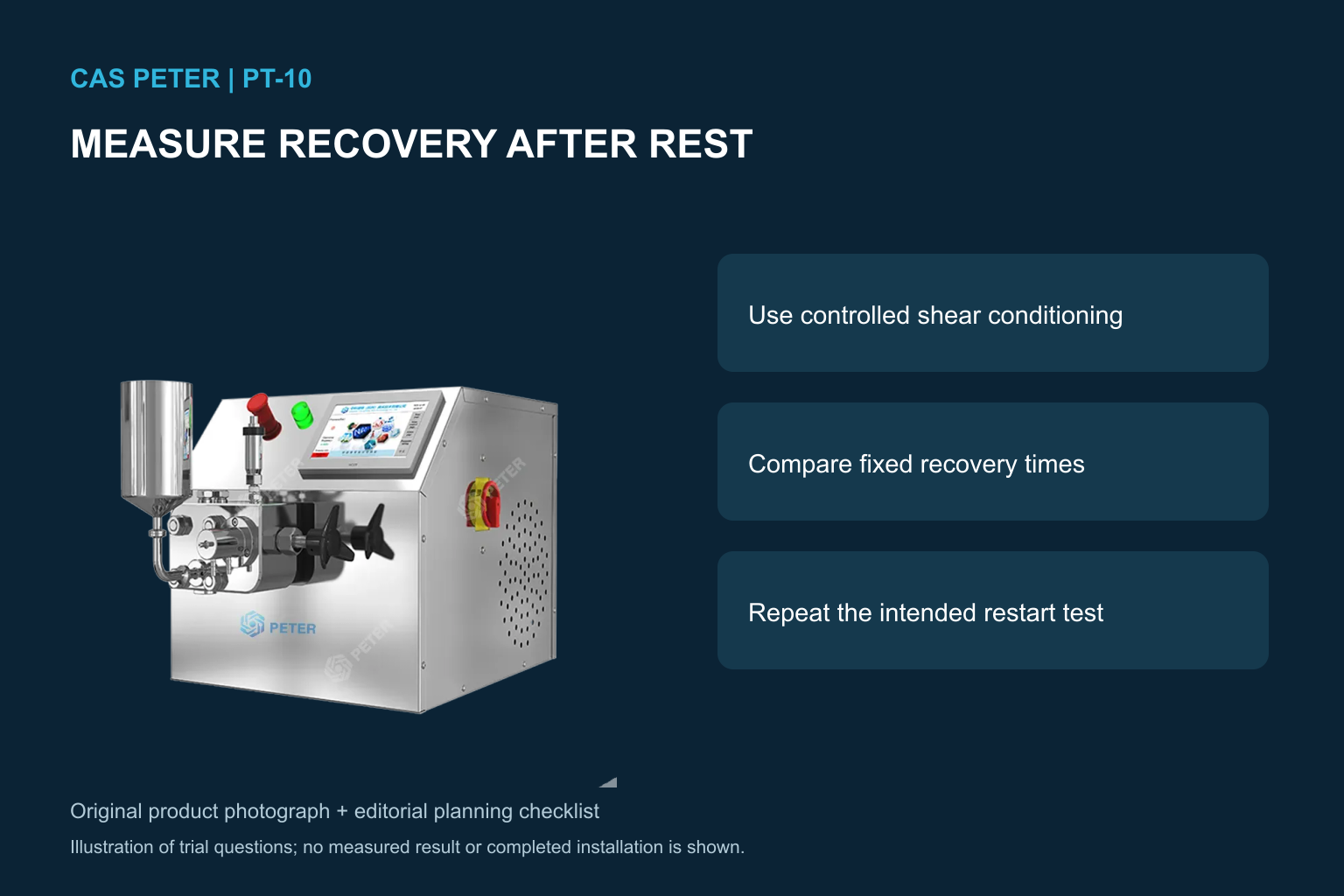
The CAS PETER PT-10 product page is a starting point for a small development configuration discussion. Suitability must be confirmed for the proposed mineral slurry. The pictured product is a reference model, not a documented bentonite installation, a demonstration of abrasion resistance or evidence of a validated pressure range for this material.
Design the comparison around two measurement histories
Use one set of samples to preserve the actual process history. Measure these at defined times after collection using the same handling procedure. They answer the practical question of what arrives at the next operation after a known delay. Keep temperature and the delay between collection and measurement visible in the result table.
Use a second set with standardized laboratory conditioning before the recovery test. These help compare how the materials respond after the same imposed shear history. Select the conditioning and recovery procedure with a rheologist so it is suitable for the sample and instrument. Record geometry, loading, temperature, shear or stress sequence and the point defined as the beginning of recovery.
Do not mix results from these two histories in one ranking. A freshly collected sample may look easier to pump because it has just experienced intensive shear. A conditioned recovery experiment asks whether that state changes after a controlled interval. Both can be useful, but they cannot replace each other.
A test panel for structural recovery and practical handling
This table is a development checklist, not a set of universal numerical acceptance criteria. Choose limits that reflect the intended application and demonstrated method repeatability.
| Question | Suggested observation or test | Conditions to hold fixed | Interpretation limit |
|---|---|---|---|
| What is delivered after processing? | Flow measurement at defined times after collection | Sampling, temperature and delay | A fresh outlet reading may reflect recent shear |
| How does structure recover? | Controlled recovery experiment after matched conditioning | Instrument sequence, loading and rest interval | Recovery depends on the chosen protocol |
| Does a rested batch restart? | Application-relevant transfer or pumping trial | Rest duration, vessel and permitted agitation | A beaker pour does not establish plant restart performance |
| Does separation occur? | Undisturbed storage observation and representative sampling | Fill height, container, temperature and time | Good suspension appearance alone does not prove easy pumping |
| Has the coarse population changed? | Suitable particle-size measurement and microscopy | Dilution and dispersion preparation | A size result alone cannot demonstrate exfoliation |
| Is the result repeatable? | Independent feed preparations and repeated selected condition | Clay grade and complete preparation history | Repeated readings of one sample are not independent batches |
Preserve failed results as well as successful ones. If a trial leaves unrecovered material in the feed vessel or cannot complete the planned transfer, record the recovered mass and interruption. Testing only the easy-flowing fraction produces an incomplete assessment of process suitability.
Make rest periods relevant to the real operation
Choose recovery intervals that represent actual delays, such as the expected hold before the next process or a planned production interruption. Short laboratory intervals can be useful for screening, but they should not silently replace a longer operational requirement. State the interval in every reported result.
Keep an undisturbed portion for visual observation. Before applying the restart action, record the surface, sediment and any visible separation. Then apply the defined agitation or transfer procedure and document the outcome. This sequence distinguishes spontaneous stability during rest from recoverability under practical handling.
If the slurry is intended for coating or formulation, test that next step after the same delay. A strong rested structure may help one function while making another operation difficult. Define both requirements rather than treating the highest viscosity or greatest apparent recovery as universally desirable. Product acceptance should reflect the application, not a single instrument maximum.
Interpret apparent improvements without overstating the mechanism
When outlet viscosity falls but returns during rest, report the measured time-dependent behavior. Do not describe the change as irreversible platelet breakup without structural evidence. If the rested slurry becomes stronger than the control, check preparation, hydration, solids and sample history before deciding that pressure caused a useful network change.
A hysteresis loop can identify history-dependent behavior under a particular sweep procedure. Its area depends on how the experiment is run and should not be presented as a universal recovery-time measurement. Use a defined recovery experiment when the decision depends on how quickly the structure rebuilds. Preserve the underlying curves and test sequence for review.
If particle sizing requires dilution or additional dispersion energy, explain how that preparation differs from the original slurry. The measurement may answer a question about diluted material rather than the structure that controls concentrated handling. For equipment planning, the feed viscosity and solids guide addresses the flow constraints, while the wetted-materials and abrasive slurry guide addresses a separate compatibility decision.
Decide when further pressure testing is justified
Continue testing only when a compatible feed can be processed safely and the result addresses the intended failure. If the main limitation is hydration variability or inconsistent preparation, stabilize those conditions before adding machine variables. If a formulation change is introduced, treat it as a new condition rather than comparing it directly with an old feed as evidence of a pressure improvement.
During screening, change one principal factor at a time and record pressure, passes, temperature and usable recovery. Select a promising condition based on the combined recovery, handling and application results. Then repeat with independent batches. Where differences are within measurement variation, retain that uncertainty rather than declaring the most intensive treatment the winner.
For a supplier inquiry, include clay identification, dry-solids basis, additives, water information, preparation and hydration method, flow data, largest relevant particles, trial volume and the required rest-to-restart sequence. Ask for confirmation of feed suitability, wetted configuration, sampling and cleaning. A useful proposal connects equipment to a verifiable trial; it does not promise an unmeasured dispersion structure.
Educational context: interpreting flow behavior
The university lesson below introduces rheological measurement concepts. It helps frame questions about viscosity and test conditions, but it is not a bentonite pressure-processing recipe or a validation of a specific slurry.

Educational source: NPTEL IIT Kharagpur. Watch the lesson on YouTube.
Frequently asked questions
Does lower viscosity immediately after homogenization prove permanent improvement?
No. Measure the slurry after defined rest intervals and compare matched controls. The immediate result may depend on recent shear and temperature, while the next operation may encounter a substantially different state.
Can a particle-size result prove bentonite exfoliation?
No. Particle sizing alone does not establish platelet exfoliation or the structure of the concentrated slurry. Use an appropriate structural characterization plan if exfoliation is a required outcome, and keep that claim separate from handling measurements.
What should determine whether a trial passes?
Use the intended application’s combination of suspension stability, structural recovery, practical restart, usable recovery and equipment compatibility. Establish acceptance criteria before testing and confirm the selected condition with independent feed preparations.