

Hazelnut Milk Homogenization: Qualify Cake-Based Beverage Flow Before Scale-Up
Hazelnut milk homogenization should be qualified against the flow behavior of the actual beverage feed, especially when the ingredient is cold-pressed hazelnut cake. A pressure setting alone cannot predict whether the finished drink will pour, pump and remain acceptably uniform. Define the cake preparation, solids concentration, temperature history and final heat treatment before comparing processing conditions. Measure the flow curve alongside particle structure and separation during storage, rather than treating a smaller mean particle size as proof of a successful beverage.
Why cake-based hazelnut milk needs its own flow trial
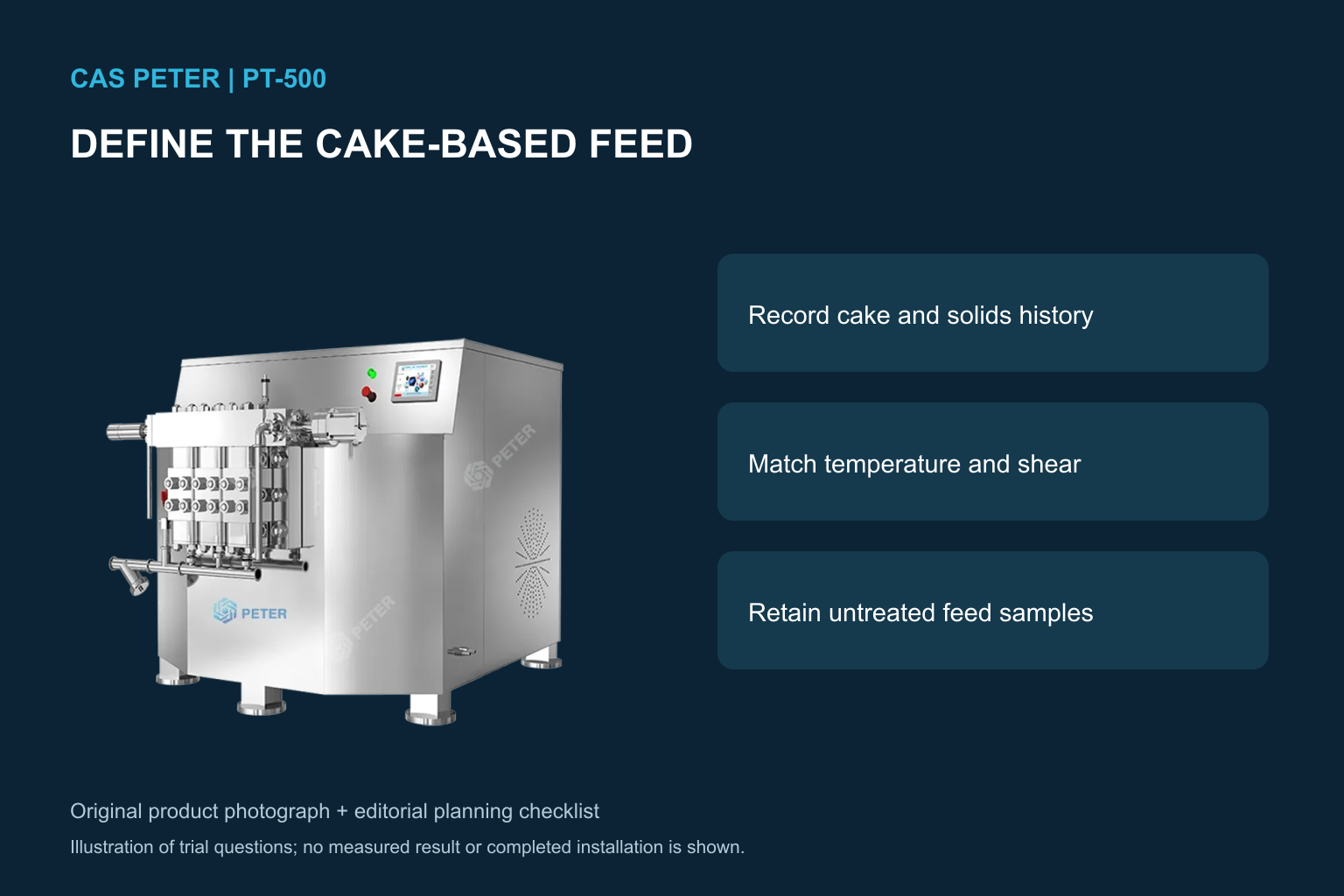
A beverage prepared from a pressing by-product is a particular formulation, not a universal substitute for a whole-kernel recipe. Record the ingredient supplier, pressing history, residual oil information, moisture and preparation method. When these details change between batches, pressure trials may be comparing different feeds before the homogenizer has done anything.
For a development team, the practical question is whether a reproducible feed can produce a drink that meets the intended handling and drinking requirements. A thick sample may resist visible separation while being difficult to transfer. A thinner sample may pour more easily while exposing a sedimentation problem. Agree on both requirements before selecting a process.
The original study by Gül and colleagues investigated cold-pressed hazelnut cake beverages using particle analysis, microscopy and rheological measurements. It reported reduced consistency under the conditions investigated and identified a soft-gel response. Those observations support measuring flow and structure together; they do not establish a pressure recipe or energy saving for every hazelnut formulation. See the researchers’ institutional record and abstract.
Keep this topic separate from sesame milk whole-seed and filtered beverage trials. Both involve nut beverages, but the present decision concerns the handling of a cake-based suspension and the relationship between its resting structure and its flow under an imposed shear history.
Establish the beverage specification before changing pressure
Write the intended solids content and ingredient preparation into the trial sheet. Define whether the product is a pourable drink, a concentrated intermediate or a blend intended for dilution. A flow result from one of these products cannot be used as an acceptance value for the others without a bridging comparison.
Specify the temperature at which each requirement applies. Transfer conditions, filling conditions and consumer use may involve different temperatures. The laboratory measurement should identify which question it answers. Reporting a viscosity value without temperature leaves the production team unable to compare that result with its own experience.
Choose an observation period and separation criteria relevant to the development stage. These are project requirements, not published shelf-life claims. Include appearance, sediment, cream layer and ease of redispersion. Where appropriate, add sensory assessment using an approved procedure; an instrument reading alone cannot establish acceptable mouthfeel.
Use a matched feed and a limited process comparison
Prepare enough of one representative feed to support the comparison. Record milling, hydration, screening and mixing conditions before dividing it into trial portions. Retain an untreated portion, and handle it as similarly as practical except for the high-pressure treatment. This helps distinguish processing effects from changes caused by waiting, settling or different feed preparation.
Begin with a small comparison designed around the main uncertainty. If the feed varies with cake concentration, study that variation explicitly instead of changing solids, pressure and heat conditions together without a plan. If repeat passes are investigated, label each stage and record the cumulative treatment history.
Measure inlet and outlet temperatures and the cooling procedure. A pressure label omits what happened to the sample between passes. Sampling only from the final collection vessel also hides the point at which a useful change occurred. Retaining stage samples can reveal whether further processing added value or merely changed handling conditions.
Do not feed a coarse cake slurry into a selected machine without equipment review. Ask the supplier to assess the actual feed size, fibrous fraction, solids concentration, flow and cleaning requirements. Screening should be documented because removing part of the feed changes the beverage that is being evaluated.
Compare flow curves rather than isolated viscosity values
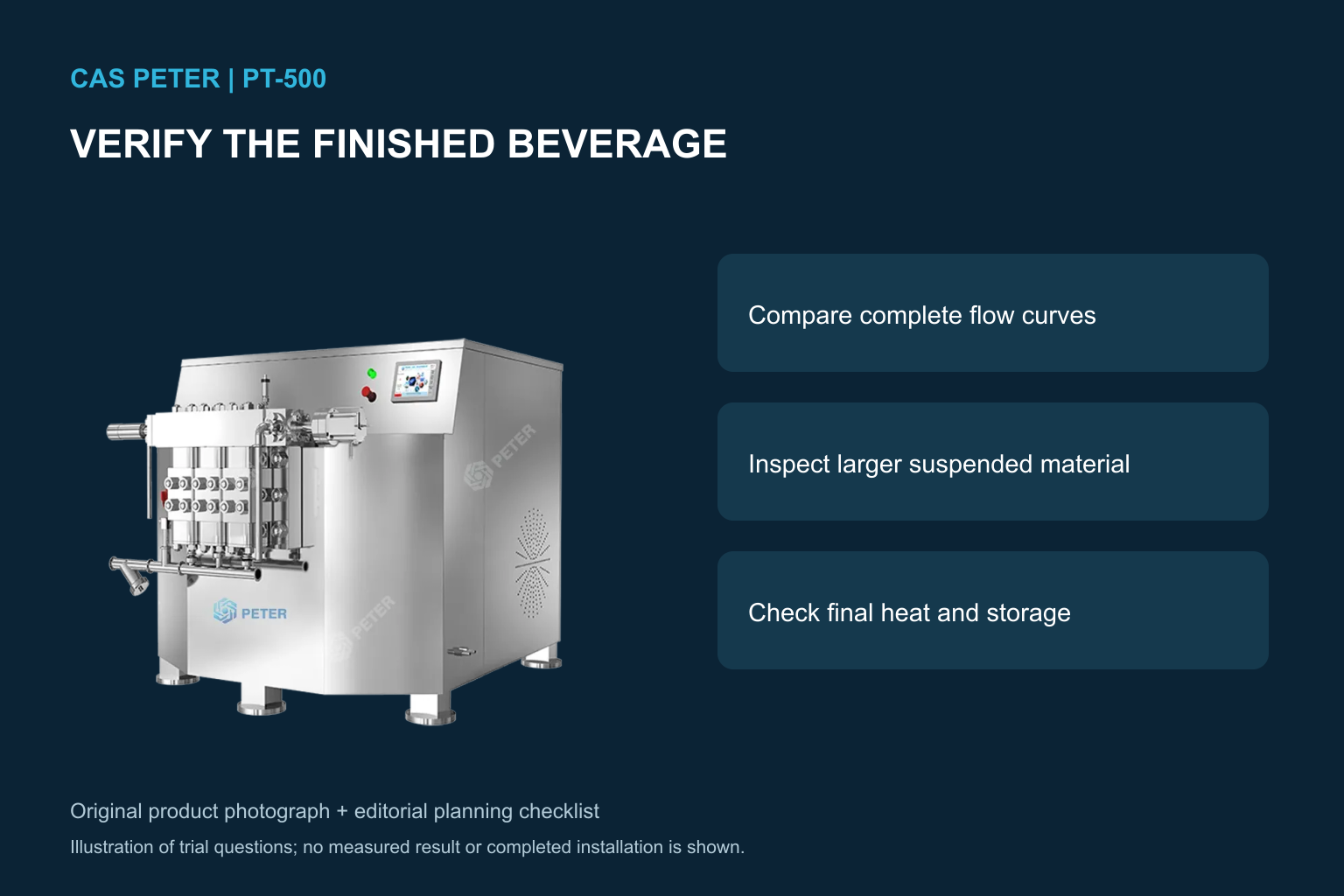
For a shear-dependent material, one reported viscosity represents one measurement condition. A development report should state the instrument geometry, temperature, sample loading, preconditioning, shear program and waiting period. Repeat these conditions when comparing batches. A change in the measurement procedure can otherwise look like a formulation improvement.
Compare the relevant region of the flow curve with the process question. A test intended to investigate pouring need not answer every question about transfer through production equipment. If a fitted model is used, state the fitting range and inspect the underlying data. A good mathematical fit cannot compensate for a sample that slipped, settled or was loaded inconsistently.
Oscillatory measurements may help investigate a structure that behaves differently at rest and during flow. Establish an appropriate test procedure before comparing those data. Do not automatically replace a steady-shear result with an oscillatory result: the cake-based study specifically found that a direct Cox–Merz correspondence required modification for its samples. This is a reason to verify the relationship in the actual material.
The following table is a qualitative development checklist, not a set of product acceptance limits. It applies the measurement questions raised by the cited rheology study to a practical beverage trial.
| Development question | Record or measure | Decision supported |
|---|---|---|
| Are the feeds comparable? | Cake identity, preparation, solids and untreated feed behavior | Decide whether pressure results can be compared directly |
| Does handling improve? | Flow curves at defined temperature and shear history | Select a useful handling window rather than the lowest reading |
| Is resting structure retained? | Defined rest period and an appropriate structural test | Investigate whether thinning is accompanied by weak suspension support |
| What changed physically? | Full size distribution and representative microscopy | Distinguish changes in larger material from changes in the average |
| Does the final process preserve the result? | Repeat flow and separation checks after the final treatment | Decide whether the candidate remains suitable for the finished beverage |
| Is production transfer supported? | Supplier-reviewed feed and process requirements | Identify further trials before selecting a configuration |
Connect particle changes with beverage behavior
Use a representative sampling method for size analysis. A sample taken from the top of a vessel after settling may exclude the very material responsible for sediment. Record mixing immediately before sampling and any dilution or dispersion step used by the instrument method.
Inspect the full distribution, not only a mean. A reduction in the main population does not demonstrate that a coarse tail has disappeared. Microscopy provides a complementary view of the remaining material, although a few attractive images should not be treated as representative without a sampling plan.
Avoid assigning every observed change to oil droplets. A cake-derived beverage may contain multiple structural features, and the analytical method needs to identify what its output represents. If image interpretation remains uncertain, describe the observed structures rather than claiming a mechanism that has not been established. The particle-size measurement guide can help frame this method review.
Keep subsequent processing separate from the homogenization result
A separate study by Gül and colleagues evaluated pressure, temperature and cake concentration within an experimental design, then examined heat treatment of the selected formulation. Its institutional research abstract describes an optimum within that particular experimental domain. That optimum is not a universal operating point for other recipes or equipment. The abstract supports keeping formulation and temperature inside the development plan; it does not establish microbial safety for a new beverage.
In your own trial, retain a sample after homogenization and another after the final production treatment. Apply the same analytical method to both. If the final drink behaves differently, investigate the intervening operation before raising pressure to compensate. A process change directed at the wrong stage may increase complexity without resolving the actual problem.
Microbial safety requires its own validated process and appropriate professional assessment. Physical uniformity and easy pumping are not evidence of microbial safety. Likewise, a beverage that remains visually mixed has not thereby established its declared shelf life or allergen suitability.
Review the result as a production decision
Prepare a short comparison that includes both improvements and tradeoffs. For example, a hypothetical candidate may meet the transfer requirement while developing a larger sediment layer during the chosen observation period. That result calls for formulation and structure review, rather than a simple statement that lower viscosity is better.
Discuss the actual material with CAS PETER using the PT-500 production-type homogenizer product page as an equipment enquiry starting point. Supply the feed description, desired throughput, acceptable temperature history and cleaning needs. The listed equipment is not evidence of a completed hazelnut beverage installation, and a specific configuration requires confirmation.
For the broader process context, consult the food and beverage homogenization overview. Before scaling, agree on the evidence still missing: repeatability across ingredient batches, the final thermal sequence, storage observations and the supplier’s review of feed compatibility. A successful small trial is a basis for the next controlled step, not a guarantee of production performance.
Educational video: understanding food rheology
The NPTEL lesson below introduces general food rheology. Use it to understand why flow depends on measurement conditions; it is not a hazelnut-specific operating instruction or a demonstration of the equipment shown here.

Educational source: NPTEL IIT Kharagpur. Watch the lesson on YouTube.
Frequently asked questions
Can a whole-hazelnut recipe be used as the control for a cake-based beverage?
It can be a separate reference product, but it is not a matched processing control. Retain untreated portions of the same cake-based feed so that ingredient differences are not confused with the effect of homogenization.
Should every sample be diluted to the same concentration before viscosity testing?
Test the beverage concentration relevant to the decision. Dilution may be useful for a defined analytical method, but a diluted measurement does not directly establish how the undiluted product will pour or transfer. Record and justify each preparation step.
Does a reduction in laboratory viscosity establish lower production energy use?
No. It is a reason to investigate handling under the actual process conditions. Production energy depends on the complete system and requires appropriate measurement; the laboratory flow result alone cannot quantify a saving.
References
- Gül and colleagues — Effect of high pressure homogenization on microstructure and rheological properties of hazelnut milk.
- Gül and colleagues — Effect of multi-pass high pressure homogenization on physicochemical properties of hazelnut milk from hazelnut cake: an investigation by response surface methodology.
Select the candidate that meets the agreed handling and finished-beverage requirements together. Bring the matched feed records and final-process measurements to the equipment discussion so the next trial addresses a defined production question.