

High Pressure Homogenization Methods for Dispersion
A formulation team can obtain a promising first sample at high pressure and still choose the wrong production route. The usual decision is not simply “more pressure or less pressure.” It is whether the premix is safe and uniform enough to enter the machine, whether discrete passes or recirculation will expose every portion consistently, and whether temperature rise, viscosity, or oversized agglomerates will change during processing. If these questions are postponed, a trial may consume material, accelerate wear, or produce a particle-size result that cannot be reproduced at scale. This guide compares the practical methods, feed limits, pass strategies, measurements, cleaning needs, and scale-up records required to select a defensible dispersion process without assuming that every formulation should—or can—become a nano-dispersion.
The short answer is that high-pressure homogenization should be treated as a controlled sequence: prepare a pumpable and screened premix, select a flow path, define pressure and thermal limits, process by counted passes or qualified recirculation, and measure the distribution with a method suited to the size range. ISO 13320 covers laser-diffraction particle-size analysis, while ISO 22412 covers dynamic light scattering; neither standard certifies the homogenizer or guarantees dispersion stability. High-pressure processing can deagglomerate particles or reduce droplets, but chemistry, solids loading, rheology, and re-agglomeration set the attainable endpoint. The next step is therefore a feed-risk review followed by a documented design-of-experiments trial.
Why premix quality affects dispersion results
The first process limit sits upstream of the homogenizing valve or interaction zone. Dry pockets, sediment, entrained air, stringy material, and hard agglomerates can cause erratic feeding or local blockage. A useful premix does not need to meet the final particle-size target, but it should be uniform enough that a representative sample can be taken and pumpable enough to enter the selected equipment under the supplier’s feed conditions. That makes rotor-stator mixing, powder wetting, staged liquid addition, or other low-pressure preparation complementary operations rather than interchangeable alternatives.
Feed screening should distinguish soft agglomerates from hard contaminants. A coarse screen may protect a narrow passage from foreign matter, yet an arbitrary fine screen may also remove the very solids the formulation is intended to contain. Record screen opening, retained mass or observations, batch temperature, visual uniformity, and hold time before the first pass. If settling occurs faster than the feed vessel can remain mixed, the trial is testing a changing formulation rather than a stable process condition.
Viscosity also has to be measured at a stated temperature and shear condition because many dispersions are non-Newtonian. A single viscosity number without method details cannot predict feeding behavior. Confirm the machine’s permitted viscosity, solids, particle, and chemical-compatibility limits with the manufacturer before testing. This feed qualification is the practical foundation of high pressure homogenization in dispersion: pressure can only act consistently on material that reaches the processing zone consistently.
Choose the dispersion method that matches the material
A high-pressure homogenizer forces a pressurized stream through a restricted geometry, converting pressure energy into intense local deformation, turbulence, and related breakup mechanisms. The exact balance depends on equipment geometry and formulation. The APV Homogenizer Handbook explains valve homogenization principles and the importance of product properties and process conditions, but it should be used as an engineering reference—not as evidence that one setting transfers across every machine or material.
The correct high pressure homogenization method is therefore defined by both the hardware and the operating pattern. Discrete-pass processing gives a clear exposure count and makes pass-by-pass sampling straightforward. Recirculation can be practical for development or tank-based processing, but “three vessel turnovers” is not the same as three identical passes for every fluid element; mixing and residence-time distribution matter. A staged-pressure route can help establish whether a milder first pass improves feed uniformity before a higher-pressure pass, while a single fixed-pressure route reduces variables when the feed is already well controlled.
| Method choice | Best control advantage | Main limitation to test | Minimum trial record |
|---|---|---|---|
| Premix only | Low process complexity for coarse dispersions | May not break persistent droplets or agglomerates | Mixer geometry, speed, time, temperature, order of addition |
| Discrete high-pressure passes | Known exposure count and clean pass-by-pass comparison | Transfer, hold-up, and handling between passes | Pass number, pressure, inlet/outlet temperature, sample point |
| Recirculation | Convenient repeated processing from one vessel | Unequal residence histories and cumulative heating | Vessel volume, flow, mixing state, elapsed time, temperature profile |
| Staged pressure | Separates feed conditioning from endpoint refinement | Additional variables and possible overprocessing | Pressure and temperature for every stage, with matched samples |
Method selection should include hidden operating cost. More passes mean more run time, cooling duty, transfers, sampling, cleaning exposure, and wear opportunity. Recirculation may reduce transfers but complicate the proof of equal exposure. A defensible total-cost comparison therefore uses yield after hold-up, acceptable-batch time, cleaning time, consumable inspection frequency, and rejected or reworked material—not purchase price alone.
How pressure, passes, temperature, and viscosity interact
Pressure is an input, not the product specification. Raising it can increase disruptive energy, yet the result may plateau or reverse if droplets recoalesce, stabilizer coverage is insufficient, temperature changes the phase behavior, or sensitive material degrades. A peer-reviewed study of a specific parenteral fat emulsion varied pressure, emulsion temperature, and homogenization cycles, using photon correlation spectroscopy, single-particle optical sensing, and microscopy. Its reported process window included 500–1900 bar, and the authors found that the variables interacted; notably, greater shear was not automatically required to reduce the large-droplet tail. Those findings are formulation-specific, but they demonstrate why pressure cannot be optimized alone (Grumbach et al., 2022).
A development plan should begin with safe equipment and formulation boundaries, then vary one factor at a time for screening or use a planned experimental design when interactions are expected. At each condition, record actual operating pressure rather than only the setpoint, inlet and outlet temperatures, flow or batch time, pass count, cooling settings, visible foam, and sample timing. Stop criteria should be defined before the run: excessive temperature, unstable feeding, abnormal sound or vibration, pressure fluctuation, visible leakage, or a manufacturer-defined operating limit.
Temperature control starts before the first pass. Cooling only the final product can miss a short thermal excursion at the processing zone or outlet. Conversely, colder is not automatically better if viscosity rises and feeding becomes unstable. The most transferable high pressure homogenization technique is to control and report inlet condition, measure outlet condition, and compare size results only between samples with equivalent thermal and hold histories.
Measure particle size with a defined method and endpoint
“Average particle size” is too vague for process approval. Laser diffraction under ISO 13320 derives a distribution from the angular pattern of scattered light and is often useful across broader particle-size distributions. Dynamic light scattering under ISO 22412 evaluates fluctuations in scattered light caused by Brownian motion and is commonly applied to sufficiently small, dispersed particles. The techniques use different physical models and report different distribution conventions, so their numbers should not be treated as interchangeable.
For laser diffraction, record sample preparation, dispersion medium, refractive-index assumptions where applicable, obscuration or concentration conditions, analysis model, and reported percentiles. For DLS, record dilution, medium viscosity, temperature, measurement angle or instrument configuration, analysis output, and sample handling. Microscopy can add morphological context and reveal a sparse oversized population that a headline mean obscures. Stability should be checked at defined times and storage conditions because an immediately small distribution does not prove resistance to re-agglomeration or coalescence.
Scale-up begins when the laboratory protocol is written, not after an endpoint is achieved. Preserve the formulation composition, order of addition, premix energy and time, feed temperature, pressure history, number of exposures, sampling location, and analytical method. Then identify what cannot remain identical—flow path, hold-up, cooling capacity, vessel mixing, residence-time distribution, or cleaning sequence—and test those differences explicitly. Matching pressure alone does not establish process equivalence.
| Application objective | Feed questions | Trial measurements | Decision evidence |
|---|---|---|---|
| Emulsion droplet reduction | Is the premix uniform, and is stabilizer coverage adequate? | Distribution, oversized tail, temperature, timed stability | Target distribution without unacceptable recoalescence |
| Solid-particle deagglomeration | Are hard particles within passage and wear limits? | Size distribution, microscopy, viscosity, settling behavior | Reduced agglomerates without unacceptable contamination or wear |
| Encapsulation or carrier development | Can the ingredients tolerate shear and temperature history? | Size method plus application-specific loading or integrity test | Physical endpoint and functional quality both remain acceptable |
| Scale-up confirmation | Which mixing, cooling, hold-up, and residence conditions change? | Matched sampling, pressure and thermal history, yield, cleaning record | Predefined acceptance criteria met across representative runs |
Include cleaning, wear, and validation in the equipment choice
Product-contact materials, seals, and cleaning chemistry must be compatible with the actual formulation and intended market. Request a wetted-parts list, cleaning instructions, drainability information, and inspection points for the specific configuration. Abrasive solids can change wear behavior, while dried residue in a narrow passage can make the next start-up difficult. Maintenance planning should therefore connect observed pressure stability, throughput changes, leakage, and particle contamination to defined inspection or replacement actions.
ISO 13320 and ISO 22412 are particle-size analysis standards, not certificates of hygienic design, pharmaceutical suitability, or regulatory acceptance. Validation scope depends on the product and destination market. A regulated application may also require qualified analytical methods, traceable calibration, documented cleaning acceptance, material records, and change control. Procurement should ask which documents are available for the exact model and configuration rather than infer compliance from a generic product category.
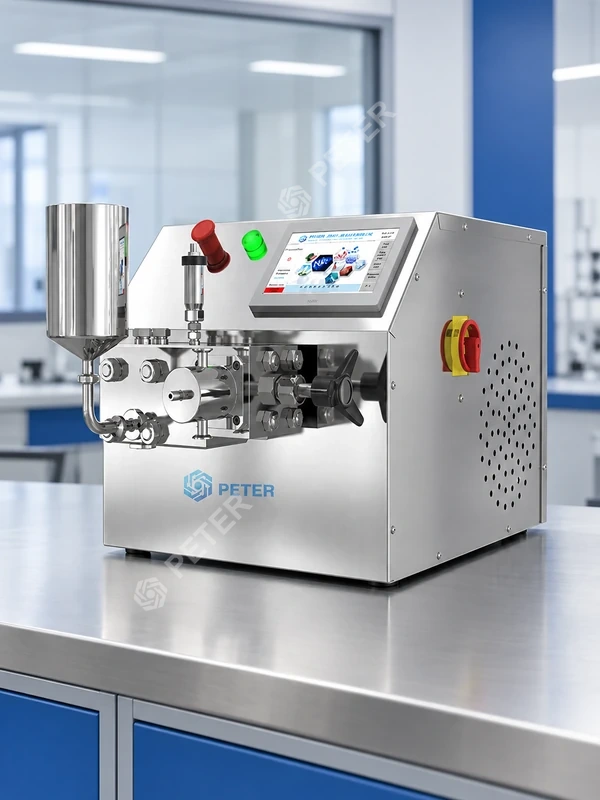
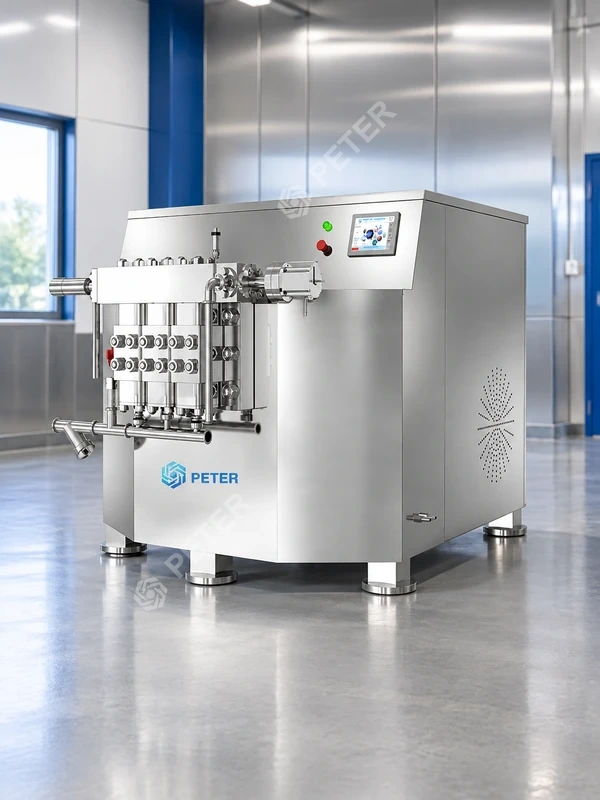
CAS PETER offers experimental and production-oriented high-pressure homogenizers and microfluidizers, but equipment selection should follow a sample and documentation review. Teams comparing small development routes can examine the experimental PTH-10 high-pressure microfluidizer, while a separate throughput or scale requirement may lead them to review the PTH-20 high-pressure microfluidizer. These links identify product options; suitability, permitted feed limits, materials, cleaning approach, and configuration still require confirmation.
Before requesting a quotation, send the supplier a concise trial brief: formulation family, batch volume, expected size range, viscosity method and temperature, solids or oil loading, largest expected agglomerate, temperature ceiling, preferred pass strategy, cleaning constraints, and analytical endpoint. The nanoparticle homogenizer buyer checklist helps separate equipment questions from formulation claims, and the benchtop-to-pilot guide outlines scale-transfer questions. Across high pressure homogenizer applications, the strongest purchase specification is a documented operating window, not a promise that maximum pressure will solve every dispersion.
Frequently asked questions
What is a high-pressure homogenizer used for?
It is used to apply controlled high-pressure processing to liquid dispersions and emulsions for objectives such as droplet reduction, deagglomeration, or improved distribution uniformity. Suitability depends on pumpability, viscosity, solids, feed-particle limits, chemistry, temperature sensitivity, and the required analytical endpoint.
How does a high-pressure homogenizer work?
A pump pressurizes the feed and sends it through a restricted valve or interaction geometry, where the rapid energy dissipation creates local conditions that can disrupt droplets or agglomerates. The outcome depends on equipment geometry and formulation as well as pressure, temperature, number of exposures, and stabilization chemistry.
What role does high pressure homogenization method play in a high-pressure homogenizer system?
The method defines how the system is used: premix preparation, feed screening, pressure sequence, discrete passes or recirculation, thermal control, sampling, and cleaning. Two teams using the same machine can obtain different results if these method elements are not aligned and recorded.
Which process limits should you check for a high-pressure homogenizer?
Check the permitted feed-particle or agglomerate size, viscosity range and measurement condition, solids loading, chemical compatibility, inlet and outlet temperature limits, pressure range, and cleaning requirements for the exact configuration. Also confirm utility needs, sample or batch hold-up, wear-part inspection, and any application-specific documentation before committing material.
References
- Grumbach, C., Krüger, V., and Czermak, P. “A New Control Strategy for High-Pressure Homogenization to Improve the Safety of Injectable Lipid Emulsions.” Pharmaceutics, 2022. Full text at PubMed Central.
- SPX FLOW/APV. APV Homogenizer Handbook, publication 3005-01-06-2008-US. Manufacturer handbook PDF.
- International Organization for Standardization. ISO 13320:2020, Particle size analysis—Laser diffraction methods. ISO catalogue entry.
- International Organization for Standardization. ISO 22412:2017, Particle size analysis—Dynamic light scattering (DLS). ISO catalogue entry.
Conclusion
High-pressure dispersion is not a contest to reach the smallest reported number or the highest pressure. The sound decision sequence is to qualify the premix, confirm feed and equipment limits, choose a pass strategy, control the thermal history, and then judge the result with a named particle-size method plus an application-relevant stability or function test. Scale-up should preserve the critical history of the material, while explicitly testing changes in mixing, hold-up, cooling, and cleaning. Never skip oversized-particle screening, temperature records, or method details merely because an average size looks favorable. Teams ready to translate a trial brief into equipment questions can review CAS PETER’s high-pressure homogenizer and microfluidizer range and contact the supplier with formulation boundaries and acceptance criteria for configuration-specific guidance.