

Blueberry Juice Anthocyanin Retention After Homogenization
Blueberry juice anthocyanin retention after homogenization should be evaluated with matched juice preparation, a recorded temperature history, and measurements that continue through storage. A darker sample immediately after treatment can reflect better pigment extraction, changes in suspended material, or a genuine difference in pigment concentration. It does not establish how much pigment will remain in the package. Build the trial around both the amount recovered immediately and the fraction retained later. Keep cultivar, enzyme treatment, filtration, oxygen exposure, packaging and analytical preparation consistent so that the result answers a processing question your production team can act on.
Define the pigment question before selecting pressure
A development team may want a stronger initial colour, a slower loss of anthocyanins during refrigeration, or a consistent colour between fruit lots. These are different targets. Write the primary target into the trial sheet and identify a secondary quality requirement, such as acceptable sediment or flavour. Set acceptance limits from the product brief and validated quality methods before examining the treated samples.
Describe the starting material precisely. Whole berry puree, pressed juice, enzyme-treated juice and clarified juice contain different amounts and forms of suspended material. Record the cultivar, frozen or fresh state, thawing procedure, dilution and any enzyme addition. If those steps change between treatments, apparent improvements cannot be assigned confidently to homogenization. Retain enough of each starting batch for a matched untreated control and for repeat analytical preparation.
The food homogenization overview gives the wider processing context. This article focuses on pigment retention during a storage trial. Use the separate particle measurement guide when choosing physical size measurements and the apple juice colour investigation for a complementary example of enzyme and colour measurements.
What published blueberry work establishes
An original continuous-flow blueberry juice study compared a defined high-pressure treatment with thermal processing and followed quality during refrigerated storage. Its results depended on inlet temperature and operating conditions. The investigators also prepared the juice through specific thawing, enzyme treatment, pressing and filtration steps. Their result therefore applies to that experimental system. It provides a reason to investigate temperature and storage together, rather than a transferable recipe for an arbitrary juice or machine.
A research review comparing pressure techniques and anthocyanins distinguishes high hydrostatic pressure from ultra-high-pressure homogenization. This distinction matters when reading claims about pigment extraction or stability. A batch held under pressure and a flowing liquid passing a restriction have different process histories. Treat evidence from one technique as background until its relevance to your selected process has been established.
The proposed workflow below is an engineering trial framework. It does not assign the published equipment’s pressure, temperature, flow or preservation performance to CAS PETER products. A supplier should confirm the feasible operating envelope for the actual feed and selected configuration before a trial is booked.
Use a temperature record that follows the juice
Measure inlet temperature, discharge temperature and the temperature after cooling. Also record elapsed time between processing and analytical sampling. A single temperature written beside the pressure setting hides the product’s actual exposure. Record where every sensor is located and whether it measures flowing juice or a surrounding service fluid. Include sensor verification in the trial preparation.
Keep the untreated reference under a comparable waiting and handling schedule. If one sample stays warm while another is cooled immediately, the comparison combines several effects. Where resources allow, include an additional control chosen by a food process specialist to investigate the thermal contribution. Label it accurately, with its actual temperature and time history, so the laboratory can interpret the contrast.
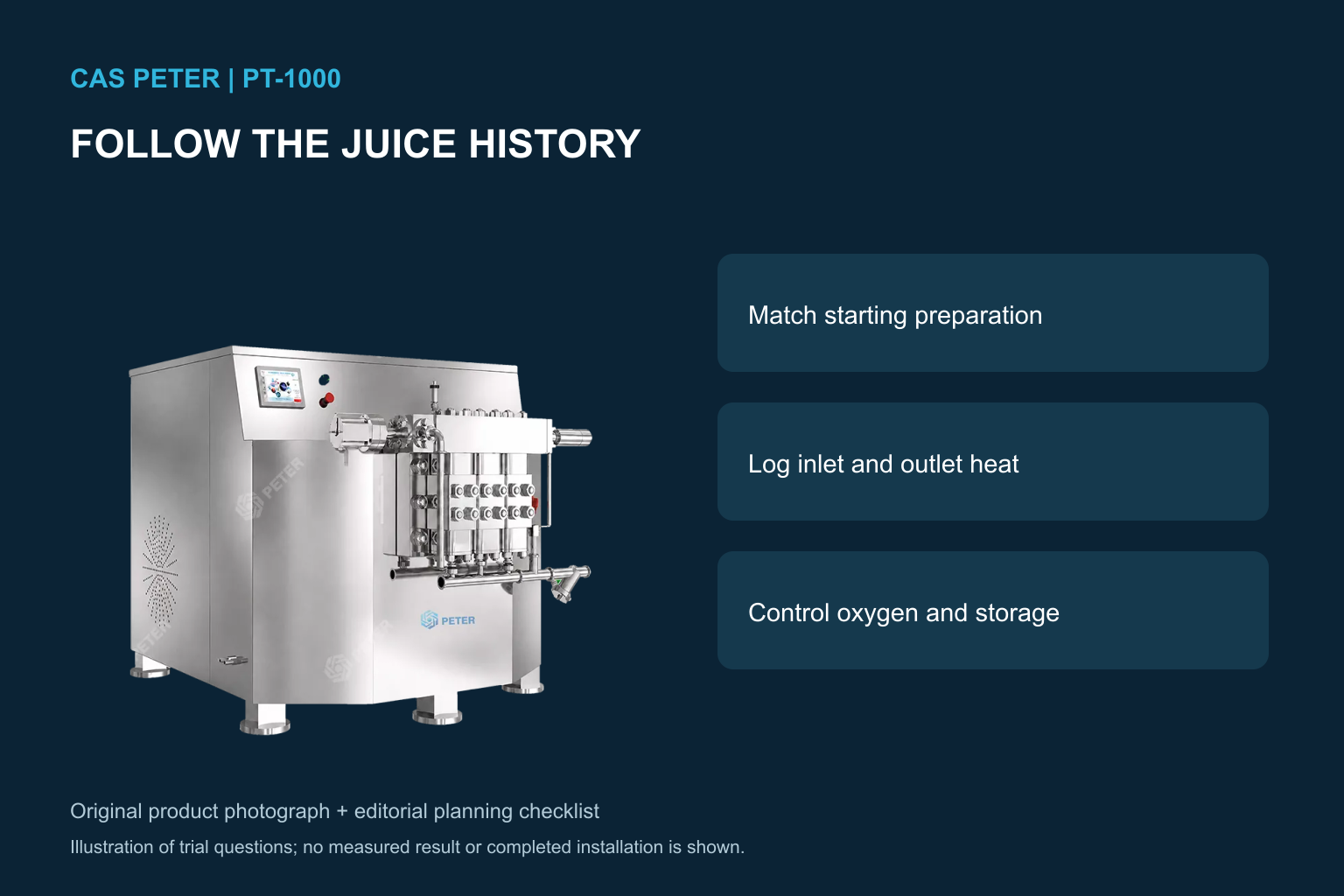
Arrange samples in a sequence that avoids long unrecorded waiting periods. Clean the sampling containers in advance, prepare labels, and agree who records time and temperature. If the machine requires a startup period, identify the point at which stable running begins. Keep startup material separate from the representative sample, and include any product loss in the batch record.
Measure extraction and retention separately
Define the analytical method before collecting results. A total monomeric anthocyanin assay and a chromatographic profile answer related but different questions. Ask the laboratory which compounds or equivalents it reports, the units used, the extraction procedure and the method’s limitations for your juice. Apply one validated preparation method to all treatments. Preserve laboratory blanks and quality controls according to that method.
Express the immediate treatment result relative to the matched starting juice. Express storage retention relative to each treatment’s own initial value. For a concentration-based comparison with unchanged sample basis, retention at time t is C(t) divided by C(0), multiplied by 100 percent. Both values must use the same analytical method and units. This ratio describes a measured concentration change. If dilution, evaporation or removal of solids differs, add a mass balance before interpreting it as retained pigment mass.
For example, an illustrative sample measured at 80 mg per litre initially and 60 mg per litre later has a concentration retention of 75 percent. Those values are a calculation example, with no connection to a CAS PETER trial. A second treatment could have a lower initial concentration but a higher retained fraction. Report initial concentration, later concentration and retained fraction together so that purchasing and quality teams see the complete comparison.
Build a sampling plan that survives storage
Allocate separate sealed containers to the planned sampling points whenever the storage design permits. Repeatedly opening one bottle can change its exposure and reduce the volume available for representative sampling. Record container material, closure, fill volume, headspace and storage location. Use the intended commercial package in a later confirmation stage if the early experiment uses laboratory containers.
Choose sampling intervals around the expected product life and the sensitivity of the analytical method. There is no universal schedule suitable for every blueberry product. Include an initial sample after a defined cooling step and enough later points to identify whether treatments diverge. Record actual storage temperatures and any excursions, rather than relying solely on the refrigerator’s set point.
| Trial question | Record or measurement | Interpretation boundary |
|---|---|---|
| Did processing change initial pigment recovery? | Matched starting juice and immediate treated sample, identical assay basis | Extraction and dilution can affect concentration |
| Does the pigment persist during storage? | Each treatment’s initial and later anthocyanin results | Use the same sample preparation throughout |
| Does visible colour follow the assay? | Instrumental colour under fixed measurement conditions | Cloud and suspended material can influence appearance |
| Is physical appearance acceptable? | Undisturbed layer photographs and defined resuspension observations | A small size result alone does not establish package stability |
| Is the product suitable for sale? | Separate safety validation and finished-product quality review | A pigment retention experiment is insufficient for a release decision |
These are proposed decision checks. The table contains no product specification, safety limit or guaranteed processing outcome.
Keep colour, cloud and pigment results connected
Take colour readings using one instrument setup and a consistent sampling procedure. State whether samples are measured after a defined mixing step or in their undisturbed condition. Where settling occurs, photograph the package before mixing and record the location from which the analytical sample was withdrawn. Otherwise, a change in the amount of suspended matter can be mistaken for a treatment effect on the entire bottle.
Consider paired physical and chemical observations. A sample may retain its measured anthocyanins while developing an unacceptable sediment layer. Another may look more uniform but show a lower measured concentration. Record these as distinct findings. A useful trial report lets the team choose a treatment that meets the combined product brief, with the reason for accepting or rejecting each candidate stated explicitly.
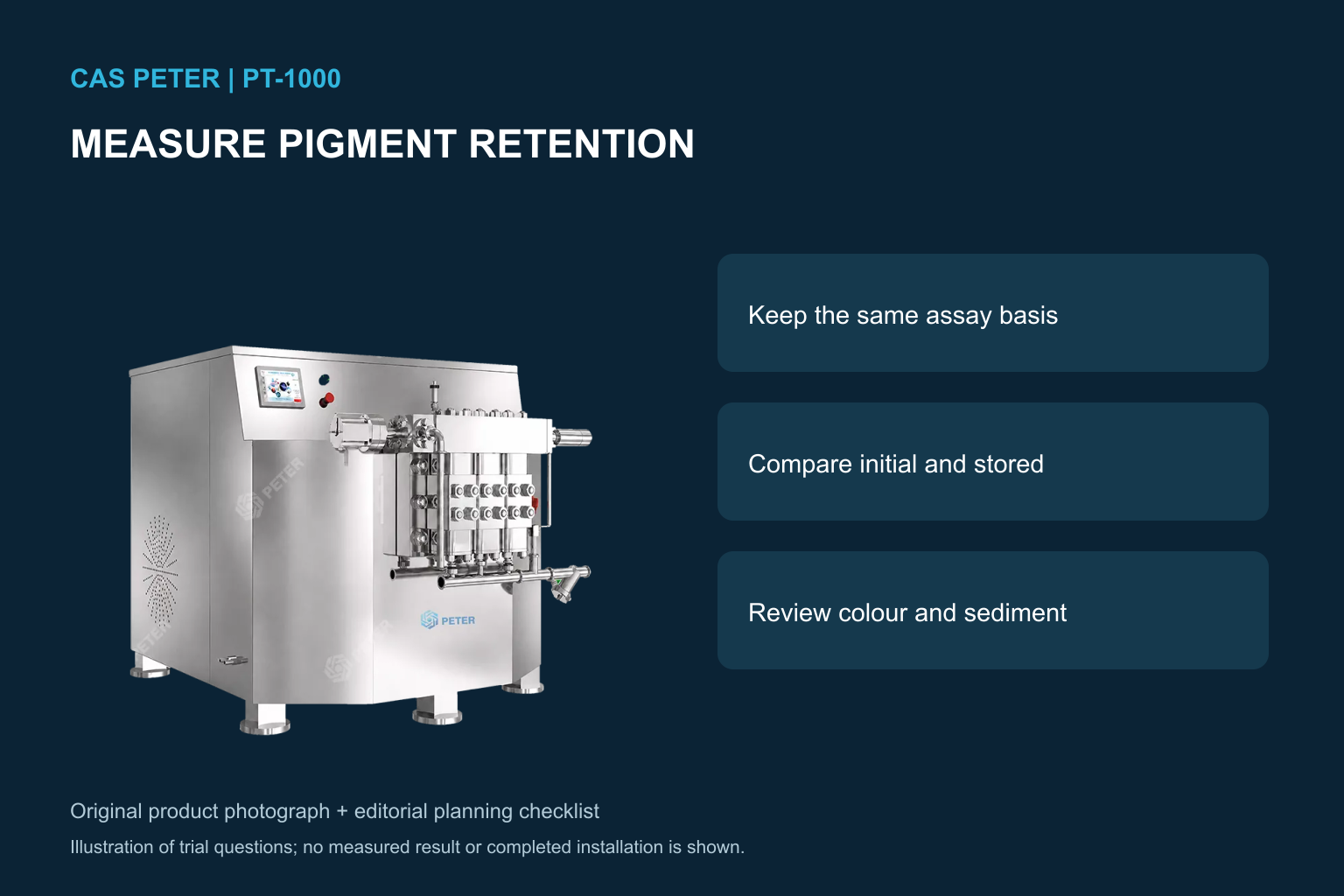
Ask for analytical repeatability and repeat processing runs appropriate to the decision. Several readings from one bottle describe measurement variation. Separate processing runs help reveal whether a condition is reproducible. Keep those sources of variation separate in the report and avoid presenting a large number of instrument readings as independent production batches.
Plan equipment review around the actual feed
The CAS PETER PT-1000 product page is a starting point for discussing a production-oriented homogenization project. Send representative juice information and ask the supplier to confirm feed preparation, temperature control, pressure range, product-contact materials, cleaning requirements and sampling arrangements for the supplied configuration. The pictured machine identifies a catalogue product. It does not document a blueberry installation or demonstrate the study’s operating conditions.
Prepare a written trial brief with starting volume, solids description, viscosity information where available, required product recovery and the proposed sample schedule. Ask how flow and temperature will be recorded during stable operation. Discuss the handling of pulp or coarse material before processing, and agree how the system will be cleaned between treatments without contaminating the next sample.
If a laboratory condition is promising, verify it on the intended production route. Compare the complete temperature history and sample quality alongside flow and pressure. Include the time required for startup, sampling, cleaning and changeover when evaluating practical output. A high instantaneous flow reading does not describe the quantity of acceptable packaged juice produced over a complete shift.
Use education material as supporting context
The following NPTEL lesson explains factors affecting food quality during processing and storage. It supports the reasoning behind matched handling and a controlled storage plan. It is general education and does not validate a particular blueberry process.

Educational source: NPTEL IIT Kharagpur. Watch the lesson on YouTube.
Frequently asked questions
Does a darker blueberry juice prove better anthocyanin retention?
A darker appearance alone is insufficient. Compare a defined pigment assay with instrumental colour and suspended-material observations. Retention also requires later measurements against the treatment’s own initial value under a documented storage plan.
Can I copy the pressure in a published blueberry study?
Use the study to design questions for a controlled trial. Confirm the actual juice preparation, equipment configuration, temperature history and operating limits before selecting conditions. Results from a different machine and preparation route need verification on your product.
Can a successful pigment trial establish shelf life?
A pigment trial contributes quality evidence. Establishing market shelf life also requires appropriate microbiological safety validation, packaging assessment, sensory review and other finished-product requirements for the intended distribution conditions.