

Calcium Carbonate Homogenization Trials: Qualify Dispersant and Slurry Flow First
Calcium carbonate homogenization trials should begin with dispersant selection, slurry flow and feed suitability before pressure is increased. Compare a well-prepared unprocessed slurry with the same formulation after homogenization, then examine particle distribution, rheology, settling and the intended application. A finer diluted sample does not prove that the concentrated slurry will remain pumpable or stable. Mineral grade, liquid chemistry, dispersant characteristics and solids loading must stay identifiable throughout the experiment. The purpose is to establish whether pressure processing adds useful performance to a compatible formulation, rather than use pressure to compensate for an undefined feed.
Distinguish dispersion from particle synthesis
A prepared calcium carbonate slurry contains existing mineral particles. A dispersion trial investigates their distribution and interactions in the selected liquid, potentially including breakup of agglomerates. This is different from producing calcium carbonate through a chemical precipitation reaction. Equipment and results from a reactive synthesis process do not automatically apply to processing a purchased mineral slurry.
Define the intended claim before selecting tests. If the target is agglomerate reduction, distinguish it from reducing the dimensions of primary mineral particles. If the target is easier handling, measure the slurry under relevant flow conditions. A generic request for nanoparticles conceals these differences and makes it difficult to decide whether the trial has succeeded.
Keep the mineral identity, supplier grade, surface treatment and batch history with the trial record. Do not assume that ground and precipitated grades, or treated and untreated grades, can share an operating recipe. Confirm the actual material specification and the equipment supplier’s assessment before processing a representative sample.
Establish the formulation before comparing pressure
Document the liquid source, pH, solids concentration, dispersant identity and active-content basis. Include the dispersant’s relevant specification rather than only its trade name. The amount of a commercial solution added is not necessarily the amount of active polymer present, so preserve both values when preparing comparison batches.
An original study of polyacrylic acid molar mass and calcium carbonate rheology investigated how polymer characteristics and concentration affected suspension behavior. It supports treating dispersant formulation as a controlled variable. It does not establish one dose that will suit all mineral grades, process waters and applications, or prove that a particular slurry is compatible with a homogenizer.
A University of Moratuwa research record on combined dispersing agents describes a formulation investigation involving calcium carbonate suspensions. Its available abstract supports the importance of studying dispersant combinations and flow at a defined solids loading. It is not a validated recipe for the material in your factory, and its reported outcome should not be treated as an equipment capacity guarantee.
Prepare a representative feed and control
Fix the order of liquid, dispersant and mineral addition, as well as the mixing and hold periods. Record the batch mass and avoid interpreting a change in formulation caused by evaporation or dilution as a processing effect. Retain an untreated control from the same prepared batch whenever possible.
Check for coarse contamination and unsuitable feed particles using a procedure agreed with the equipment supplier. Record any screening, separation or premixing because those steps can change the measured distribution. The resulting feed must be characterized after preparation, not described only by the specification of the powder originally supplied.
Sample the slurry while it is representative. A sample drawn from a settled container’s upper layer may have a different solids content and particle population from material entering the machine. Define mixing before sampling and document the sampling position. If settling during the processing period is significant, investigate its effect on the feed before comparing operating conditions.
Use a trial matrix that separates formulation and processing
The following qualitative framework contains no universal pressure, solids or dispersant limits. It links questions to measurements so that formulation changes are distinguishable from the additional effect of homogenization. Establish acceptance criteria from the intended use and confirmed equipment configuration.
| Question | Controlled comparison | Evidence required | Decision supported |
|---|---|---|---|
| Is the mineral adequately wetted and dispersed? | Same grade and liquid with documented preparation | Coarse material, mixing history and representative feed distribution | Whether feed preparation needs revision |
| Does dispersant choice improve handling? | Defined active polymer basis and matched solids | Flow curves, settling and preparation repeatability | Which formulation merits a machine trial |
| Does homogenization add useful change? | Same prepared slurry before and after processing | Full distribution, microscopy where useful and rheology | Whether pressure processing improves the selected route |
| Does the result persist during use? | Fixed storage, rest and remixing procedures | Sediment, redispersibility and post-rest flow | Whether fresh results survive handling |
| Is the configuration suitable? | Actual feed and proposed operating conditions | Supplier compatibility review and monitored trial observations | Whether further equipment evaluation is justified |
| Does the slurry perform in the application? | Matched application formulation and procedure | Relevant coating, filling or processing measurements | Whether analytical changes deliver practical value |
Keep formulation screening manageable. Change one defined variable at a time when the objective is to identify a cause. When broader screening is necessary, use an experimental design that can distinguish interactions rather than choosing a favorable sample from many undocumented combinations.
Measure concentrated flow as well as diluted size
Record viscosity or rheological behavior at relevant temperature and shear conditions. A single viscosity number without its method can be difficult to use. Select the measurement range to address storage, pumping or application, and document the sample’s preparation and rest history before analysis.
Particle-size analysis often requires dilution. Describe the dilution medium, concentration, mixing and delay before measurement. Dilution can alter the conditions surrounding particles, so a well-dispersed analytical sample is not by itself evidence that the original concentrated slurry has the same structure or handling behavior.
Use the capacity guide for viscosity, solids and feed size to organize the material data supplied with an inquiry. Keep measured flow separate from a throughput promise. Equipment capacity must be assessed for the actual formulation, operating condition and configuration, rather than inferred from a water-based nominal rating.
When interpreting a change in apparent viscosity, consider whether temperature, solids content or preparation history also changed. Compare samples after a defined conditioning procedure. A hot outlet sample and a cold control may produce an attractive difference that disappears when both are tested under equivalent conditions.
Verify what changed in the particle population
Preserve the full particle distribution and the method used to obtain it. Compare the coarse portion with microscopy or another suitable observation when it helps distinguish agglomerates from primary particles. Avoid claiming that primary crystals have been made smaller simply because an apparent aggregate size has decreased.
Document analytical dispersing energy and additives. If the instrument’s sample preparation breaks weak structures, the reported distribution may not describe the untreated product. Keep the analytical procedure consistent across controls and processed samples, and record any justified changes so their effect can be evaluated.
Assess repeated samples rather than relying on one measurement. A heterogeneous mineral slurry may produce variability from sampling as well as processing. Record independent preparation and processing replicates where appropriate, distinguishing them from repeated instrument readings of one small sample. These provide different information about reproducibility.
Test settling, sediment and recovery after rest
Define the storage container, fill level, temperature and observation period before comparing candidates. Record visible separation and sediment using consistent observations. A stable-looking opaque container may conceal concentration gradients, so plan representative sampling or other appropriate measurements when those gradients matter.
Evaluate the sediment’s behavior under a documented remixing procedure. A product intended for use after routine agitation may have different acceptance criteria from one that must be supplied without remixing. Report the conditions required to recover a uniform slurry rather than using an unexplained description such as easily redispersed.
Repeat rheological and size measurements after rest or the intended handling cycle. Keep any change caused by remixing identifiable. If the product recovers its fresh appearance but requires excessive effort to pump or leaves a persistent coarse fraction, that practical limitation should remain visible in the development conclusion.
Confirm compatibility before considering scale
Abrasive mineral feeds require an equipment-specific review of wetted materials, seals, processing passages and maintenance expectations. Provide the actual feed distribution, solids, liquid chemistry and known contamination. Do not infer compatibility from the material name alone or from a demonstration with another mineral.
The guide to seals and wetted materials explains what information to discuss. Ask the supplier to confirm suitability for the selected configuration, including limits and inspection requirements. This article provides no wear-life estimate, acceptable contamination limit or approval to process an unreviewed slurry.
Monitor the trial for unexpected operating behavior and inspect relevant equipment surfaces according to the supplier’s procedure. Where contamination matters to the application, agree on suitable sampling and analysis. A successful particle-size result does not establish that equipment wear or product contamination is acceptable over a production campaign.
Connect the trial to the finished application
For a coating or filled formulation, repeat evaluation after the slurry is mixed with the other ingredients. Use the intended addition sequence and application procedure. A useful intermediate slurry may change when blended, so select final tests that address the actual product rather than stopping at the mineral dispersion.
Record the performance endpoints needed by the application, such as coating consistency or relevant surface properties, without assuming that a smaller size will improve every outcome. Keep the application comparison controlled. Changing binder composition while changing the slurry process would make it difficult to assign the result to either change.
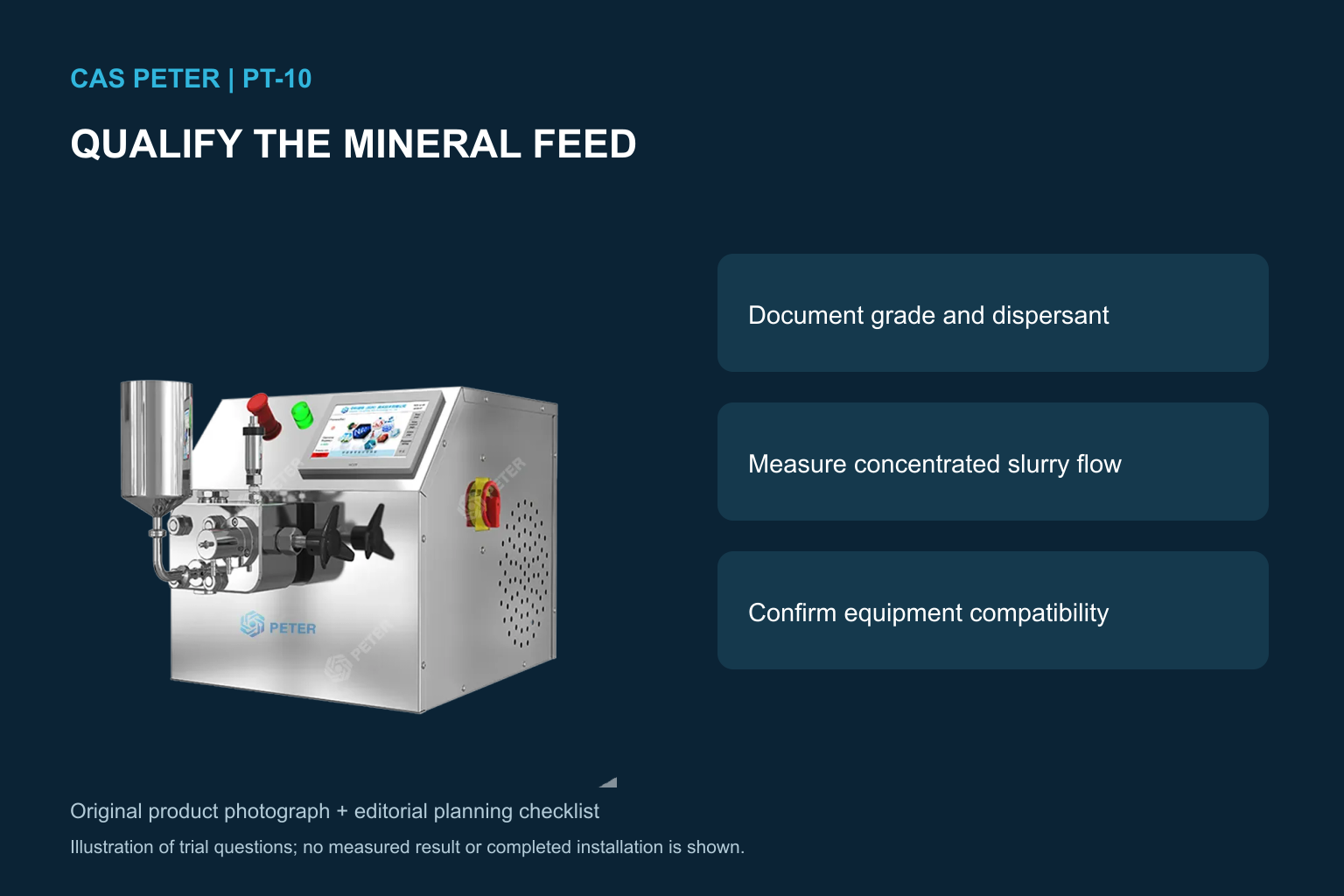
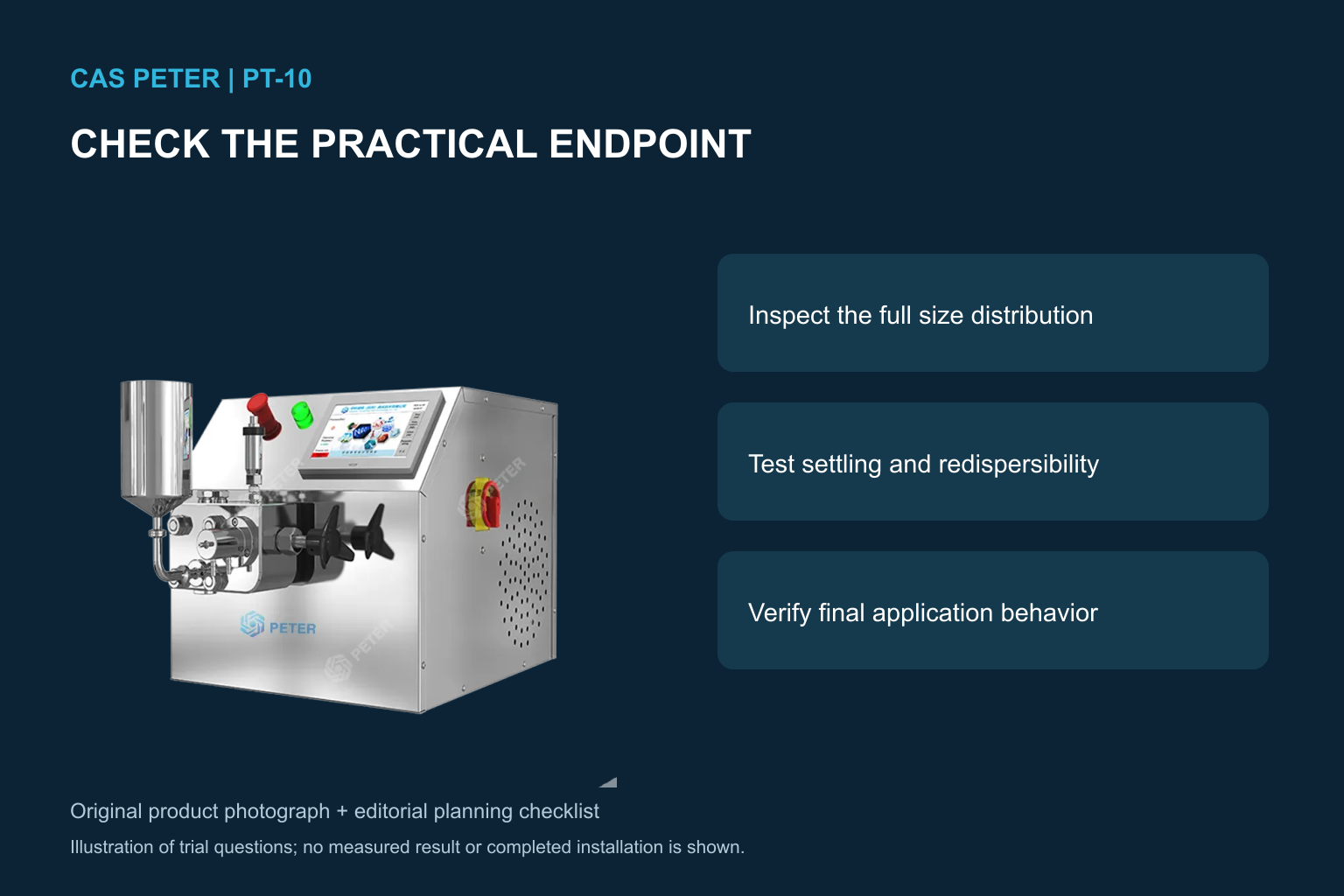
Discuss a representative trial with the CAS PETER PT-10 model as a starting point for configuration review. Supply batch quantity, formulation details, feed characterization, required endpoint and available cooling. The referenced product photograph identifies the model; it does not document an approved calcium carbonate installation or prove compatibility.
Use the dispersion methods support guide for wider process-selection context. Advance to scale evaluation only when material suitability, repeatable processing and the final application’s requirements have been demonstrated. Preserve the unsuccessful conditions so the proposed operating window includes its practical boundaries.
Educational background: rheology
The following NPTEL food-rheology lesson introduces flow concepts that also help interpret slurry measurements. It is general educational background, not calcium carbonate formulation evidence, a mineral processing demonstration or a source of machine operating limits.

Educational source: NPTEL IIT Kharagpur. Watch the lesson on YouTube.
Frequently asked questions
Can higher pressure replace dispersant screening?
No. Establish a compatible and reproducible feed formulation first, then test whether homogenization adds a useful effect. Dispersant identity, active concentration, liquid chemistry and mineral grade must remain documented throughout the comparison.
Does a smaller diluted particle result prove better concentrated flow?
No. Measure the concentrated slurry under relevant temperature, shear and rest conditions. Dilution and analytical dispersion can change particle interactions, so the instrument sample may behave differently from the product being pumped or stored.
Can the same setup process every calcium carbonate grade?
That must be confirmed for the actual feed and configuration. Mineral grade, surface treatment, coarse particles, solids, liquid chemistry and wear considerations all belong in the equipment supplier’s review before a trial or scale decision.