

Carbon Black Dispersion After Homogenization: Verify Flow After Rest and Dilution
Carbon black dispersion after homogenization should be judged by its flow after controlled rest and dilution, alongside evidence of coarse material and storage behavior. A low viscosity measured immediately after strong shear does not prove that the dispersion will pump, pour or remain uniform after holding. Record the carbon grade, surface treatment, dispersant, liquid composition and shear history, then compare representative samples using a repeatable measurement sequence. The useful endpoint is the behavior required in the intended process, rather than the lowest isolated viscosity reading.
This guide focuses on rheological qualification of a liquid carbon black dispersion. It does not establish a conductive ink specification, a battery-electrode recipe or the compatibility of a particular feed with any homogenizer. Those applications require additional, separately defined tests.
Define the flow problem in practical terms
Identify when the formulation fails. Does it become difficult to restart after overnight holding? Does it pour readily but settle during transport? Does dilution make an apparently uniform concentrate form large structures? These observations call for different comparisons and should be recorded before changing processing intensity.
Describe the relevant handling sequence: premixing, pressure treatment, transfer, cooling, holding, dilution and final application. Include where agitation is available and where the material remains undisturbed. A sample measured straight from the outlet has experienced a different history from material held in a storage vessel or package.
Set application-specific acceptance criteria. These may include a defined restart test, a permissible flow range at a stated temperature, absence of unacceptable coarse material and practical redispersion after storage. Decide those criteria before ranking trial conditions, and do not substitute a generic viscosity limit found in an unrelated formulation.
Keep carbon grade and formulation identity traceable
Record the carbon black grade, lot, available surface-treatment information, solids basis and liquid composition. Identify the dispersant by its actual material and concentration basis. A mass fraction based on total slurry differs from an addition based on dry carbon, so label each basis explicitly.
Document wetting and premixing. Dry pockets, floating powder and entrained air should be resolved within a reviewed preparation procedure before the pressure-processing trial. Keep a coarse-feed observation and, when appropriate, a defined screening record. Any removed material changes the batch composition and must be included in the interpretation.
A USDA research summary on aqueous carbon black dispersions describes a route using steam jet-cooked corn starch followed by high-pressure homogenization. The study found starch associated with the carbon surfaces and reported stable aqueous dispersions in that system. This supports treating surface stabilization and preparation chemistry as integral parts of dispersion. The summary does not establish that plain water, an arbitrary starch or more homogenization alone will produce the same result.
For a formulation change, compare against the accepted reference with the same preparation and test sequence. If both the carbon grade and dispersant change at once, label the result as a formulation comparison instead of assigning the difference to the machine.
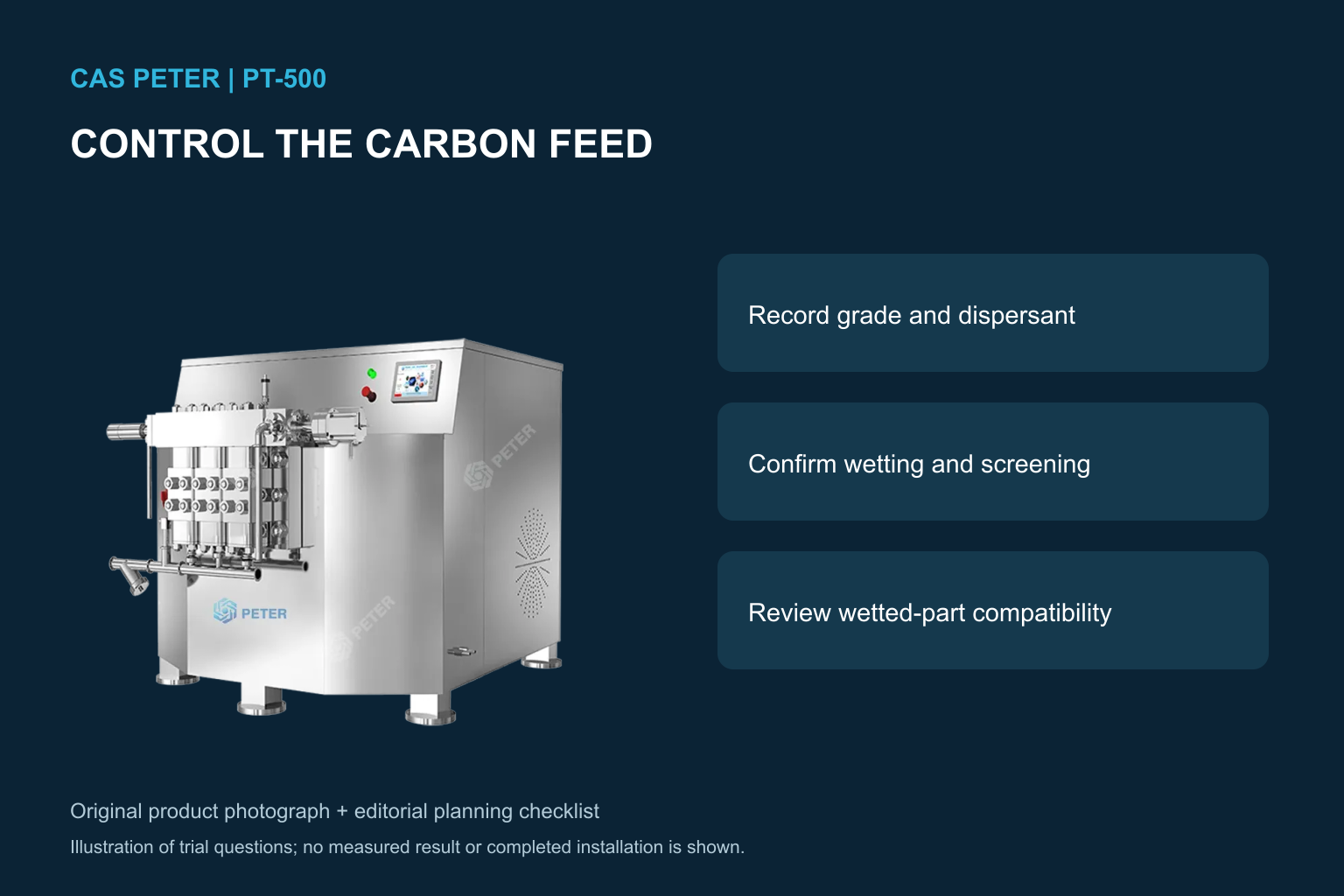
Review feed compatibility before a pressure trial
Provide the supplier with the full liquid composition, solids level, feed particle information, viscosity behavior and intended operating temperature. Confirm the relevant wetted materials, seals, wear considerations and cleaning route. An equipment photograph or model name cannot answer those compatibility questions.
The CAS PETER PT-500 product page identifies a real production-type model for discussing a representative trial. Confirm the proposed configuration and feed requirements rather than transferring pressures, throughput or results from another manufacturer’s research equipment. The illustration in this article is a product reference and planning aid, not evidence of a completed carbon black installation.
Use the wetted materials and abrasive-slurry guide to organize the compatibility review. Include any other solids, solvents or additives in that discussion. A preliminary dilution used to make the sample flow more easily changes the formulation being tested and should not silently replace the intended production feed.
Review the planned sampling and material balance as well. Record retained volume, recovery and any material left in transfer lines. If the feed separates during preparation, define how representative sampling is maintained without concealing the undisturbed stability of the stored product.
Use shear history as part of the measurement definition
A viscosity value needs context: instrument, geometry, sample temperature, loading method, preconditioning, imposed shear and reading duration. Keep those conditions identical when comparing treated and reference samples. Where the material is time dependent, a value without its timing can be misleading.
A research study combining carbon black rheology and structural measurements links flow behavior to evolving particle clusters and networks. Its experiments used carbon black in mineral oil prepared with an ultrasonic bath, followed by controlled rheological testing. It is relevant to interpreting structure under shear, but it is not a high-pressure homogenization optimization study and supplies no settings for a water-based production formulation.
That distinction leads to a useful trial question: is the changed flow behavior persistent under the agreed measurement history, or is it mainly an immediate response to recent shear? Answer it with matched preconditioning and timed observations rather than assuming the fresh outlet sample represents every later state.
Choose the measurement sequence with the laboratory responsible for rheology. A rapid sweep can capture a transient response; a longer test may reveal continuing structural change or measurement artifacts. Record observations such as slip, settling, air and poor repeatability instead of forcing every curve into a fitted model.
Compare fresh material with rested and restarted samples
Collect representative samples at an agreed point after treatment and temperature equilibration. Reserve separate portions for immediate characterization, undisturbed holding and restart testing. Repeatedly shaking the only storage sample destroys its original resting history.
For a recovery test, define the initial measurement, the imposed shear step, the rest interval and the subsequent measurement. The exact protocol should match the development question and equipment available. If multiple rest intervals are used, label them explicitly and avoid combining them into a single claimed recovery percentage.
The qualitative matrix below translates the two research sources into practical development questions. It is an editorial test plan, not a table of source-reported performance limits or a guarantee of any product outcome.
| Observed behavior | Controlled follow-up | What to compare | Decision supported |
|---|---|---|---|
| Thin immediately after processing, thicker after rest | Repeat measurements at defined rest intervals | Reference and treated samples at matched temperature | Whether flow remains suitable after holding |
| Flow result depends strongly on loading or mixing | Standardize loading and preconditioning | Independently prepared aliquots | Whether the method is repeatable enough to rank trials |
| Stable concentrate changes after dilution | Reproduce the actual liquid and addition sequence | Concentrate, freshly diluted and held diluted samples | Whether the formulation survives intended use |
| Acceptable bulk viscosity but visible coarse structures | Inspect representative material with suitable microscopy or coarse-fraction checks | Feed, treated and stored portions | Whether a flow result conceals incomplete dispersion |
| Stored sample restarts poorly | Apply a defined practical remix or transfer procedure | Recovery after realistic handling | Whether the required restart procedure is feasible |
Keep the full distribution of observations. Averages can conceal a recurring bad restart or a coarse fraction in one preparation. Distinguish analytical repeatability from independently prepared batch repeatability, and investigate failures before selecting an operating window.
Test dilution as a new formulation condition
When the dispersion is a concentrate, reproduce the intended dilution liquid, concentration and order of addition. Water quality, added binder or other components may change the surrounding environment. A dilution prepared solely for instrument convenience is not equivalent to the intended application dilution.
Document mixing intensity, time, temperature and the delay before measurement. Use a defined, practical procedure rather than repeatedly adding shear until the sample looks acceptable. Reserve an undisturbed portion so that separation and coarse structures can be observed independently of the remixing procedure.
Compare the initial diluted material with a held diluted sample. Examine flow and visible structure together. If dilution changes the result, investigate composition and preparation sequence before simply increasing the number of pressure passes on the original concentrate.
For methods used to characterize particle populations, refer to the pigment dispersion trial checklist. Carbon black is optically challenging and its structure can be altered by analytical preparation, so the laboratory should validate the chosen method and report its limitations for the actual matrix.
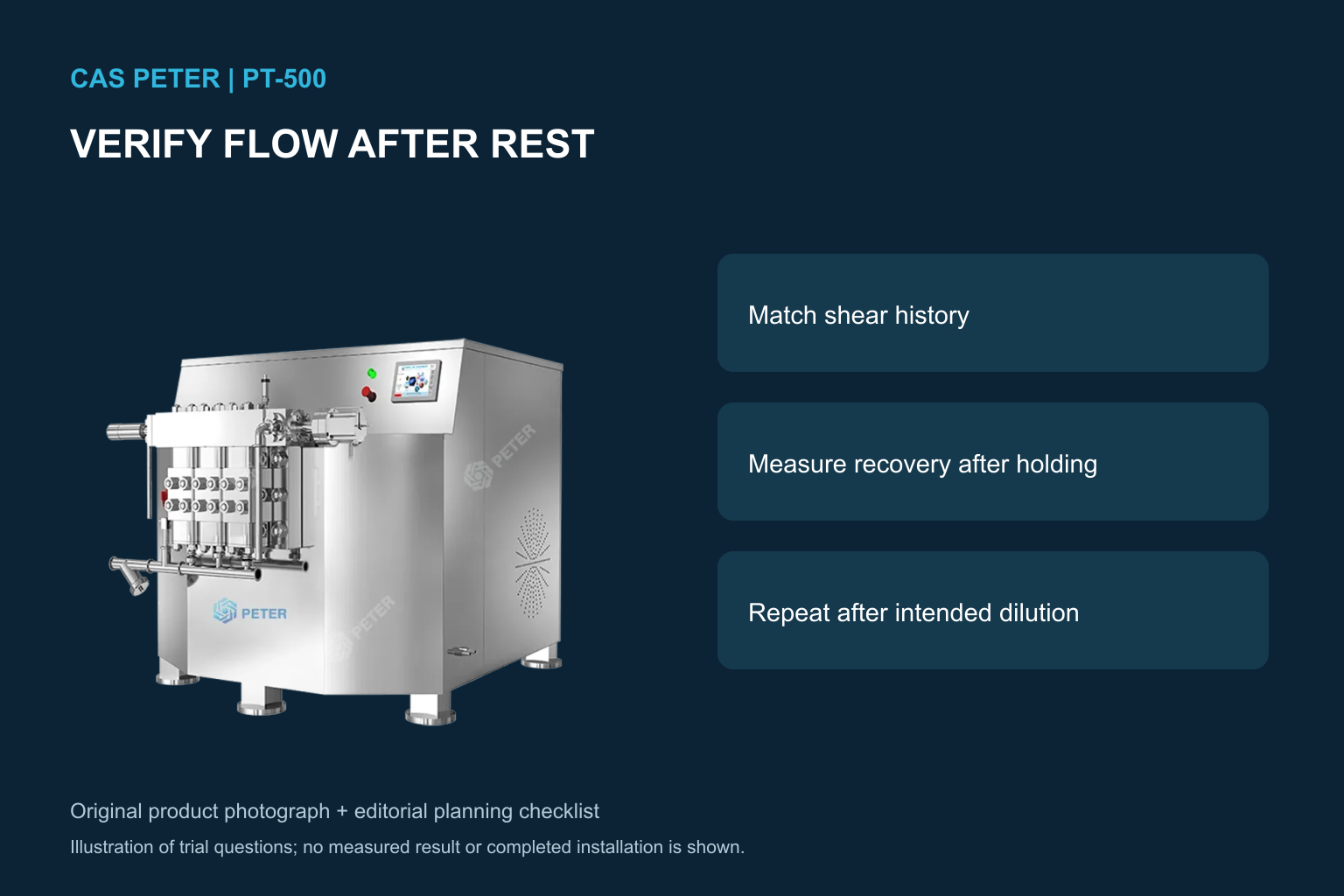
Balance dispersion, flow and final function
A process may improve one property and worsen another. Lower apparent viscosity can help a particular transfer operation while allowing more separation during an undisturbed hold. A structured system may resist settling but become difficult to restart. Define which combination is acceptable for the intended application rather than treating either direction of change as automatically better.
If the application is an ink or coating, include the relevant drawdown, application or film tests. If electrical performance matters, test it using a defined sample preparation and measurement procedure. Neither a small apparent particle size nor a rheology result alone establishes conductivity, adhesion or final coating performance.
Record process intensity alongside these outcomes. Include pressure, pass definition, inlet and outlet temperatures, holding time and cooling. A recirculating run needs a clear residence description. Compare a preferred condition with a lower-intensity control to determine whether added treatment brings a useful application benefit.
Investigate the source of inconsistent results. Check batch composition, premix uniformity, temperature drift and sampling before attributing every change to the homogenizer. Retain failed observations in the trial record so the selected process is supported by the whole comparison.
Prepare a reviewable scale-up package
Confirm the preferred route using independently prepared batches and representative feed. Supply the formulation identity, feed records, measurement protocol, fresh and rested results, dilution observations and final-function checks. Identify any acceptance requirement that remains untested.
For scale-up, discuss transfer and hold-up, cooling capacity, cleaning and the expected feed variation with the supplier. A successful small trial does not by itself establish production throughput or wear life. Those require review of the actual installation and operating conditions.
The high-pressure dispersion methods guide provides broader process context. Use the carbon-specific evidence above to define the next trial and judge the stored material in the way it will actually be handled.
Educational background: flow and rheology
This university lecture introduces rheology concepts that help explain why flow depends on measurement conditions. Its educational principles apply to the test questions here, while its food context is not evidence for any carbon black formulation or production setting.

Educational source: NPTEL IIT Kharagpur. Watch the lesson on YouTube.
Questions about carbon black dispersion trials
Does lower viscosity immediately after homogenization prove improvement?
No. Compare the result after defined rest, at matched temperature and under a repeatable shear history. Judge whether the material meets the intended transfer, storage and application requirements rather than ranking a single fresh reading.
Why should a concentrate be tested after dilution?
Dilution changes the formulation environment and may change particle interactions and flow. Reproduce the intended diluent, concentration, addition order and holding time, then assess the diluted material separately from the concentrate.
Can a rheology test establish conductive-ink performance?
No. Flow behavior helps qualify handling and structure, but electrical and film performance require their own controlled tests. State the application endpoints and evaluate them on representative material prepared with a documented process.