

Hydroxyapatite Homogenization: Distinguish Deagglomeration from Crystal Changes
Hydroxyapatite homogenization can help investigate the dispersion of agglomerated particles, but a smaller suspension measurement does not by itself prove that the primary crystals became smaller or retained the same phase and morphology. Begin with a characterized powder or precipitate, preserve a matched untreated control, and compare the wet dispersion with complementary morphology and composition evidence. Separate synthesis, stabilizer addition and pressure processing in the trial record. This guide addresses material-processing development and equipment inquiries. It does not establish dental efficacy, implant suitability or medical-product approval for any powder, suspension or CAS PETER machine.
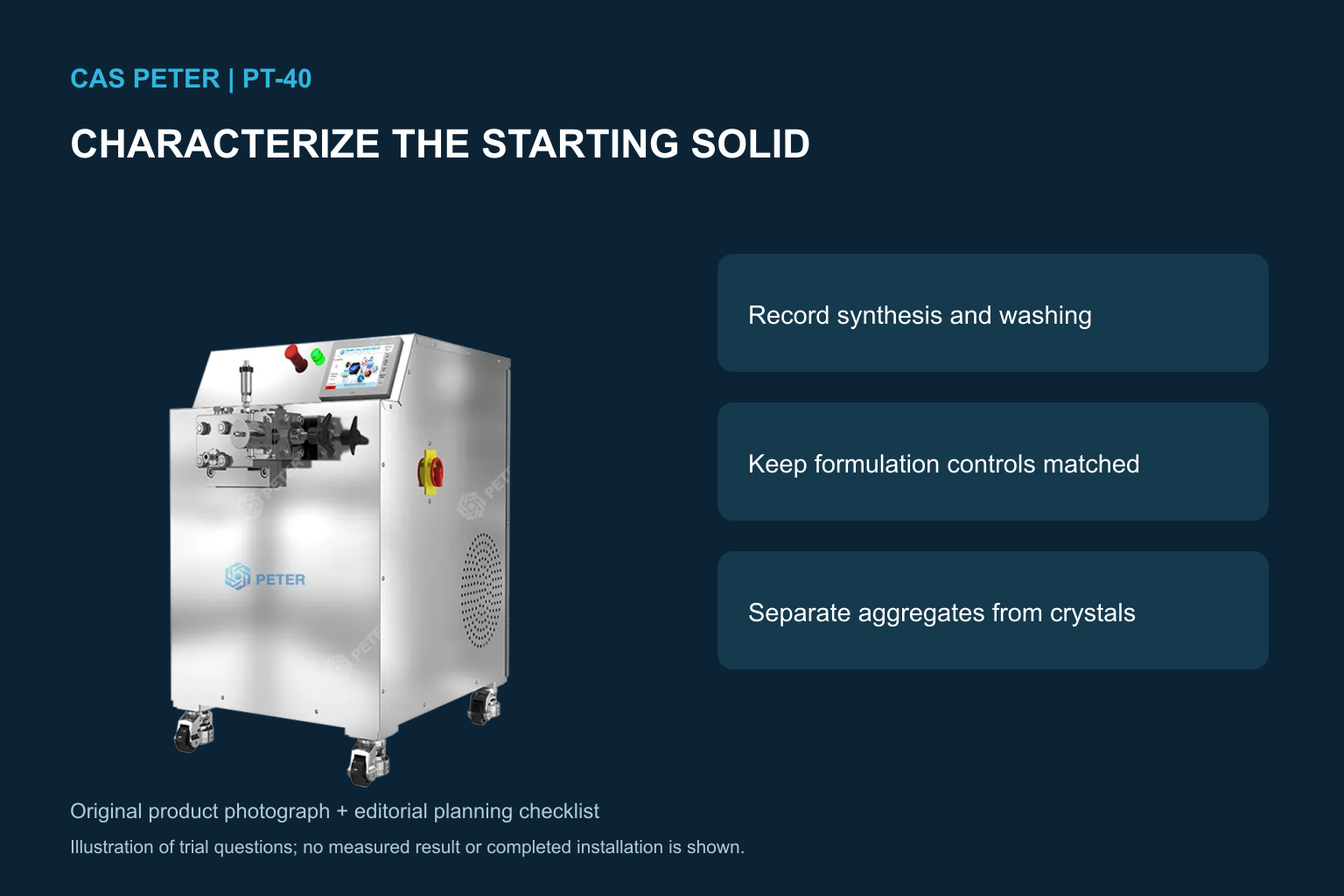
Define which hydroxyapatite material enters the machine
Hydroxyapatite can arrive as a freshly prepared precipitate, a washed wet solid, a dried powder or a material that has undergone further heat treatment. These histories are not interchangeable. Document the synthesis or supplier information, washing, drying, storage and any dopants or surface treatments. The same chemical name can conceal different starting particle structures and dispersion behavior.
Record the actual solids content, liquid composition and visible coarse material in the homogenizer feed. If the material was washed or diluted, explain how the final composition was established. A recipe based on the amount of starting salt does not necessarily describe the amount of solid collected after precipitation and washing.
State the intended end use of the dispersion at the development level: for example, a material-characterization study or a subsequent forming experiment. That purpose determines whether morphology, storage behavior, concentrated flow or another property is most important. Avoid designing the trial around the smallest number that a sizing instrument can display.
Separate synthesis from subsequent deagglomeration
The University of Parma research record describes hydroxyapatite prepared by wet chemistry before homogenization in the presence of stabilizers. Its accessible abstract reports particle characterization using multiple methods. The sequence matters: the homogenizer did not replace the preceding synthesis. The record provides evidence for that study, not a universal process specification or a guarantee for another powder.
A separate citric-acid hydroxyapatite slurry study investigates stabilization associated with the preparation chemistry. This is relevant background for deciding how formulation and pH controls should be recorded. It does not demonstrate pressure-processing performance, and its chemistry should not be treated as an interchangeable additive recipe for every hydroxyapatite suspension.
Together these studies support a practical experimental distinction. Changes may arise during precipitation, washing, stabilizer addition or mechanical treatment. Preserve suitable controls for those stages if the question is which operation caused the observed difference. Otherwise a final size measurement cannot isolate the contribution of homogenization.
Distinguish agglomerates, particles and crystallites
An agglomerate can contain multiple smaller particles. A microscopy measurement of a visible particle and a diffraction-derived crystallite dimension answer different questions. A particle may also contain more than one coherently diffracting region. Use the terms according to the method rather than presenting every dimension as a common “nanoparticle size.”
A wet sizing method describes the dispersed objects under its own preparation conditions. If dilution, agitation or sonication is required, those operations can influence the result. Report them. A strongly pretreated analytical sample may no longer represent the suspension leaving the production vessel, especially when the aim is to evaluate persistent agglomerates.
Microscopy can help assess shape and aggregation, while an appropriate phase-characterization method can examine whether the material remains consistent with the intended solid phase. The exact methods and acceptance criteria belong to the project laboratory. A smaller wet distribution should trigger a comparison with those complementary results, not replace them.
Build the minimum controls around the question
Use one characterized material batch for the first comparison. Divide it into untreated feed, any formulation-only control and pressure-treated samples. Match liquid composition and elapsed time as closely as practical. If a stabilizer is added only to the treated sample, the experiment combines formulation and mechanical effects and should be reported that way.
Control sample temperature and storage before analysis. Allowing one specimen to rest overnight while measuring another immediately can change the comparison. Establish a sampling schedule that the laboratory can follow, including any redispersion before measurement. Identify both the sample as collected and the sample as prepared for the instrument.
The table below is an editorial framework informed by the cited studies. It contains no recommended pressure, stabilizer dose or medical-material specification. Select the actual methods with the material-characterization team.
| Development question | Relevant control | Useful evidence | Boundary of the conclusion |
|---|---|---|---|
| Did preparation chemistry change the feed? | Matched synthesis batch before and after the formulation step | pH, solids, composition and documented washing history | Does not isolate the effect of homogenization |
| Were agglomerates dispersed? | Untreated feed with the same analytical preparation | Wet distribution, coarse fraction and representative microscopy | A smaller hydrodynamic size is not automatically a smaller crystallite |
| Did shape or phase change? | Starting material collected and prepared comparably | Appropriate microscopy and phase characterization | One attractive image cannot establish the whole population |
| Is the concentrated suspension practical? | Same solids and temperature | Flow behavior, settling and defined redispersion | Dilute stability does not prove concentrated feed suitability |
| Does the next operation preserve the result? | Wet dispersion before drying, forming or formulation | Application-specific measurements and recovered mass | Suspension quality does not establish final-product performance |
Read phase and composition evidence carefully
If phase preservation matters, compare the starting material and the processed solid using a documented specimen preparation. Drying a sample for characterization may introduce changes or preferentially retain one fraction. State whether analysis concerns the entire recovered sample or a selected portion, and record any washing before analysis.
Elemental composition can be useful, but it does not replace phase identification or explain every surface change. Similarly, a nominal calcium-to-phosphorus ratio is not a complete description of particle identity. Interpret composition alongside the preparation history and the methods appropriate to the material, rather than claiming that one ratio proves all quality requirements.
For doped or surface-modified hydroxyapatite, identify the modification explicitly. Do not assume that conclusions for an unmodified powder transfer without testing. The liquid phase and additives can influence both dispersion and the way an analytical specimen is prepared. Keep those variables visible in the report.
Test realistic flow and settling conditions
A diluted suspension can be easy to measure while the actual feed is difficult to pump or keep representative. Measure flow behavior at a documented concentration and temperature, using a procedure relevant to the feed-handling question. Record whether the material changes after rest or repeated mixing. Avoid treating a single viscosity reading as a complete flow description.
Observe settling in identical containers without disturbing the samples between observations. Note the supernatant, sediment height and compactness, then evaluate redispersion with a defined procedure. A small-particle result immediately after mixing does not show whether the same population will remain dispersed during a realistic holding period.
If the next process includes dilution, binder addition or another liquid, test that transition separately. A suspension that is stable in its preparation water may behave differently after formulation. Those observations belong to application development and should not be interpreted as evidence that the original pressure step failed or succeeded on its own.
Keep drying and downstream shaping outside the initial size claim
Drying can change how particles contact one another. If the intended product is a dry powder, compare the reconstituted material with its own wet precursor under a defined redispersion procedure. Record recovered mass and analytical preparation. Visual disappearance of powder does not establish recovery of the original wet distribution.
For a forming or coating study, measure the property relevant to that operation after adding the actual binder or other ingredients. A well-dispersed aqueous feed does not establish final coating adhesion, sintering behavior or biological performance. Link each conclusion to the stage that was tested, and leave unmeasured downstream properties open.
The DLS and laser diffraction guide provides context for comparing particle measurements. The wetted-material compatibility guide covers equipment questions for demanding suspensions. Both complement this hydroxyapatite-specific distinction between dispersion and crystal identity; neither supplies a validated medical-material processing route.
Confirm equipment compatibility before a material trial
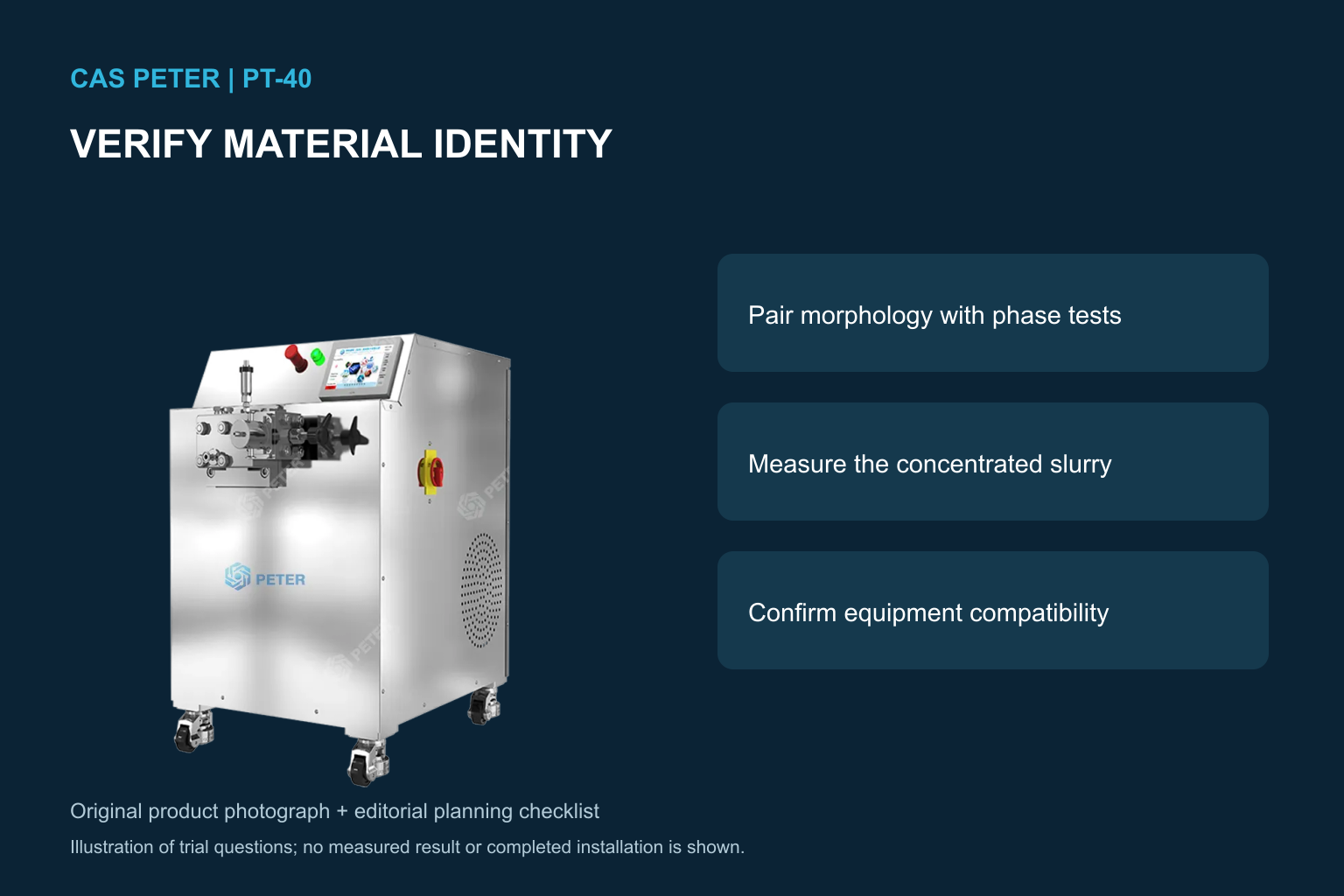
The CAS PETER PT-40 product page is a reference for discussing a pilot-scale trial. Suitability must be confirmed against the actual solids, coarse-particle population, flow behavior, liquid chemistry and temperature requirements. The illustration does not establish compatibility, allowable feed size, wear performance or a guaranteed hydroxyapatite endpoint.
Provide the equipment supplier with a representative feed description and the proposed upstream preparation. Ask how unacceptable coarse material will be detected before processing, which wetted components need review and how samples and retained material will be collected. Confirm the operating procedure for the configured machine rather than copying settings from a paper that used another device.
Plan a recovery balance across feed, collected product, samples and material retained in the system. Where contamination is relevant, agree on an appropriate analytical comparison and blank procedure. A successful trial should address both product quality and practical processing, with wear-related questions examined rather than assumed away.
The dispersion methods guide offers a broader framework for setting the trial objective. Choose the next condition only after reviewing the current evidence. More pressure or additional passes may add processing exposure without answering the original question. A documented stopping criterion should depend on the intended material properties and operating constraints.
Educational background on colloidal stability
The NPTEL lesson below introduces general colloidal stability concepts. It helps explain why a dispersed particle population and a stable suspension are related but separate observations. It is not a hydroxyapatite synthesis protocol, a pressure-processing demonstration or evidence for dental or implant performance.

Educational source: NPTEL-NOC IITM. Watch the lesson on YouTube.
Frequently asked questions
Does a smaller hydroxyapatite suspension size prove smaller crystals?
No. A wet size result can reflect reduced agglomeration without demonstrating a change in crystallite dimensions. Use complementary morphology and appropriate phase-characterization methods to investigate the intended distinction.
Should synthesis and homogenization be treated as one operation?
Only if the project deliberately studies a combined process and reports it that way. To isolate the homogenizer contribution, preserve a representative pre-pressure feed and suitable formulation controls from the same material batch.
Can a stable laboratory dispersion establish dental or implant suitability?
No. Dispersion stability is a material-processing observation. Dental efficacy, implant suitability and medical-product approval require additional application-specific evidence and qualification beyond the measurements described here.