

Lignin Nanoparticle Homogenization: Distinguish Solvent Effects from Mechanical Size Reduction
Lignin nanoparticle homogenization should be evaluated with the lignin isolation history and liquid composition held under control. A fine particle recovered after processing can reflect mechanical treatment, solvent-mediated particle formation or the later recovery step. Compare material before and after each operation instead of assigning the final size entirely to homogenizer pressure. Document the solvent system, confirm equipment compatibility before any trial and verify whether the recovered material retains its useful morphology and dispersibility after solvent exchange or drying. Published conditions are research examples, not operating instructions for every lignin grade or machine.
Start with the lignin, not a target particle diameter
Lignin is not a single standardized powder. Record the source, isolation process, lot, moisture basis and known residual components. Kraft lignin and organosolv lignin should not be treated as interchangeable feedstocks simply because both carry the same material name. Even within one source, a change in recovery or drying history can create a different starting dispersion.
Describe the intended product as well. A dispersion for incorporation into a polymer, a dry powder and a colloidal intermediate have different acceptance questions. The product specification should distinguish size, shape, recovery, redispersibility and application performance. A small reported diameter alone cannot describe all of these attributes.
The dispersion methods guide introduces the broader role of high-pressure processing. The focus here is the lignin-specific attribution problem: which operation created the particles being measured, and do those particles remain useful after the rest of the intended process?
Separate pressure homogenization from high-shear mixing
The term homogenization covers different mechanical operations. In a study of organosolv lignin from birch, researchers investigated isolation history and pressure homogenization in different ethanol-water systems. The observed particle morphology depended on both the starting lignin and the liquid composition. This supports testing solvent and isolation effects alongside the mechanical operation rather than treating pressure as the only variable.
A separate USDA-hosted research paper by Nair and colleagues studied kraft lignin using a high-shear mixer and examined chemical and polymer-composite properties. That operation is different from forcing a suspension through a high-pressure homogenizer. Its treatment time, particle results and composite findings cannot be transferred as a pressure-processing recipe or a performance claim for CAS PETER equipment.
When comparing published routes, first label the operation accurately. Then identify any dissolution, precipitation, washing, centrifugation or drying between the feed and the reported particle image. Without that sequence, two particle-size numbers may describe fundamentally different materials rather than competing machine results.
Make solvent history visible in the experiment
Prepare an explicit flow diagram in the development record: lignin isolation, initial dispersion, solvent conditioning, mechanical treatment, liquid exchange and final recovery. Sample at boundaries where the material may change. A sample taken only after drying cannot explain whether particle formation occurred during homogenization or during the subsequent change in liquid composition.
Include a matched solvent-conditioned control that bypasses the pressure step. Keep its mixing, residence time and temperature history as comparable as practical. If it forms a similar population after liquid exchange, the mechanical contribution needs closer examination. If pressure changes morphology or distribution reproducibly, keep that conclusion tied to the particular feed and solvent system tested.
Changing solvent content may change both dissolved material and suspended particles. State whether a measurement is on the whole dispersion, a separated fraction or a washed recovered solid. A transparent liquid is not proof that every lignin component has dissolved, and a dried microscopy specimen does not reproduce the entire wet-state population.
Review equipment compatibility before handling a solvent feed
Do not copy a solvent-rich published method directly onto a catalog machine. Confirm the complete composition, temperature, pressure envelope, seals, wetted materials, electrical installation and applicable solvent-handling requirements with the equipment supplier and responsible site personnel. A product photograph or model name cannot establish compatibility with a particular liquid.
The same review should include the actual suspended solids, coarse contamination and material tendency to deposit. Agree on feed preparation, representative sampling, cleaning and recovery before the trial. Removing a coarse fraction may protect equipment but also changes the feed; record what was removed and keep the resulting size claim scoped to that prepared material.
If a suitable configuration cannot be confirmed, change the trial route or defer machine processing. Literature evidence that a solvent system worked in one laboratory is not evidence that the proposed production installation can handle it. An aqueous route should also be evaluated on its own merits rather than assumed to reproduce a solvent-assisted result.
Use a sequence-based measurement plan
This table is a qualitative planning framework drawn from the process distinctions in the two cited studies. It contains no transferable pressure settings, size targets or recovery guarantees. Define the acceptance criteria for the actual application before comparing experimental runs.
| Process boundary | Question | Evidence to retain | Common attribution error |
|---|---|---|---|
| Isolated lignin | What structure and particle population enter preparation? | Isolation record, representative images and moisture basis | Calling all lignin grades equivalent |
| Solvent-conditioned feed | Did liquid composition already change the material? | Matched bypass control and wet-state observations | Assigning solvent-induced changes to pressure |
| After mechanical treatment | Did size distribution or morphology change reproducibly? | Comparable sampling, temperature and full distribution | Comparing unlike analytical preparation methods |
| After solvent exchange | Did the population persist or reform? | Liquid composition, recovery and particle observations | Reporting the recovered fraction as the entire treated batch |
| After drying and reuse | Can the intended dispersion or composite be prepared? | Defined redispersion procedure and application testing | Calling a fine dry image proof of functional recovery |
Keep analytical preparation in the batch record. Dilution, pH adjustment and sonication may alter particles before an instrument sees them. If a method requires such preparation, use it consistently and describe its limits. Where possible, retain an observation of the original dispersion so the reader can distinguish processing results from analytical redispersion.
Track material recovery alongside size
A fine recovered fraction can look attractive while representing only part of the original material. Record dry solids entering the sequence and the quantities collected in product, supernatant, wash liquids, deposits and samples as far as practical. Keep solvent removal and water content distinct from actual lignin recovery.
When a separation discards a coarse or soluble fraction, state that explicitly. The final distribution may be narrower because material was removed rather than because every particle became smaller. Both routes can be useful, but they lead to different yield, waste and scale-up questions. A development decision needs those tradeoffs visible.
Avoid reporting a mass balance with unrealistic precision. Explain the measurement basis, retained moisture and unresolved losses. If the recovery is uncertain, resolve that uncertainty before making a strong claim about the efficiency of the size-reduction operation. A particle-size result and a material-yield result should remain separate lines in the report.
Verify morphology and dispersibility after downstream processing
Compare wet-state size information with microscopy appropriate to the material. Microscopy can reveal shape and aggregation that a single average misses, but specimen preparation may change the appearance. Report how samples were deposited, washed and dried. Do not use one favorable field of view as proof of a uniform whole batch.
After solvent exchange, repeat the measurements under the new liquid conditions. If the final product will be dried, define the drying operation and the procedure used to redisperse it. A powder that needs intensive laboratory sonication to recover a fine distribution may not meet an application that allows only ordinary mixing.
Follow the intended polymer or coating preparation as a separate stage. Keep lignin loading, base polymer, solvent removal and conditioning fixed when comparing materials. Improvements reported for one polymer blend do not establish the performance of an unrelated coating, adhesive or composite. Measure the actual property the application requires.
Interpret a promising result before increasing process intensity
If the bypass control and treated sample converge after liquid exchange, investigate whether that downstream step dominates particle formation. If both remain different, compare recovery and morphology to determine what the difference represents. A smaller result with much lower recovered material may be a fractionation outcome rather than a better whole-stream process.
If size changes but the intended composite does not improve, the particle metric may not be the limiting factor. Review dispersion within the matrix, formulation compatibility and the relevant application test. Keep the experimental outcome even when it does not favor additional mechanical treatment; it can prevent purchasing equipment around a metric that does not deliver useful product value.
Repeat the selected route independently before discussing scale-up. Compare preparation times, thermal histories, recovery steps and analytical repeatability. The goal is a process that produces a defined usable material consistently, rather than the smallest isolated particle found in a single demonstration.
Build an equipment inquiry around representative material
The CAS PETER PT-40 product page provides a real pilot-scale product reference for discussing configuration. It does not certify a lignin solvent system or guarantee nanoparticle formation. Confirm compatibility and performance with the actual feed, proposed sequence and representative trial before selecting a configuration.
Send the supplier the feed composition, solids basis, starting particle distribution, solvent and pH history, temperature limits, recovery expectations and downstream use. Ask how bypass controls and samples can be collected, how the equipment will be cleaned and what material remains in the system. These details let a demonstration answer the development question instead of producing only an initial size printout.
Related guides cover choosing particle-size methods after processing and reviewing wetted materials for solvents and abrasive feeds. Use them to prepare questions, then resolve the configuration with verified material and equipment information.
Learn how extraction and precipitation influence lignin particles
The TU Wien educational video below introduces nanolignin and the role of extraction and precipitation. It provides useful upstream context; it is not a pressure-homogenizer demonstration or an instruction to reproduce solvent processing on a particular machine.
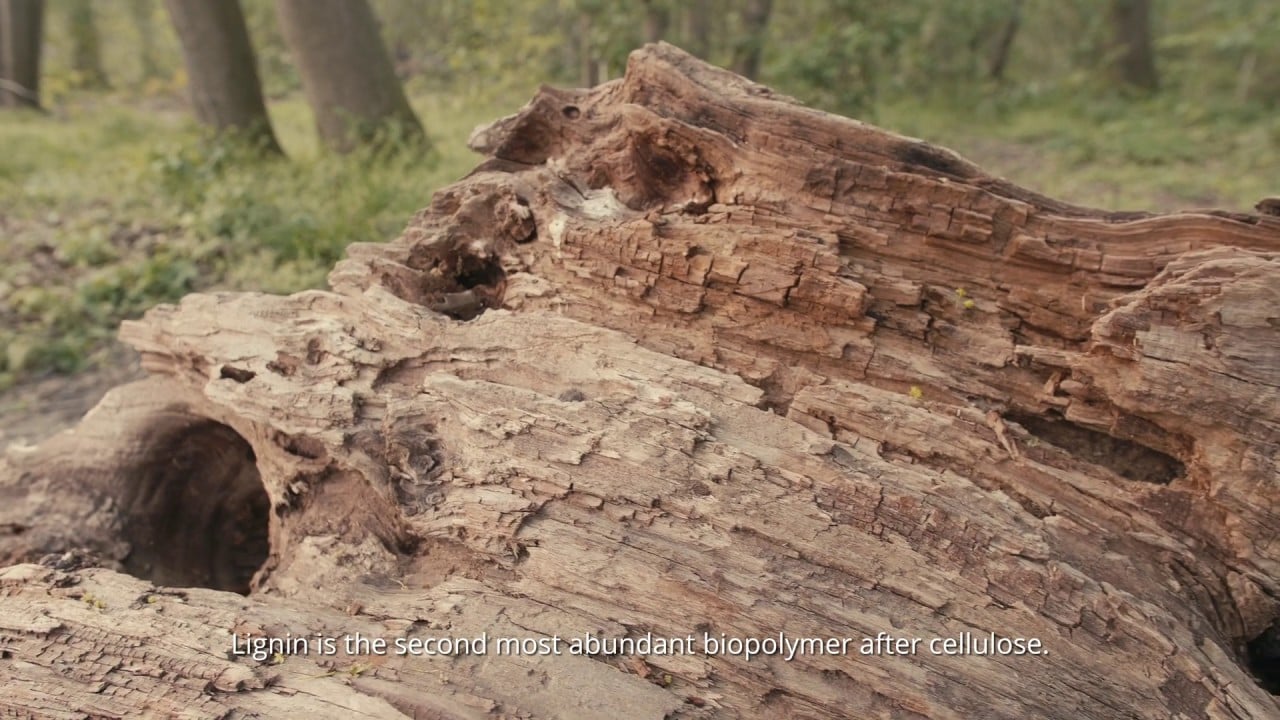
Educational source: TU Wien TV. Watch the lesson on YouTube.
Questions about lignin nanoparticle homogenization
Does a fine lignin particle size prove that pressure caused the change?
No. Isolation, solvent conditioning, precipitation and recovery can also affect the measured population. Compare a matched bypass control and sample before and after each important operation to identify the contribution of pressure treatment.
Can high-shear mixer results be used to choose homogenizer pressure?
No. A high-shear mixer and a pressure homogenizer apply different operations. Published mixer times and particle outcomes can inform scientific questions, but pressure-processing conditions must be developed for the actual feed and confirmed equipment configuration.
What should be checked after drying a lignin dispersion?
Evaluate recovery, morphology and redispersibility using the intended reuse procedure, then test the actual application. A fine particle image before drying does not establish that the powder will recover the same dispersion or improve every polymer system.