

Oat Milk Homogenization: Verify Stability After the Final Heat Step
Oat milk homogenization stability should be judged in the finished beverage, after the intended heat treatment and storage, rather than from a smooth sample collected at the machine outlet. Fix the grain preparation, enzyme treatment, solids, added oil and sampling conditions before comparing pressure settings. Then evaluate sediment, cream formation, particle-size distribution and flow together. A setting that improves the fresh dispersion may still leave a heat-sensitive or poorly redispersible product. The practical question is whether the complete recipe survives its complete process with acceptable texture and separation, not whether the smallest measured particle size has been reached.
Start with the beverage you actually intend to sell
Whole-grain, filtered and oil-enriched oat beverages are different feeds. A process developed for one should not be transferred to another without a matched trial. Record the grain source and lot, milling or grinding method, water addition, filtration, enzyme identity and treatment history. Keep the sequence explicit: an oat slurry measured before starch conversion is not a valid control for a beverage measured afterward.
State the desired use as well. A drinking beverage needs an acceptable mouthfeel and manageable separation during storage. A coffee ingredient also needs testing in the intended coffee preparation. A product intended for further fermentation needs assessment after that next step. Do not use a neutral-water dilution result as acceptance for every application. Write the actual failure to be resolved, such as compact sediment after storage or visible separation after heating, before choosing measurements.
Use the dairy and food homogenization overview to place the mechanical step in the wider process. Keep food safety qualification separate from physical stability: a uniform appearance cannot establish a safe shelf life.
What the oat research supports, and where it stops
A primary study of whole germinated oat milk combined grain germination, enzymatic preparation and high-energy fluidic microfluidization. In its particular system, treatment reduced particle size and delayed settlement, while apparent viscosity also changed. Those observations support measuring both size and flow in an oat beverage. They do not establish a universal optimum for filtered commercial oat milk, a valve homogenizer or a different grain preparation. The study’s complete process matters as much as its pressure setting.
A separate study of bottled oat milk under high-pressure processing used sealed containers subjected to hydrostatic pressure. That is a different operation from passing a flowing beverage through a homogenizing valve or chamber. Its thermal and microbiological findings cannot be adopted as a CAS PETER homogenization claim. When reviewing literature, identify the equipment arrangement and treatment sequence before putting any reported result in a trial specification.
For this trial guide, the useful shared lesson is to define the matrix and process first. The suggested checks below are a development workflow, not a prediction of either paper’s numerical results.
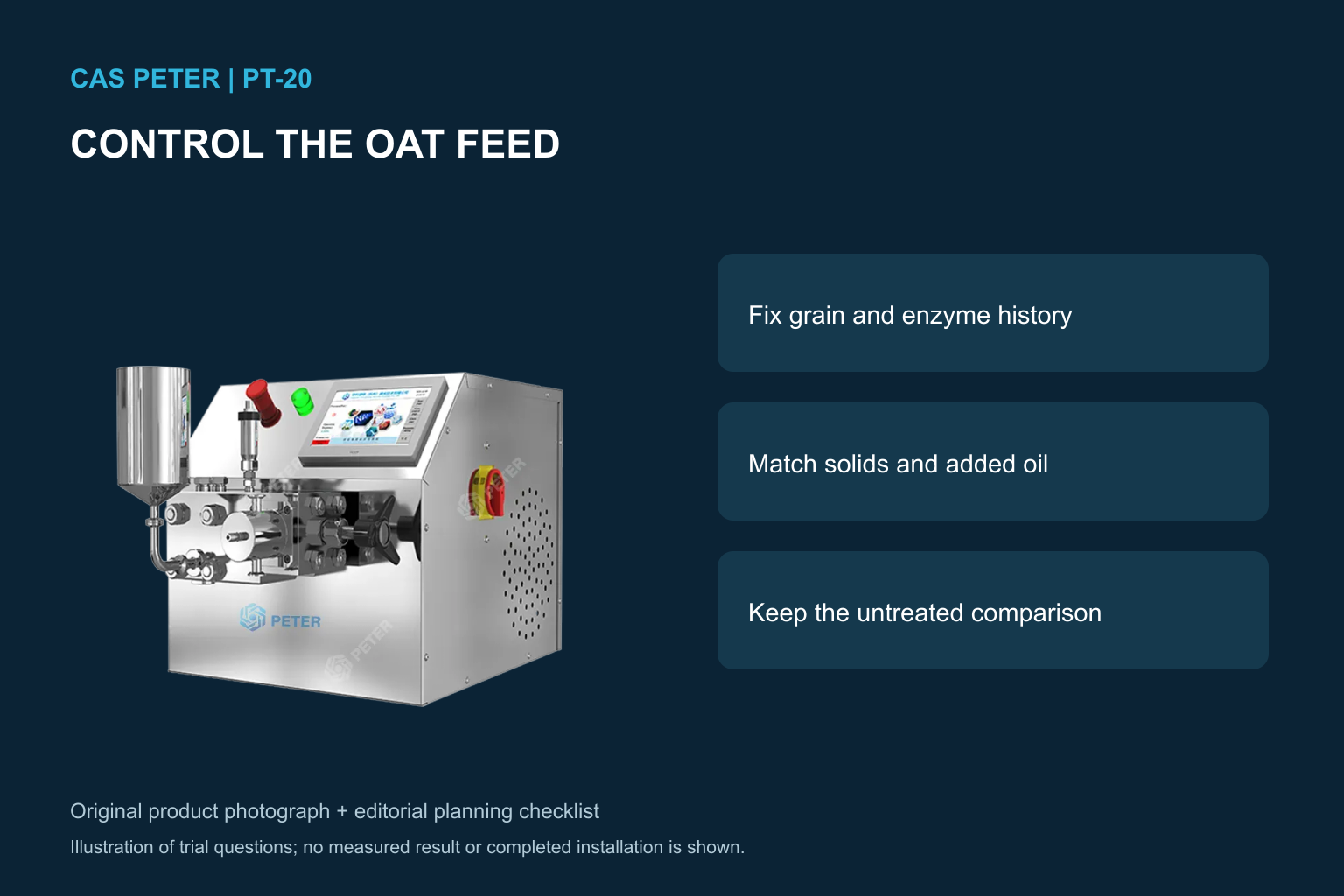
Lock the feed preparation before comparing machine settings
Prepare enough of one feed batch to support the comparison. Measure total solids using a consistent method and record pH, temperature and the time since preparation. If oil is added, record its amount and premixing procedure. If the feed is filtered, record the filtration step so that a reduction in coarse material is not mistakenly attributed to homogenization.
Enzyme treatment deserves its own checkpoint. Record when the enzyme is added, when the treatment ends and how that endpoint is established. Samples that continue changing while waiting for analysis will give a misleading comparison. Similarly, record any holding and heating before the machine. Comparing a cold, freshly prepared control with a warm, aged treatment makes pressure difficult to interpret.
Retain an untreated portion of the same prepared feed. Subject it to the same subsequent heating, cooling and storage as the processed portions where practical. If different portions must wait different lengths of time, record those differences rather than hiding them in one batch label. Independent feed batches are needed before deciding whether an apparent improvement is repeatable.
Build a trial that separates pressure from temperature and passes
Begin with a machine and feed compatibility review. Confirm allowable feed particle size, viscosity, solids, wetted materials, cleanability and the required cooling arrangement with the equipment supplier. An oat beverage containing retained coarse material should not be assumed suitable simply because the liquid can be poured into a beaker.
Change one primary processing factor at a time during screening. Keep the number of passes and the feed preparation fixed when comparing pressure. If passes are the variable, keep the pressure and sampling procedure fixed. Record inlet and outlet temperatures for each sample and note how the product is cooled between passes. A later sample may have experienced more recirculation and a different thermal history even when the displayed pressure is unchanged.
Collect representative samples after stable operation is established. Identify startup material separately and record usable product recovery. An attractive small sample is less persuasive if a substantial fraction of the batch is excluded. Preserve the control and processed portions using the same containers and handling schedule so the measurement reflects the treatment rather than bottle geometry or storage position.
Use a measurement panel that can identify the failure
The following is a qualitative development checklist. It contains no universal acceptance limits; choose limits from the intended product specification and demonstrated measurement repeatability.
| Question | Measurement or observation | Comparison needed | Interpretation limit |
|---|---|---|---|
| Is coarse material still present? | Full particle-size distribution and representative microscopy | Same preparation and dilution method | A smaller average can conceal a remaining coarse tail |
| Does sediment form during storage? | Standardized bottle photographs and sediment observations | Same fill height, temperature and elapsed time | A centrifuge result is a screening result, not a shelf-life claim |
| Is the top layer different? | Cream-layer or surface-layer inspection | Undisturbed matched bottles | Top and bottom separation should not be combined into one score |
| Has texture changed? | Flow curve at controlled temperature | Same shear and rest history | One viscosity reading does not describe every use condition |
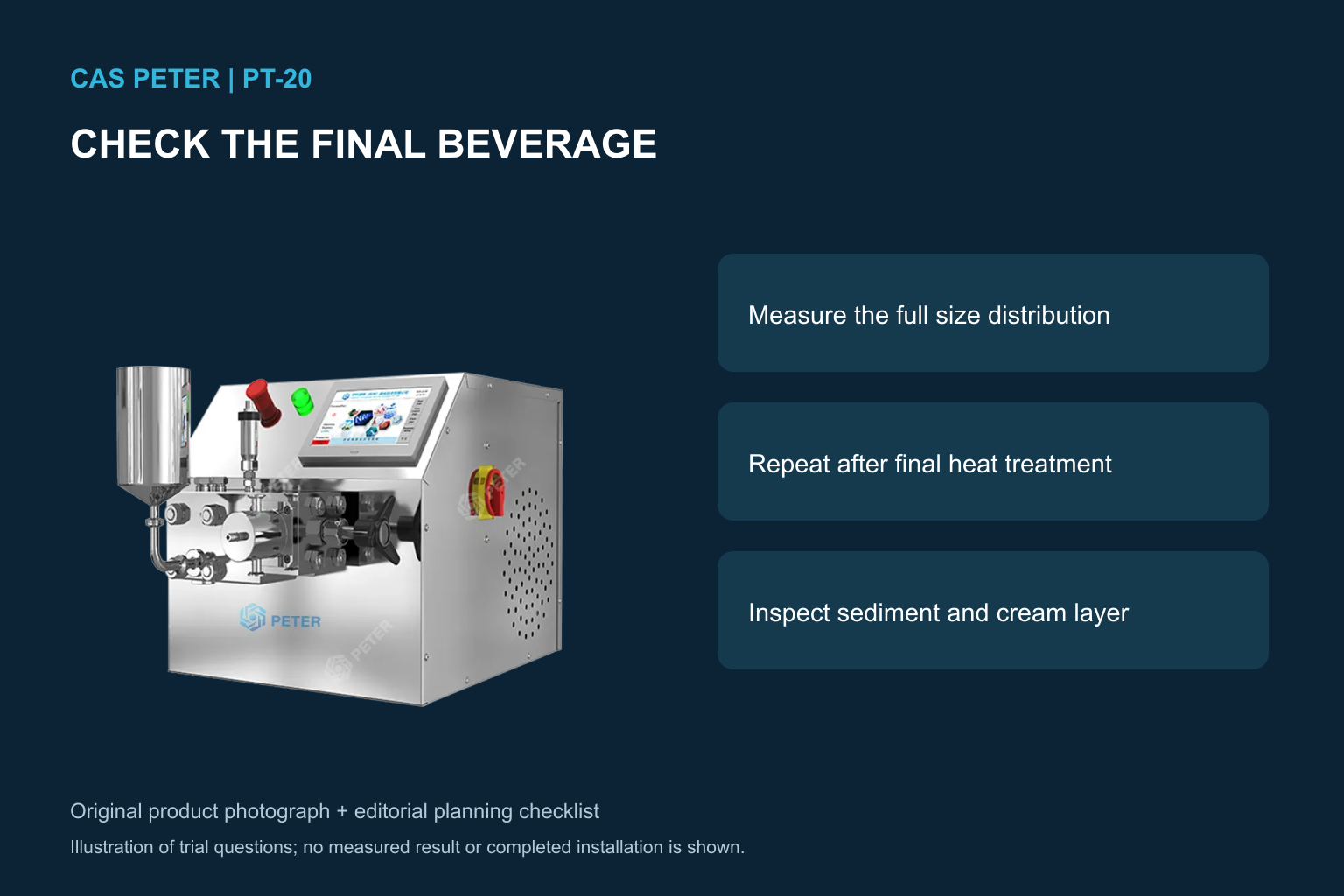
| Does heating change the result? | Repeat size, appearance and flow after the intended heat step | Heated control and heated processed samples | Fresh outlet quality does not establish final-product stability |
| Can the beverage be restored? | Defined gentle mixing and subsequent observation | Same mixing action for each bottle | Vigorous laboratory mixing may hide a consumer-relevant defect |
Inspect both top and bottom regions without first shaking the bottle. Photograph the undisturbed state, then carry out the defined redispersion action. This preserves evidence of separation while allowing the team to decide whether the remaining defect is acceptable for the product’s instructions for use.
Make the final heat step a planned checkpoint
Collect samples immediately before and after the intended thermal operation. Record the heating procedure, actual product temperature history where available, cooling and the time to analysis. Reproduce the intended sequence rather than adding an arbitrary heat exposure simply because it is convenient in the laboratory.
A processed beverage that becomes unstable only after heating needs a different investigation from one that settles before heating. First check whether the same behavior occurs in the matched control. Then review formulation, enzyme history and the thermal procedure alongside homogenization. Avoid repeatedly increasing pressure without evidence that a remaining coarse fraction is the cause of the final defect.
For coffee use, define the beverage-to-coffee ratio, preparation temperature and coffee source before comparing formulations. Treat that application challenge as a separate development endpoint. A sample that passes cold storage may still need reformulation for its intended use. Report those results separately so a successful cold-bottle test does not accidentally become a claim of universal compatibility.
Read particle size alongside viscosity and separation
Use a sizing technique suitable for the sample’s actual distribution. Record the dilution medium and dispersion procedure, and preserve the whole curve. Do not compare results obtained with different sample preparation as though pressure were the only difference. Microscopy can help check whether the detected coarse population is representative, but specimen preparation also needs a consistent method.
Relate the size result to the observed failure. If the average becomes smaller but compact sediment remains, examine the coarse tail and the sediment itself. If separation improves while the beverage becomes too thick, the process has created a tradeoff that must be evaluated against the intended texture. If size is unchanged after heat but appearance changes, do not force every observation into a particle-breakup explanation.
The existing oat beta-glucan homogenization guide addresses a narrower polymer and viscosity question. This beverage trial includes the whole matrix and final process. The almond beverage stability guide provides a complementary way to separate different visible failure modes; it is not a substitute recipe for oats.
Define a decision and an equipment inquiry
Choose the least demanding setting that meets the complete product specification reproducibly. Include final heat performance, storage observations, texture, usable recovery and process practicality in the decision. If two conditions are indistinguishable within method variation, do not describe the higher pressure as an improvement solely because its nominal setting is higher.
For discussion of an oat beverage development trial, the CAS PETER PT-20 product page is a starting point for configuration questions. Provide the real feed and intended processing sequence before requesting pressure, throughput or cooling advice. The photograph identifies a catalogue model; it does not show a documented oat milk installation or guarantee a food-contact configuration.
Send a short inquiry containing feed composition, grain preparation, enzyme and heat history, solids and viscosity information, largest relevant particles, trial volume, required recovery, cleaning expectations and the final defect to be resolved. Ask the supplier to confirm suitability and a trial plan. Keep results from pilot work separate from production guarantees until the scale and operating arrangement have been verified.
Educational context: why flow measurements matter
The following university lesson introduces food rheology. It helps explain why measurement conditions matter when comparing beverage flow; it is not an oat milk operating recipe or evidence of a validated shelf life.

Educational source: NPTEL IIT Kharagpur. Watch the lesson on YouTube.
Frequently asked questions
Can homogenization alone prove that oat milk is shelf stable?
No. Physical uniformity does not establish microbiological safety or a validated shelf life. Evaluate the finished beverage after its intended heat treatment, packaging and storage, using an appropriate safety qualification and a separate physical stability specification.
Should pressure always increase when sediment remains?
No. First inspect the coarse tail, feed preparation, formulation and final thermal history. A smaller average particle size may coexist with sediment, and extra processing may change texture without resolving the actual failure.
Why test both the fresh beverage and the heated beverage?
They represent different points in the process. Comparing matched samples before and after the intended heat step reveals whether an apparent improvement at the machine outlet survives into the product that will actually be packaged or used.