

Resveratrol Nanoemulsion Digestion: Separate Retention from Bioaccessibility
Resveratrol nanoemulsion digestion should be evaluated by measuring both the active compound remaining in the complete digest and the amount recovered in a clearly defined bioaccessible fraction. Droplet size before digestion cannot answer either question alone. Use matched formulations, controlled simulated digestion and validated extraction to distinguish chemical loss, redistribution and analytical loss. A promising laboratory fraction is evidence about that test system; it is not proof of absorption or a health benefit in people.
For formulation teams, the practical decision is which delivery system remains measurable, reproducible and suitable for the intended food or ingredient. High-pressure processing can be one preparation step, but the final result also depends on the composition, interfacial material, storage history and analytical method.
Write the endpoint before preparing a nanoemulsion
Start with the claim the trial must support. Chemical retention asks whether the selected form of resveratrol is still present. Release asks where it moves during a particular test. Bioaccessibility asks how much enters a fraction defined as potentially available for absorption under the method. Cellular uptake and human bioavailability require additional evidence and should not be inferred from those earlier endpoints.
Specify whether the assay measures trans-resveratrol, another identified form, or a combined result. Avoid calling an unidentified peak “active content.” If the formulation contains plant extracts, record their composition and additional compounds that may affect extraction or detection. Pure resveratrol and a grape-derived mixture are not interchangeable trial materials.
The emulsion process guide provides broader equipment context. This article focuses on designing a digestion comparison that does not confuse small initial droplets with successful delivery.
Use published systems as questions, not ready-made recipes
The primary study on interface composition and resveratrol stability prepared nanoemulsions with different casein-related interfacial compositions and examined resveratrol interactions and stability. It supports treating interface chemistry as an experimental variable. It does not establish that every protein or emulsifier provides equivalent protection, and its laboratory ingredients and preparation conditions should not be copied into a commercial food without a separate suitability assessment.
A second primary study examined resveratrol in tea-protein Pickering emulsions during simulated digestion. Its observations show why the gastric and intestinal stages must be distinguished when interpreting emulsion behavior. Those were particle-stabilized emulsions, not a directly interchangeable high-pressure nanoemulsion recipe. Use the paper to frame stage-specific observations, rather than transfer its performance to another interface or a CAS PETER machine.
The protocol below is an editorial planning framework. It combines these questions with analytical controls that a qualified laboratory should adapt and validate. It does not prescribe a clinical result, a formulation claim or a universal bioaccessibility target.
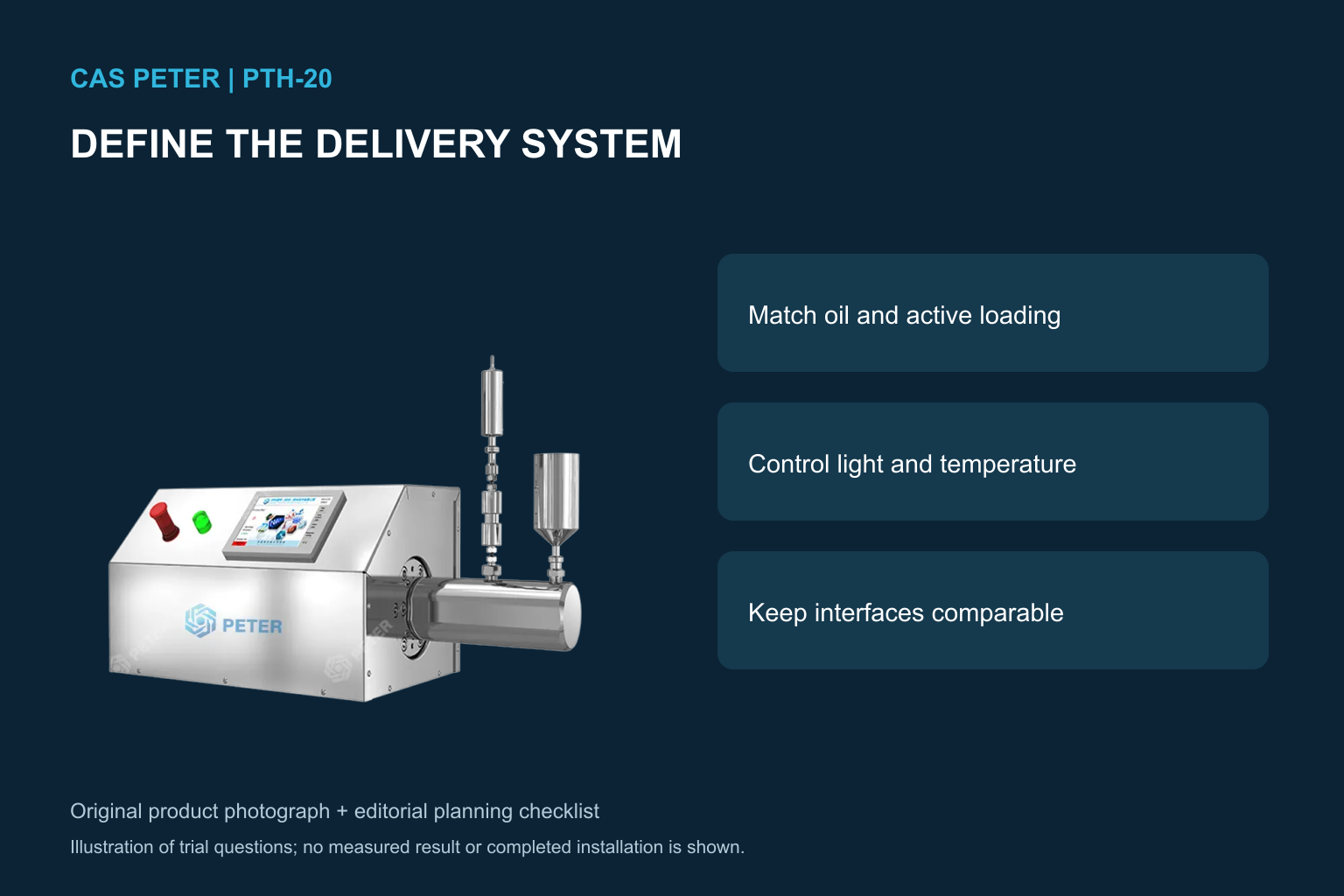
Control loading and formulation history
Choose one batch of active material and document purity information, storage and preparation date. Prepare the oil phase consistently, including the method used to dissolve or disperse resveratrol. Check for visible crystals before and after emulsification. A nominal addition is not the same as a verified dissolved or encapsulated amount.
Keep the oil fraction, emulsifier addition and aqueous composition matched when comparing processing conditions. If the purpose is to compare interfaces, state that explicitly and keep the other variables as constant as practical. Otherwise a change in oil type or active loading may be incorrectly attributed to homogenization.
Record the pre-emulsion method, feed temperature, pressure history, pass arrangement and cooling. Protect samples from uncontrolled light exposure during preparation and sampling. Use equivalent containers and waiting times for the control. Save a sample before high-pressure processing and another immediately afterward so that a later digestion failure can be traced to the appropriate stage.
Establish a baseline before simulated digestion
Measure actual active content in the whole emulsion using a validated extraction. Include an extraction blank and a recovery check in the formulation matrix. Analyze an appropriate active standard in parallel. If recovery is poor before digestion begins, there is no reliable baseline from which to calculate retention.
Characterize initial droplet size with a method suitable for the sample. Retain the distribution and the dilution procedure. Also examine the sample for coarse material or crystals, because a single size average may overlook a small but important population. Distinguish an optical observation from confirmed chemical identification.
Run storage history as a defined variable. Fresh and aged emulsions can enter digestion with different active content or physical states. Either digest freshly prepared samples on the same schedule or deliberately include an ageing comparison. Record light, temperature, package and elapsed time so the result refers to a reproducible starting material.
Plan the digestion stages and controls
Ask the laboratory to document the chosen simulated digestion method, including pH control, enzyme activity basis, bile addition, mixing, dilution and stage duration. Use a recognized method appropriate to the research question, and record any modification. Two tests described merely as “in vitro digestion” may expose samples to different conditions.
Include a formulation blank without resveratrol, an appropriate non-encapsulated active control and the complete delivery system. The blank can reveal interfering signals or scattering from the digest itself. The non-encapsulated control needs a clearly documented vehicle; a solvent-rich reference may behave differently from a food-compatible preparation and should be interpreted accordingly.
Arrange sampling so that removing aliquots does not materially change the remaining digestion mixture. Use separate vessels where necessary. Define the procedure for stopping or stabilizing each analytical sample, and validate that the procedure preserves the compound and does not create an artificial distribution between fractions.
| Endpoint | Material to analyze | Required method record | Interpretation boundary |
|---|---|---|---|
| Initial chemical loading | Complete emulsion before digestion | Extraction, calibration and matrix recovery | Confirms the amount actually entering the test |
| Gastric-stage retention | Complete sample collected at the defined stage | Quenching, timing and total sample volume | Describes survival in that simulated stage |
| Intestinal-stage retention | Complete final digest | Extraction of all relevant phases | Separates total loss from redistribution |
| Operational bioaccessibility | A specifically isolated intestinal fraction | Separation conditions and fraction volume | Depends on what the method includes or excludes |
| Physical transformation | Digest with a suitable blank and imaging or sizing method | Dilution and instrument limitations | Does not identify resveratrol concentration by itself |
This qualitative table provides decision questions rather than numerical acceptance limits. The two cited studies address different interfaces; neither supplies a pass criterion for a new commercial formulation.
Define the fraction before reporting a percentage
Write down how the intestinal fraction is obtained. Centrifugation, filtration and other separation steps can retain different structures. Record force rather than only rotor speed where relevant, along with temperature, duration, membrane information and the volume recovered. The label “micellar fraction” should match the method’s demonstrated separation capability.
Check whether separation removes crystals, droplets, protein aggregates or compound adsorbed to the vessel. A clear supernatant does not automatically contain every potentially available molecule. Conversely, residual fine droplets may contribute to the measured concentration. Use a suitable check to understand what your fraction actually contains.
Report the denominator alongside every percentage. A fraction compared with the original dose answers a different question from the same fraction compared with the active remaining in the final digest. Both may be informative, but they should never share an unlabeled “bioaccessibility” heading. Include total volumes and dilution factors so that concentration changes are not mistaken for mass changes.
Check recovery across the whole experiment
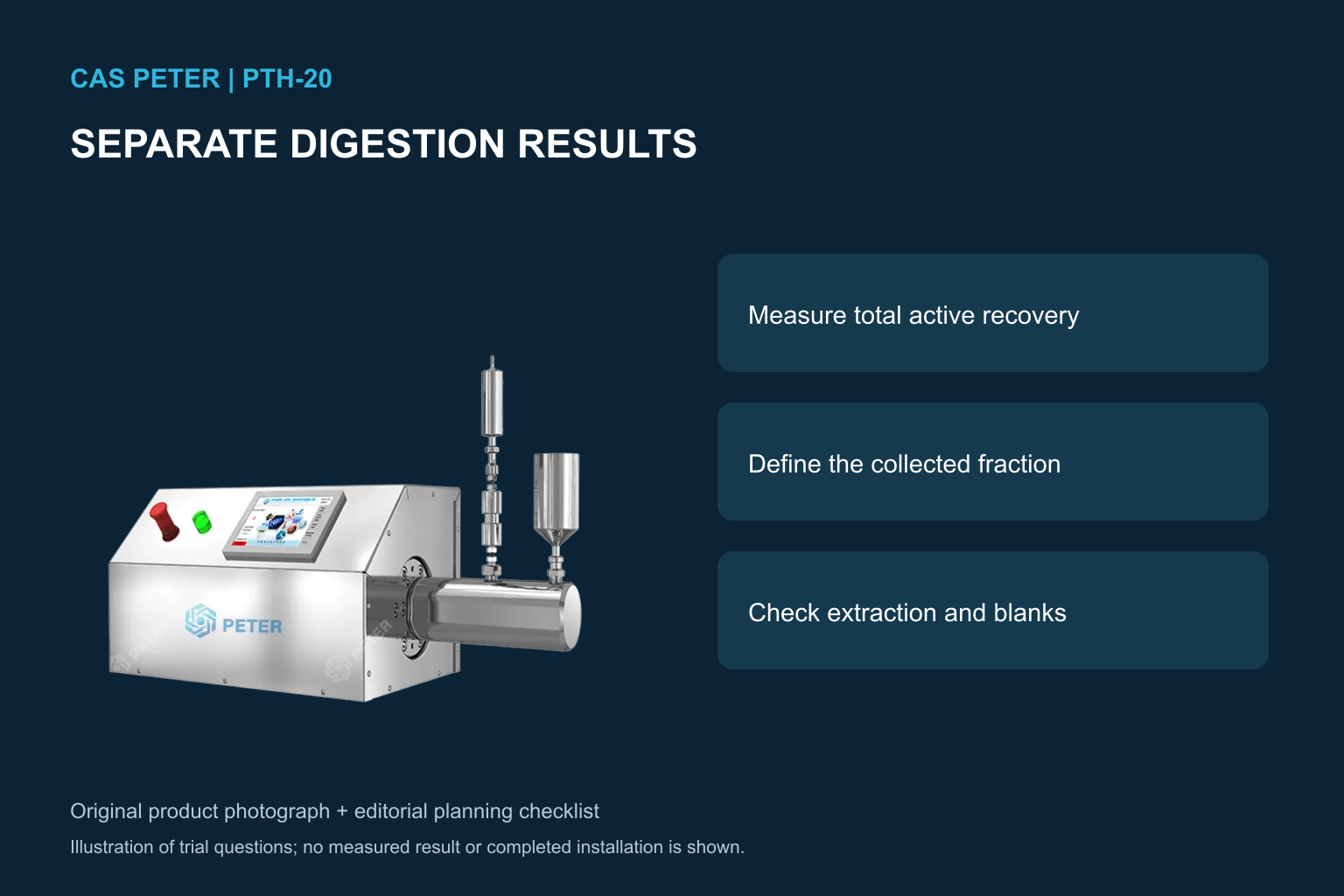
Analyze the complete digest and selected fraction in parallel when practical. If the whole digest retains the compound but the selected fraction contains little, investigate partitioning or separation rather than concluding that the compound degraded. If both appear low, examine chemical stability and analytical recovery together.
Use matrix-matched recovery experiments at relevant stages. An extraction that works in a fresh emulsion may fail in an enzyme-rich digest. Check the stability of prepared extracts during the time they wait for analysis. A consistent analytical sequence and documented quality controls help distinguish a formulation effect from an instrument or handling effect.
Retain chromatograms and supporting observations, not only a spreadsheet percentage. Investigate unexpected peaks or a changed response before assigning a mechanism. Antioxidant assays can provide another response, but they do not replace compound-specific quantification because other ingredients and digestion products may contribute to the signal.
Connect physical changes with chemical results
Digestion deliberately changes the environment surrounding droplets. A size increase in a gastric sample may indicate aggregation under those conditions, but the next stage can behave differently. Interpret the time sequence and a suitable blank before calling the formulation irreversibly unstable. Confirm important observations with an additional method when available.
Dynamic light scattering in a complex digest can report mixed populations. Enzymes, bile-related structures, proteins and residual droplets may all influence the signal. Follow the nanoemulsion stability testing guide for the distinction between distribution changes and a single average, then select methods appropriate to the digestive matrix.
Likewise, charge measurements require their own medium and dilution records. A change does not identify the location of resveratrol. The guide to zeta potential interpretation explains why a charge value should be considered alongside formulation and other observations, rather than used as a universal stability pass mark.
Choose a process on reproducible evidence
Compare independently prepared batches, not just repeated readings from one vial. Keep a record of failed preparations and specify whether they failed during processing, storage, digestion or analysis. A formulation that gives a high fraction once but poor reproducibility may be unsuitable for development even when its best result looks attractive.
When discussing the CAS PETER PTH-20, provide oil and emulsifier identity, active loading, solvent content, pre-emulsion properties, batch quantity, temperature limits and cleaning needs. Ask for confirmation of wetted-material compatibility and feed suitability. A product photograph or a published preparation pressure cannot establish the correct configuration for your material.
Select provisional conditions that meet physical quality and chemical recovery requirements together. Then repeat the full workflow with the intended food matrix and realistic storage. Keep claims limited to the experiment actually completed. This produces an equipment decision supported by a transparent test rather than a small-droplet photograph or an unlabeled percentage.
Educational background: emulsion technology
This NPTEL lesson introduces emulsion concepts useful when discussing interfacial composition and dispersed phases. It provides general education, not a resveratrol digestion method or evidence of human efficacy.
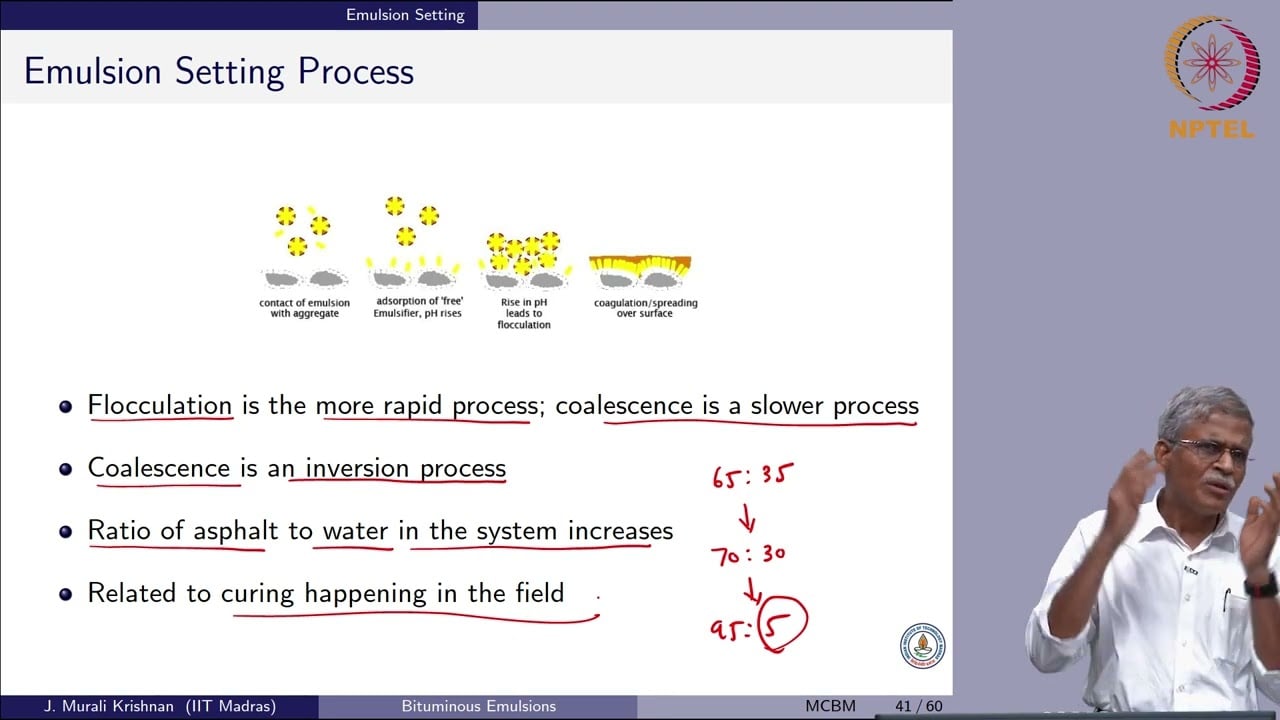
Educational source: NPTEL-NOC IITM. Watch the lesson on YouTube.
Frequently asked questions
Does a smaller nanoemulsion always improve resveratrol bioaccessibility?
No. Initial droplet size is one characteristic of the delivery system. Composition, active state, digestion conditions and the method used to isolate the analytical fraction also affect interpretation. Measure compound recovery and the defined fraction directly.
Can an in vitro digestion percentage be called human bioavailability?
No. A simulated digestion result describes the laboratory model and its operational fraction. Absorption, metabolism and outcomes in people require additional evidence. State the method and denominator without extending the claim beyond the test.
What should be checked when resveratrol recovery is unexpectedly low?
Check initial loading, sample volumes, extraction recovery, matrix interference, sample handling and separation losses alongside possible degradation. Analyze the whole digest where practical so that redistribution is not mistaken for destruction of the compound.