

Walnut Milk Homogenization: Separate Oil-Body Breakup from Heat Aggregation
Walnut milk homogenization should be evaluated as two connected tasks: dispersing the oil-containing feed and keeping that dispersion intact through the intended heat treatment. A smaller particle result immediately after processing does not establish stability in the packaged beverage. For a useful trial, keep walnut preparation, solids and formulation constant, compare samples before and after heating, and distinguish oil creaming from protein-rich aggregates and sediment. This guide explains how to build that comparison, interpret walnut research without copying its settings, and prepare an equipment enquiry around the actual beverage.
Define the walnut beverage before selecting pressure
A walnut beverage is a mixed system. Grinding releases oil-containing structures together with protein and insoluble material. The balance depends on kernel treatment, water addition, extraction and filtration. Two samples described as walnut milk can therefore contain different loads of oil, protein and coarse solids. Their responses to homogenization need not match.
Start with a written product definition: walnut ingredient, skin removal, roasting history, water composition, extraction temperature, filtration and final formulation. Record the mass of kernels entering preparation and the recovered mass of beverage. Retain a representative sample before homogenization. Without this baseline, an apparently improved dispersion could simply reflect more material being removed upstream.
Also define the intended finished state. A chilled drink, a heat-treated shelf-stable formulation and a fermented walnut product have different acceptance questions. Decide whether the priority is minimal separation, a particular mouthfeel, compatibility with another plant protein or stability through filling. Homogenization conditions should be compared against those objectives rather than chosen from the smallest number in a particle-size report.
What walnut research actually supports
In Chen and colleagues’ original walnut–soymilk study, the authors associated poor stability in the examined walnut system with aggregation during heating. Adding raw soymilk helped the processed mixture resist formation of larger aggregates. This is evidence that ingredient interactions and processing order matter; it is not a universal instruction to add soy to every walnut beverage. A soy-containing formula introduces its own product, composition and labelling requirements.
A separate original study of roasting and homogenization in walnut yogurt examined how those treatments influenced particle characteristics and the fermented product’s texture and microstructure. Its endpoint was yogurt, not an unfermented drink. The practical lesson is to follow the material into its final state. A condition that produces a useful fermentation gel cannot automatically be called the best condition for a pourable beverage.
These studies justify investigating heat response and ingredient history alongside dispersion. Neither establishes that a particular CAS PETER model has already processed the reader’s formula. The trial approach below is an engineering comparison proposed for evaluation, not a reproduction of either paper’s results or a validated commercial recipe.
Keep ingredient history separate from homogenizer effects
Prepare the main comparison from one well-mixed feed batch where possible. If roasting is a variable, create separately documented batches and compare homogenization conditions within each batch. Otherwise, differences in extraction and thermal history can be incorrectly attributed to pressure.
Treat walnut-only and walnut–soy formulations as separate experimental groups. Within a group, match final solids and composition as closely as the question requires. If adding soymilk also increases total protein, record that change explicitly. The result then describes a formulation change together with processing, rather than proving an isolated pressure effect.
Keep a handling control that experiences the same holding, mixing and cooling schedule without the intended high-pressure treatment. This helps reveal changes caused by residence time or temperature alone. Record the actual inlet and outlet temperatures for each run, including later passes. A nominally identical pressure setting can produce different sample histories when the feed warms during recirculation.
Sample around the final heat step
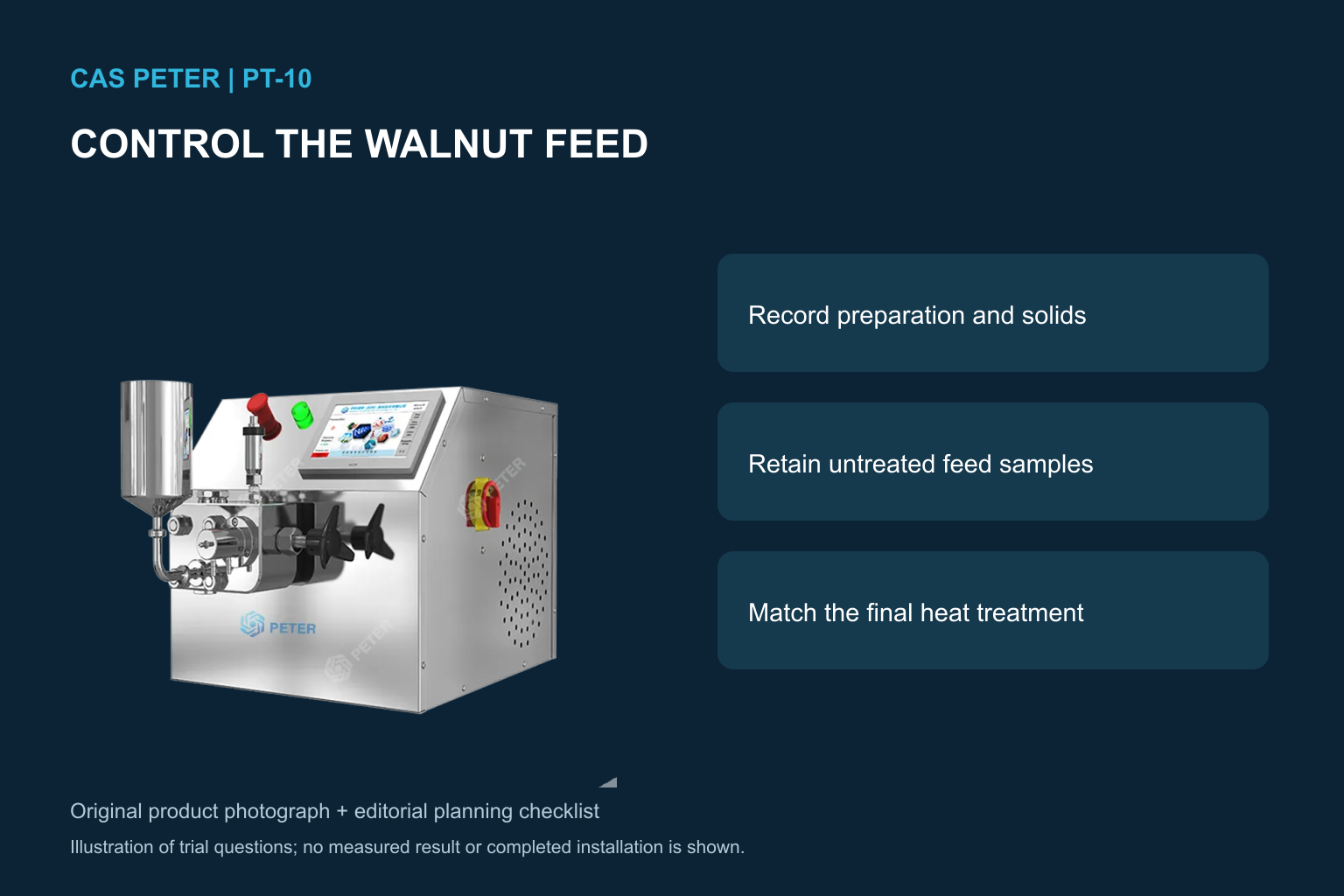
Take matched samples at four practical points: prepared feed, immediately after homogenization, after the intended heat treatment and cooling, and during storage. Use the same sample identifiers through all stages. If a sample looks good before heating but separates afterward, the heat step has exposed a weakness that the initial particle result did not resolve.
Specify heating and cooling by the measured product history available in the pilot setup. A bath setting alone is insufficient to describe what the beverage experienced. Record container fill, holding arrangements and the point at which timing begins. Keep these conditions consistent across treatments so that aggregation can be compared fairly.
Homogenization does not, by itself, establish microbiological safety or a commercial shelf life. Physical stability trials should sit alongside the qualified heat process, hygienic handling and microbiological programme appropriate to the intended product. Repeatedly opening a storage bottle for inspection can alter its conditions; use separate containers when that matters to the comparison.
Read separation as a set of different failures
Oil rising to the top, a compact deposit at the bottom and loose flocculation throughout the liquid are different observations. Photograph the whole bottle against the same background and record each layer separately. Describe whether gentle inversion restores uniformity, and whether visible grains or persistent clumps remain.
Use particle measurements with a clear preparation procedure. Dilution may change interactions between proteins and oil-containing structures. Record the dilution medium, ratio, mixing and waiting time. When possible, compare the instrument result with microscopy or another observation that shows whether the larger population consists of droplets, aggregates or insoluble fragments.
Avoid using a single average to describe every component. A mean value can fall while a troublesome coarse tail remains. Keep the full distribution and the instrument’s reporting basis. If different instruments are used, do not treat their diameters as interchangeable without understanding the measurement principles and sample preparation.
A decision table for the walnut trial
The following is a qualitative trial-planning table, informed by the distinction between heat aggregation and formulation effects in the cited walnut studies. It contains no universal operating limits.
| Observation | Comparison to make | Evidence needed before changing the process |
|---|---|---|
| Smaller measured particles but a cream layer remains | Compare post-process and stored bottles at matched composition | Layer photographs, distribution and redispersion observations |
| Stable before heating, clumps after cooling | Hold formulation fixed and compare the final thermal histories | Microscopy, coarse population and actual heating records |
| Walnut–soy blend performs differently | Separate ingredient change from pressure change | Protein and solids records plus matched untreated controls |
| Less sediment after finer filtration | Quantify what filtration removed | Feed and recovered beverage masses and solids |
| More passes improve size but worsen mouthfeel | Compare the complete product rather than size alone | Temperature history, flow behaviour and agreed sensory checks |
| Yogurt texture improves after processing | Keep the claim specific to the fermented formulation | Fermentation records, gel properties and water separation |
Compare flow and sensory quality at the intended temperature
A stable-looking bottle is not enough if the drink becomes too thick, grainy or difficult to pour. Measure flow under a defined procedure and at a relevant product temperature. For a laboratory viscosity measurement, specify the instrument geometry, shear conditions, sample rest and temperature. Preserve the method when comparing later batches.
Sensory evaluation also needs a consistent protocol. Use coded samples, a fixed serving temperature and attributes relevant to the product brief. Record graininess, oiliness, thickness and any heat-related change separately. An unstructured preference comment is difficult to connect with a particular processing mechanism.
Do not infer nutritional retention or oxidative stability from colour alone. If those are part of the product claim, include appropriate analytical tests and storage conditions. Bottle appearance can establish an appearance observation; it cannot independently establish chemical retention, safety or consumer benefit.
Place the equipment discussion after the feed review
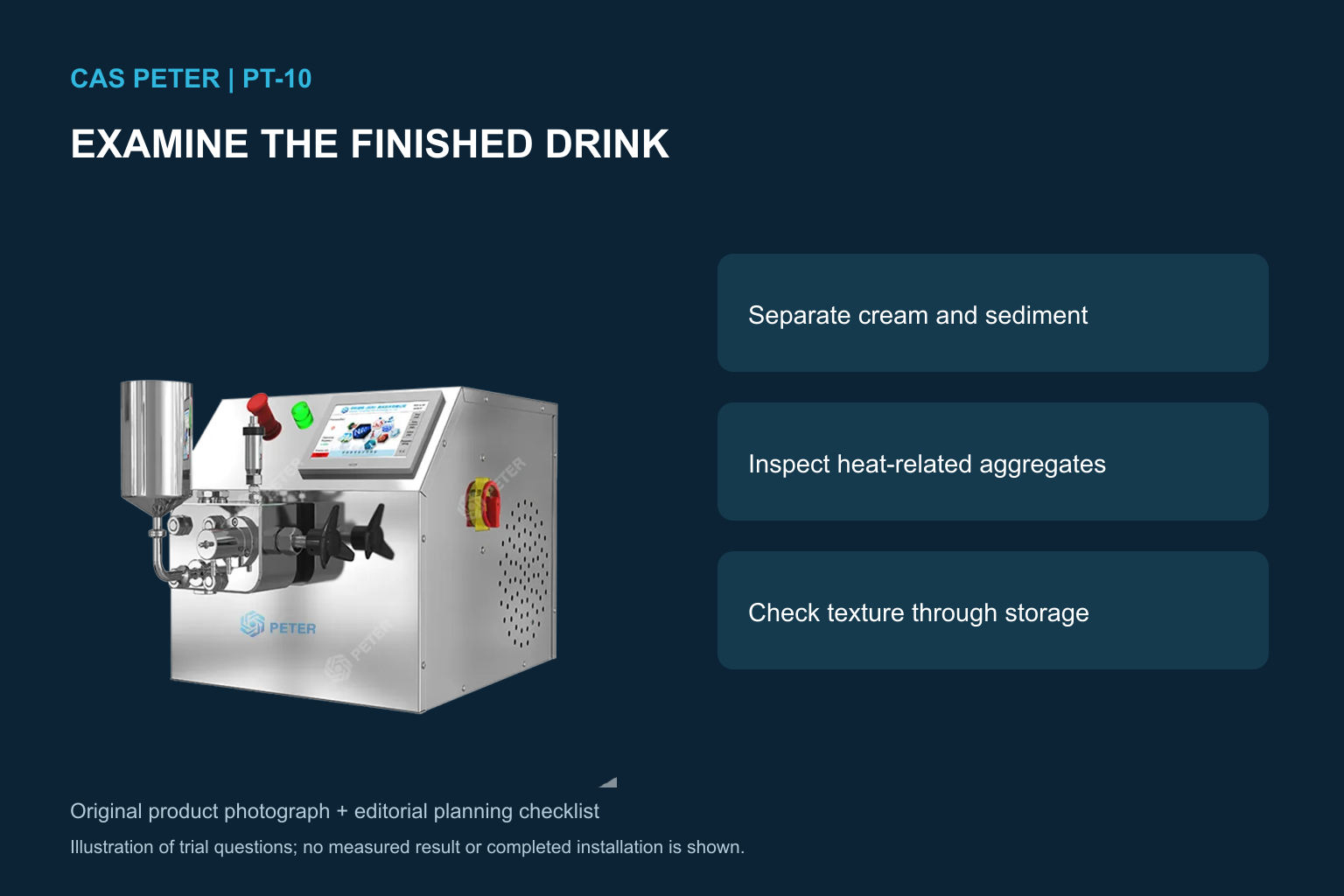
The CAS PETER PT-10 product page provides a real laboratory equipment reference for an initial discussion. Its presence here does not confirm suitability for a particular walnut feed, final viscosity or hygienic requirement. Supply the actual formulation and coarse-particle information, and ask the manufacturer to assess the proposed operating range and configuration.
For a meaningful enquiry, include the available sample volume, required collection volume, target throughput, inlet temperature, intended number of treatments, cleaning expectations and the heat process that follows. Explain whether the trial will compare walnut-only and mixed-protein systems. Ask how residual hold-up, cooling and sample recovery will be handled so that the comparison remains representative.
Use the site’s dairy and food homogenization guide for the broader process context. The almond beverage stability article offers a complementary way to separate creaming, sediment and oxidation questions, while the oat beverage final-heat-step guide helps frame sampling after the complete thermal process. Their ingredient-specific findings should not be transferred directly to walnut milk.
Build a release decision from repeatable observations
Choose acceptance criteria before ranking conditions. Examples of trial questions include whether separation remains within the product brief, whether gentle redispersion is adequate, and whether the texture remains acceptable after the final heat treatment. Set actual limits through the development programme; this article does not supply validated limits.
Repeat the promising condition with an independently prepared feed. A single good result from one kernel batch may reflect a favourable raw material. Keep records of supplier lot, preparation yield and composition so that a later change can be investigated. If the repeat fails, review feed differences before increasing pressure.
For the final trial report, connect every conclusion to the sample and stage actually measured. “Smaller immediately after processing” and “acceptable after heating and storage” are different statements. Preserve the raw distributions, photographs, flow measurements and preparation records so that the selected condition can be reviewed when moving to another scale.
Educational background: emulsion formation
The following NPTEL lesson supports the general emulsion concepts behind the trial. It is not a walnut formulation recipe, a machine demonstration or evidence of performance by the equipment pictured in this article.
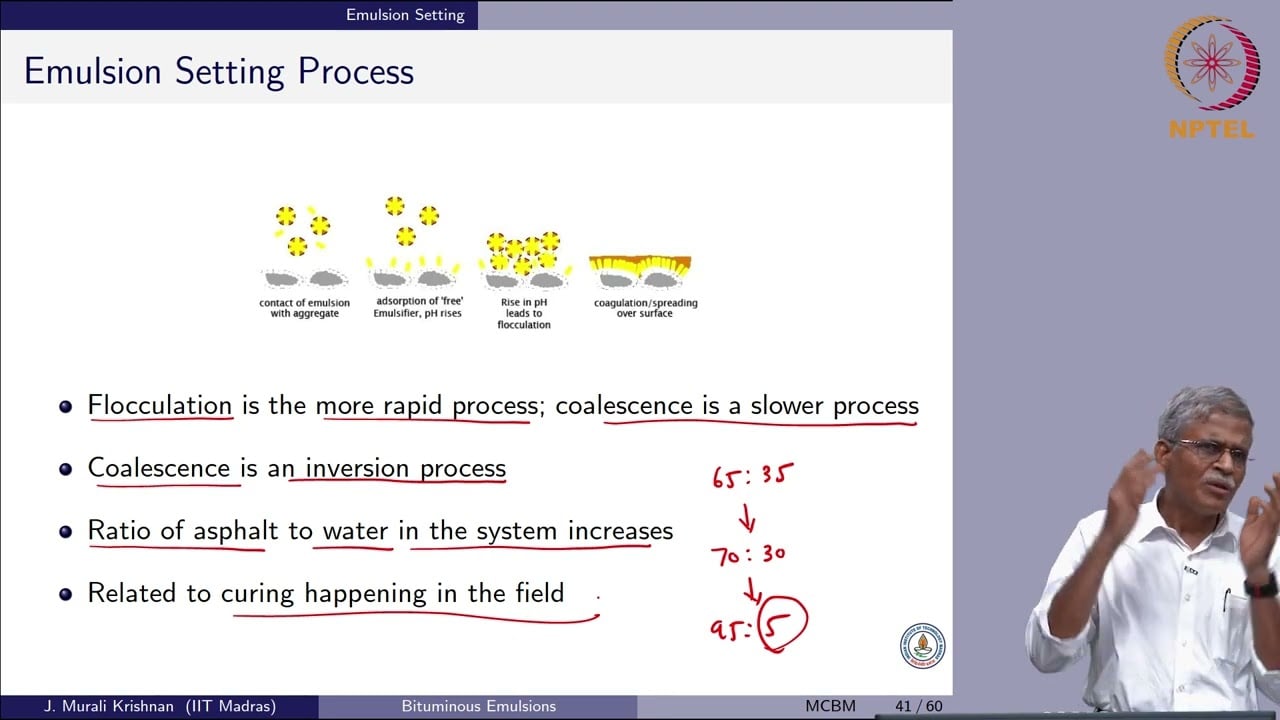
Educational source: NPTEL-NOC IITM. Watch the lesson on YouTube.
Frequently asked questions
Does more pressure always make walnut milk more stable?
No. Judge the complete formulation after heating, cooling and storage. More intense treatment can change particle populations and temperature history, but an initial size reduction does not establish resistance to later aggregation or acceptable mouthfeel.
Should raw soymilk be added to every walnut beverage?
No. The cited study investigated a specific mixed system. Soy addition changes the formulation and product requirements. Compare it as a documented formulation option, with appropriate composition controls, rather than treating it as a universal processing aid.
Can walnut yogurt results be used to approve a walnut drink?
They can inform questions about ingredient history and processing, but they cannot approve a different product. A fermented gel and a pourable beverage require their own final-product tests, thermal histories and acceptance criteria.