

Whey Protein Heat Stability After Homogenization: Test the Final Thermal Step
Whey protein heat stability after homogenization must be checked through the intended heating and cooling sequence, in the actual formulation. A smoother dispersion immediately after pressure processing does not establish that the protein will remain dispersed during a later thermal step. Compare an untreated control, a temperature-history control where practical, and homogenized material using the same protein concentration, pH, mineral composition and sample age. Then evaluate changes in soluble protein, aggregation, flow and visible separation after heating. This approach helps ingredient developers decide whether homogenization improves their finished product, rather than simply improving its appearance before the most demanding operation.
Define the product that must survive heating
Begin with an acceptance statement that describes the intended food. A pourable protein beverage, an ingredient concentrate and an emulsion gel need different outcomes. Increased viscosity may be useful in a gel and unacceptable in a drink. A trial therefore needs to identify both the desired function and the changes that would make the material unsuitable.
Record the whey ingredient type, supplier lot and declared composition. Whey protein isolate, concentrate and a blend with other proteins should not be treated as interchangeable feedstocks. Include other ingredients in the record, especially acidulants, mineral additions, sugars and stabilizers. If the first screening uses protein in water, label it as a screening formulation and repeat successful conditions in the complete recipe.
Specify when pressure processing occurs relative to heating. Homogenizing a native protein solution before thermal treatment asks a different question from breaking down aggregates after a previous heat treatment. Moving the homogenizer between these positions changes the material entering the machine. It also changes what a successful result means. Keep processing order fixed within a comparison, and evaluate a changed order as a separate experiment.
What the research supports—and what it does not
A study of dynamic ultra-high-pressure processing of whey protein evaluated structure and several functional properties in a dilute protein preparation. Its thermal measurements did not support a simple rule that pressure always increases heat stability. Improvements in selected functional measurements occurred alongside changes in thermal denaturation behavior. That is a reason to measure the relevant thermal endpoint directly, rather than infer it from a smaller particle result.
A pilot-scale investigation of whey protein gel emulsions examined combined heating and pressure in a particular emulsion system. The resulting structures depended on the treatment combination. Its relevance is the interaction between formulation, heating and homogenization; it does not supply a universal recipe for a clear whey beverage or a production line with a different residence-time distribution.
These are different experimental systems. Their reported pressures and temperatures are not operating recommendations for CAS PETER equipment. Neither paper demonstrates the performance of a particular CAS PETER machine or validates the shelf life of a customer formulation. The trial framework below is an editorial planning approach, to be adapted with the ingredient supplier, equipment manufacturer and analytical laboratory.
Build a formulation and thermal-history record
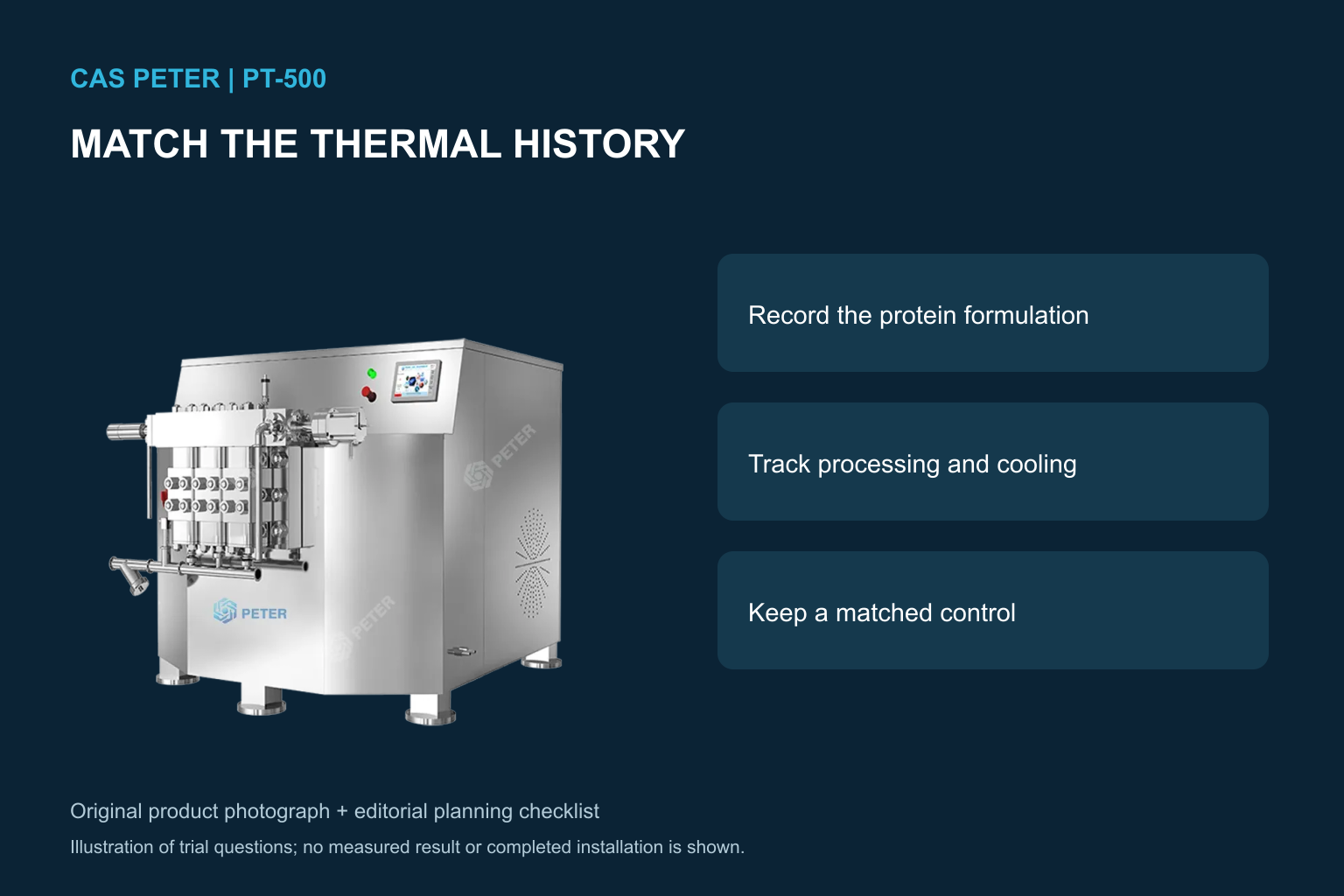
Prepare a single well-mixed parent batch whenever feasible and divide it into the comparison groups. Record the hydration procedure and time between preparation and processing. If protein has not hydrated consistently, later differences may reflect preparation rather than the pressure treatment. Do not silently add water to one group to make it easier to pump; that changes the protein concentration being compared.
Measure pH using the same method and temperature for all groups. Record mineral additions and the source water, rather than describing the formulation only as “neutral whey.” When pH adjustment changes dilution or introduces additional ions, include that change in the formulation sheet. If pH is an experimental variable, treat each pH as its own formulation block.
Temperature history needs more detail than a single inlet reading. Record feed temperature, outlet temperature, cooling arrangement, time before the final heating step and final cooling procedure. Repeated passes may give a sample more than one heating and cooling exposure. The guide to temperature rise during homogenization explains why pressure settings alone do not describe the thermal experience of a batch.
Use controls that separate the causes of change
The untreated control should undergo the same preparation, holding and analytical schedule as the processed groups. It should not be an older sample taken from a different batch. A pumped or circulated control can also be useful if the transfer route itself changes aeration, temperature or holding time. Describe exactly what this control includes.
Where the experimental setup permits, use a temperature-history comparison to explore how much of the observed difference might be associated with heating. Such a comparison will not perfectly reproduce all local conditions inside a homogenization device. Present it as a useful control with limitations, not as a complete separation of mechanical and thermal effects.
Choose a manageable set of processing conditions that the manufacturer has confirmed are compatible with the feed and installed configuration. Change one planned factor at a time during screening, or use a documented experimental design when studying interactions. Collect independent batches for confirmation; repeatedly measuring one bottle does not demonstrate repeatable manufacturing performance.
Run the intended final thermal challenge
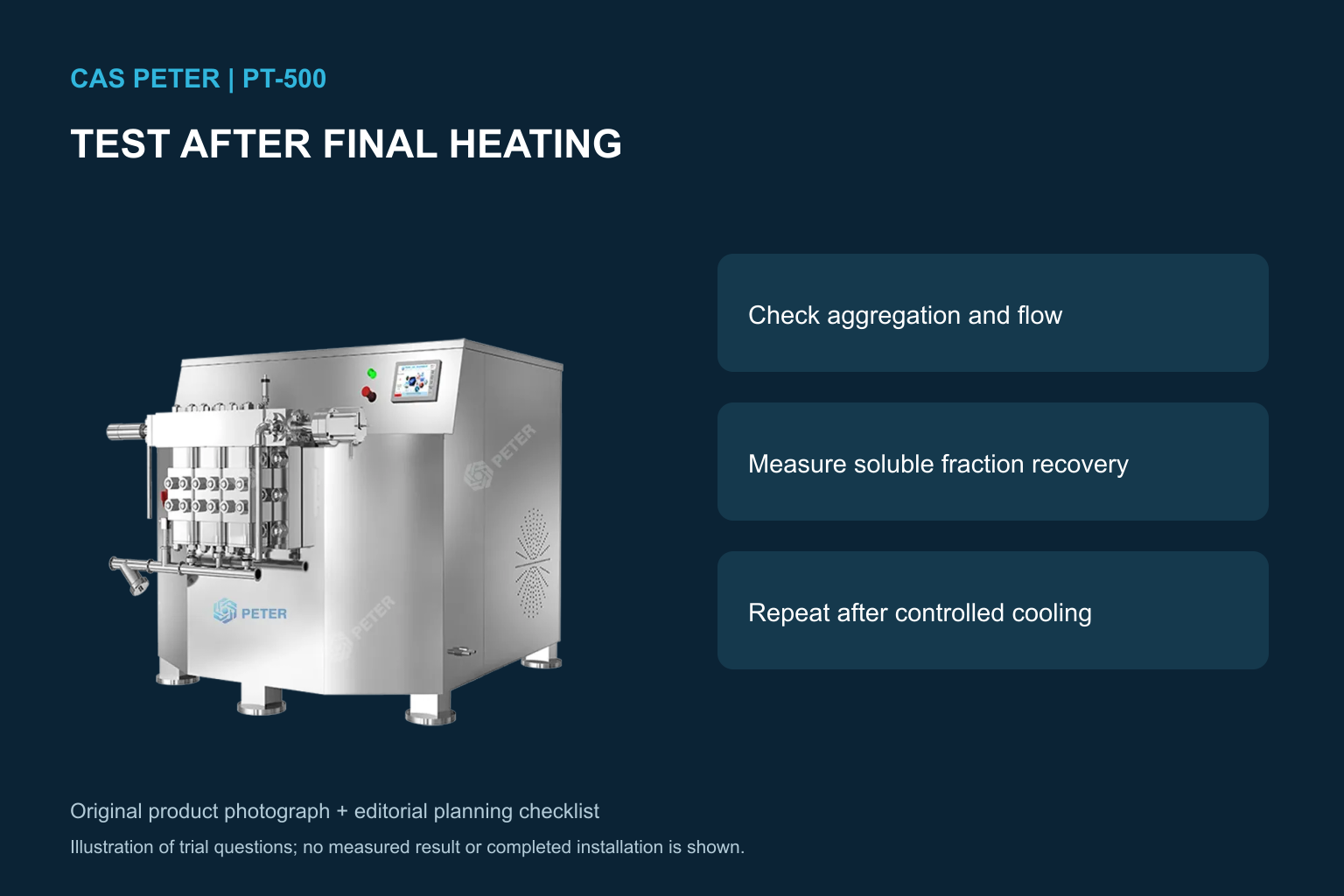
A laboratory heating test should represent the question being asked. A convenient water-bath treatment can rank candidate formulations, but it does not automatically reproduce an industrial heat exchanger. Document the sample vessel, heating profile, hold definition and cooling profile. A nominal setpoint without a measured sample history is insufficient for a meaningful comparison.
If the product will undergo another process after heating, include that operation in a later confirmation stage. Dilution, flavor addition or filling may expose weaknesses that are absent in the concentrated ingredient. Use a staged trial so that the first experiment remains interpretable while the final decision still reflects the complete product route.
Do not turn this quality trial into a microbial validation claim. Protein aggregation, viscosity and visible sediment describe physical or functional behavior. They do not establish that a process achieves a required food-safety outcome. The thermal operation and any microbial acceptance requirements need their own validated basis.
Choose measurements that answer different questions
| Trial question | Useful comparison | Interpretation limit |
|---|---|---|
| Does heating create visible instability? | Matched photographs and separation observations before and after heating | Appearance cannot identify the chemical cause |
| Does the protein remain in the chosen soluble fraction? | A defined separation method followed by a validated protein assay | The result depends on the separation protocol |
| Does aggregation change? | Suitable size analysis plus microscopy where needed | A single average size can conceal a coarse fraction |
| Does the product remain pourable? | Flow measurements at matched temperature and sample age | Results from different shear histories are not directly comparable |
| Does performance persist after cooling? | Repeat the agreed tests after a controlled hold | An immediate reading does not establish storage life |
This table proposes qualitative trial questions rather than published pass limits. The two linked studies illustrate why multiple endpoints are needed, but the acceptance criteria must come from the intended product specification. Set those criteria before selecting the apparently best treatment.
For protein assays, document the sampling and extraction procedure and check whether recipe components interfere with the analytical method. Report both the assay result and its basis. A percentage described as “soluble protein” is incomplete if the reader cannot tell how the soluble fraction was separated or how recovery was calculated.
For particle measurements, choose a method suitable for the material and expected size range. Avoid comparing measurements made after different dilution steps. Diluting a heated protein system can change the environment being measured. Record the dilution medium and timing, and retain representative undiluted material for complementary observations.
Interpret a smaller particle result cautiously
A decline in a measured particle-size statistic can be useful evidence of dispersion change. It does not by itself distinguish all of the processes that matter to thermal performance. Combine size measurements with the formulation history and the post-heating results before deciding whether the treatment is beneficial.
Consider a trial in which homogenization improves the initial appearance but the heated sample develops more sediment than the untreated control. The immediate visual improvement should not outweigh the failure at the product’s required endpoint. Investigate formulation, processing order and temperature history before increasing pressure further.
Conversely, a modest initial change may still be useful if the complete product meets its post-heating flow and separation requirements more consistently. The decision should weigh the agreed quality endpoints, reproducibility and process practicality together. The plant-protein emulsion evaluation guide offers a related example of qualifying an ingredient in its finished formula, although its material-specific findings should not be transferred to whey.
Translate the result into an equipment discussion
For production planning, the CAS PETER PT-500 product page is a starting point for discussing a production-type machine. It is not proof that a particular whey formulation can be processed at a specified capacity or achieve a specified thermal result. Confirm the installed pressure range, contact materials, cleaning arrangements, cooling needs and permissible feed characteristics directly with the supplier.
Send the supplier a concise material description and the trial’s actual objective. Include protein concentration, pH range, expected viscosity, any visible solids, operating temperature and the position of the machine in the thermal sequence. Describe the proposed acceptance tests so that machine suitability and product quality are discussed together.
Scale-up should preserve the relevant process history rather than only a pressure number. Compare time outside controlled cooling, pass routing, sample recovery and the downstream thermal operation. Keep the successful laboratory control alongside production trials where practical. The broader dairy and food homogenization guide provides context for connecting process selection with finished-product requirements.
Further learning: food rheology
The NPTEL lesson below provides neutral educational background on food flow behavior. It helps explain why a viscosity result needs a stated measurement condition. It is not a whey-specific thermal validation method or an endorsement of any machine.

Educational source: NPTEL IIT Kharagpur. Watch the lesson on YouTube.
Frequently asked questions
Does high-pressure homogenization always improve whey protein heat stability?
No. The outcome depends on the formulation and the complete processing history. Evaluate the homogenized material through the intended heating and cooling sequence, using controls and several relevant quality measurements. Immediate dispersion quality alone is insufficient.
Can a smaller particle size replace a thermal stability test?
No. A size result describes one aspect of the sampled dispersion under the measurement conditions. Thermal acceptance also requires observations such as aggregation, soluble-fraction recovery, flow and separation after the intended heat treatment.
Which pressure should be used for a whey protein trial?
There is no universal pressure recommendation for all whey products. Agree on a safe, equipment-compatible screening range with the manufacturer, keep formulation and thermal history controlled, and select conditions from reproducible finished-product results.