

Zinc Oxide Dispersion After Homogenization: Separate Dissolution from Deagglomeration
Zinc oxide dispersion after homogenization should be assessed by tracking both suspended particles and dissolved zinc. A smaller light-scattering size, clearer liquid or lower sediment level can have several explanations: agglomerate breakup, settling of a coarse fraction, dissolution or changes caused by the measurement medium. These outcomes are not interchangeable. Use representative sampling, a matched dispersant system and a validated separation method before calling a trial successful. The objective is to retain the required particulate material in a usable formulation, with acceptable storage and application behavior, rather than to obtain the smallest isolated instrument reading.
Define whether the trial concerns dispersion or synthesis
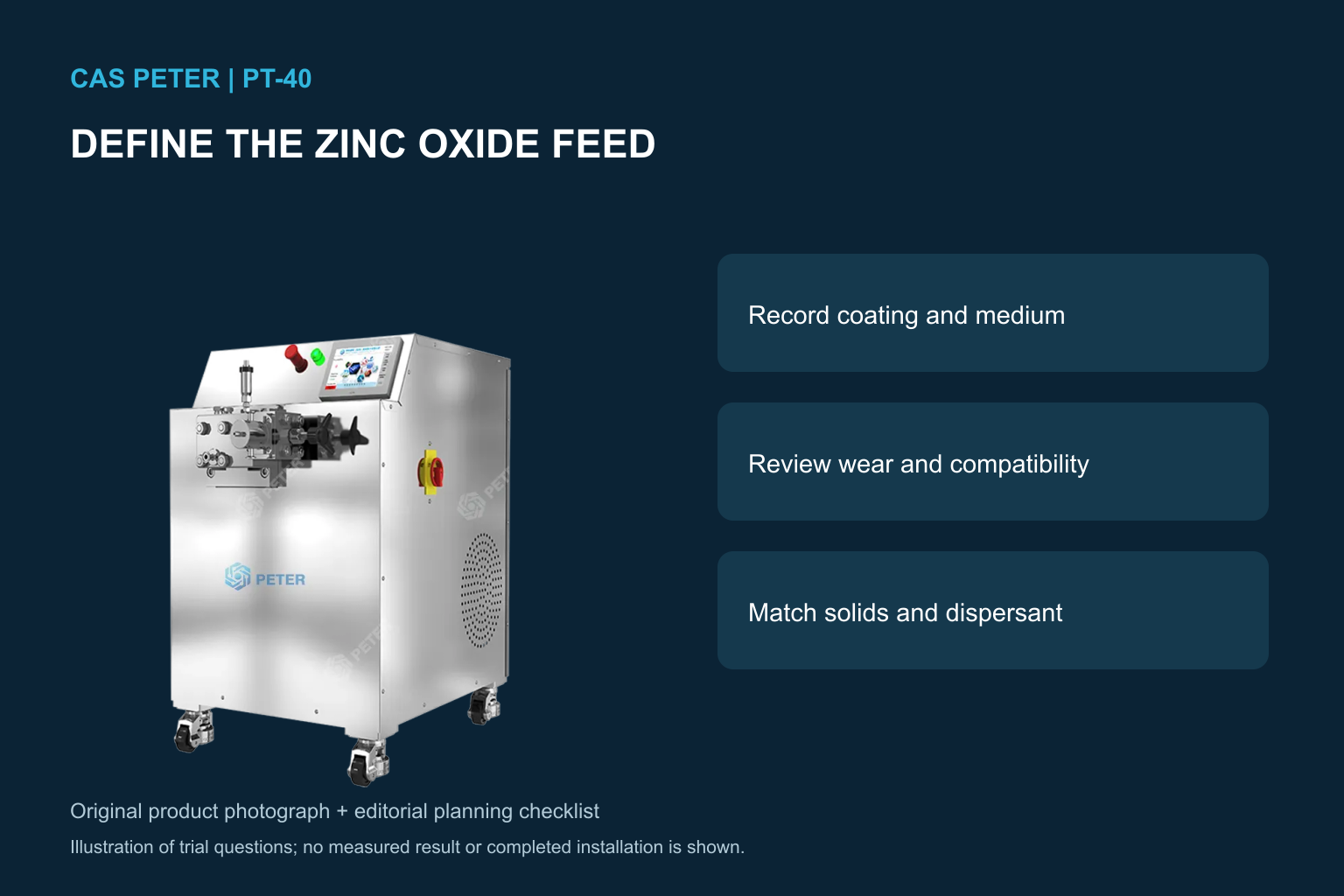
Start with the actual powder or stock dispersion. Record supplier, lot, surface coating, moisture and the available particle-characterization information. A primary crystal size reported for a powder is different from the size of the objects moving through a liquid. Those objects may contain several crystals, carry a coating or form larger agglomerates. Preserve these distinctions in the trial record.
Dispersion processing begins with existing solids. Synthesis creates the material through a chemical or physical preparation route. If a paper uses a heated pressure reactor to form zinc oxide, its pressure and temperature do not describe a homogenizer dispersion trial. Confusing the two can lead to an unsuitable equipment request and an incorrect interpretation of what a machine can achieve.
The study of PVA-based compositions containing zinc oxide prepared zinc oxide through precipitation followed by a pressure-reactor step, then incorporated the powder into formulations. Its observations are useful for understanding changes after incorporation. They do not establish high-pressure homogenization settings or prove that a valve or microfluidizer will produce the same particles from arbitrary feed.
Make the liquid medium part of the specification
Document the continuous phase, pH, conductivity, dispersant identity and concentration. State whether the zinc oxide is coated and whether the coating is intended to remain present. A recipe change made to improve wetting may also change dissolution or interactions between particles. Keep the original and modified systems separate in the trial plan instead of merging them into one pressure-response series.
A study of zinc oxide suspension stability examined both hydrophilic and coated material in different media. Its stock suspensions were prepared by ultrasonication, not high-pressure homogenization. The study showed why particle behavior and zinc dissolution need time-dependent characterization, and why transferring a stock dispersion into another medium requires a separate check. Its physiological-media formulations are not universal dispersant recommendations for industrial products.
Match medium composition during measurement. Diluting a dispersion with pure water can change the conditions around the particles, especially when the original formulation contains salts, polymers or surfactants. If dilution is necessary, justify the diluent and demonstrate that it does not create a different size distribution during the measurement interval. Record dilution factor, order of addition and time before analysis.
Plan a representative homogenization trial
Prepare a uniform, supplier-reviewed predispersion that meets the equipment feed requirements. Check the accepted coarse material and viscosity before processing. Do not force an incompatible powder slurry into a trial merely because a product page mentions nanoparticle applications. Material compatibility, abrasion, feed handling and cooling need to be assessed with the actual formulation.
Record pressure, number of passes, flow and temperatures rather than only the nominal setpoint. Measure recovered mass and keep losses visible. If coarse solids remain in a vessel or line, the collected sample may appear finer because the missing fraction was not recovered. A useful trial should account for that possibility before attributing the size change to deagglomeration.
Collect an untreated reference from the same prepared batch and apply comparable handling. Mix samples using a defined procedure before taking aliquots. Excessive remixing can break weak structures and alter the very storage behavior being investigated. For settling studies, preserve undisturbed replicate containers so particle-size sampling does not destroy the visual evidence.
Read particle-size results with their limitations
Dynamic light scattering describes a hydrodynamic response under a particular sample preparation and measurement model. It does not directly count primary zinc oxide crystals. A small population of larger objects can strongly influence an intensity-based result, and removing coarse material before the test changes the population. Save the distribution, quality indicators and dilution history rather than retaining only a mean diameter.
Use a complementary method when the size range or heterogeneity requires it. Microscopy can help distinguish visible clusters from isolated objects, while another appropriate size method may better capture a broad coarse tail. The DLS and laser diffraction comparison discusses why different instruments can give different answers. Agreement should be judged in light of what each method measures, not demanded by forcing unlike outputs into one number.
Distinguish crystallite size, dry-image dimensions and hydrodynamic size in the report. Drying can change agglomeration, and an image covers only the sampled area. A crystal-size estimate from diffraction should not be labeled the full liquid-particle distribution. Together, several methods can clarify the sample; separately, each has a limited scope that should remain visible.
Separate dissolved zinc with a validated method
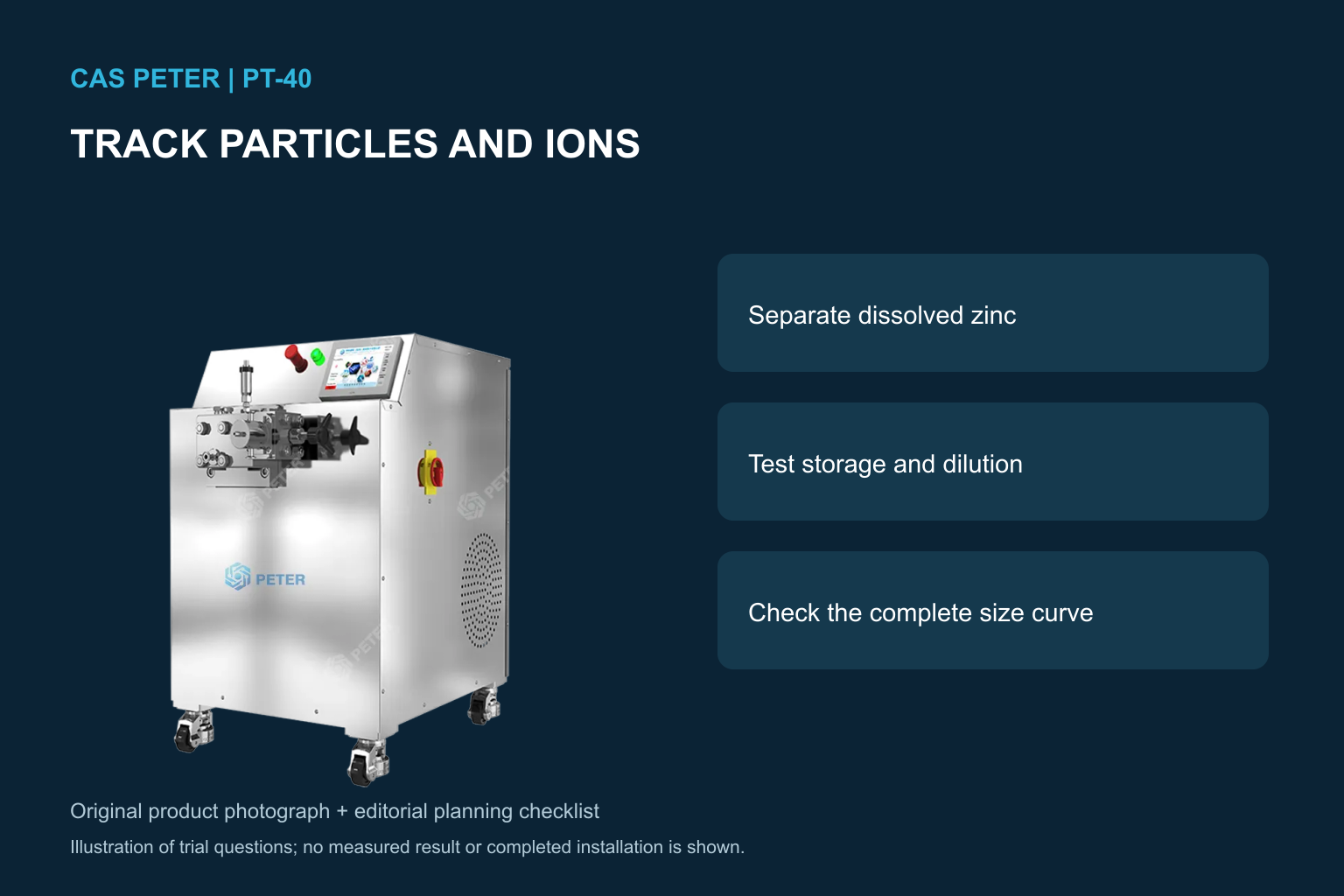
Define how the liquid fraction is separated from suspended material before zinc analysis. Centrifugation or filtration can be useful, but neither automatically guarantees complete particle removal or quantitative recovery of the dissolved fraction. Residual fine particles may contribute zinc during analysis, while adsorption or incomplete transfer can produce losses. The method needs checks appropriate to the formulation and concentration range.
Use blanks and recovery controls. Analyze a medium blank, examine whether the separation materials contribute contamination and test recovery of an appropriate dissolved-zinc reference. Where feasible, check that the separated fraction is free of particles at the level relevant to the conclusion. Explain what the analytical measurement represents rather than equating every zinc result with free ionic zinc.
Follow the time after processing. A sample measured immediately and one measured after a day may have different dissolved and particulate fractions even if their reported size is similar. The linked suspension-stability study observed that size stability did not mean the suspension chemistry remained unchanged. This is a reason to measure several relevant properties, not to copy its biological medium into an industrial trial.
Use a diagnostic table instead of one success number
This original framework combines the distinctions demonstrated in the two cited studies with practical trial controls. It contains proposed checks, not measured CAS PETER results or universally applicable limits. Choose acceptance criteria according to the required particulate product and the validated methods available.
| Observation after processing | What it could hide | Check to perform | Decision it can support |
|---|---|---|---|
| Smaller DLS mean | Coarse particles may have settled before sampling | Representative remixing and a coarse-tail method | Whether the complete dispersion became finer |
| Clearer liquid | Dissolution or solids loss may have occurred | Zinc fractions and recovered material balance | Whether clarity reflects retained particulate material |
| Constant size during storage | Medium chemistry may still change | pH, conductivity and dissolved-zinc measurement | Whether the formulation is stable beyond particle size |
| Stronger size growth after dilution | Measurement medium may destabilize the dispersion | Matched-medium dilution and timed readings | Whether the reported change belongs to preparation or storage |
| Acceptable fresh suspension | Hard sediment may develop later | Undisturbed storage and a defined redispersion test | Whether the product remains usable |
Evaluate storage, redispersion and the application
Store replicate samples in the intended container under defined conditions. Record sediment height or another justified separation measure without repeatedly disturbing the same sample. Then test redispersion using a fixed, realistic procedure. A loose sediment that readily returns to the required distribution differs from a hard deposit requiring intense reprocessing. Do not report both simply as stable because the upper liquid looks uniform after vigorous mixing.
Test the dispersion after the next formulation step. A stock can behave differently after it is blended into a polymer solution, coating or other application medium. The PVA-composition study reported changes in particle dimensions after incorporation and phase separation requiring remixing for analysis. That system illustrates the need to qualify the final matrix; it does not establish an antimicrobial claim or performance guarantee for a different product.
Select the application test before choosing the trial winner. A coating may require uniform film appearance and handling performance, while another use may require a defined particulate loading after dilution. Keep product-specific claims supported by appropriate tests. A finer laboratory dispersion alone does not demonstrate optical performance, biological efficacy or regulatory suitability.
Connect equipment choice with the actual material
The CAS PETER PT-40 product page provides a product reference for discussing a pilot-scale trial. Confirm suitability using representative feed, particle loading, rheology, coating chemistry, wetted materials and wear requirements. Its photograph identifies the machine model; it is not evidence of a completed zinc oxide installation or approval for every abrasive formulation.
The high-pressure dispersion guide provides broader trial planning. Review the wetted-material and abrasive-slurry discussion when defining compatibility. These decisions belong alongside the measurement plan: a formulation that gives a promising analytical result still needs a repeatable and suitable processing configuration.
Submit powder and medium details with an inquiry, including the intended use, feed range, desired output and storage requirement. Add the complete particle-size method and the dissolved-zinc separation procedure. A target stated only as a very small diameter is incomplete because it does not specify retained solids, stability or final application performance.
Make the conclusion proportional to the evidence
Repeat promising conditions on independent feed preparations and retain both favorable and unfavorable observations. Compare particulate recovery, dissolved-zinc behavior, storage, redispersion and application results. If the size improves while particulate material is lost, report the tradeoff. If stable size coexists with chemical change, preserve that limitation instead of compressing the result into a simple pass.
The useful outcome is a documented operating window with a clear material specification and test method. It should explain what the process changed, what remained acceptable and which uncertainties still need resolution. That gives production and purchasing teams a more reliable basis for the next trial than a photograph of a white suspension or a single size printout.
Educational video: colloidal stability
This neutral NPTEL lesson introduces stability in colloidal systems. It supports the distinction between dispersing particles and keeping them dispersed. It is not a zinc oxide preparation recipe and does not replace formulation-specific testing.

Educational source: NPTEL-NOC IITM. Watch the lesson on YouTube.
Frequently asked questions
Does a lower DLS size prove successful zinc oxide deagglomeration?
No. Sampling, settling, dilution and changes in the liquid medium can alter the result. Compare representative samples, retain the full distribution and use a complementary method where needed. Check particulate recovery and dissolved zinc before assigning the change entirely to deagglomeration.
Can a clearer zinc oxide suspension indicate dissolution?
It can, but clarity alone cannot identify the cause. Settling or loss of coarse material can also clear the upper liquid. Use a validated particle-separation and zinc-analysis procedure with a material balance to distinguish these possibilities.
Can ultrasonication or pressure-reactor settings be transferred to a homogenizer?
No. Ultrasonication, chemical synthesis in a heated pressure reactor and high-pressure homogenization have different purposes and exposure histories. Use related studies to define measurement questions, then qualify the actual feed and equipment configuration through a representative trial.