

Pickering Emulsion Homogenization: Separate Particle Preparation from Droplet Formation
Pickering emulsion homogenization should be planned as two separate operations: preparing suitable solid stabilizers and forming oil droplets in their presence. A smaller particle suspension does not automatically produce a better emulsion, and a smaller initial droplet size does not establish long-term stability. For a useful development trial, control the particle history, oil-to-water ratio, processing temperature and final formulation, then examine droplet structure, separation and flow together. This guide focuses on nanocellulose-stabilized oil-in-water systems and the decisions needed before transferring a laboratory result to a larger homogenizer.
What makes a Pickering emulsion different?
In a conventional emulsion, surface-active molecules help stabilize the boundary between oil and water. A Pickering emulsion uses solid particles as stabilizers. The particles must interact appropriately with both liquids and be present where new interfacial area is formed. An aqueous powder suspension that looks uniform may still perform poorly when oil is added.
Nanocellulose is a useful example because particle shape and surface condition matter alongside size. The research review on nanocellulose-stabilized emulsions describes how different cellulose materials contribute to interfacial stabilization. Long fibrils can also influence the structure of the surrounding liquid. Consequently, resistance to visible creaming can reflect several mechanisms operating together.
The engineering question is therefore more precise than whether a homogenizer can make the sample look smooth. Ask which operation needs improvement and what evidence would distinguish improved droplet protection from a thicker continuous phase. The general high-pressure emulsion processing guide provides the broader equipment context; the present article addresses the solid-particle formulation problem.
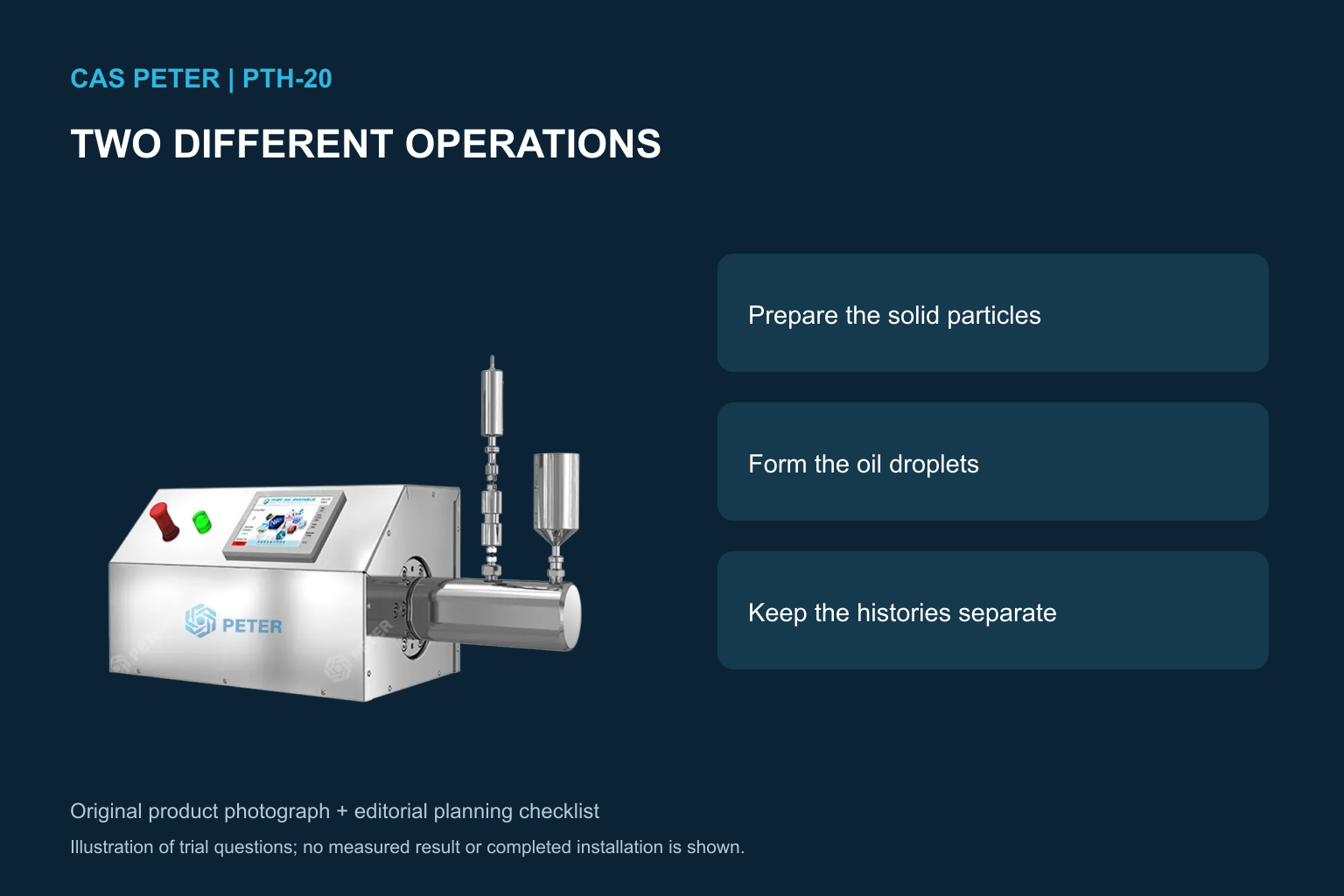
Separate stabilizer preparation from emulsification
The first operation changes the solid material. Its starting state may already include chemical pretreatment, washing, surface modification, drying or mechanical refining. Homogenization is only one part of that history. Record the supplier grade, solids basis, storage conditions and preparation route before comparing pressures or pass counts.
The second operation breaks up oil in the presence of that stabilizer. Here, the relevant inputs include oil identity, oil fraction, particle concentration, aqueous chemistry and the coarse premix. Changing both the stabilizer treatment and the emulsification procedure in the same experiment makes the result difficult to interpret.
A practical first comparison uses one particle batch to prepare several emulsions under controlled droplet-formation conditions. A separate comparison holds emulsification conditions constant while changing particle preparation. This staged design exposes interactions without assuming that the same processing setting is optimal for both operations.
Do not send untreated fibrous feed into a machine merely because a research paper used cellulose. The supplier must first review particle dimensions, plugging potential, viscosity and wetted-material compatibility. Feed preparation requirements are specific to the actual equipment configuration.
Define the starting material in enough detail
For nanocellulose, a single reported diameter may hide very different shapes. A rod, flexible fibril and compact fragment can produce different flow and interfacial behavior even when a sizing instrument reports similar values. Keep microscopy or other shape-sensitive evidence alongside the instrument result where available.
Drying and redispersion also deserve their own record. A freshly prepared wet dispersion and a dried powder dispersed in water are not interchangeable starting materials. State mixing sequence, hydration time and any pretreatment rather than attributing every observed change to the high-pressure step.
A primary study using palm-fiber cellulose combined upstream preparation with homogenization and then tested the resulting emulsions under defined conditions. Its value for development is the separation of material characterization and emulsion evaluation. It does not supply a universal recipe for unrelated cellulose grades or commercial formulations.
Before selecting trials, define what the particles must accomplish in the finished product. A pourable beverage, a concentrated ingredient and a spreadable formulation impose different requirements. A highly structured sample may resist separation yet fail the intended pumping, pouring or dilution requirement.
Build a comparison that can identify the cause
The following table is an editorial trial-planning framework. It translates the material and stability questions discussed in the cited research into comparisons; it does not prescribe numerical settings or claim measured performance.
| Development question | Hold constant | Compare and document | Decision supported |
|---|---|---|---|
| Does particle preparation help? | Oil, aqueous phase and emulsification procedure | Particle morphology, solids basis and treatment history | Whether to revise stabilizer preparation |
| Is droplet formation limiting? | One characterized particle batch and formula | Coarse premix, processing history and droplet distribution | Whether an emulsification change is useful |
| Is the liquid network masking separation? | Oil fraction and storage conditions | Microscopy, flow behavior and separation photographs | Whether apparent stability is mainly structural |
| Will the ingredient tolerate use? | Defined finished-product recipe | Dilution, pH or salt addition in the intended order | Whether a concentrate result transfers to use |
| Can the process be repeated? | Agreed preparation instructions | Independently prepared batches and recovered mass | Whether the result is robust enough for scale-up |
Use an untreated or current-process reference with the same formulation wherever feasible. If an oil-free particle dispersion is needed to interpret viscosity, label it as a diagnostic sample rather than comparing it directly with an oil-containing product as though composition were identical.
Keep an explicit sample map. Identify the particle batch, premix batch, treatment, sampling point and storage container. Ambiguous labels can make a well-executed trial unusable, especially when solids preparation occurs on a different day from emulsification.
Watch the interface and the continuous phase
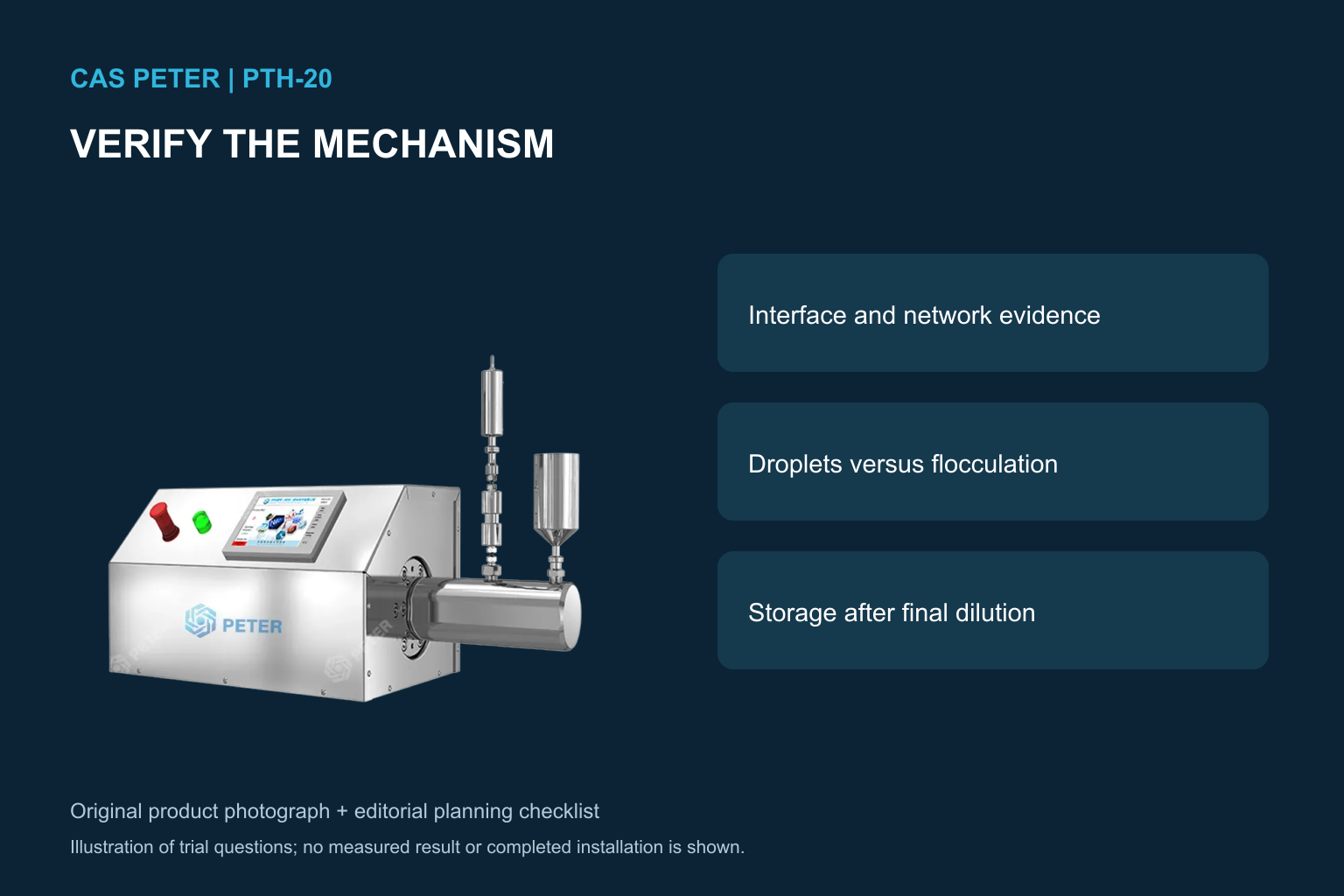
Visible separation alone cannot identify coalescence. Droplets may move together without fusing, or a structured aqueous phase may slow their movement. Microscopy, a suitable droplet-size method and a documented separation test provide complementary evidence. Use consistent sample preparation when comparing treatments.
Dilution during analysis can change the system being studied. It may weaken a fibril network or change the balance between free and associated particles. Record the diluent and the handling procedure. Interpret a diluted analytical result as a measurement under those conditions, alongside observations on the undiluted product.
When reporting particle and droplet data, keep the two populations distinct. A sizing technique may respond to solid particles, oil droplets or associated clusters. The site’s DLS and laser diffraction comparison explains why method selection and distribution reporting matter. It should not be assumed that a single instrument resolves all components of a Pickering formulation.
Photograph stored samples before disturbing them. Then document whether the separated material can be redispersed by the handling expected in use. Aggressive laboratory remixing may restore appearance while exceeding anything a customer or production line would normally apply.
Test the finished formulation, including dilution
A particle-stabilized concentrate can behave differently after dilution or ingredient addition. Define the intended water, pH, salt content and mixing sequence before choosing challenge conditions. Test realistic use conditions rather than selecting convenient extremes without a product requirement.
Measure flow with temperature and preparation history stated. For a structured dispersion, a viscosity value without shear conditions is difficult to compare. Where a formulation must recover after pumping or mixing, include a relevant rest period and repeat the agreed observation rather than assuming the initial measurement remains representative.
Storage tests should include more than a final photograph. Establish observation times, container geometry, fill level and storage temperature in advance. Keep formulation controls under the same conditions. Record changes in droplet distribution and flow alongside the height or appearance of separated layers.
Physical stability also does not establish chemical retention, microbiological suitability or approval of an ingredient for a specific market. Those are separate product-development questions. The post-homogenization stability testing guide can help organize complementary physical observations without replacing application-specific quality work.
Connect the trial to an equipment discussion
The CAS PETER PTH-20 product page is a relevant starting point for a laboratory equipment discussion. Its photograph identifies the equipment used in this article’s illustrations. It is not evidence that the illustrated machine has processed the reader’s cellulose grade or achieved a particular emulsion result.
Send the supplier a description of the feed at each proposed operation, including solids, largest relevant particles, flow behavior, liquid composition, working temperature and available volume. State whether the inquiry concerns particle preparation, emulsification or both. Request confirmation of the actual configuration and sample-handling limitations.
During scale-up, compare outcomes and process history rather than copying only pressure and pass count. Mixing before the pressure stage, cooling between treatments, hold-up and product recovery can all affect the practical comparison. Record recovered usable product separately from the nominal amount charged.
A sensible stopping point is the least demanding tested process that meets the agreed formulation requirements consistently. Additional processing that produces a slightly smaller reported size but worsens flow, handling or storage performance has not demonstrated an overall improvement.
A neutral lesson on emulsion stabilization
The Harvard University lecture below explains stabilization at the oil–water interface. It supports the interfacial part of the discussion; it is not a nanocellulose processing protocol or an endorsement of any homogenizer. For Pickering systems, combine these basic emulsion concepts with direct evidence about the solid stabilizer and continuous-phase structure.

Educational source: Harvard University. Watch the lesson on YouTube.
Frequently asked questions
Should the particles and the finished emulsion receive the same treatment?
Not automatically. Particle preparation changes the stabilizer, while emulsification creates droplets in a formulated system. Evaluate these operations separately first, then investigate their interaction. Keeping their histories distinct makes the trial easier to interpret and reproduce.
Does a smaller droplet size prove that the Pickering emulsion is better?
No. The formulation must also meet storage, flow, dilution and application requirements. Smaller initial droplets can be useful evidence, but they do not establish adequate particle coverage, resistance to later coalescence or suitability for the finished product.
Can a stable-looking sample be held mainly by a cellulose network?
Yes, a network in the continuous phase can contribute to resistance against droplet movement. Use structural observations and flow measurements together with droplet analysis to investigate that contribution. Report the evidence without claiming one stabilization mechanism from appearance alone.