

Orange Juice Cloud Stability After Homogenization: Pectin, Pulp and Storage
Orange juice cloud stability after homogenization depends on more than reducing the size of suspended pulp. Pectin structure, residual enzyme activity, extraction history and storage conditions also influence whether the juice remains acceptably cloudy. A useful trial measures these factors alongside sedimentation, turbidity and sensory quality. It does not treat a bright, uniform sample immediately after processing as proof of shelf life. For development teams, the goal is to preserve the intended cloudy appearance through the actual product’s handling and storage conditions while keeping quality and safety evaluations separate.
Define the cloud before choosing a treatment
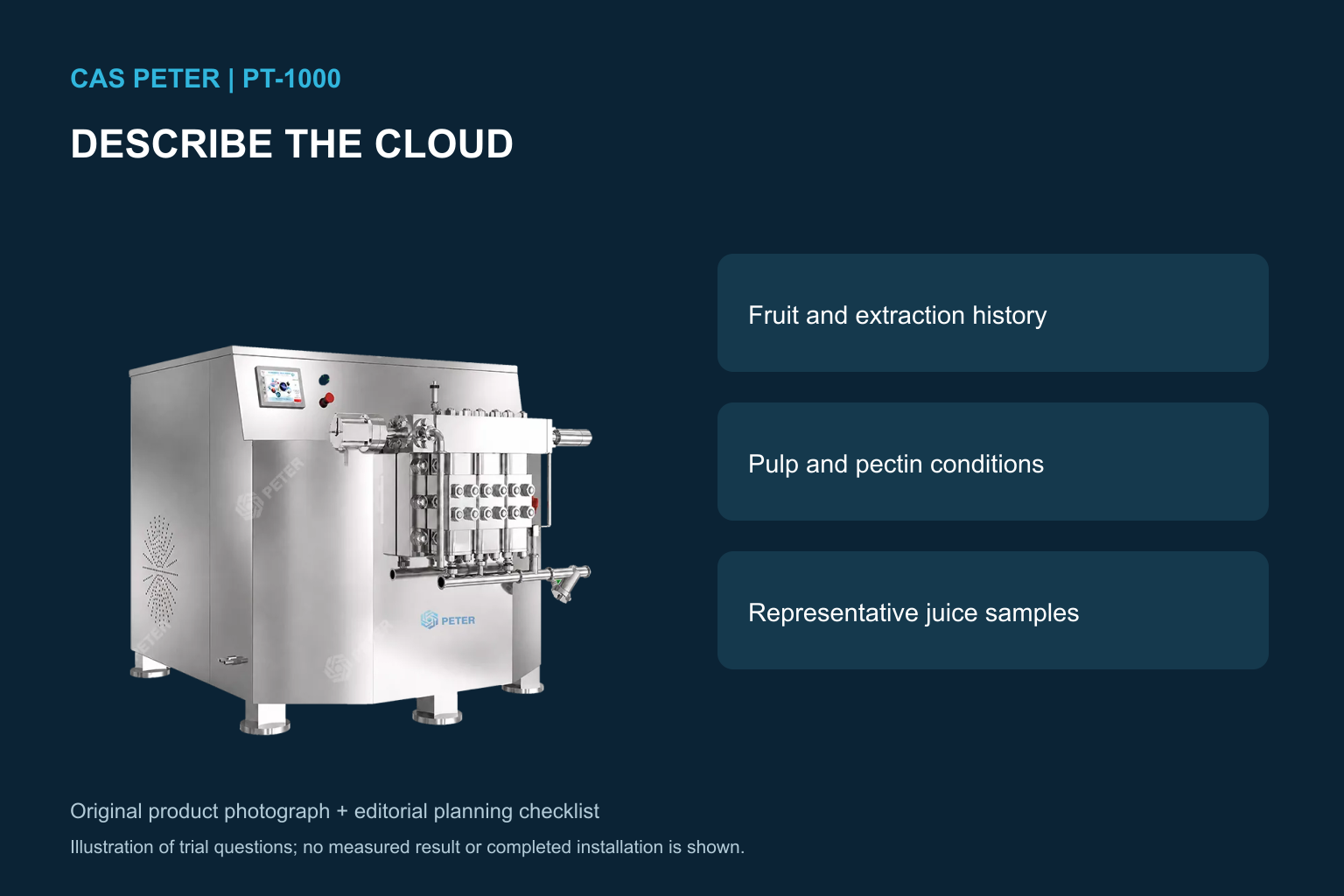
Cloud is the dispersed material that gives orange juice its characteristic appearance. In practice, the visible system includes components with different sizes and interactions. A coarse pulp fraction and the finer material remaining in the surrounding liquid should not be treated as one uniform population.
Start with the intended product specification. A juice sold with visible pulp presents a different comparison from a low-pulp formulation. Document whether the process includes finishing, screening, centrifugation or blending before homogenization. Removing pulp to help a machine accept the feed also changes the product being evaluated.
The food homogenization overview introduces the broader process context. The narrower question here is whether a specific orange juice maintains the desired cloud during storage. That requires a product-specific comparison rather than borrowing settings from milk, tomato juice or another citrus formulation.
Use a representative production lot for an initial screen, then confirm promising results with independently prepared material. Fruit variety, maturity and extraction conditions belong in the batch record. If those inputs change at the same time as homogenization, later differences cannot confidently be assigned to the pressure stage.
Why pectin needs its own investigation
Pectin contributes to the behavior of the dispersed system, and its condition can change during processing and storage. The primary study of pectin structure and NFC orange juice investigated structural changes together with physical stability. It supports looking beyond particle size when interpreting an apparently improved juice.
That study’s findings are specific to its materials, methods and experimental conditions. They do not establish that a particular pressure will produce the same response in every juice. Nor do they justify treating all pectin modifications as beneficial. The relevant test is how the actual juice behaves under its intended use conditions.
Separate direct observations from explanations. A reduction in sediment is an observation. A proposed contribution from changed pectin interactions is an interpretation that needs supporting measurements. If molecular characterization is unavailable, report that limit instead of attributing the result to a mechanism that was not measured.
A later study of water-soluble pectin during cloud destabilization examined differences associated with storage and the phase in which pectin was recovered. Its abstract provides additional reason to follow the system over time. The practical lesson is to compare fresh and stored juice, rather than assigning lasting stability from the initial sample alone.
Keep enzyme activity and physical stability distinct
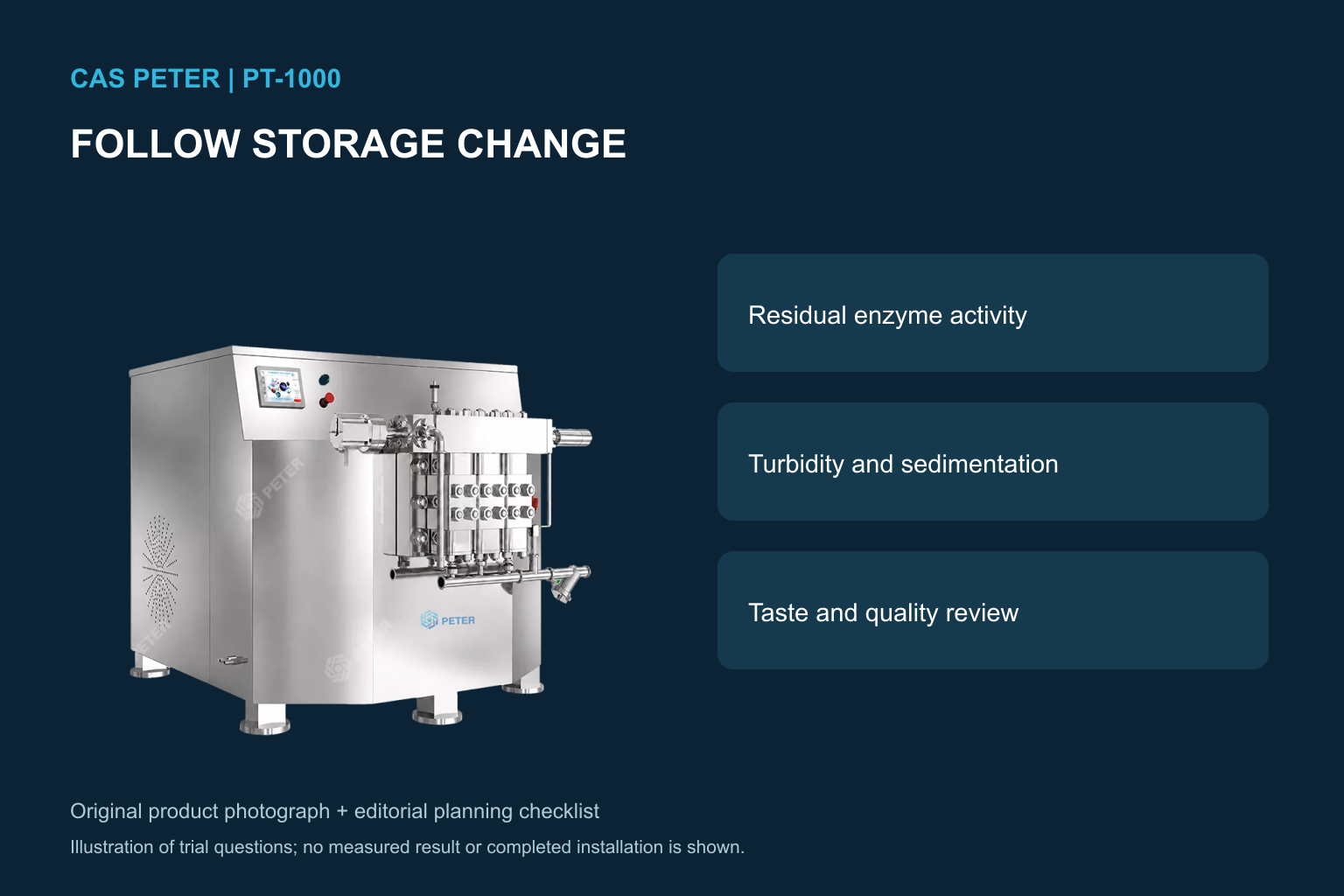
Residual pectin methylesterase activity is an important part of a citrus-juice investigation, but it should not be used as a substitute for observing cloud behavior. An enzyme result describes the sample under an analytical method. The product’s appearance reflects the combined system over its storage history.
Use a defined assay and record sample preparation, holding time and the basis used for comparison. If activity is reported relative to untreated juice, make clear which untreated batch supplied the reference. Comparing percentages based on different references can obscure the actual difference between treatments.
Avoid comparing a measured residual activity directly with a literature value obtained by another method as though the values were interchangeable. Differences in assay conditions and the juice matrix can matter. Where testing is outsourced, agree the reporting units and method before the production trial.
A physical cloud-stability improvement does not establish microbial control. Homogenization conditions, packaging, hygiene and any preservation process require their own appropriate evaluation. This article offers no substitute treatment schedule or shelf-life claim. The site’s homogenization and sterilization discussion explains why these questions must remain separate.
Design a controlled orange-juice comparison
First define the baseline: the current process, or an untreated juice with the same upstream preparation where that comparison is appropriate. Then change a manageable part of the homogenization history while keeping fruit source, pulp preparation, packaging and storage comparable.
Record inlet and outlet temperatures, cooling and treatment sequence. A comparison described only by pressure can conceal different thermal histories. If repeated passes are studied, document how the sample is collected, held and returned between treatments instead of describing all circulation as an identical pass.
The following qualitative table is a proposed planning framework. Its purpose is to connect a question with evidence, based on the cited pectin research and normal controlled-comparison logic. It supplies no universal acceptance limits.
| Question | Measurement or record | Comparison requirement | Interpretation limit |
|---|---|---|---|
| Has the initial appearance changed? | Turbidity with method and sampling position stated | Same juice preparation and measurement conditions | Initial appearance does not predict shelf life |
| Does the cloud remain dispersed? | Sediment, layer height and undisturbed photographs | Same containers, fill level and storage conditions | A single final photograph can miss earlier changes |
| Has the suspended material changed? | Suitable size distribution and supporting microscopy | Consistent dilution and analytical handling | Size alone does not identify pectin interactions |
| Is enzyme behavior different? | Defined residual PME activity assay | Matched baseline and consistent method | Activity alone is not a cloud-stability result |
| Is the product still acceptable? | Relevant taste, color and flow assessment | Agreed sample conditions and qualified evaluation | Physical improvement does not establish safety |
Retain enough material for the planned storage observations before starting the trial. A treatment that leaves only one small sample may be impossible to evaluate without repeatedly opening or disturbing it. Allocate separate containers where the sampling plan requires an undisturbed observation.
Measure turbidity and sediment without confusing them
Turbidity measures an optical response under defined conditions. Sedimentation describes movement and accumulation of material. Their results are complementary. A sample may begin very cloudy and still lose acceptable appearance during storage, so report the time course rather than only the initial reading.
Specify sampling height and whether the juice was mixed before analysis. An undisturbed upper-layer sample and a thoroughly remixed whole-container sample answer different questions. Keep both if they serve the investigation, but label them clearly and avoid treating their readings as directly equivalent.
For particle analysis, record the instrument, reporting basis and any dilution. The DLS versus laser diffraction guide gives useful background on method boundaries. Orange juice can contain a broad and complex population, so a method suitable for one fraction may not describe all suspended pulp.
Photographs should use consistent lighting, background and container geometry. Include the untreated or current-process reference in the same observation series. Attractive images taken under changing lighting conditions are weak evidence of a real difference in cloud retention.
Follow the actual storage and handling route
Choose storage observations around the proposed product route and quality requirements. Keep the conditions and observation times explicit. If temperature excursions or transport handling are relevant, investigate them through a defined comparison rather than allowing uncontrolled exposure to become part of the trial.
Inspect containers before remixing, then assess the behavior after a realistic handling step. This distinction helps describe whether separation is readily reversible in normal use. A laboratory blender may redisperse material but does not represent a consumer gently shaking a bottle or a production line transferring juice.
Assess color, flavor and flow alongside cloud. A treatment that reduces sediment but changes the intended sensory character may not be useful. Establish who will evaluate the samples, how they will be prepared and which attributes matter before seeing the results.
Confirm a promising condition with another batch rather than choosing the single best bottle. If fruit or extraction variability strongly changes the response, the next task is to understand that dependency. It may be more valuable to improve upstream consistency than to increase homogenization intensity.
Prepare an equipment inquiry from the feed description
The CAS PETER PT-1000 product page provides a production-equipment reference for supplier discussion. The original product photograph is used in this article’s illustrations. This does not claim a documented orange-juice installation or validate any setting for the reader’s formulation.
Provide the supplier with the actual pulp preparation, solids information, largest relevant particles, flow behavior, liquid chemistry, temperature range and required throughput. Ask for confirmation that the proposed machine configuration can accept that feed. A machine name alone cannot confirm compatibility with every juice stream.
Also describe cleaning requirements, product recovery expectations and the planned connection to upstream preparation and downstream packaging. These details affect whether the tested process can be operated consistently. Request confirmation against the intended configuration rather than inferring hygienic or preservation performance from a general product description.
The trial report should identify the accepted product outcome and its remaining limits. A defensible conclusion might be that one treatment improved cloud retention over the tested interval for the tested batch. Extending that statement to commercial shelf life requires the additional relevant evidence, including the separate safety and packaging work.
Further learning about pectin
The educational pectin lesson below is listed in the University of Mysore’s MOOC resource catalogue. It provides background on pectin as a food component. It is not an orange-juice homogenization protocol, and general descriptions of pectin behavior should not be treated as direct proof of stability in a particular juice.

Educational source: EMYS. MOOC. Watch the lesson on YouTube.
Frequently asked questions
Can smaller pulp particles guarantee stable orange juice cloud?
No. Particle size is only one part of the system. Pectin condition, enzyme activity, formulation and storage history also need attention. Compare size results with actual sedimentation, turbidity and product-quality observations over the agreed test period.
Should PME activity replace a storage test?
No. A residual enzyme activity result helps characterize the treatment but does not directly establish the juice’s cloud behavior during use. Keep a defined storage comparison and interpret both sets of evidence together.
Does improved cloud stability prove the juice is safe to sell?
No. Cloud stability concerns physical appearance. Product safety, preservation, packaging and shelf life require their own appropriate evaluations. Do not use an attractive or stable-looking homogenized sample as proof that those requirements have been met.