

Almond Milk Homogenization: Diagnose Creaming, Sediment and Oxidation
Almond milk homogenization can improve physical uniformity, but stability must be checked as separate problems: upward creaming, downward sedimentation, particle aggregation and quality changes during storage. A smaller average particle size does not prove that all four have been controlled. Start with a defined almond beverage base, compare matched heat and homogenization histories, and inspect the complete product over time. Evaluate oxidation and microbiological safety independently instead of treating a stable-looking bottle as evidence of acceptable shelf life.
This guide focuses on diagnosing separation in an almond beverage and designing a useful processing trial. For the broader equipment and application context, see our dairy and food homogenization guide. No single pressure or processing sequence is presented as a universal almond drink recipe.
Identify where material is moving
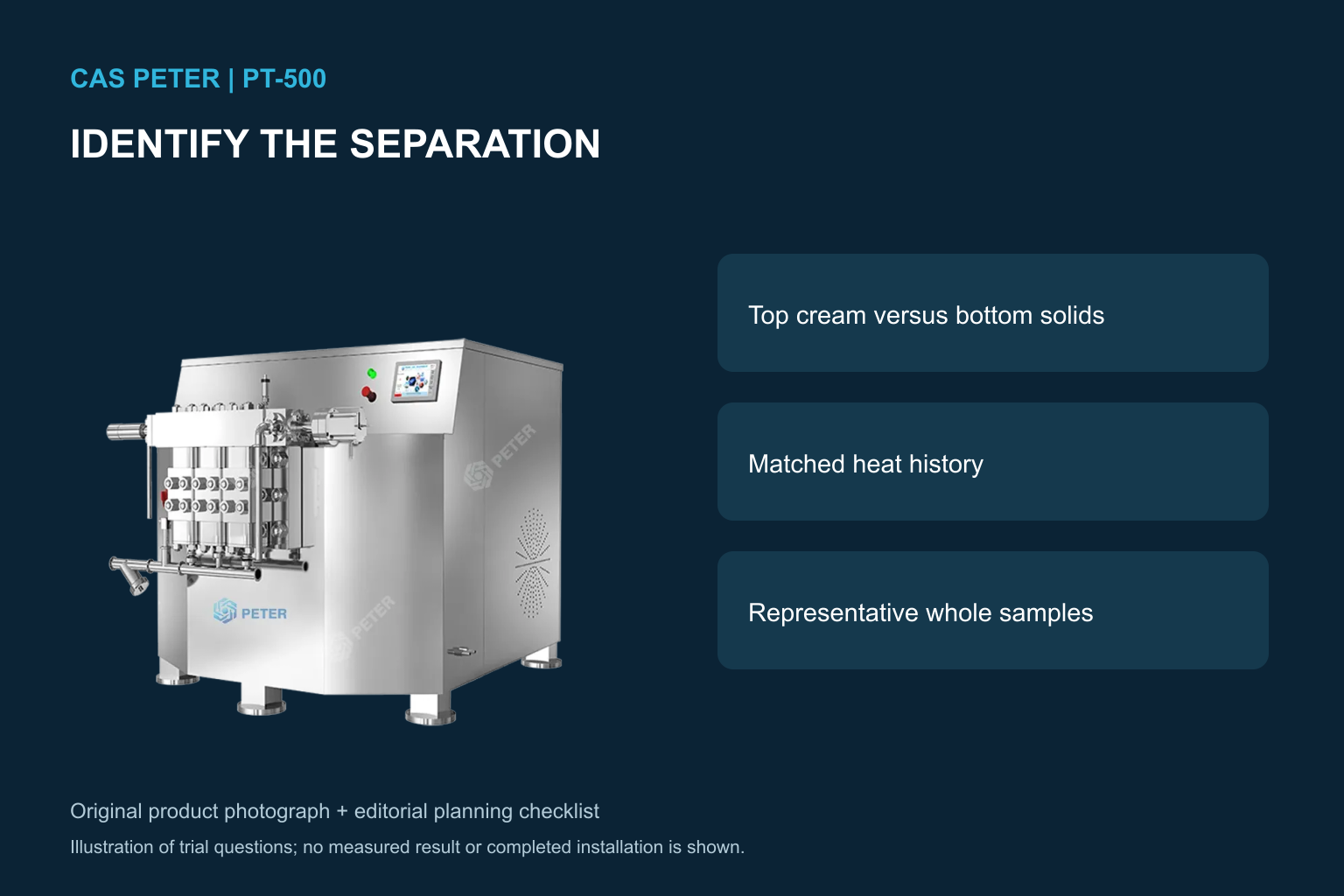
Examine undisturbed samples before shaking. A lighter layer near the top suggests a different physical problem from a compact deposit at the bottom. Record both when they coexist. A photograph of a mixed sample taken immediately after shaking can conceal separation and therefore cannot serve as the only stability record.
Describe the observation without assuming the mechanism. Top separation, bottom sediment, visible clumps and a change in pour behavior are useful factual descriptions. Confirm whether droplets, solid fragments or aggregates are contributing through suitable particle measurements and microscopy where available. The next processing experiment should follow that diagnosis.
Use the same container geometry, fill quantity, lighting and storage orientation for comparisons. Mark a scale or use a consistent image reference. If the product is intended to be shaken before use, assess redispersibility with a defined procedure as well as undisturbed separation. A loose sediment that redistributes readily and a persistent compact layer are not equivalent outcomes.
Standardize the almond base before testing pressure
Record almond source and lot, preparation, grinding, water ratio, filtration or screening and any added ingredients. Changing the amount of coarse material removed before homogenization can change sedimentation independently of the machine. Keep a retained feed sample so that the treated product can be compared with the material actually processed.
Document the order of ingredient addition and hydration. Sugars, stabilizers, proteins and mineral additions can change the liquid surrounding the particles. If the formulation is still being developed, separate the equipment comparison from the ingredient comparison first, then test the most promising combination in the complete intended recipe.
Measure feed temperature, pH and the concentration measures used by the project. Sample a well-defined, representative portion of the base. If the feed settles while waiting for processing, record the mixing method and sampling location. Otherwise, apparent differences between runs may simply reflect different proportions of almond solids reaching the machine.
Distinguish homogenization from the complete heat process
Record homogenization and heating as separate operations with a clear sequence. Identify whether the base is heated before, after or during the treatment being studied. Outlet temperature and the time spent before cooling belong in the record, because two runs with the same pressure may have different thermal histories.
A study of ultra-high-pressure homogenized almond beverage assessed physical properties, storage and volatile compounds under specified treatment conditions. Its results support evaluating multiple quality outcomes together. The tested process is not interchangeable with every conventional homogenizer or formulation, and its storage findings should not be transferred to an unvalidated production line.
Use a matched handling control when practical. If one sample is cooled promptly and another remains warm, a later quality difference cannot be assigned confidently to pressure. Record sample filling and cooling times and keep the analysis schedule comparable. These details matter when interpreting both physical separation and aroma changes.
Measure distributions rather than relying on one diameter
An almond beverage contains more than a single population of ideal oil droplets. Select a particle method that fits the expected range and mixture. Retain the distribution and the preparation method, rather than recording only an instrument-generated average. A small number of large structures may matter to sediment, texture or later aggregation even when an average decreases.
Use microscopy as a complementary observation when available, with consistent magnification and sample handling. Avoid assigning every visible structure to oil or protein without suitable evidence. The aim is to determine whether treatment changed the material relevant to the observed defect, not to produce an attractive image alone.
Our DLS versus laser diffraction guide discusses the interpretation of different particle measurements. For a mixed beverage, dilution and sample selection can alter the structures being examined. Keep those procedures fixed and report them with the result so the comparison remains reproducible.
Connect each defect with a practical next test
The following qualitative table is a troubleshooting framework. It does not claim that a particular mechanism has been proved by bottle appearance. Confirm the proposed explanation using the actual formulation and a repeatable measurement.
| Observed problem | Question to investigate | Useful trial or measurement |
|---|---|---|
| Cream layer develops at the top | Are droplets separating, flocculating or insufficiently stabilized? | Compare droplet distributions and microscopy before and after storage |
| Coarse bottom sediment forms | Is residual plant material or aggregation contributing? | Review grinding and screening, then examine sediment composition and redispersibility |
| Clumps appear after heating | Did the complete formulation become unstable during the heat step? | Compare matched samples before and after the intended thermal sequence |
| Bottle looks stable but aroma changes | Has chemical quality changed despite physical uniformity? | Use suitable oxidation measurements and controlled aroma evaluation |
| Results vary between batches | Did raw material or base preparation change? | Repeat a retained reference base and review preparation records |
Include oxidation and aroma in the storage plan
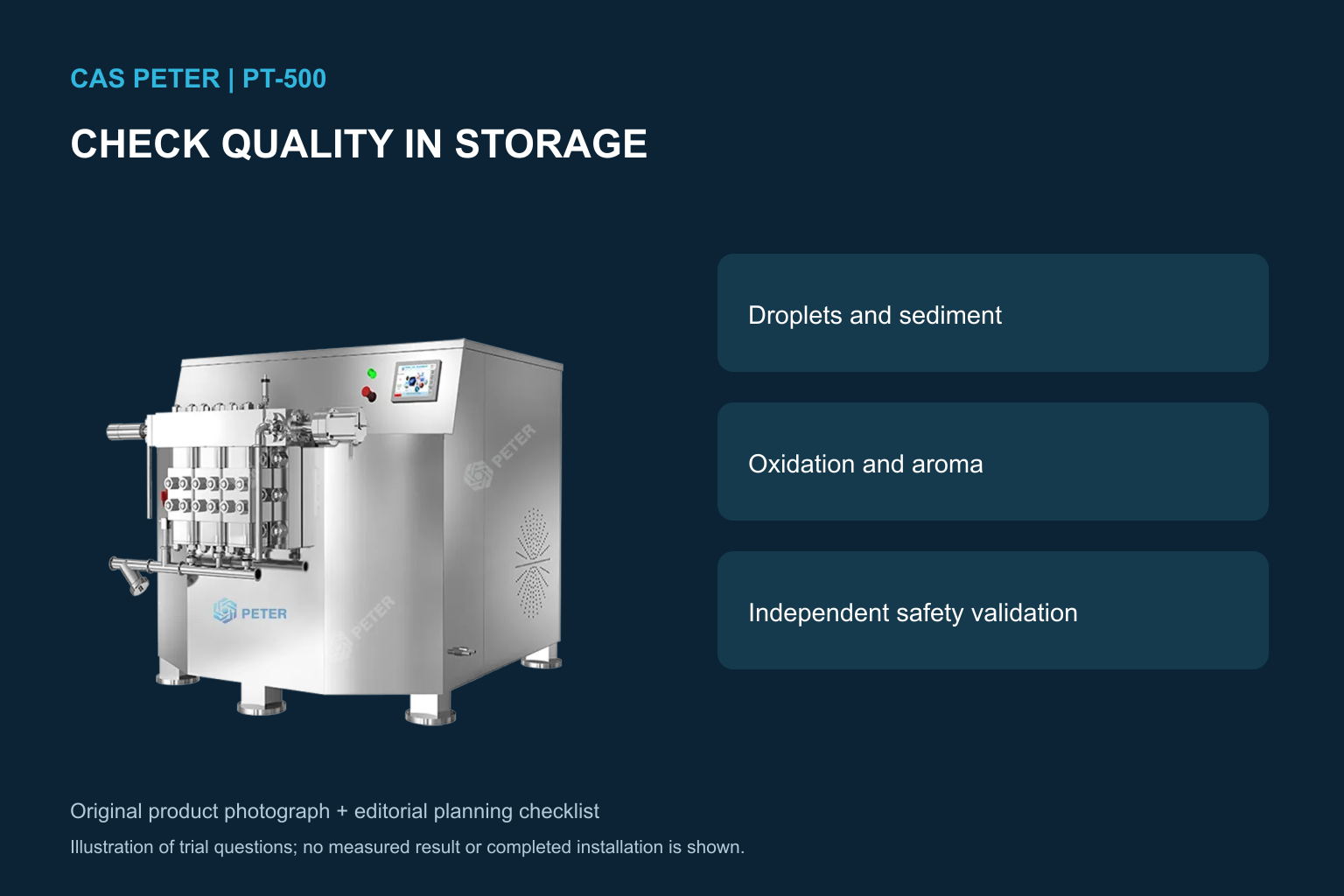
Physical stability and chemical quality answer different questions. Keep representative samples for the measurements chosen by the development team, including suitable oxidation indicators when lipid quality matters. Use a documented sensory or instrumental method for aroma rather than relying on an informal comparison of differently handled bottles.
Control the container, headspace, light exposure and storage temperature in the trial. Record when a bottle is opened and whether the same bottle is used repeatedly. Sampling itself can change exposure conditions. Use a plan that allows results at different intervals to be compared without introducing avoidable handling differences.
The almond beverage study linked above reports changes in volatile compounds alongside physical observations. The practical lesson is to measure the properties that define product acceptance independently. A reduction in visible separation should not be described as better overall quality unless the relevant aroma, chemical and other acceptance criteria also support that conclusion.
Keep safety validation separate from bottle appearance
A uniform-looking beverage can still be microbiologically unacceptable. Homogenization used for particle control should not be assumed to replace a validated safety process. The required assessment depends on the complete product, intended storage, packaging and applicable requirements, with qualified food safety expertise defining the necessary validation.
Our guide to homogenization and sterilization boundaries explains why physical processing outcomes and microbial control claims must be distinguished. Any published microbial reduction applies to the tested conditions and process, rather than automatically to a different machine operating at a similar nominal pressure.
A study of commercial plant-based milk substitutes examines their physicochemical properties and dispersion stability. It illustrates why product composition and processing belong in the same evaluation. Use that background to organize a trial, while keeping product safety and any intended shelf-life claim tied to the actual validated process.
Use emulsion science to frame the problem
The Harvard University lecture below provides educational background on emulsions and foams. It helps explain why interfaces and formulation matter when oil is dispersed in water. It is not an almond beverage production protocol, a storage-life demonstration or a recommendation for a particular equipment supplier.
Educational source: Harvard University. Watch the lesson on YouTube.
When applying the concepts, distinguish the oil-droplet problem from the plant-solid problem. A formulation intervention that changes droplet stability may not remove coarse sediment. Similarly, screening out solids can improve appearance without solving oil separation. Keeping these mechanisms distinct makes each development experiment more informative.
Plan an equipment trial around the actual beverage
The CAS PETER PT-500 product page provides a starting point for discussing production-oriented homogenization. Confirm the proposed configuration, acceptable feed, cleaning arrangement and temperature control against the real almond base. A model name or published water capacity does not establish the output rate or stability of a particular beverage.
Provide the supplier with representative material information and the intended processing sequence. Include solids content, flow behavior, largest expected feed structures, ingredient additions and the analyses that will determine success. Ask how the trial will collect comparable samples and how changes in outlet temperature or flow will be recorded.
Do not select a condition only because it makes the freshest sample look smoothest. Rank candidates after the intended heat sequence and planned storage observations. Include the ability to redisperse solids, the desired texture and chemical quality, as well as the operating burden. A reproducible result that meets the full specification is more useful than a single impressive particle measurement.
Prepare a decision record before scaling
For each candidate, keep the base preparation record, actual equipment settings, temperature history, particle distributions and bottle observations together. Attach the chemical and microbiological assessments that fall within the agreed trial scope. Mark incomplete tests as pending so an equipment choice does not accidentally become an unsupported product claim.
Repeat the selected condition with a representative independent batch before using it as the basis for scale-up discussions. If the result changes, investigate raw material, preparation and sampling alongside the machine settings. Scaling should preserve the process questions that produced the result, including feed consistency and cooling, rather than copying pressure alone.
Frequently asked questions
Will higher pressure prevent all almond milk separation?
No. Droplets, solid particles, ingredient interactions and heat history can contribute to different separation problems. Diagnose the defect and compare the complete formulation before deciding whether another processing condition is justified.
Is a stable-looking almond drink evidence of a safe shelf life?
No. Physical appearance does not establish microbiological safety or chemical quality. Shelf-life and safety claims require the appropriate assessment of the actual formulation, packaging, processing and storage conditions.
Should a trial measure creaming and sediment separately?
Yes. Record top separation and bottom sediment independently, then assess redispersibility using a repeatable procedure. This helps distinguish droplet-related behavior from coarse solids or aggregation and makes the next trial more targeted.