

Apple Juice Browning After Homogenization: Separate Color from Enzyme Control
Apple juice browning after homogenization should be evaluated separately from cloud appearance and particle-size reduction. A lighter or more uniform sample immediately after processing does not prove that browning enzymes are controlled, and a darker sample does not identify the cause on its own. Compare matched juice portions with recorded oxygen exposure, temperature history, and storage conditions. Measure color alongside enzyme activity and relevant composition rather than selecting a pressure from appearance alone. This guide focuses on designing that comparison; it does not provide a pasteurization recipe, a shelf-life guarantee, or a pressure setting transferable to every apple variety and machine.
Define the color problem before selecting the process
Start by naming the observed failure. The juice may become darker immediately after processing, gradually change during refrigerated storage, or appear different because the cloud has been redistributed. Each observation requires a different comparison. Keep records of when the difference first appears and whether it occurs throughout the container or only in a separated fraction. Photographing a settled bottle beside a freshly mixed bottle cannot establish a chemical color change.
Define the intended product as well. A clear juice and a cloudy juice have different optical and appearance requirements. If the product specification calls for a natural cloud, removing suspended material to simplify an analytical test changes the sample. It may still be a useful test, but the result must be identified as a clarified fraction rather than the finished beverage. Maintain a whole-product observation alongside it.
Use the dairy and food homogenization overview for wider process planning. The present question is narrower: whether a proposed apple-juice operation delivers the required color behavior under a defined exposure and storage history. It should not become another generic guide to all juice stabilization problems.
What published apple-juice research can establish
An experimental study of high-pressure homogenization in apple juice measured physical properties, color, and enzyme-related outcomes together. Its value for trial design is the combined measurement strategy. It does not justify assuming that smaller particles indicate enzyme inactivation. Published pressure conditions and sample preparation belong to the study’s particular apparatus and juice; they are not automatically specifications for a production machine.
A cooling-assisted apple-juice investigation likewise evaluated storage behavior and multiple quality attributes. Its reported outcomes are conditional on the process and storage system studied. Read the detailed methods and results before transferring any number. The experimental pressure range includes conditions that must not be presumed available on the equipment being considered. A product-page model name alone cannot establish equivalence to the research setup.
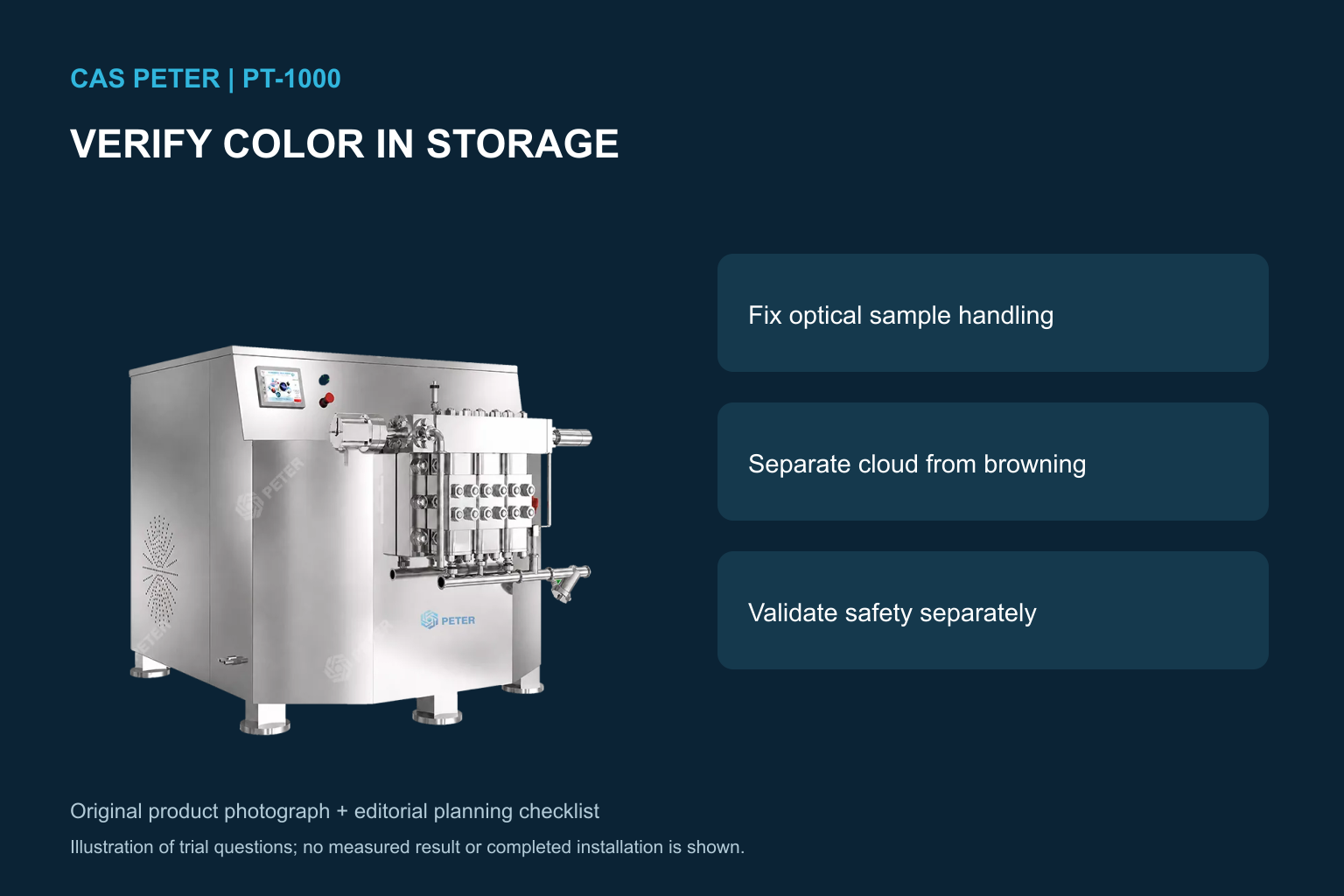
These studies support a practical distinction: mechanical treatment, thermal exposure, and quality changes need to be tracked together. They do not establish a universal safe beverage process. Keep microbiological validation and the applicable finished-product requirements under a qualified food-processing assessment rather than using color or cloud stability as evidence of safety.
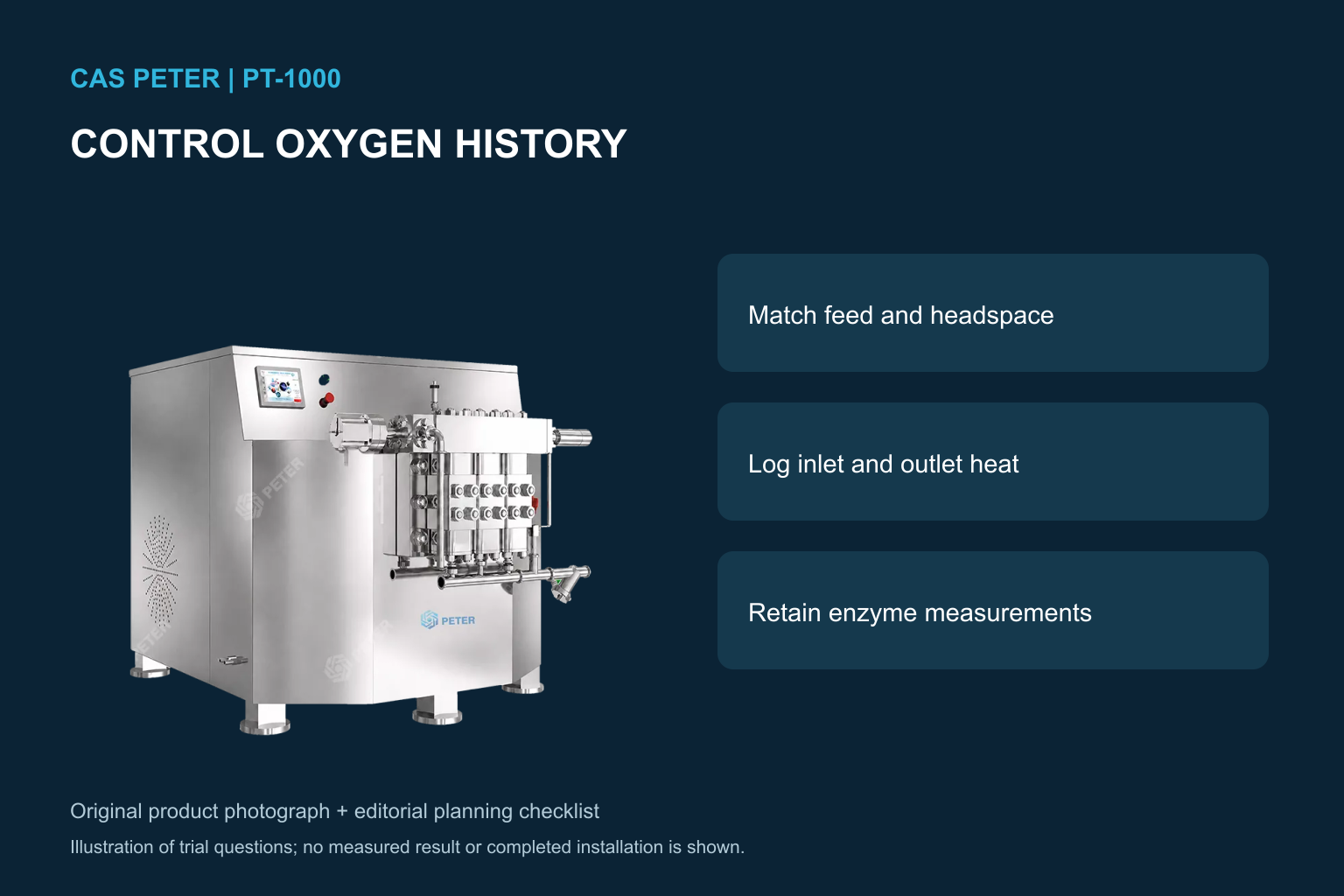
Control oxygen exposure through the whole comparison
Apple preparation can introduce different amounts of air before homogenization begins. Record fruit preparation, pressing or extraction, transfer method, tank headspace, mixing, and elapsed time. Use one parent juice batch split into comparison portions where possible. If different batches are necessary, document variety, maturity, ingredient additions, and the preparation schedule so that batch variation is visible.
Keep container fill and closure conditions comparable during storage. A mostly full sealed vial and a repeatedly opened bottle have different exposure histories. Allocate separate containers to time points when repeated opening would confound the question. Record how samples are withdrawn and whether they are shaken, poured, or gently mixed before analysis.
If dissolved oxygen measurement is available and suitable for the juice, incorporate it into the plan with calibration and sampling details. If it is not available, preserve the documented handling conditions and identify oxygen exposure as an unresolved variable. Do not infer a measured oxygen concentration from the absence of visible foam or from a closed cap.
Match thermal history without claiming a standard recipe
Log feed, outlet, collection, and cooling temperatures at meaningful process positions. A single final temperature may miss earlier exposure. Record elapsed time between processing and cooling, and between cooling and analysis. For a pass comparison, the last sample may have accumulated more total time and heat exposure than the first, even when both are eventually stored at the same temperature.
Include a handling control and, where the experimental question requires it, a separately designed thermal comparison. The purpose is to distinguish explanations, not to claim perfect equivalence from a simplified control. State which aspects are matched and which remain different. A cooled collection vessel does not prove that every part of the process remained at the collection temperature.
Use the site’s guide to homogenization and sterilization boundaries when evaluating the broader process. Browning control, microbial control, and physical stability are distinct acceptance questions. A favorable outcome in one does not replace validation of the others.
Separate chemical color from cloud-related appearance
Use a defined instrument, measurement geometry, sample path length, and preparation protocol for color comparisons. Record whether the sample is analyzed as whole juice, mixed juice, settled supernatant, or a deliberately clarified fraction. Keep those categories separate in the report. Turbidity and suspended material influence how a cloudy beverage looks, so visual and instrumental comparisons need consistent preparation.
Take photographs under fixed lighting with the same background and container type as supporting documentation. These images help show the product appearance but should not replace the quantitative method. Avoid automatic phone adjustments that vary unpredictably between samples if the photographs are intended for a controlled comparison.
Inspect the size distribution and settling behavior as complementary observations. The DLS versus laser-diffraction guide helps frame measurement choice. Select a method appropriate to the actual sample and size range rather than requiring one instrument to describe every dissolved and suspended component in apple juice.
Use a diagnostic table to organize the trial
The following table is an editorial comparison plan based on the studies and process distinctions above. It contains no validated pressure, temperature, or shelf-life limits.
| Observation | Possible explanation to investigate | Matched check | Process decision supported |
|---|---|---|---|
| Immediate appearance changes after treatment | Cloud redistribution, chemical color change, or both | Whole-juice color and a separately identified analytical fraction | Decide which appearance attribute needs further work |
| Color changes mainly during storage | Continuing reactions and storage exposure | Fixed closure, temperature, time points, and enzyme assay | Investigate formulation and storage together with processing |
| Smaller particles but continued browning | Physical refinement without sufficient reaction control | Size distribution alongside residual enzyme activity | Avoid adding passes solely to chase a smaller size |
| Strong differences between replicate batches | Fruit, preparation, oxygen, or measurement variation | Independent batch records and repeated preparation | Improve control of the dominant source before scale-up |
| Attractive appearance with uncertain safety | Quality observation without microbial validation | A separately validated food-safety process | Withhold shelf-life or safety claims until supported |
Choose a small set of informative comparisons before expanding the trial matrix. If all differences disappear when sample handling is standardized, additional machine settings may be unnecessary. If the effect persists, use the paired measurements to select the next variable. This makes the trial more useful than collecting a large grid of unrelated pressure and pass results.
Measure enzyme activity with a consistent analytical method
An enzyme assay depends on extraction, substrate, pH, temperature, timing, and the expression of the result. Use a suitable validated method and apply it consistently to controls and treated samples. Identify the reference activity when reporting residual activity. A percentage without its denominator or baseline gives little basis for comparing experiments.
Sample composition and turbidity may interfere with an optical assay. Include appropriate blanks and suitability checks within the laboratory method. If different sample preparation is required for enzyme analysis and whole-juice color, document both workflows. Avoid calling the methods contradictory merely because they measure different aspects of the product.
A low result at one time point does not establish permanent control throughout the intended storage period. Reassess at the planned times when that question matters. Keep the conclusion tied to the assay and the tested conditions. If the method cannot distinguish an actual activity change from interference, resolve that issue before using it to select a production condition.
Review flavor, composition, and the final package
Color is a useful quality attribute but it is not the whole product. Preserve the ability to assess aroma, flavor, texture, and any composition claims that matter to the commercial specification. Use an appropriate evaluation plan and sample-safety controls. Do not taste an experimental juice merely because its appearance is acceptable.
Test the intended packaging and storage condition after the processing comparison is sufficiently controlled. Container material, headspace, closure, light exposure, and handling may change the final result. A small sealed laboratory vial provides development evidence; it does not establish the performance of a filled commercial package through distribution.
Define the report around the intended decision. For example, the evidence may support moving one treatment into a package trial while leaving enzyme control unresolved. That is a valid development outcome when clearly stated. It becomes misleading only when a limited appearance result is presented as complete product or shelf-life validation.
Discuss scale and equipment suitability explicitly
The CAS PETER PT-1000 production equipment page supplies a real product reference for discussing scale and configuration. It does not demonstrate this article’s apple-juice application or the pressures used in the cited studies. Confirm the applicable operating envelope, feed requirement, hygienic configuration, cooling arrangement, and utilities with the supplier using current documentation.
Share the juice preparation record and the quality targets before requesting a trial. Ask how the proposed operating arrangement will preserve a documented time and temperature history and representative sampling. Select equipment through a formulation-specific demonstration with explicit acceptance criteria, rather than transferring a research pressure or choosing a model from a desired particle-size claim.
Further learning: why fruit browns
The University of Maine Cooperative Extension demonstration below introduces apple browning and the value of controlled comparisons. It explains the underlying food-science question at an educational level. An apple-slice activity is not an industrial juice preservation protocol or evidence of a machine’s performance.

Educational source: The University of Maine. Watch the lesson on YouTube.
Frequently asked questions
Does homogenization always prevent apple juice browning?
No. A physical change in the juice does not establish adequate enzyme control. Compare color and enzyme-related measurements under defined oxygen, thermal, and storage conditions for the particular juice and equipment.
Why might a treated juice look lighter without better browning control?
Cloud redistribution and sample preparation can change optical appearance. Compare consistently prepared whole juice and clearly identified analytical fractions before attributing a color difference to chemical or enzyme changes.
Can an attractive stored sample prove that apple juice is safe?
No. Appearance, physical stability, and microbiological safety require different evidence. Use a separately validated food-safety process and do not infer shelf life from color alone.