

Coconut Milk Heat Stability After Homogenization: A Thermal Trial Guide
Coconut milk heat stability after homogenization depends on the formulation, droplet interface and complete heating and cooling history. Smaller initial droplets do not guarantee that the emulsion will remain uniform after a thermal process. Heating may change protein interactions and promote aggregation, while cooling can introduce additional changes in the fat phase. Evaluate the homogenized product before heating, after the intended thermal treatment and during relevant storage. Use microscopy, particle measurements, separation observations and flow behavior together, and validate food safety through a separate appropriate process assessment.
This guide is for teams investigating a coconut milk that looks satisfactory immediately after homogenization but separates or thickens later. It focuses on heat-related physical stability rather than prescribing a universal homogenization pressure or a commercial sterilization schedule.
Identify the failure that appears after heating
Describe the visible change precisely. Creaming is movement and concentration of droplets into a layer. Flocculation is clustering of droplets that retain their individual identities. Coalescence creates larger droplets through merging. Sediment can also include insoluble material from extraction. A top layer and a large particle-size result do not identify which mechanisms are responsible.
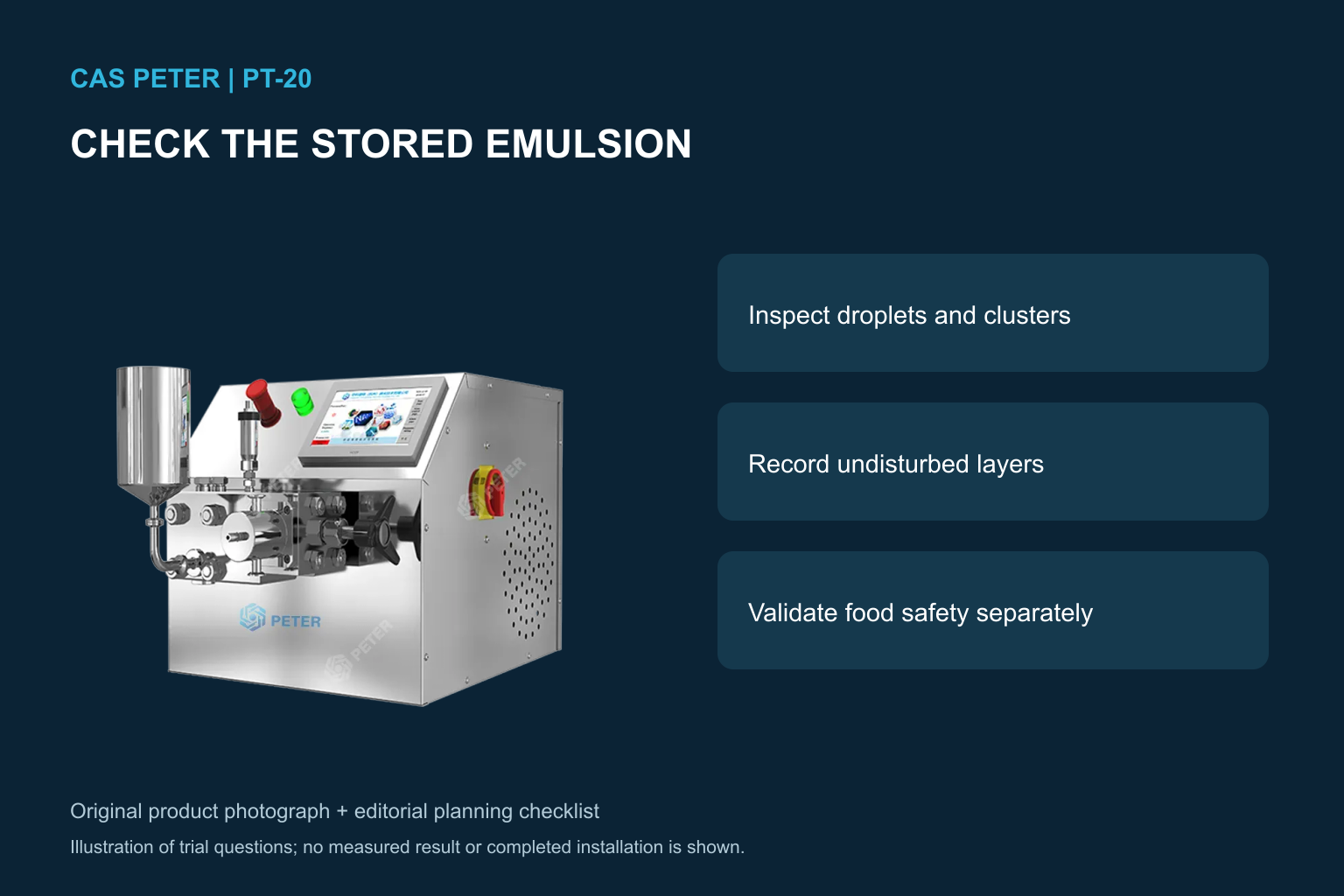
Photograph samples in identical containers at defined times, with a scale and consistent lighting. Record layer heights without shaking the container first. Then use a defined gentle redispersion procedure if redispersibility is part of the product specification. Keep the undisturbed observation and the redispersed assessment as separate records.
The primary study on heating and homogenization of coconut milk emulsions found that smaller primary droplets after homogenization could coexist with increased flocculation in the tested system. This is a useful warning against choosing conditions from primary droplet size alone. It does not predict the behavior of every coconut source, stabilizer system or production line.
Establish a representative starting formulation
Record the coconut material, extraction procedure, screening, dilution and fat and protein measurements needed for the comparison. A concentrated coconut cream and a diluted beverage have different compositions. If batches vary, begin by testing processing conditions within one representative batch, then repeat the preferred route using additional relevant raw-material lots.
Document the water and all added ingredients. Changes in salt, acidity or stabilizer composition can affect the result, so measure the finished blend rather than relying only on the written recipe. Include the hydration procedure and addition sequence for permitted ingredients. An incompletely hydrated stabilizer can confound the processing comparison.
For a product intended to retain a plant-based or allergen-specific claim, ingredient selection requires its own review. Research materials are not automatically approved commercial ingredients. Some laboratory studies compare substances for mechanistic reasons; their use in a paper is not a recommendation for a marketed food. Confirm suitability and applicable requirements for the intended product and destination.
Compare homogenization and heat as separate steps
Use a small matched design that distinguishes the contribution of each operation. A useful starting framework includes unhomogenized and homogenized portions, each examined before and after a defined thermal treatment. Keep composition and sample handling consistent. Add further conditions only when the first comparison identifies a question worth testing.
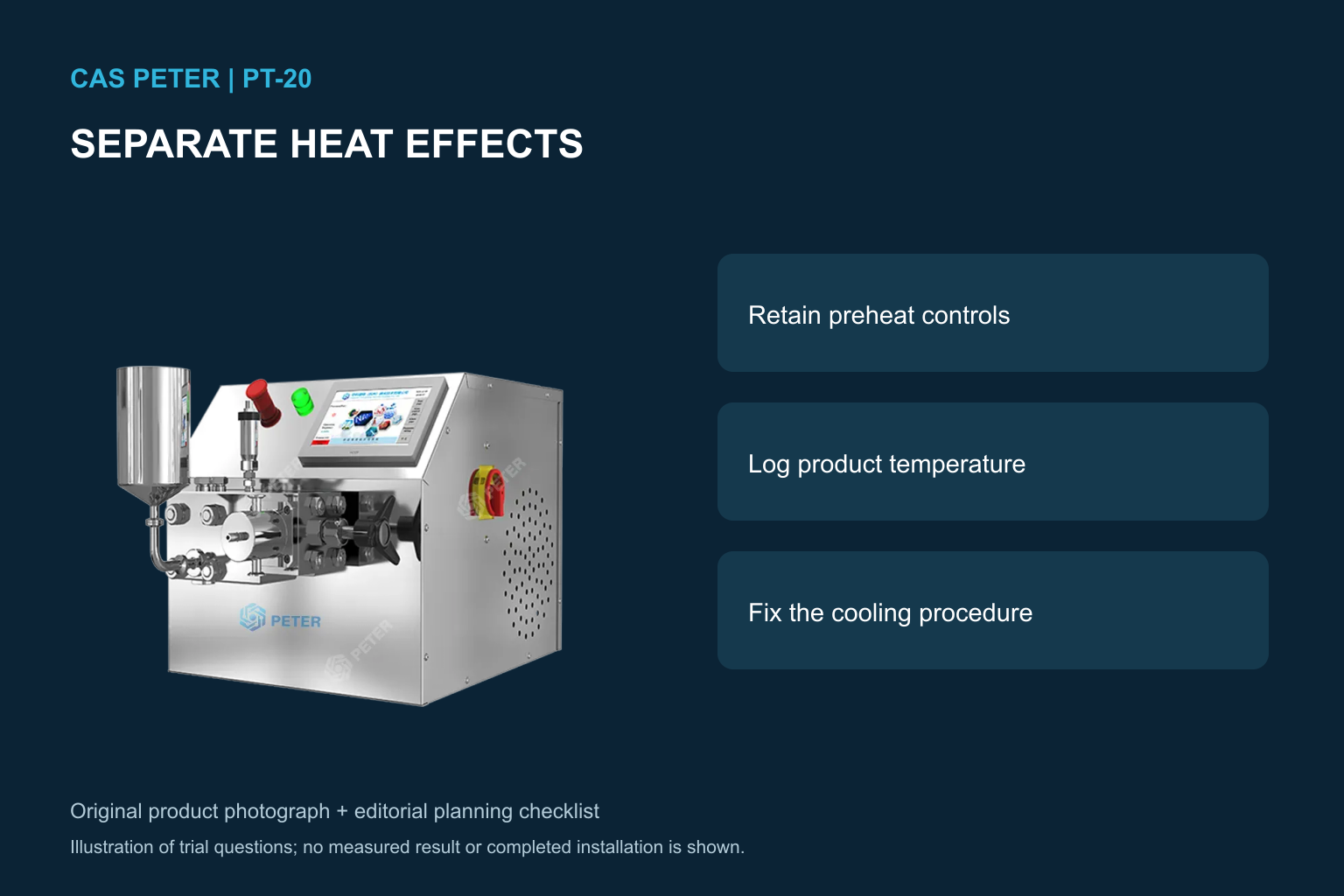
Take the preheat sample at the same process stage for every condition. If one portion waits substantially longer before heating, record and control that difference. Log homogenizer inlet and outlet temperature as well as any cooling between passes. A sample cooled before thermal treatment may still have experienced a different earlier temperature history.
Apply a thermal treatment representative of the intended development question using suitable equipment and supervision. Record measured product temperature, hold time, heating rate and cooling history where relevant. A bath setpoint does not by itself establish the sample temperature. Small laboratory vessels also do not establish a commercial process’s heating uniformity or microbiological adequacy.
Test the interface and the bulk product together
Inspect both the untreated product and the heated product microscopically using a consistent preparation method. Look for clusters, large individual droplets, insoluble particles and visible free oil. Document dilution because it can disrupt weak structures. If the preparation breaks flocs, the image may understate the original clustering in the bottle.
Choose a particle-measurement method appropriate to the system and define whether it is intended to measure primary droplets or effective aggregates. A dispersion procedure used to reveal primary droplet size should not be confused with the product’s undisturbed structure. For additional context on measurement assumptions, see the DLS and laser diffraction guide.
Measure viscosity under defined conditions, including temperature, shear history and the instrument procedure. Thickening after processing is not automatically an improvement: it can reflect a network that changes pouring behavior or storage stability. Likewise, a thinner sample may reflect a formulation or structural change that cannot be diagnosed from viscosity alone.
The following table is an editorial diagnostic framework based on separating these observations. It contains no validated product specification or numerical acceptance limit.
| Observation after heat treatment | Evidence to collect | Comparison to preserve | Question to resolve |
|---|---|---|---|
| Larger upper layer | Undisturbed layer heights and microscopy | Container, storage temperature and observation time | Is clustering changing how droplets cream? |
| Larger apparent particle size | Images and controlled dispersion measurements | Dilution and measurement preparation | Are primary droplets larger or are they clustered? |
| Free oil or irreversible separation | Images before and after defined redispersion | Composition and complete temperature history | Has droplet merging or interface failure occurred? |
| Strong viscosity change | Flow measurements at fixed temperature | Shear history and solids content | Is the change compatible with the product specification? |
| Stable bottle but failure in use | A representative cooking or formulation test | Ingredient dose and use conditions | Does the intended application impose another stress? |
Evaluate stabilizer choices through the actual thermal route
A stabilizer that improves an unheated emulsion may not protect it during heating. The primary study on thermal treatments of coconut milk with surface-active stabilizers compared different interfacial systems and showed that their responses depended on the treatment. The practical implication is to test the chosen formulation through the intended route, rather than selecting an ingredient from an initial appearance result.
Treat a change in stabilizer identity, level or addition sequence as a formulation experiment. Keep the coconut base and processing history constant while testing that change. If both formulation and pressure are altered together, include enough controls to identify which change contributes to the result. Otherwise the trial may produce a better bottle without explaining how to reproduce it.
Confirm any commercial ingredient’s suitability separately, including label goals, allergen implications and applicable food requirements. Do not copy research surfactants into a food formula. The goal of reading the research is to understand why interface composition matters, then design an appropriate product-development test with permitted materials.
Include cooling and storage before accepting the result
Cool samples using a defined procedure and start the storage clock from a stated point. Record handling during cooling, since agitation and temperature history can influence the structure being observed. Compare samples at the same measurement temperature so that simple temperature-dependent flow differences do not dominate the assessment.
Select storage conditions from the intended product and distribution route. If cold storage or temperature cycling is relevant, include it explicitly. Passing a heating test does not establish freeze-thaw stability, and a stable sample at one temperature does not qualify every storage condition. Choose observation intervals that answer the actual shelf-life development question.
Check the product in its intended use. Coconut milk sold for cooking may meet a different physical specification from a drink intended to pour uniformly without shaking. Record whether redispersion is expected, whether a cream layer is acceptable and which visible changes constitute rejection. A written specification prevents an inconsistent judgement after the results arrive.
Keep physical stability and microbiological validation distinct
A uniform-looking emulsion can still require an appropriate validated preservation process. Homogenization and a laboratory heat-stability test do not independently establish sterility, safe shelf life or suitability for ambient distribution. Product composition, packaging and the complete manufacturing route must be considered by the responsible qualified team.
Use the guide to homogenization and sterilization boundaries to frame the distinction during equipment discussions. The heat-stability trial answers whether the physical product tolerates the proposed treatment. It does not replace the separate work needed to establish food safety or a commercial thermal process.
When physical stability fails, avoid reducing a required preservation treatment simply to improve appearance. Investigate the formulation, process sequence, homogenization conditions and permitted stabilization approach while maintaining the independently established safety requirements. Any revised route needs assessment on both physical quality and safety grounds.
Discuss a representative trial with the equipment supplier
The CAS PETER PT-20 laboratory homogenizer is a real product for discussing benchtop development trials. Confirm compatibility with the coconut feed, working volume, temperature limits, cleaning, cooling and available configuration. Its product photograph is used to identify the equipment, not to claim that a particular formulation has passed heat-stability testing on that machine.
Provide the supplier with the complete process sequence and acceptance method. Include whether homogenization occurs before or after another heating step, how samples will be collected and which downstream equipment will be used. Do not assume a stage arrangement, aseptic capability or a production specification from a model name or photograph.
The broader food homogenization guide helps organize this discussion. Request a trial report that includes feed composition, operating history, preheat and postheat measurements, storage results and repeatability. The preferred condition is the one that meets the finished-product requirements reliably within the proposed process, with its limitations documented.
Further learning: emulsion structure and stability
The NPTEL IIT Madras lesson below discusses stability of biphasic liquids. Its background on dispersed systems helps explain why an initially uniform emulsion still needs stability assessment. It is general educational material, not a coconut-milk food-safety schedule or a recommendation to use pharmaceutical excipients in food.

Educational source: NPTEL-NOC IITM. Watch the lesson on YouTube.
Frequently asked questions
Why can homogenized coconut milk separate after heating?
Heat can change interactions at the droplet interface and promote clustering or other structural changes. Smaller initial droplets do not guarantee heat stability. Compare preheat and postheat microscopy, particle measurements and undisturbed separation behavior.
Does higher homogenization pressure always improve heat stability?
No universal relationship applies to every formulation. Evaluate selected conditions with the same feed and complete thermal route, then compare the finished product during relevant storage. Include temperature history and configuration when interpreting the result.
Does passing a heat-stability test establish a safe ambient shelf life?
No. Physical stability testing evaluates product structure and appearance under specified conditions. Safe shelf life and ambient distribution require a separate appropriate assessment of the formulation, preservation process, packaging and manufacturing controls.