

Lutein Emulsion Bioaccessibility: Verify Micellar Recovery After Digestion
Lutein emulsion bioaccessibility should be evaluated by measuring the lutein recovered in the operationally defined micellar fraction after a controlled digestion test. A small initial droplet size, attractive yellow color or high loading does not establish that result. Compare formulations using measured starting lutein, matched digestion conditions and a documented separation and extraction method. Keep chemical retention, digestive release and micellar recovery as separate outcomes. This guide helps formulation and process teams build that comparison without treating an in vitro result as proof of human absorption or assuming that a stronger homogenization treatment must produce a better delivery system.
Start with the analytical question
Specify whether the project aims to preserve lutein during processing, maintain a physical emulsion during storage or improve its measured micellar recovery after digestion. These questions require connected but different measurements. A formulation may preserve the active well yet perform poorly in the chosen digestion assay. Another may give a higher percentage recovery from a lower starting amount. Reporting only the most favorable percentage makes those outcomes difficult to compare.
Identify the active material precisely. Free lutein, lutein esters, plant extracts and blends containing zeaxanthin should not be treated as interchangeable analytical targets. Record the supplied composition and determine what the assay can separate and quantify. If the method measures combined pigments, label the result accordingly. Do not publish a lutein-specific conclusion from an unresolved signal that includes other components.
The broader emulsion processing guide explains the equipment context. Here, the decision centers on what happens between the prepared emulsion and the analytically recovered fraction, rather than on a general claim that the formulation is stable or nano-sized.
Use research to frame the comparison
A published biopolymer-stabilized lutein emulsion research abstract compares starch- and gum-stabilized emulsions, tracking droplet behavior, lutein retention and in vitro bioaccessibility. Its results support keeping these outcomes separate when evaluating a carrier. The accessible record is a conference abstract rather than a full experimental protocol; it is used here only for that limited comparison. It does not supply a validated high-pressure recipe for a CAS PETER machine.
A separate lutein and zeaxanthin emulsifier study found that the emulsifier associated with the smallest particles was not the one associated with the highest bioaccessibility. It also describes separation and chromatographic analysis of a micellar fraction. That comparison supports measuring the digestive endpoint directly instead of ranking samples only by initial droplet size. The study used specific surfactants for research; citing it does not recommend their use in a commercial food or establish their regulatory suitability.
These publications support the questions in the workflow below. The acceptance thresholds, sample handling and final formulation must be developed for the intended product. Neither publication demonstrates a human health benefit from the equipment shown in this article.
Define the formulation and retain the controls
Prepare a formulation record that includes the active form, measured lutein concentration, carrier oil, oil fraction, emulsifier, aqueous phase composition and preparation order. Include relevant temperatures and protection from light during preparation and storage. Preserve an aliquot of the starting active and a retained reference emulsion. If a batch later gives unexpectedly low recovery, those samples help distinguish degradation, preparation differences and analytical losses.
Use a coarse emulsion reference with the same composition when examining a homogenization effect. When comparing emulsifiers, make that a separate formulation experiment. Keep the oil fraction, active dose and digestive loading controlled or clearly explain why they differ. A design that changes all of them at once can compare complete products, but it cannot isolate the effect of pressure treatment.
Include an appropriate blank without the active, and analytical recovery controls selected by the laboratory. Where a free-active comparator is relevant, document how it is dispersed and dosed. A poorly prepared comparator can exaggerate the apparent advantage of an emulsion. Choose controls that answer the stated question rather than selecting the easiest condition to outperform.
Confirm the starting emulsion before digestion
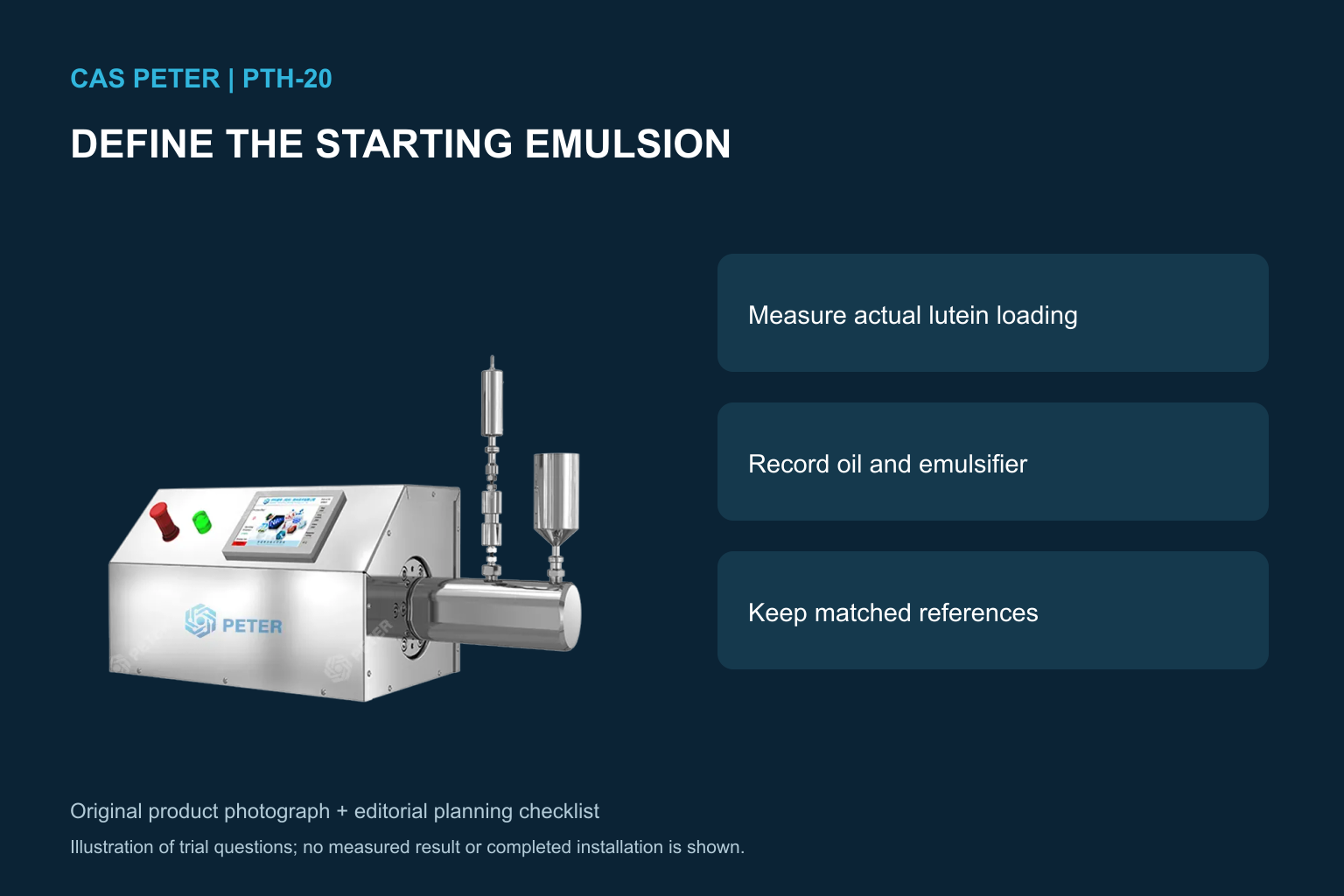
Measure the actual lutein present after processing, not only the nominal amount added. Document any separation, visible crystals or incomplete dissolution. Check the droplet distribution using a suitable measurement method and record the sample preparation. A dilution used for particle analysis may change the dispersion, so it should not automatically become the preparation used for digestion.
The DLS and laser diffraction guide helps explain measurement scope. Use droplet results to describe the starting system, while preserving the full formulation identity. If a multimodal distribution or large-particle tail is present, do not reduce the description to one small mean value. Pair quantitative measurements with representative observations where needed.
For a processing comparison, record feed and outlet temperatures, pass history and the time until digestion starts. If a sample is stored first, define storage duration, container, headspace and exposure. A result from freshly prepared material should not be presented as proof that the same performance persists through the product’s intended shelf life.
Lock the digestion and separation method
Use a documented digestion model suited to the research question and have the analytical laboratory define its scope. Control sample loading, phase volumes, enzyme and bile preparation, pH, temperature, mixing and timing. Record deviations. These are assay conditions, not product manufacturing instructions. A change in the model can change the measured endpoint even when the emulsion itself is unchanged.
State how the micellar fraction is operationally isolated. Centrifugation, filtration and collection position are not interchangeable details. Different separations may collect different material. Preserve the original method record, including dilution and extraction factors. Where feasible, retain fractions for a recovery investigation instead of discarding everything except the preferred analytical portion.
Before comparing numbers across laboratories or publications, check whether they use the same denominator and separation definition. A percentage based on initial emulsion lutein differs from a percentage based on lutein remaining in total digesta. Label the quantity exactly. If those definitions are unknown, compare the experimental questions qualitatively rather than placing incompatible percentages in one performance ranking.
Report recovery on a clear mass basis
An internal micellar recovery calculation can be expressed as 100 multiplied by measured lutein mass in the collected micellar fraction, divided by measured lutein mass initially introduced into the digestion. Both values must use the same mass unit, and the numerator must account for the complete collected fraction and all dilution factors. Use this definition only when it matches the laboratory method; do not silently rename a differently defined published bioaccessibility value.
For an illustrative calculation, suppose the measured initial dose is 100 micrograms and the complete collected fraction contains 20 micrograms after correction for extraction and dilution. Recovery on that stated basis is 20%. These invented numbers explain the calculation only. They are not experimental findings, acceptance limits or expected results for a CAS PETER system.
The proposed reporting table below separates the stages. The laboratory should establish suitable quality controls and uncertainty for each measurement before a purchasing or formulation decision relies on it.
| Stage | Required record | Comparison question | Interpretation limit |
|---|---|---|---|
| Before processing | Active identity and measured dose | Are the starting materials comparable? | Nominal addition alone cannot establish actual loading |
| After processing | Measured retained lutein and droplet distribution | Was the active retained while the emulsion formed? | Small droplets do not establish digestive performance |
| After digestion | Lutein in total digesta under the chosen method | How much measurable active remains? | Retention does not establish micellar recovery |
| After fraction separation | Collected volume and lutein concentration with dilution corrections | How much active enters the defined fraction? | The fraction is defined by the separation procedure |
| Final comparison | Recovery basis, variability and assay checks | Is the difference reproducible and meaningful? | In vitro recovery is not demonstrated human absorption |
Diagnose a weak result without overprocessing
If starting retention is low, investigate preparation, handling and analytical recovery before making digestion claims. If retention is acceptable but micellar recovery is low, examine the formulation and assay behavior. If the apparent improvement disappears when the denominator is corrected, revise the conclusion. Keep the underlying measurements visible so the interpretation can be reviewed without repeating the entire experiment.
Do not respond to every weak digestion result by adding homogenization passes. A change in droplet size is only one possible process response. Compare a small, supplier-approved processing matrix with a fixed formulation first. Then test promising formulation changes independently. Stop escalating treatment when it adds thermal exposure or handling without improving the defined outcome.
Keep storage and delivery claims separate
Run the chosen digestion assay on material of a defined age. If the commercial objective concerns stored product, include relevant stored samples in the plan. The nanoemulsion stability testing guide covers a complementary question: whether a physical system changes over time. Pair that assessment with chemical analysis rather than assuming unchanged appearance means unchanged lutein.
Describe the final conclusion narrowly. A repeatable improvement in the selected in vitro assay supports that assay result for the tested formulation. It does not establish clinical efficacy, suitability for infants, a regulatory claim or performance in every food matrix. Commercial ingredient selection and product claims need review by the responsible formulation, quality and regulatory teams.
Prepare a useful equipment discussion
The CAS PETER PTH-20 product page is a starting point for discussing a pressure-processing trial. Provide the complete formulation, oil fraction, emulsifier, active form, viscosity at a stated temperature, coarse-emulsion condition, sample quantity and target measurements. Ask the supplier to confirm feed suitability, cooling, contact materials and trial configuration. A product photograph does not demonstrate a digestive delivery result.
Request samples with traceable processing records, enough retained material for the agreed analysis and a matched reference. Agree who performs chromatography, digestion and data interpretation before the trial. The useful equipment decision combines process consistency, active retention, cleaning and handling requirements with the measured formulation outcome. It cannot be reduced to the smallest reported droplet or the highest available pressure.
Further learning: emulsion technology
This neutral university lesson explains emulsion principles. It supports the formulation discussion and does not replace a validated digestion or analytical method.

Educational source: NPTEL-NOC IITM. Watch the lesson on YouTube.
Frequently asked questions
Does a nano-sized lutein emulsion guarantee higher bioaccessibility?
No. Measure the digestive endpoint directly. Initial droplet size, emulsifier, active identity and the assay method all need to be documented, and the cited emulsifier study did not rank bioaccessibility in the same order as initial particle size.
Is micellar recovery the same as human absorption?
No. Micellar recovery is a result from the selected in vitro separation and analysis procedure. It does not directly measure transport into the body, clinical benefit or the performance of an untested commercial product.
What is the most important reporting detail?
State the measured initial lutein dose, the collected fraction and the calculation denominator. Include dilution corrections, the digestion method and variability so another reviewer can understand exactly what the reported percentage represents.