

Pea Protein Emulsion Stability After Homogenization: Qualify the Ingredient in the Finished Formula
Pea protein emulsion stability after homogenization must be qualified in the finished formula, using both fresh droplet measurements and storage challenges. A smaller initial droplet size does not establish resistance to flocculation, coalescence, heat or added salts. Compare protein lots at a clearly defined composition, control hydration and processing history, and test the actual beverage or dressing conditions. The practical goal is a repeatable ingredient-and-process combination that maintains the required appearance, flow and oil distribution through its intended use.
This guide concerns the behavior of oil-in-water emulsions stabilized with pea protein. It complements the separate discussion of pea protein solubility after homogenization: protein becoming more dispersible is an input to emulsification, while the performance of the finished emulsion is a separate acceptance decision.
Define the product before comparing homogenization conditions
A pourable beverage and a spoonable dressing can require very different structures. A formulation that limits creaming by building a thick network may be suitable for a sauce but unacceptable in a light drink. Write down the intended oil content, protein contribution, flavor system, processing sequence, packaging and storage conditions before screening pressures or repeat passes.
Set observable acceptance criteria rather than relying on the word stable. These might include an agreed limit for the cream layer, absence of a persistent oil ring, a target pouring range and the ability to redisperse a package with normal handling. Use product-specific limits established by the development team; there is no universal homogenization setting or particle-size threshold that covers every pea ingredient.
Keep a reference formula and a reference ingredient lot. When a new powder performs differently, repeat the reference in the same experimental session. Otherwise an apparent ingredient effect could come from different water, a changed premix, delayed sampling or the order in which the samples were processed.
Treat ingredient identity as an experimental variable
Record the supplier, lot, declared protein content, moisture information and any available extraction or drying history. Equal powder additions need not provide equal protein levels. Decide whether the comparison is based on the same powder mass, the same measured protein concentration or the same commercial recipe, and state the basis beside the results.
A study of seven commercial pea protein ingredients found substantial differences in emulsifying behavior after high-pressure homogenization. The soluble protein fraction was associated with fresh droplet size, but ingredients producing small droplets still differed in their resistance to storage destabilization. That supports qualifying each ingredient in the actual application instead of assuming all pea isolates are interchangeable. The work used the ingredients at their native pH and ionic conditions, which limits simple attribution of every difference to protein structure alone.
Do not turn those findings into a ranking of suppliers for another recipe. The useful purchasing question is whether a proposed lot meets the same functional tests as the accepted lot under controlled processing. Require an application trial when the powder source or manufacturing route changes.
Control hydration, pH and the coarse emulsion
Prepare the aqueous phase consistently. Record water quality, ingredient addition order, mixing conditions, hydration temperature and the interval between wetting the powder and adding oil. Inspect for dry pockets, visible lumps and excessive foam. If the feed is not representative, later particle measurements cannot explain the process reliably.
Measure pH after the ingredients have equilibrated and again after the complete recipe is assembled. Record relevant salt additions and their point of introduction. A buffer used for an analytical experiment can change the system being evaluated; it should not silently replace the water and mineral environment of the intended product.
Make the coarse emulsion in a repeatable way and sample it before the pressure treatment. That baseline shows whether the final improvement arose from premixing, homogenization or both. Keep enough feed for the planned comparison so that a later condition is not made from a fresh, differently hydrated premix.
Confirm feed particle size, viscosity, temperature and compatibility with the equipment supplier before a trial. Screening or pretreatment should have a defined purpose and be documented. Removing a coarse fraction can change protein composition and functionality, so a screened sample cannot automatically represent the original commercial formulation.
Separate protein pretreatment from emulsion processing
There are two different experiments: treating an aqueous protein dispersion before oil is introduced, and homogenizing the complete oil-in-water premix. They expose different interfaces and can produce different outcomes. Label the route clearly rather than reporting both as the same treatment.
For the first screening round, change one planned variable while keeping the other relevant conditions controlled. Record operating pressure, pass definition, sample volume, inlet and outlet temperatures, holding time and cooling sequence. If a recirculating arrangement is used, explain the residence history instead of assigning every portion an exact pass count without evidence.
A second round can test interactions once a promising region is identified. For example, a selected ingredient may need a different protein-to-oil balance rather than greater processing intensity. Keep the untreated or premix control so that any gain is judged against the whole preparation route.
Use the plant protein homogenization trial guide for broader feed and trial questions. The procedure here adds an emulsion-specific endpoint: retention of the intended oil distribution and product texture after downstream challenges.
Use complementary tests to identify the failure mechanism
Droplet measurements, microscopy, physical separation and flow behavior answer different questions. Use the same sampling position and sample handling at each time point. A sample drawn only from the lower aqueous region of a creamed bottle will not represent the original package.
The following is a qualitative development checklist. Its decisions follow the ingredient comparison above and the environmental-challenge study below; it is not a published product specification or a table of universal limits.
| Observation | Additional check | Possible interpretation | Practical next comparison |
|---|---|---|---|
| Small fresh droplets but a later cream layer | Inspect the cream and lower phase separately | Migration or clustering may occur without a large initial mean size | Compare the same lot across storage times and handling conditions |
| Large apparent size after holding | Microscopy and a validated analytical dispersing procedure | Droplet clusters and irreversible droplet growth must be distinguished | Compare untreated sample with analytically dispersed aliquot |
| Oil ring after a heat step | Inspect free oil and droplet structure | The interface may not withstand the complete thermal sequence | Match the recipe and vary only the relevant processing route |
| Little visible separation but excessive thickness | Flow curve and pouring test at matched temperature | A network may suppress separation while changing usability | Assess the intended beverage or dressing endpoint |
| New lot fails while the reference passes | Repeat matched protein and oil levels | Ingredient functionality may have changed | Qualify the lot before revising machine settings |
Dilution used for measurement must be validated. It can change pH, ionic conditions and droplet interactions. Keep an undiluted observation beside the diluted result and report the diluent, concentration basis and waiting time. A laboratory dispersing reagent belongs in an analytical aliquot, not in the saleable food.
Challenge the emulsion with the real downstream sequence
Apply the intended heat treatment, cooling, filling and storage sequence to a representative portion. Where order matters, evaluate that order directly. An emulsion measured before heating has not demonstrated post-heat stability, and a sealed laboratory vial may not reproduce the intended package headspace or handling.
A study of acid-soluble pea protein emulsions examined a specially separated protein fraction under acidic conditions. It found that the tested emulsions could resist the studied heat treatment, while high salt concentrations promoted aggregation, with heating worsening the effect. This is evidence that heat and salt should be examined together when relevant. It does not establish the same behavior for whole pea isolate at neutral pH, nor does its preparation recipe constitute a commercial food formula.
Use separate containers for destructive observations whenever possible. Repeatedly opening and shaking a single bottle changes its history. Label storage position, temperature, light exposure and sampling schedule, and distinguish visual storage checks from microbiological shelf-life validation. Pressure processing alone does not establish the safety or shelf life of a finished beverage.

Compare repeatability before accepting an ingredient or machine
Repeat the preferred condition with independently prepared batches. Repeated instrument readings from one batch assess analytical variation; they do not prove preparation repeatability. Include the reference ingredient during confirmation so the decision remains anchored to a known formulation.
Evaluate the whole result: fresh emulsion, challenged emulsion, storage behavior and usability. Reject a condition that improves one number while producing unacceptable flavor, viscosity, oil release or handling. When the preferred condition is close to an acceptance boundary, investigate normal variations in hydration, ingredient composition and temperature before moving to a larger run.
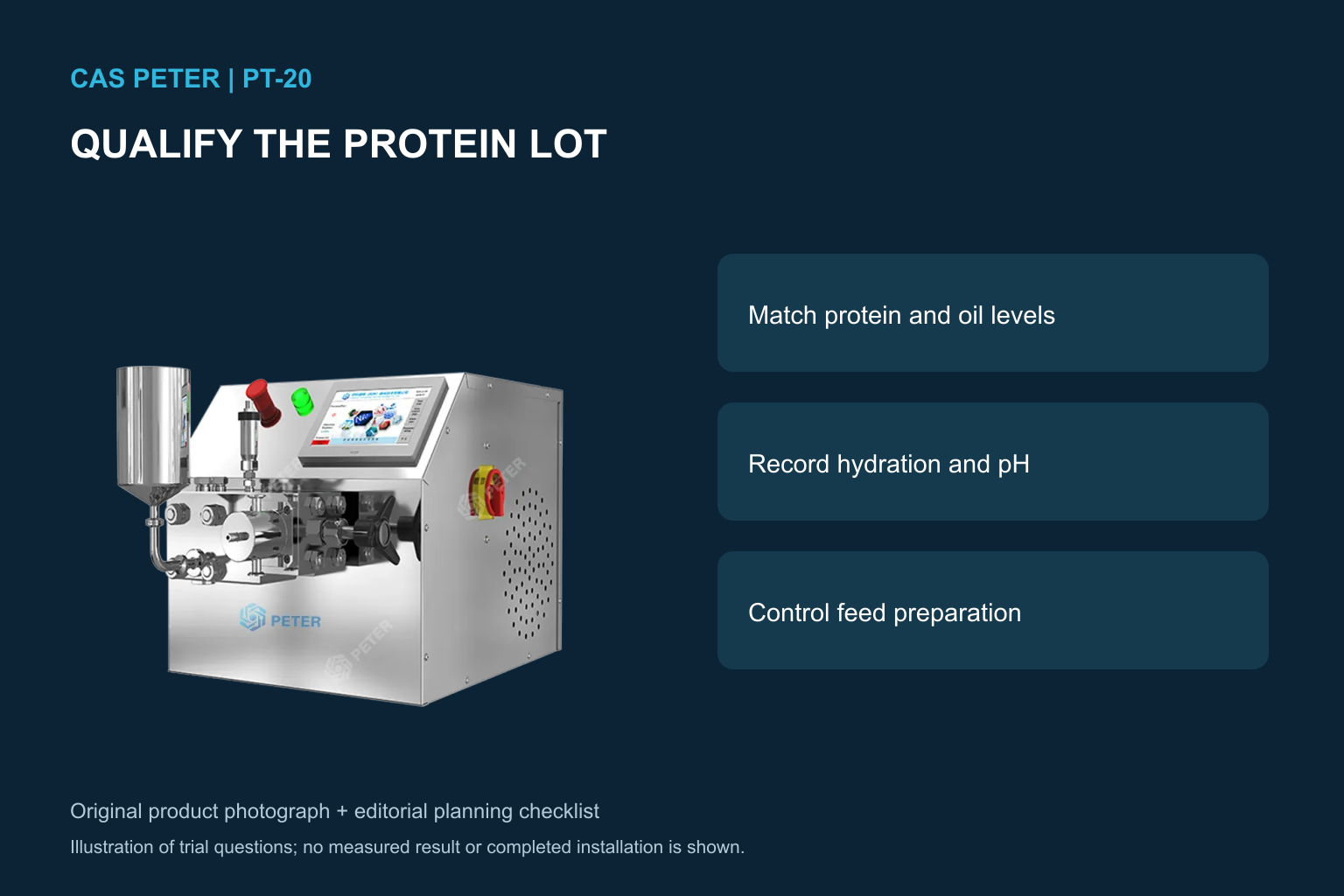
For equipment discussions, the CAS PETER PT-20 product page provides a real model reference. Ask the supplier to review the actual feed, required process route, cooling, cleaning and representative trial volume. The photograph identifies the equipment; it does not prove that a particular pea formula has been qualified or that the research settings are available in the proposed configuration.
The broader dairy and food homogenization guide can help frame the production discussion. Bring the measured product outcomes to that discussion, alongside the process records, rather than choosing equipment from the smallest reported droplet size alone.
Educational background: how emulsification works
This neutral university lesson explains emulsification principles relevant to creating and stabilizing an oil-in-water system. It provides background for the trial questions above; it does not supply a pea protein recipe or certify any equipment configuration.
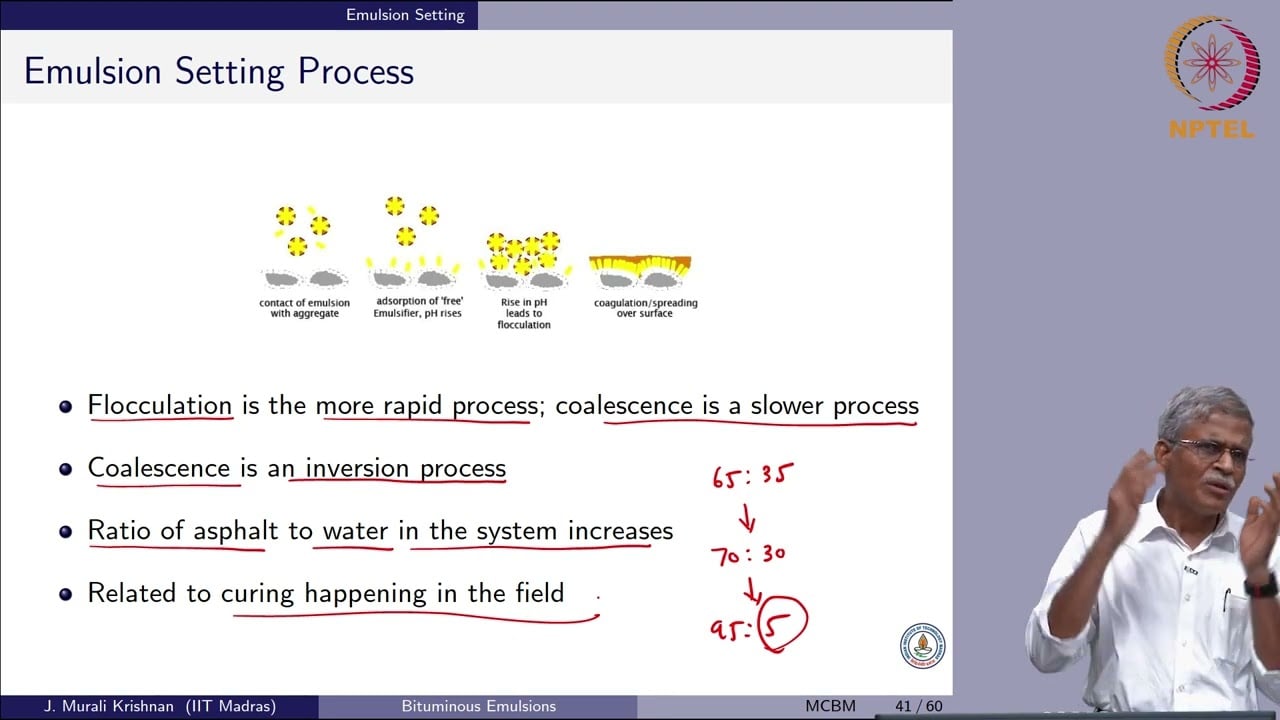
Educational source: NPTEL-NOC IITM. Watch the lesson on YouTube.
Questions about pea protein emulsion trials
Does a smaller droplet size prove better storage stability?
No. Fresh droplet size is one measurement. Storage can also involve flocculation, coalescence, migration and changes in the surrounding protein network. Compare droplet results with microscopy, package observations and flow behavior under matched conditions.
Can one pea protein isolate replace another without testing?
A replacement should be qualified in the intended formulation. Match the comparison basis, retain a reference lot and repeat the preparation and storage challenges. Similar label protein content does not establish equivalent emulsifying functionality.
Should poor stability always be addressed by increasing pressure?
No. First check hydration, formulation, pH, salts, premixing and the downstream sequence. Greater treatment intensity is only one possible experimental variable. Select the route that repeatedly meets the finished-product requirements within the confirmed equipment limits.